 100 punkti
Autor soovib selle materjali allalaadimise eest saada 100 punkti.
100 punkti
Autor soovib selle materjali allalaadimise eest saada 100 punkti.
 ~ 18 lehte
Lehekülgede arv dokumendis
~ 18 lehte
Lehekülgede arv dokumendis
 2015-11-22
Kuupäev, millal dokument üles laeti
2015-11-22
Kuupäev, millal dokument üles laeti
 1 laadimist
Kokku alla laetud
1 laadimist
Kokku alla laetud
 0 arvamust
Teiste kasutajate poolt lisatud kommentaarid
0 arvamust
Teiste kasutajate poolt lisatud kommentaarid
 kasv
Õppematerjali autor
kasv
Õppematerjali autor
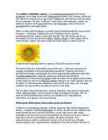
There are also new breeds of sunflowers which are transgenic, so that they are resistant to some diseases.[citation needed] Sunflowers also produce latex and are the subject of experiments to improve their suitability as an alternative crop for producing hypoallergenic rubber. Additionally, the stem of a dead sunflower can dry out open wounds.[citation needed] For farmers not intending to grow it, the sunflower is considered a noxious weed. The wild variety will grow unwanted in corn and soybean fields which can have a negative impact on yields. Diseases Main article: List of sunflower diseases Greek myth In Greek mythology, a girl named Clytie fell in love with the sun god Apollo, and would do nothing but watch his chariot move across the sky. After nine days, she was transformed into a sunflower. However, the word "sunflower" and its cognates existed
with several types of biomes. Savannas are frequently seen as a transitional zone, occurring between forest and desert or prairie. Although the term savanna is believed to have originally come from a Native American word describing "land which is without trees but with much grass either tall or short", by the late 1800s it was used to mean "land with both grass and trees". It now refers to land with grass and either scattered trees or an open canopy of trees. Changes in fire management Savannas are subject to regular fires and the ecosystem appears to be the result of human use of fire. For example Native Americans created subtropical savannas by periodic burning in some areas of the US southeastern coast where
(d) increases; plants at later stages are large / plants in early stages are small; trees / shrubs. are woody, appear later in succession; 2 [9] 15. max 1 mark from following: 1 economic definition of sustainable; e.g. similar quantities of timber can be harvested year on year 2 grants for planting forests / management schemes; 3 planting to ensure sustainable harvest rate; max 3 marks for planting strategy: 4 trees not planted too closely together; 5 support young trees to prevent damage e.g. from grazing animals; 6 species planted that are suitable for prevailing conditions / native spp; 7 softwood sp. / conifers / named conifer / fast growing sp. planted; 8 deciduous broadleaved species around edges for aesthetic reasons;
For instance, a study by Canbolat et al. (2007) showed that root length, root and shoot weight of plants were decreased by soil compaction, which suggests that microfloral activity in compact soil is lower. Cultural practices The mankind has and will have a major influence on changing the microflora of soils. There are countless activites that have and minor effect, but change the soil composition in the long term as a whole. Although, some activites like agriculture, waste management and forestry carried out to satisfy the needs of the people have major impact on in areas of action. Sidorenko and Buzoleva (2007) stated that soil microbiocenosis is one of the most complicated biological communities. Various interrelationships occur between bacteria in the process of their activity, including those at the metabolic level. These interralationships can will bias the balanced system. For instance, Halasz et al. (2011) researched clearly showed
combustible in addition to having a strong smell which makes them stand out to the human nose. Methane leaks from landfills are an ongoing problem, as is the production of biogas in poorly maintained compost piles, manure lagoons, and outhouses. Spontaneous fires and explosions caused by build-ups of gas have been recorded in many regions of the world, illustrating a major problem which needs to be confronted by waste management companies. When this gas is trapped, however, it can be made useful, instead of just being a nuisance. Trapped biogas can be used to power stoves for cooking and heating, in addition to other applications. By trapping the gases, people can prevent methane from reaching the atmosphere, thereby reducing degradation caused by methane gas. The ability to turn waste products into something which can be utilized is also
Water pollution Attention for water pollution exploded in the 1980s. The oil spill of the Exxon Valdez showed many around the world just how horrible the effects of water pollution could be. However, even the Exxon Valdez spill barely touched the surface of the problem of water pollution. The ship spilt only 5% of the oil spilt that year, and oil is just one of many pollutants that people dump into the water every year. Every year, 14 billions pounds of sewage, sludge, and garbage are dumped into the world's oceans. 19 trillion gallons of waste also enter the water annually. The problem of ocean pollution affects every nation around the world. This is especially true because water is able to transport pollution from one location to another. For many years, chemicals were dumped into bodies of water without concern. While many countries have now banned such behavior, it continues to go on today. As the world has industrialized and its population has grown, the problem of water poll
For consumers the impact mainly translates itself into higher prices for food products. Margit Tepner k0848752 Figure 5. Global biofuel production tripled between 2000 and 2007 (IEA, 2009). 3.1. Maize Maize is the primary feedstock for bioethanol in the USA, where demand for ethanol has increased the total demand for maize. Biofuels' feedstock production has shifted the land area away from maize for food and animal feed production. On the other hand, as maize is more profitable to grow due to biofuels, some farmers have shifted their cultivation from rice and wheat cultivation to maize. As a result, the prices of all staple crops, such as rice, wheat and maize have been affected (Rosegrant, 2008). Corn is one of the most widely used food staples in the world. In 2005, the US produced 42% of the world's corn and it is has a variety of uses. About 50% of the field corn grown in the USA is used for animal feed, but smaller volumes, i.e
The most striking/obvious similarity is that ...... Is similar to The first picture is similar to the other. Both Both pictures are about being a parent. Similarly In the same way Likewise Räägime erinevustest: The main/greatest/most important/most significant difference between the pictures is that...... In the first picture, ..... whereas/while/but in the second one ..... On one hand ..... on the other hand...(ühelt poolt, teiselt poolt) Neither picture (mitte kumbki piltidest) In contrast Unlike While Vasta piltide all olevale küsimusele I think ….. Describe, compare and contrast the pictures. What are the benefits of living in such environments? Ülesande teises pooles tuleb vastata küsimustele. Eksamil õpilane neid küsimusi ei näe. NB! Viimane küsimus antud ülesandes eeldab vastamist kaudse küsimusega.
 annaabi.ee











Kõik kommentaarid