 10 punkti
Autor soovib selle materjali allalaadimise eest saada 10 punkti.
10 punkti
Autor soovib selle materjali allalaadimise eest saada 10 punkti.
 ~ 7 lehte
Lehekülgede arv dokumendis
~ 7 lehte
Lehekülgede arv dokumendis
 2014-11-11
Kuupäev, millal dokument üles laeti
2014-11-11
Kuupäev, millal dokument üles laeti
 2 laadimist
Kokku alla laetud
2 laadimist
Kokku alla laetud
 0 arvamust
Teiste kasutajate poolt lisatud kommentaarid
0 arvamust
Teiste kasutajate poolt lisatud kommentaarid
 mar1annaava
Õppematerjali autor
mar1annaava
Õppematerjali autor
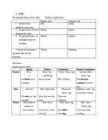
Conditionals Table of Contents Conditionals ......................................................................... 2 A. Real Conditionals ............................................................. 2 B. Unreal Conditionals ......................................................... 3 Linking words used in Conditionals ...................................... 4 Conditionals Conditions deal with imagined situations: some are possible, some are unlikely, some are impossible. A. Real Conditionals Real Conditionals refer to situations that are true, have happened, generally happen or are likely to happen. The First Conditional expresses a possible condition and a probable result: If I have time, I will help you. In the if-clause we use the Present Simple, in the main clause will + the verb.
Conditionals: 0 and I What is a conditional sentence? • Conditional sentences have at least two clauses: IF clauses and THEN clauses • Examples: If I go into town tomorrow, then I will see a movie. If he spoke Chinese, then he would work as a guide in China. If they had been faster, then they would have won the race. IF Clauses (the condition) • IF clauses present the condition. • Examples: If I go into town tomorrow… If he spoke Chinese… If they had been faster… THEN Clauses (the results) • THEN clauses present the results. • Examples: … then I will see a movie. …. then he would work as a guide in China. … then they would have won the race. IF and THEN Clauses • The word “then” is optional, but the clause is still the result of the condition. So it is a “THEN” clause, without the word “then.” 0 CONDITIONAL
First Conditional: A real possibility in the future A First Conditional sentence is for future actions dependent on the result of another future action or event, where there is a reasonable possibility of the conditions for the action being satisfied. Formation: if + present simple, + will For example: If she gets good grades, she will go to university. We are talking about the future, but we use a present tense for the condition and will for the result. In this case, the person is sure about going to university. We can use other modal verbs in the result part of the sentence. For example: I Condition Result Possibility F she gets good she will go to If the condition is met, then she definitely If grades, university. will go he gets good he may go to
22 5. Timetables Making travel arrangements · I'd like to find out about ......................... · Do you have any information on ...........? · I'm inquiring about ........................... · I'd like a .................. ticket to .........., please. · Do I have to change? · I'd like to book a ........................................ 23 MODULE 7 Countries, languages. Future forms. Conditional sentences. e.. Countries and languages Complete the following country and nationality sets: Country Nationality Cuba C .......... M .......... Moroccan Argentina A ........... E .......... Egyptian Italy I .......... Hungary H ......
Conditionals Sentences with if are used to express possibilities. 0 Zero conditional If-clause present (past) simple Main clause present (past) simple Sometimes sentences with if express certainty rather than possibility. The zero conditional is used to talk about sth. that is always true (such as a scientific fact), or that was always true in the past. In this type of conditional we can use when instead of if. E.g., If/When you mix blue and red, you get purple. If/When you don't water flowers, they die. (present simple in both parts of the sentence) If/When I asked her to come with us, she always said no. (past simple in both parts of the sentence) 1 First conditional If-clause present simple; Main clause future tense (or: can, must, may, etc., + bare infinitive) Used to talk about the consequences of a possible action (a real or very probable situation in the
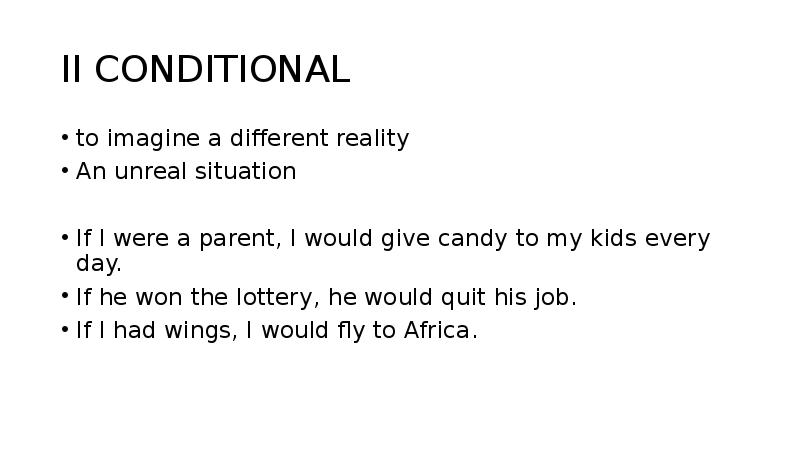
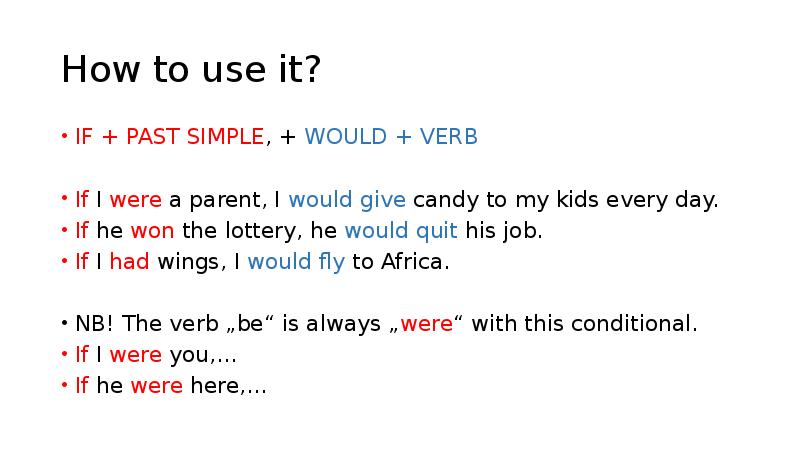
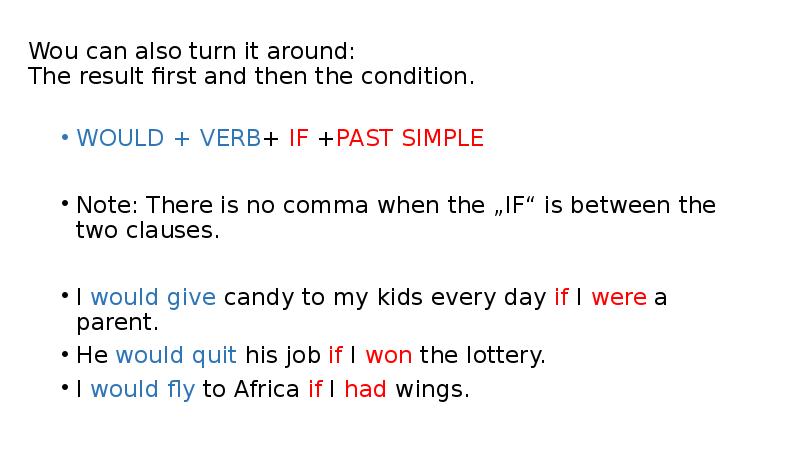
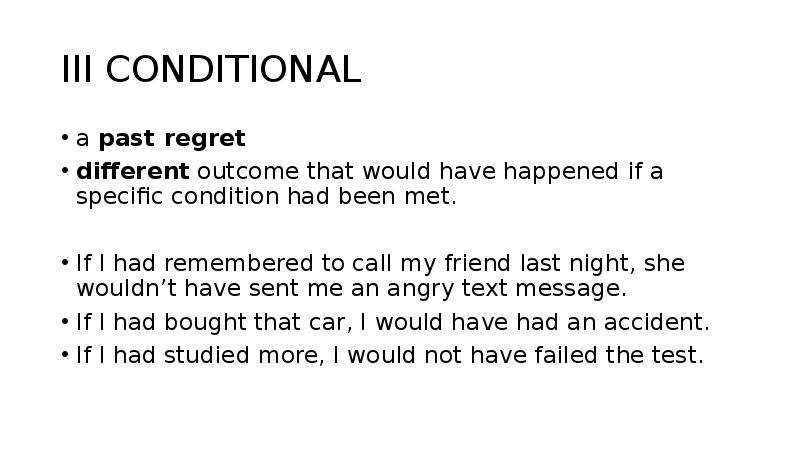
The house has been cleaned since you left. Past perfect: The house had been cleaned before their arrival. Future: The house will be cleaned next week. Future continuous: The house will be being cleaned tomorrow. 11. Conditional sentences: Three types of conditional sentences: 1.) First Conditional Type 1: if + present + future The first conditional (also called conditional type 1) is a structure used for talking about possibilities in the present or in the future. If I have time, I will travel to London Kui mul on aega, reisin ma Londonisse 2.) Second Conditional Type 2: if + past + conditional The second conditional (also called conditional type 2) is a structure used for talking about unreal
The mandative subjunctive. It occurs in subordinate that-clauses, and consists of the base form of the verb only. There is no regular concord of the indicative mood between the subject and the finite verb, and there is no back shifting of tense. The committee proposes/proposed that Mr Day be elected. His sole requirement is/was that the system work. - productive: it can be used with any verb in a that-clause when the superordinate clause satisfies the requisite semantic condition that the that-clause be introduced by an expression of demand, recommendation, proposal, resolution, intention, etc. Verbs: decide, insist, move, order, prefer, request Adjectives: advisable, desirable, fitting, imperative Nouns: decision, decree, order, requirement, resolution The employees have demanded that the manager resign. AmE should resign. BrE
Verbs! Verb forms Review of tenses Chapter 12, Pg 215 1 Timeline Draw a timeline of your life. List 810 events on the time line. Make sure you list your future graduation date! Moved to Cali 2005 Was Born Traveled to Europe Husband 1978 School graduates @ Oxford 1999 Started Got married School 1983 2008 2 The Six English Verb Tenses Three Simple Tenses Simple continuous Present You walk. You are walking I run. I am running. Past You Walked You were walking. I ran.
 annaabi.ee






Kõik kommentaarid