Leidsid 33 sarnast õppematerjali, mis on seotud failiga "The Pre-Raphaelites". Need materjalid aitavad sul teemat sügavamalt mõista.
paint, other, raphael, brother, critic, colour, painter, them, realistic, christ, poet, lady, ford, critics, royal, academy, came, work, colours, medieval, later, picture, oxford, goat, morris, friend, origin, wanted, joined, nature, wasn, turned, original, paintings, first, during, full, known, light, friends, wife, land, found, create, pose, giftquickly turned into a national hero. When the French revolution started, Jacques-Louis David was as passionate towards politics as he was towards his art. He joined the National Convention, staged Republic marches and attacked the Royal Academy. His actions almost ended with him being guillotined but fortunately he was only sentenced a time in prison. Thereupon, with the rise of Napoleon, David was released from the prison and became the Emperors new personal painter. (Graham-Dixon, 2008, p.268) With regard to the French artists in general, in the 18th century they were dependent on the Academy and therefore very restricted by formalities. King Louis XIV had forced painters to be extremely classical in their style and keep the paintings as clear and formal as possible. (Friedlaender, 1952, p.5) By the second half of the century political changes allowed art to be freer and therefore classicism started to bear a rather political note. Political art, various
The Renaissance Between 14th and 16th century in Europe From French word rebirth It was an age of growth in Europe. New, powerful city states emerged. A new middle class had more and more money to spend. Great artists, writers and thinkers lived during this time. During the Middle Ages many people who lived in the countryside worked on the land that they got from the noblemen. In return, they were protected by them Between the middle and the end of the 14th century, the plague, also called "Black Death" killed almost half of Europe's population. It spread most rapidly in the larger cities where many people lived. This led to economic depression. When the plague slowly decreased in the 15th century, the population in Europe began to grow. A new middle class emerged --bankers, merchants and trades people had a new market for their services
Ameerika Kirjandus 30.01.13 Naturalism · France, Emile Zola · Put down his theory in 1879: Le Roman Experimental, attempt to explain the development of human society throuch biological laws · Outlook is deterministic, pessimistic, fatalistic (fate or biology) · Man as an animal-clever than other beasts, still explainable within the framework · Man is not a free agent, is govern by something · Unable to determine his own faith · Hereditary · Naturalists tried to apply in fiction the processes of natural sciences · Writers task is to record facts, systems of behaviour, living conditions, never revealing any natural unbiased (completely natural) · Point of view: amoral-outside the category of morality, neither good or bad
To her, the ideal marriage is based on rational love, mutual understanding and respect. The Bronte sisters, Ann, Emily and Charlotte, wrote a few decades later. Although often viewed collectively, their literary output differs greatly from each other. Wrote under male pen names – difficult to get published as a woman. At the time they wrote, their works were considered blasphemous (dealt with sexuality and death). Emily Bronte – Wuthering Heights, critics presumed was written by a woman. Not understood by her contemporaries
officers or Church of England clergymen. His greatgrandfather, also Charles Dodgson, had risen through the ranks of the church to become a bishop. His grandfather, another Charles, had been an army captain, killed in action in Ireland in 1803, when his two sons were hardly more than babies. His mother's name was Frances Jane Lutwidge. The elder of these sons yet another Charles was Carroll's father. He reverted to the other family business and took holy orders. He went to Rugby School, and thence to Christ Church, Oxford. He was mathematically gifted and won a double first degree, which could have been the prelude to a brilliant academic career. Instead he married his first cousin in 1827 and became a country parson. Young Charles' father was an active and highly conservative clergyman of the
The making of a new nation. The Enlightenment in America. The emergence of the notion of the American Dream. The great Enlighteners: Crèvecoeur, Jefferson, Paine, Franklin. The American Enlightenment is the intellectual thriving period in the United States in the midtolate 18th century (17151789), especially as it relates to American Revolution on the one hand and the European Enlightenment on the other. Influenced by the scientific revolution of the 17th century and the humanist period during the Renaissance, the Enlightenment took scientific reasoning and applied it to human nature, society, and religion. American Enlightenment a gradual but powerful awakening that established the ideals of democracy, liberty, and religious tolerance in the people of America.
1. Beowulf. The dating of Beowulf is still controversial. The poem is one of the earliest and greatest monuments of the Germanic literatures. The main stories of the poem (the fights of B.) are versions of common folk-tales, but the poet also introduces many incidental stories, some of which belong to the world of ancient Germanic legend. He writes his folk-tales and legends in a web of other events, mainly set in the Baltic Kingdoms. He shows a very rich and leisurely portrayal of this Baltic world, providing many customs like the close relationship between lord and man in the war-band and others. All this encouraged the supposition that the unknown author of the poem was himself a bard of the ancient type portrayed within the poem (a lord's scoop). However, many people propose that the author could be
These first paintings were made by limners and artisans without formal training and were based on what was popular in England during the Tudors. The paintings are technically unskilled, strongly patterned, flat and linear. Spanish painting in America was mostly religious. In C18, painting was a luxury and necessitated wealth that had by then become available. Portraitures remained at the forefront because the rich could thusly display their status and because it was less "frivolous" than other forms of painting. In early-C18, Baroque was imitated (handsome settings, rich chiaroscuro, rich color and painterly execution). Paintings became gradually more elaborate. During mid-C18, the new immigrants introduced the style of Rococo (gracious, charming and pretty). Exemplary artist. John Singleton Copley (late-C18). He was self-taught and pursued truth in the characters of his sitters and their surroundings. He emphasized the hands of his sitters
These first paintings were made by limners and artisans without formal training and were based on what was popular in England during the Tudors. The paintings are technically unskilled, strongly patterned, flat and linear. Spanish painting in America was mostly religious. In C18, painting was a luxury and necessitated wealth that had by then become available. Portraitures remained at the forefront because the rich could thusly display their status and because it was less "frivolous" than other forms of painting. In early-C18, Baroque was imitated (handsome settings, rich chiaroscuro, rich color and painterly execution). Paintings became gradually more elaborate. During mid-C18, the new immigrants introduced the style of Rococo (gracious, charming and pretty). Exemplary artist. John Singleton Copley (late-C18). He was self-taught and pursued truth in the characters of his sitters and their surroundings. He emphasized the hands of his sitters
Hampton Court were opened to public · Why were the Brits obsessed with the middle ages? People were afraid of new things, they didn't feel comfortable in new and fast-moving world; people wanted security and they found it in old things; Middle ages became popular, "Morte d'Arthur" by Thomas Malory 2) Ruskin and the medieval revival · Who was Ruskin and what were his ideas of art and culture? He was the greatest critic in the English language; rhetorician (person in the society, who always has sth to say about anything; not part of the politics, usually from arts department...); cast nature as a reflection of divine truth; instead classicism, looking for sth essentially British; believed in artistic socialism art and morality closely linked; against mass production , emphasis on quality; preferred Gothic, medieval revival
Many aspects of Stonehenge remain subject to debate. There is little or no direct evidence for the construction techniques used by the Stonehenge builders. *The Celts in Britain and their legacy The Cets lived in Britain in The Iron Age. They were warring tribes who were battleful amongst themselves as well as inter-tribal war. They were not centrally governed. The Celts brought iron working, iron ploughs and metal swords, horses, wheels and chariots - all these things gave them an instant superiority over the native tribes. The Celts built a number of hill forts throughout the region. The society was divided into warrior aristocracy, agricultural commons and the priests, the druids. *Caesar in Britain - Britain was very rich in minerals but that wasn't the main reason Caesar wanted to defeat it. He could clearly see that Britain was a threat to his latest and greatest conquest - France. He invaded Britain twice, in 55 and 54 BC. The first invasion was
man. Wind and water have worn away and continue to wear away, unprotected sites. And the paintings and carvings are increaslibly falling victim to vandalism: they have been painted over, spoilt with knives, even used for target practice. The American Rock Art Research Association protects rock-art sites. 2) THE FAVOURITE SPORT IN BRITAIN The most popular sport is probably football. Two kinds of football is played in Great Britain. One of them, which is called association football, is played all over Europe. The other kind: rugby football is also very popular in New Zealand, France, and some other European countries. English boys play it at school, and in public parks. When they grow up, they play as members of important amateur teams or as a professional in teams competing in football ,,leagues". Professional football is as much a business as a sport. Rugby football was first played in 1823. In rugby every player is allowed to
During this period a new class called bourgeoeisie came into being. This is the period when monarchies based on nationality were estabilished. The Renaessance started in Italy In the 14th century. Then it spread all over Europe, reached England in 16th century. The struggle for power culminated in a war called The War of Roses. It was a civil war between two dynasties, families. They had different emblems on one side the Yorks (white rose) other Lancasters (red). They couldn't decide who gets the throne. War ended 1485. A new dynasty came to throne, Tudor, the first king in this dynasty was Henry Vll. When he came to throne a period of stability followed because he built a nation based state. He was good at diplomacy.He could avoid quarrels and wars with neigbouring countries. France, Spain - greatest enemies.So he could save much money and thus laid a good economic basis for his state. Besides that he built a
vivacious woman about whom a future Viceroy of India would say, "Dullness and Mrs. Kipling cannot exist in the same room."[3] Father - John Lockwood Kipling. Lockwood Kipling, a sculptor, an illustrator, museum curator and pottery designer, was the principal and professor of architectural sculpture at the newly- founded Sir Jamsetjee Jeejeebhoy School of Art and Industry in Bombay. Later in life Kipling illustrated many of Rudyard Kipling's books, and other works. Kipling also remained editor of the Journal of Indian Art and Industry, which carried drawing works from the students of the Mayo School. COUPLE named their son after the place they had first met Rudyard Lake. Alice Kipling Fleming - Sister of British author Rudyard Kipling who became a well-known psychic, producing automatic writing under the name "Mrs. Holland." Born June 11, 1868, Alice Kipling was privately educated
Chapter 21 Chapter 42 Chapter 1 It is a truth universally acknowledged, that a single man in possession of a good fortune, must be in want of a wife. However little known the feelings or views of such a man may be on his first entering a neighbourhood, this truth is so well fixed in the minds of the surrounding families, that he is considered the rightful property of some one or other of their daughters. "My dear Mr. Bennet," said his lady to him one day, "have you heard that Netherfield Park is let at last?" Mr. Bennet replied that he had not. "But it is," returned she; "for Mrs. Long has just been here, and she told me all about it." Mr. Bennet made no answer. "Do you not want to know who has taken it?" cried his wife impatiently. "You want to tell me, and I have no objection to hearing it." This was invitation enough. "Why, my dear, you must know, Mrs
In the first book of the Bible, Guinesses, Adam and Eve were created from an apple tree. One of their children, Cain, asked "Am I my brother's son?" God asked Abraham to sacrifice Issac on Mount Montezuma. Jacob, son of Issac, stole his brother's birthmark. Jacob was a partiarch who brought up his twelve sons to be partiarchs, but they did not take to it. One of Jacob's sons, Joseph, gave refuse to the Israelites. Pharaoh forced the Hebrew slaves to make bread without straw. Moses led them to the Red Sea, where they made unleavened bread, which is bread made without any ingredients. Afterwards, Moses went up on Mount Cyanide to get the ten commandments. David was a Hebrew king skilled at playing the liar. He fougth with the Philatelists, a race of people who lived in Biblical times. Solomon, one of David's sons, had 500 wives and 500 porcupines. Without the Greeks, we wouldn't have history. The Greeks invented three kinds of columns - Corinthian, Doric and Ironic
The woman, without a word of who she was, died and left her new born boy, Oliver, to the drunken nurse that stood by. Chapter2: The State gave Oliver to Mrs. Mann who housed a number of orphaned children. Mrs. Mann took a large portion of the money given to her by the authorities for each child's food so Oliver grew up small and malnourished. On his ninth birthday, the town beadle, Mr. Bumble, came to collect Oliver and take him to the board for an interview. They told him he was to live with other wards of the state to become educated and learn a trade. Oliver did not mind this, but soon after he arrived, the state decided to implement a plan that would save money by feeding the people very little. After a time on this diet, the boys at the table chose Oliver to go ask the head cook for more gruel. Oliver did this, and was taken away. A flyer was then posted that said the state would give five pounds for someone to take young Oliver off their hands.
and "Speaker" series. He has also announced his plan to write two more novels: Shadows in Flight, a book that connects the "Shadow" series and "Speaker" series together, and Ender in Exile, a book that takes place after Ender's game and before Speaker for the Dead. Furthermore, Card recently announced that Ender's Game will soon be made into a movie. Though Card is best-known for "Ender's Game", he has also written in a variety of other genres, including plays, short stories, books on writing, the Homecoming series, other science fiction books, and nonfiction, such as articles on computer technology. Orson Scott Card in 2008 and when he was younger. The Setting The novel starts off on Earth, with scenes at the school and the Wiggin home. Little attention is given to the details of this setting, not even the name of the city, and so it comes across as a standard American neighborhood.
In the end Henry quarrelled with his beautiful & powerful wife, his sons took Eleanor's side. In 1189 Henry died a broken man, disappointed & defeated by his sons and the French king. He was followed by his rebellious son, Richard. Although he spent little time in England (6 months of his 10-year reign), he was one of England's most popular kings. He was brave, a good soldier, but his nickname ,,lion-heart" shows that his culture was French. He died in 1199. He had no son. His brother John followed. King John is often regarded as the worst king England has ever had (unpopular, greedy). He wanted himself to choose archbishops, the pope didn't allow & from 1208-1213 King John locked the churches. In 1204 John lost his lands in France. He tried to recapture Normandy. As the cost of War had risen, he raised the taxes, the barons didn't like it. In 1214 the barons rebelled against John. He was forced to sign Magna Carta, the Great Charter (symbol of
Elizabeth was born in London, and educated privately at home. Her father acceded to the throne as George VI in 1936 on the abdication of his brother Edward VIII. She began to undertake public duties during the Second World War, in which she served in the Auxiliary Territorial Service. On the death of her father in 1952, she became Head of the Commonwealth and queen regnant of seven independent Commonwealth countries: the United Kingdom, Canada, Australia, New Zealand, South Africa, Pakistan, and Ceylon
Of Plymouth Plantation Of Plymouth Plantation is the single most complete authority for the story of the Pilgrims and the early years of the Colony they founded. Written between 1620 and 1647, the journal describes the story of the Pilgrims from 1608, when they settled in the Netherlands, through the 1620 Mayflower voyage, until the year 1647. The book ends with a list, written in 1650, of Mayflower passengers and what happened to them. The Age of Reason The Age of Reason: Being an Investigation of True and Fabulous Theology , a deistic treatise written by eighteenth-century British radical and American revolutionary Thomas Paine, critiques institutionalized religion and challenges the inerrancy of the Bible. Published in three parts in 1794, 1795, and 1807, it was a bestseller in America, where it caused a short- lived deistic revival
There was a film made in 2004. The play consists of 2 acts. The main characters are The Phantom and Christine, then Raoul, Carlotta, Madame Giry. It has won over 50 awards. The opera house has 17 floors, is above an underground lake, was built in 1861-1875 in a neo-baroque style, golden ornamental decorations, statues, columns and bronze busts of composers Siret: "Prince Albert" Born in 1819 in Germany. He had unhappy childhood (parents divorced when he was little), mother left them, met Victoria at age 17, they were introduced by Uncle Leopold, they fell in love. They got married and got 9 children, 40 grandchildren. At first he was unpopular, after he made many great changes he became popular. He was the president of the Royal Society of Arts for 18 years. After his death Victoria built many memorials and Royal Albert Hall in 1871, there are more than 350 performances every year. The Albert medal, the Prince Consort´s Library. Lisanna: "Yoko Ono"
invention of secondary cipher systems, and miscellaneous uses of various systems. I had no space for new material, but I did correct the errors reported to me and updated a few items. The chapters have been slightly rearranged. Readers wanting to know more about a specific point should consult the text and notes of the original. If any reader wishes to offer any corrections or to tell me of his own experiences in this field, I would be very grateful if he would send them to me. —D.K. Windsor Gate Great Neck, New York Preface CODEBREAKING is the most important form of secret intelligence in the world today. It produces much more and much more trustworthy information than spies, and this intelligence exerts great influence upon the policies of governments. Yet it has never had a chronicler. It badly needs one
The Moving Finger Agatha Christie Plot summary: Brother and sister Jerry and Joanna Burton bought a country house in an idyllic English town called Lymstock so that Jerry could recover from injuries received in a wartime plane crash. They had been living in London their whole life and thus were excited but intimidated to go. Lymstock was much like any other English village, no more than 300 people. Those that live there enjoy the peace of rural life and form a union to where it can be difficult for strangers to blend in. Fortunately, it wasn't much of a problem for Jerry and Joanna. They were just getting to know the town's strange members and their characters when an anonymous letter arrived, accusing the two of not being brother and sister, but lovers. The letter
years with his mother and then moved together with his father. Leonardo had 12 half-siblings who were all much younger than him. Leonardo received an informal education in Latin, geometry and mathematics. At the age of 14 he joined a workshop held by an artist known as Verrocchio. There he painted his painting `'Baptism of Christ'', which first gained notoriety. Leonardo Da Vinci died in 1519 at the age of 67. Leonardo was and is primarily known as a painter. Among his other works, `'Mona Lisa'' is the most famous and most parodied portrait which he pained during 1503-1519. The most reproduced religious painting `'The Last Supper'' was pained by him during 1495-1498. His drawing of the `'Vitruvian Man'' is regarded as a cultural icon, being reproduced on items such as the euro coin, textbooks and t-shirts. Perhaps fifteen of his paintings have survived. His studies in science and engineering are recorded in more than 13,000 pages of notes and drawings
It was believed that a witch often joined a pact with the devil to gain powers to deal with infertility, immense fear for her children's well-being, or revenge against a lover. The long-term result of amalgamation of distinct types of magic-worker into one is the considerable present-day confusion as to what witches actually did, whether they harmed or healed, what role they had in the community, whether they can be identified with the "witches" of other cultures and even whether they existed as anything other than a projection. Present-day beliefs about the witches of history attribute to them elements of the folklore witch, the charmer, the cunning man or wise woman, the diviner and the astrologer. Powers typically attributed to European witches include turning food poisonous or inedible, flying on broomsticks or pitchforks, casting spells, cursing people, making livestock ill and crops fail, and creating fear and local chaos.
The military occupation of the Isles ended in 410 AD. The Romans eventually brought Christianity to Britain. Hadrian's wall on the border of Scotland and England. It began construction in 122 AD. An Anglo-Saxon attack on Rome forced the Romans to leave The British Isles. They were replaced by Germanic tribes Angles, Jutes and Saxons, who drove the Celts to the north (Scotland) and west (Wales). They came from the North and Baltic Seas. Along with them came their dialects, which constitute the basis for Old English. Around 4500 words are still used today. They also had their own religion and Germanic gods. Their names are still used today: Freya Friday, Thor Thursday, Angle-land England. The Anglo-Saxons divided the cuntry into small warring kingdoms Northumbria, Mercia, Wessex, Sussex, Essex, Kent, East Anglia. Due to constant conflict weakened the kingdoms. The
Bolender of Hawthorne, California, where she lived until she was seven.[15] In her autobiography My Story, Monroe states she believed Albert was a woman. One day, Gladys announced she bought a house. A few months after they had moved in, Gladys suffered a breakdown. In My Story, Monroe recalls her mother "screaming and laughing" as she was forcibly removed to the State Hospital in Norwalk. According to My Sister Marilyn, Gladys's brother, Marion, hung himself upon his release from an asylum, and Della's father did the same in a fit of depression. Norma Jeane was declared a ward of the state, and Gladys' best friend, Grace McKee (later Goddard) became her guardian. After McKee married in 1935, Norma Jeane was sent to the Los Angeles Orphans Home (later renamed Hollygrove), and then to a succession of foster homes.[15] The Goddards were about to move to the east coast and could not take Monroe. Grace approached the
Ta kasutas maalis esimesena kirjatähti, imiteeris puu ja marmori faktuuri ning leiutas kollaazitehnika Robert Delaunay Robert Delaunay (12 April 1885, Paris 25 October 1941) was a French artist who used Orphism, which is similar to abstract art, abstraction and cubism in his work. Delaunay concentrated on Orphism, while his later works were more abstract, reminiscent of Paul Klee. His key influence related to bold use of colour, and a clear love of experimentation of both depth and tone. While he was a child, Delaunay's parents divorced, and he was raised by his uncle, in La Ronchère (near Bourges). He took up painting at an early age and, by 1903, he was producing mature imagery in a confident, impressionistic style. In 1908, after a term in the military working as a regimental librarian, he met Sonia Terk, who he later married, though at the time she was married to a German art dealer who she would soon divorce
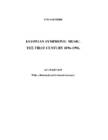
II. THE FIRST DECADE OF THE 20TH CENTURY. ARTUR LEMBA: THE BEGINNING OF ESTONIAN SYMPHONY AND OPERA. III. NEW DEVELOPMENTS IN CULTURAL AND MUSICAL LIFE: THE END OF THE TSARIST PERIOD. THE INDEPENDENT REPUBLIC OF ESTONIA: THE INTRODUCTION OF INNOVATIONS FROM WESTERN ART AND THE EVOLUTION OF NATIONALLY ORIENTED MUSICAL TRENDS. IV. THE TWENTIES. ARTUR KAPP: ROMANTICIST AND DRAMATIST. V. THE INFLUENCE OF NEW WESTERN MUSICAL TRENDS. HEINO ELLER: A PROGRAMME PAINTER. VI. THE THIRTIES. THE WIDENING OF NATIONAL SYMPHONISM. THE RISE OF ATTENTION TO HISTORY AND FOLKLORE: JUHAN AAVIK, EDUARD TUBIN, EUGEN KAPP. VII. FURTHER MATURING OF SYMPHONIC MUSIC: HEINO ELLER, EVALD AAV, EDUARD TUBIN. THE FIRST ESTONIAN BALLET. SUMMARY OF THE REPUBLICAN PERIOD. HALF A CENTURY UNDER SOVIET OCCUPATION. IDEOLOGY OVER MUSIC. EXTENSIVE INFLUX OF CONTEMPORARY TRENDS. VIII. THE FORTIES. TRANSFORMATION OF ESTONIAN LIFE. THE WAR-TIME
Soon, this subcultural phenomenon gained the attention and respect in the ‘grown-up’ world. From the fingers and cans of teenagers, it had taken a form of true artistic expression. Although still subversive, and in its large part an illegal movement, through art enthusiasts and professionals, street art earned its place in the contemporary art world. Thus, street art gave birth to artists who create breathtaking murals, and those who have incorporated video art and other performative aspects to creative work ‘on the streets’. To understand the history of street art, one must immerse oneself into the energy of this sublime cultural phenomenon, as an admirer, but perhaps as a creator as well. (Maric B. The History of Street Art, 2014 [https://www.widewalls.ch/the-history-of-street-art/] 20.12.17) NYC subway 3. GRAFFITI AND STREET ART ARE NOT THE SAME THING
we today call book printing. The first book was printed between 1444 and 1446, so these years can be considered as the beginning years of book printing. His most important preserved printings are the 40 copies of the Bible. By the end of the 15 th century there were about 1000 print-shops in Europe already. The oldest Estonian book dates back to 1535. Libraries form a vital part of education. They make available-through books, films, recordings and other media- knowledge that has been accumulated through the ages. People in all walks of life use libraries to get information for their work. Libraries also play an important role in preserving people's cultural heritage. For example, some libraries have rare books, authors' and composers' manuscripts or works by artists. Today's libraries differ very much from the ones from the past - not only in the contents and services, but also in physical layout and atmosphere. Library derives
Prof. A. V. Isacenko was replaced first by Assoc. Prof. . urovic (1955-1959) and then by Assoc. Prof. J. Kopanicák (1959-1970). The political turnaround in 1989, of course, also had impact on the evolution of Russian studies as an academic discipline. The department found itself in a peculiar situation. On the one hand, it represented one of the most developed philological disciplines with a large personnel and material base; on the other hand, the factors that had made Russian studies one of the favoured philological disciplines in the past ceased to be significant. What followed was a perceptible drop in the number of applicants for the Russian teaching programme as Russian gradually lost its dominant position at primary and secondary schools. In terms of research, literary studies, which had appeared to be less productive for decades, prevailed over Russian linguistics. Part 1. Linguistics
 annaabi.ee