Leidsid 33 sarnast õppematerjali, mis on seotud failiga "Reported speech". Need materjalid aitavad sul teemat sügavamalt mõista.
bully, simple, before, present, perfect, could, says, pealause, kõrvallause, asked, wrote, continuous, reported, speech, kaudkõne, ajamäärused, today, tomorrow, yesterday, these, those, later, modaalverbid, able, might, wasn, weren, allowedINGLISE KEEL Sisukord Sisukord 2 Ajavormid Tense vorms 3 Lihtolevik The present simple 3 Lihtminevik The past simple 3 Lihttulevik The future simple 3 Kestev olevik The present continuous 3 Kestev minevik The past continuous 4 Kestev tulevik The future conrinuous 4 Täisminevik The present perfect 4 Enneminevik The past perfect 4 Ennetulevik Future perfect 5 Üldminevik Past tense 5 Üldtulevik Future indefinite 5 Artiklid ja eessõnad 7
INGLISE KEEL Sisukord Sisukord.................................................................................................................................. 2 Ajavormid Tense vorms.......................................................................................................3 Lihtolevik The present simple..................................................................................... 3 Lihtminevik The past simple....................................................................................... 3 Lihttulevik The future simple...................................................................................... 3 Kestev olevik The present continuous......................................................................... 3 Kestev minevik The past continuous
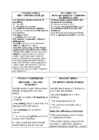
· Kui pealause on minevikus (said; asked) Past Simple(worked), Present perfect(has worked) = Past Perfect(had worked) Present Continius = Past continius (is working = was working) Do, does = did Go, goes = went Shall, will = should, would Am, is, are = was, were Was, were = had been Have, has = had Had = had had Can = could (or had been able to..) May = might Must = had to Mustn't = wasn't/weren't allowed to Went, did or have = HAD + 3. Pv · Kui pealause on olevikus NT: Hilary says, ,, I cant employ you." = Hilary says that she can't employ me. Present simple (works) = Past simple (worked) · Muutused These = those This = that Here = there Soon = later Ago = before Now = then Next year/month/week = the next year/month/week Last year/.../... = the year ../.../.. before This year/.../... = that year/.../... Today = that day, the following day · Küsimustes sõnade järjekord : ALATI ALUS + ÖELDIS
Subject: Suggested improvements Date:2nd May 2011 The purpose of this report is to comment on conditions in the college and to make recommendations for possible improvements. Although conditions are generally good, there are one or two problems. Firstly, in large classes, there is not much desk space. Secondly, the classrooms tend to be darl, especially in the winter months. Finally, during video lessons, some of us find it difficult to see screen properly. There are number of changes that could be made in order to improve the situation. To begin with, I would strongly suggest that the number of students per class kept to below ten. In this way... To sump up, while most of us are satisfied with the conditions, I feel that above improvements would make things even better. If these suggestions were carried out... Complaint Dear Sir I am writing to complain about the holiday apartment I rented from you on 15th of August. I believe your advertisement was misleading in a number of ways.
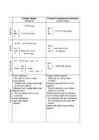
We can report people's words by using direct speech or direct speech reported speech. speech `I'm tired!', Helen said. Helen said (that) she was tired. The main verb of the sentence is usually past ( Tom said that... / I told her that...) and the rest of the sentence is usually past too. Sequence of tenses if the verb in the main sentence is in the past tense the other verbs are usually in one of the past tense too. Present Simple Past Simple I'm a teacher. He said (that) he was a teacher Present Progressive Past Progressive I'm having lunch with my He said (that) he was having parents. lunch with his parents. Past Simple Past Perfect He said (that) he had bought a I bought a new car. new car.
Reported speech is often also called indirect speech. When we use reported speech, we are usually talking about the past (because obviously the person who spoke originally spoke in the past). The verbs therefore usually have to be in the past too. For example: "I'm going to the cinema". He said he was going to the cinema. Basic tense chart The tenses generally move backwards in this way (the tense on the left changes to the tense on the right): present simple past simple I'm a teacher. He said he was a teacher past continuous. present continuous He said he was having lunch with his I'm having lunch with my parents. parents. past perfect simple
We/you/they go We/you/they do not go Do we/you/they go? NB! ERANDID! · Verbidele, mis lõpevad ss, h, ch, tch, x või oga, lisatakse ainsuse kolmdandas pöördes es. he does he goes he misses he watches he mixes · Verbid, mis lõpevad yga, mille ees on konsonant, muudavad y iks enne es lisamist. fly he flies carry he carries Võrdle: say he says Lihtolevik väljendab: · Antud momendil toimuvat tegevust, mis ei väljenda kestvat aega, näiteks see, hear, know. I see that man who you are pointing at. · Üldist, kogu aeg toimuvat või korduvat tegevust, pole oluline, kas tegevus toimub rääkimise hetkel. Teachers teach in schools. He usually goes to gym on Monday. · Tegevust mingil ajal. I go to school at 8 o´clock.
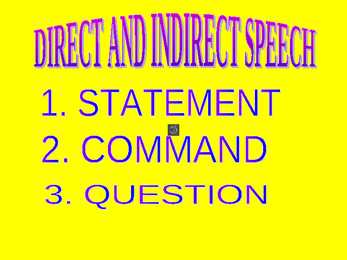
· DIRECT · INDIRECT · Am, is, are · Was/were · Shall/will · Should/would · Can · Could · May · Might · Must · Have/has to · Ought to · Had to CHANGES OF ADVERB OF TIME & PLACE · DIRECT · INDIRECT · NOW · THEN · TOMORROW · THE FOLLOWING DAY · NEXT WEEK · THE FOLLOWING WEEK · TONIGHT · THAT NIGHT · TODAY · THAT DAY · YESTERDAY · THE DAY BEFORE · LAST NIGHT · THE NIGHT BEFORE · LAST WEEK · THE WEEK BEFORE
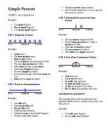
TENSES. ACTIVE VOICE. 1. Present Simple (üldolevik) I (he, she, it s) he works Eitav,küsiv do (I, you, we, they) he does not work does (he, she, it) does he work? Verbidele, mis lõpevad infinitiivis ss, -sh, -ch, -x või o, lisatakse ainsuse 3. pöördes es he touches, she goes Verbidel, mis lõpevad y-ga, mille ees on konsonant, muutub y->ies
3 TALLEGG 11 MIZDE 4 VESITERM 12 LADA 5 STOW 13 SCHWUNG 6 KALEV 14 MAIASMOKK 7 YAMAHA 15 ISKU 8 ESTRAVEL 2 Affirmative tense Use Signal Words Negative/Questions · action in the present taking always, Present Simple A: He speaks. place once, never or several every ..., N: He does not speak. normally, often, Q: Does he speak? times seldom, · facts sometimes,
Reported Speech (in other words Indirect Speech) If we report what another person has said, we usually do not use the speaker's exact words (direct speech), but reported (indirect) speech. Therefore, you need to learn how to transform direct speech into reported speech. We use reported speech when we are saying what other people say, think or believe. - Example: If this verb is in the present tense (says), it's easy. We just put 'she says' and then the sentence. When we are reporting things in the present, future or present perfect we don't change the tense. : direct speech: "I like ice cream" reported speech: She says she likes ice cream - But, if the reporting verb is in the past tense (said), then usually we change the tenses in the reported speech: direct speech: "I like ice cream" reported speech: She said she liked ice cream. .........
present simple past simple will would I'm a teacher. He said he was a teacher I'll come and see you He said he would come and see present continuous past continuous. soon. me soon. I'm having lunch with my He said he was having parents. lunch with his parents. can could present perfect simple past perfect simple I can swim under water He said he could swim under I've been to France three He said he had been to for two minutes. water for two minutes. times. France three times. present perfect past perfect continuous continuous He said he had been
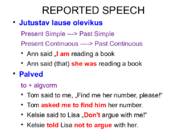
REPORTED SPEECH Jutustav lause olevikus Present Simple ---> Past Simple Present Continuous ----> Past Continuous Ann said ,,I am reading a book Ann said (that) she was reading a book Palved to + algvorm Tom said to me, ,,Find me her number, please!" Tom asked me to find him her number. Kelsie said to Lisa ,,Don't argue with me!" Kelsie told Lisa not to argue with her. Jutustav lause minevikus Past Simple --> Past Perfect (had + 3.pv) Present Perfect --> Past Perfect Past Continuous ---> had + been + ing Lynn said ,,I went to the cinema last night." Lynn said (that) she had gone to the cinema the night before. Ed said ,,I have finished the exercise."
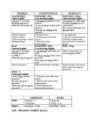
SIMPLE CONTINUOUS PERFECT I (-s) DO/DOES AM/IS/ARE + ING HAVE/HAS + III pv. I learn English I am learning English I have learned English. I get up at 7 every day. I'm reading a good book at the I've learned 10 words today. He doesn't get up at 7. moment. He hasn't learned any new What time do you get up? He isn't reading anything at the words today. moment
http://www.abiks.pri.ee Kaudkõne. Kui otsekõne pealause on minevikus (said, asked), Siis toimuvad kaudkõne kõrvallauses järgmised muutused; OTSEKÕNE KAUDKÕNE I pv. (go, goes) > II pv. (went) do/does + I pv. (eitav lause) > did + I pv. (do/does not go) > (did not go) do/does + I pv. (küsimus) > II pv. (do you go...?) > (if I went) II pv
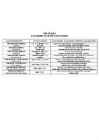
AJAVORMID JA NENDE MOODUSTAMINE AJAVORMI NIMETUS MOODUSTAMINE KASUTAMINE, SAGEDAMINI ESINEVAD AJAMÄÄRUSED THE PRESENT I pv; do/does + I Tegevus toimub korduvalt, on harjumuspärane SIMPLE live, goes twice a week, every day, usually, often, sometimes, always THE PAST (+) II pv; did + I Tegevus toimub minevikus SIMPLE lived, went yesterday, last week, two years ago, in 1996 THE FUTURE (shall)/will + I Tegevus toimub tulevikus, on üksteisele järgnev
Cali 2005 Was Born Traveled to Europe Husband 1978 School graduates @ Oxford 1999 Started Got married School 1983 2008 2 The Six English Verb Tenses Three Simple Tenses Simple continuous Present You walk. You are walking I run. I am running. Past You Walked You were walking. I ran. I was running. Future You will walk. You will be walking. I will run. I will be running. Three Perfect Tenses Perfect continuous Present perfect you have walked
7. Verb: The principal forms of the verbs: Verbil on 4 põhivormi: Regular verb Irregular verb 1. the base form Talk Speak üldoleviku tüvivorm 2. the past form/ -ed form Talked Spoke üldmineviku vorm 3. the past participle (-ed Talked Spoken participle) mineviku kesksõna 4. the present participle (- Talking Speaking ing participle) oleviku kesksõna The tenses: Expressing the future: Simple Perfect Continuous Perfect Continuous Present Base Have / has + to be + base+ ing has/ have been +s + pariticiple base+ -ing
Conditionals Sentences with if are used to express possibilities. 0 Zero conditional If-clause present (past) simple Main clause present (past) simple Sometimes sentences with if express certainty rather than possibility. The zero conditional is used to talk about sth. that is always true (such as a scientific fact), or that was always true in the past. In this type of conditional we can use when instead of if. E.g., If/When you mix blue and red, you get purple. If/When you don't water flowers, they die. (present simple in both parts of the sentence) If/When I asked her to come with us, she always said no.
· For certain/sure Tel · The truth l · A lie, story, secret, joke · The time · The difference · One from another · Somebody one's name · Somebody the way · Somebody so · Someone's · fortune as · a question k · a favour · the price · after somebody · the time · around · something/somebo dy Direct speech Reported speech Present simple Past simple My flight leaves He said his flight left at 3 3 o'clock. o'clock. Present Past Continuous continuous He said he was playing I am playing tennis that afternoon. tennis this afternoon. Present Perfect Past Perfect I have cleaned I said he had cleaned my room. his room. Past Simple Past Simple or Past I paid 12 for the Perfect video. He said he paid/had
INGLISE KEELE KORDAMINE TIME CLAUSES Present Simple · Permanent states, facts (Tom works..) · Repeated and habitual actions, routines (She usually goes..) · Laws of nature and general truths (The sun sets in the west) · Timetables and programmes · Sporting commentaries, rewiews (Beckham wins the ball, crosses and Owen scores) · Feelings and emotions (I love Tallinn..) TIME EXPRESSIONS USED WITH PRESENT SIMPLE: usually, often, always, every day/week etc, in the morning/evening
1. Active/Passive Active - the professor teaches the students. Passive - The students are taught by the professor 2. Present Simple [VERB] + s/es in third person. Tegevus on korduv või tavapärane. You speak English. I play tennis. Cats like milk. The train leaves tonight at 6 PM. I am here now. Active= Once a week, Tom cleans the car. Passive= Once a week, the car is cleaned by Tom. 3. Present Continuous [am/is/are + present participle]. Tegevus toimub/ei toimu praegusel hetkel. You are watching TV. You are learning English now. I am studying to become a doctor. I am meeting some friends after work. Active= Right now, Tom is writing the letter. Passive= Right now, the letter is being written by Tom. 4. Past Simple [VERB+ed] or irregular verbs. Tegevus algas/lõppes minevikus täpsel ajal. . You called Debbie. I saw a movie yesterday. I finished work, walked to the beach, and found a nice place to swim
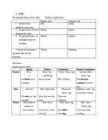
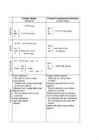
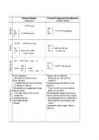
Ing Present Simple Present Progressive/Continuous (lihtolevik) (kestev olevik) I vorm (play) am JAATAV he is I vorm+ing (playing) she I vorm+s (plays) are it do not I vorm (don't play) am
Ing Present Simple Present Progressive/Continuous (lihtolevik) (kestev olevik) I vorm (play) am JAATAV he is I vorm+ing (playing) she I vorm+s (plays) are it do not I vorm (don't play) am
Ing Present Simple Present Progressive/Continuous (lihtolevik) (kestev olevik) I vorm (play) am JAATAV he is I vorm+ing (playing) she I vorm+s (plays) are it do not I vorm (don't play) am
FUTURE SIMPLE BE GOING TO Will + infinitive (will go) Am/is/are going to + infinitive (is going to rain) 1.A decision at the moment of 1.Future plans made before the speaking: moment of speaking: A: 'I'm cold'. A: 'We've run out of milk.' B: 'I'll close the window'. B: 'I know, I'm going to buy some.' 2.Prediction based on opinion: 2.Prediction based on present I think the Conservatives will win the evidence: next election. Look at those boys playing football! 3
Tests Superstar 1 Luke Prodromou Test 1 Name____________________ Class_______ Use your English 1 Complete these sentences using the correct form (present simple or present continuous) of the verb in brackets. _ 1 She is in a band and she _________________________________ (record) a CD at the moment. _ 2 She is an actress and often _________________________________ (appear) on television. _ 3 At the moment she _________________________________ (have) a rest because she is tired. _ 4 Mike is a doctor and he _________________________________ (live) in Manchester. _ 5 I _________________________________ (start) work at 8.30 every morning.
Golden Grammar rules 1. Don't use an with own. Sue needs her own room. (NOT Sue needs an own room.) I'd like a phone line of my own. (NOT ... an own phone line.) 2. Use or rather to correct yourself. She's German or rather, Austrian. (NOT She's German or better, Austrian.) I'll see you on Friday or rather, Saturday. 3. Use the simple present play(s), rain(s) etc to talk about habits and repeated actions. I play tennis every Saturday. (NOT I am playing tennis every Saturday.) It usually rains a lot in November. 4. Use will ..., not the present, for offers and promises. I'll cook you supper this evening. (NOT I cook you supper this evening.) I promise I'll phone you tomorrow. (NOT I promise I phone you tomorrow.) 5. Don't drop prepositions with passive verbs. I don't like to be shouted at. (NOT I don't like to be shouted
THE TENSES AJAVORMID JA NENDE KASUTAMINE AJAVORMI NIMETUS MOODUSTAMINE KASUTAMINE; SAGEDAMINI ESINEVAD AJAMÄÄRUSED THE PRESENT SIMPLE I pv. (+ s); do/does + I pv. Tegevus toimub korduvalt, on harjumuspärane. püsiv olukord, ajagraafikutega seotud tulevik Lihtolevik live, goes every day, usually, often, sometimes, always THE PAST SIMPLE II pv.; did + I pv. Tegevus toimub minevikus. Lihtminevik lived, went yesterday, last week two years ago, in 1998
sentences. All students of English, be they native speakers or those who are studying English as a second language, will profit from the fundamental introduction and review of grammar provided by SADDLEBACK'S BASIC ENGLISH GRAMMAR 1 and 2. Helpful marginal notes throughout the books have been provided to reinforce existing skills and call attention to common problem areas. We wish you every success in your pursuit of English proficiency. 1 What is Grammar? 5 The Simple Past Tense 98 Regular and Irregular Verbs 99 Was and Were 104 2 The Capital Letter 6 The Past Progressive Tense 106 The Future Tense 108 Can and Could 112
REPORTED SPEECH 2. Kui saatelause verb on oleviku aegades, siis ei muutu kaudse kõne verbi aeg. Kui saatelause verb on minevikus, toimub väit- ja küsilausetes aegade nihe: Prsent Simple Past Simple Present Progressive Past Progressive Present Perfect Past Perfect Present Perfect Progressive Past Perfect Progressive Past Simple Past Perfect Past Progressive Past Perfect Progressive Past Perfect jääb muutmata Past Perfect Progressive jääb muutmata Future Simple Future in the Past 3. Kui saatelause verb on minevikus, asendatakse kaudses kõnes mõned lähedust väljendavad sõnad kaugust väljendavate sõnadega: This that These those Here there Now then Ago before Today that day Tomorrow the next day Yesterday the day before Last night the previous night Next week the following week Aegade nihet ei toimu kui 1. Lause väljendab üldtuntud tõde
kaudses kõnes 4.2b Kestev minevik Kasutame: et rääkida asjades, mis on minevikus kestvad. They were walking along the bank of a river. et rääkida sündmusest, mis oli kestev, kui teine sündmus aset leidis They were driving down the road when a dog ran in front of the car. et rääkida tegevustest, mis leidsid aset samal ajal minevikus While I was cooking lunch, Gina was washing the floor. 4.2c Past perfect simple (Had+past participle) Kasutame et rääkida sündmustest, mis leidsid aset enne, kui teine mineviku vorm When I saw her, I realised I had met her before kaudses kõnes 4.2c Kestev täisminevik Kasutame: et rääkida tegevusest, mis kestsid kuni nimetatud sündmuseni minevikus I had been walking for three hours when I came to a small village. kaudses kõnes UNIT 5 5.1 Time expressions .
Windows are not made of wood. Simple Present · · New York is a small city. It is not important that this fact is untrue. [VERB] + s/es in third person USE 3 Scheduled Events in the Near Examples: Future · You speak English. · Do you speak English?
 annaabi.ee