Leidsid 33 sarnast õppematerjali, mis on seotud failiga "Population". Need materjalid aitavad sul teemat sügavamalt mõista.
children, employment, transition, women, migration, alternation, living, different, influence, traditions, work, quite, role, diseases, south, change, birth, economy, traditional, ageing, average, increase, 18th, changes, influenced, famine, places, colonies, north, percent, unemployment, agriculture, industrial, between, influences, death, ethnicEsimene rühm 1. Name the processes of population that have an economic importance. 2. What is demographic transition and what influences it? 3. Speak about demographic explosion. 4. What is demographic crisis? 5. Speak about the course of demographic transition up to 1950s. 6. Speak about full employment in the NORTH. 7. What is natural increase? 8. Why is the rapid increase of population so acute problem? 9. Name the factors that influence death rate. 10. What are the main reasons for death in the developing world? 11. Analyse a population pyramid (what stage was in 2000?). Vastused 1. 1. Demographic transition, 2. Changes that take place in education and full employment, 3. Migration, 4. Urbanization, 5. Etno-cultural process. 2. This is a theory according to which all societies start with traditional alternation (vaheldus) of generations
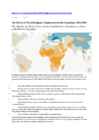
S. than people who identify as Jewish on the basis of religion. Four out of every 10 Christians in the world will live in sub-Saharan Africa. These are among the global religious trends highlighted in new demographic projections by the Pew Research Center. The projections take into account the current size and geographic distribution of the world’s major religions, age differences, fertility and mortality rates, international migration and patterns in conversion. As of 2010, Christianity was by far the world’s largest religion, with an estimated 2.2 billion adherents, nearly a third (31%) of all 6.9 billion people on Earth. Islam was second, with 1.6 billion adherents, or 23% of the global population. If current demographic trends continue, however, Islam will nearly catch up by the middle of the 21st century
I Native Americans · Origin of Native Americans Origin is debatable Siberia->Alaska Crossed the land bridge around 14,000 years ago "ice-free corridor" Hunters, searching for fresh grounds · Different tribes and their way of life In tents, dark skin, hair is long, black and straight, women-agriculture, men- hunting. bands(chief. Travelled together) and tribes land was owned by the tribe that occupied it. 200 different tribes Apache- "enemy"- hunted buffalos, oil and natural gas from their land Cherokee- largest tribe Cheyenne- from Minnesota and S & N Dakota. High system of laws Northwest Ordinance of 1787 Signed in 1787 by Thomas Jefferson. The creation of the Northwest Territory as the first organized territory Ohio River was settled, 5 new states Advancement of education, maintenance of civil liberties, exclusion of slavery Promised not to invade or disturb Indians
English Literature ,Victoria Age 1) Overview of the Victorian age · Periodization During the reign of Queen Victoria (1837-1901) · Why is the Victorian Age compared to the Elizabethan Age? Both are associated with the reign of a very popular queen; Victorian age idealised the Elizabethan Age; many changes in different fields- economy, religion etc.; focusing more on people's attitudes, political developments etc; Victorian age was inspired by Elizabethan era; Britain became an empire · What were the most important changes in politics, religion and social life that occurred during the Victorian age? Politics: 1848 Chartist movement (voting right for the working class); women's suffrage movements; feminist outburst (wanted to have business openly; own property, voting etc
6. Changes in the number of population since the 1840s. 1841: 6.5M in Ireland, 8.2M on the island 1901: 3.2M in Ireland, 5M on the island 1951: 3.0M in Ireland, 4.4M on the island 2011: 4.6M in Ireland, 6.4M on the island Causes of emigration from Ireland. The Irish Famine caused some 150,000 people to leave the island. The Great Famine (1845-52) killed roughly a million and prompted another million to emigrate. In 1890, 40 % of Irish people were living abroad "Exodus in reverse" has been used to describe Irish people returning to Ireland, especially from the US. Immigration from many countries, but mostly from Poland, the UK, Lithuania, Latvia, Nigeria and Romania. Is Ireland still an emigration country? No 7. What is the difference between the Irish Free State and the Republic of Ireland? All three names refer to the same country (Northern Ireland was part of the Irish Free State for one day, if you want to be really pedantic).
· His great-granddaughter Cornelia Hoffmann (b. 1734) married Isaac Roosevelt, which makes her the great-great-grandmother of Franklin Delano Roosevelt, president of the US from 193345. · Hans Rebane = 1897 founded the first Estonian-language newspaper in the US Eesti Ameerika Postimees (published in NY until 1911) · 1898 founded an Estonian Lutheran congregation in NY (still exists today) 2. Signficant waves of migration from Estonia to the US in the 20th century, their reasons. *The failure of the 1905 Revolution: The first significant wave of immigration · Brought a strong Socialist contingent to the United States; led to the formation of many Estonian American Socialist and Communist organizations. * The 1920s30s: · Establishment of independent Estonia · Tightening of American immigration laws · Estonian immigration to the United States slowed down dramatically
Education Education is so multifaceted that it is difficult for me to know where to begin discussing it, or how to prioritize the many factors. Relaying my own experience is easy: I had a standard classroom approach, supplemented by inordinate reading. In only the briefest and least memorable instances did I receive any individual tutoring. Education is commonly thought of as the job of schools. Adults cry "educate our children!" Everyone has opinions about the best way to do the job. It is of urgent importance, and all the numerous factors are much studied, debated, and new (or old) ideas continually tested or retested. Some people say "it's as simple as . . . " and then name their pet peeve or passion. My view is not of an education specialist, but of one who loves sharing what I learn, and owes much to educators. Since I don't have an educational theory neatly worked-out, nor an outline
After the dutch sailor Abel Tasman visited New Zealand and named it Zeeland, more and more settlers arrived, conflicts over land led to several wars between the British and Maori in the North Island. The South island remained rather peaceful until gold was found there and thousand of people hurried there to look for gold. Since World War , New Zealand has moved towards its own unique national identity and place in the world. New Zealand was the first sovereign state to give votes to women. Weather and climate: New Zealand is in the Southern Hemisphere, which of course means mid summer is at Christmas time while mid winter is June/July. The climate is oceanic temperate. The seasonal variations in New Zealand weather are smaller than continental North America or mainland Europe. North Island has a warm mild climate, almost sub-tropical in the extreme north. Auckland average summer temperature (January) is about 21C and winter is 11C. Annual rainfall in North Island is
amalgamation of a group of villages), which is cheaper than creating an entirely new town. 1. Ethnic makeup English 81% Welsh 2% Scottish 10% Northern Irish 2% Irish 2% ethnic minority groups English is the official language, but many people know more than one language. Around 20% of the people in Wales speak Welsh and children learn it in Welsh schools. About 70,000 people in Scotland speak Gaelic. For centuries people from overseas have settled in Britain to escape persecution or in search of a better standard of living. they have brought with them their languages, cultures and religions. The most widely spoken minority languages today are from the Asian subcontinent, the other languages include Italian, Spanish, Greek, Turkish and Chinese. The largest ethnic minorities are of Caribbean or African descent (1
Originally 800 lines; cut down to 433. Highly symbolic – the barren land of the human heart. Eliot provided poets with a new range of technical innovations, e.g. abrupt scenematic cutting (scenes end suddenly); shift in tone; bathos (an abrupt stylistic transition, e.g. from elevated to the commonplace); collection of fragments; experimentation with language. At the end of Eliot’s career – plays, e.g. “Murder in the Cathedral” (1935). Also a critic – criticism and poetry become almost indistinguishable. Virginia Woolf
British Literature in the 20th-21st Century REVISION QUESTIONS 1. The Contradictory, diverse, chaotic 20th century. New developments in science and philosophy. The essence and influence of Freudian theory. Contradictory, diverse, chaotic 20th c- simultaneous rejection and invocation of the past. While modernists apotheosized the creative geniuses of the past, they also rejected old poetic forms. Challenge old and established beliefs and more and more people had access to books and education more people went to universities. profound change in morals: · No universal value and perspective on things · Multiple truths, multiple perspectives
and economic conditions may affect the current definitions of crime and the form of the legal, law enforcement, and penal responses made by society. These structural realities remain fluid and often contentious. For example, as cultures change and the political environment shifts, behavior may be criminalised or decriminalised, which will directly affect the statistical crime rates, determine the allocation of resources for the enforcement of such laws, and influence the general public opinion. Similarly, changes in the way that crime data are collected and/or calculated may affect the public perceptions of the extent of any given "crime problem". All such adjustments to crime statistics, allied with the experience of people in their everyday lives, shape attitudes on the extent to which law should be used to enforce any particular social norm. There are many ways in which behaviour can be controlled without having to resort to the criminal justice system
Notions for The New World Native Americans Origin of Native Americans Nearly one-third of Native American genes come from west Eurasian people linked to the Middle East and Europe, rather than entirely from East Asians as previously thought, according to a newly sequenced genome. Native peoples of North and South America descended from ancestors who arrived via land bridges from East Asia, possibly in a single migration. Different tribes and their way of life The men were hunters, warriors, and protectors, while the women tended to the children, their homes, and farmed. It depended on the tribe when it came to artwork. In some tribes, the men would actually weave baskets and blankets. Natural foods were consumed and hunted. Deer, buffalo, fish, and various birds were the game of choice. Corn, beans, squash, berries, nuts, and melons were the fruits and vegetables that were consumed
interactions of a country's citizens and businesses. In addition to mentioned afore, Estonia tends to perform favourably in measurements of civil liberties, education, and press freedom. Living in Estonia has many of its good sides, for instance it is a secure place from nature disasters and it has a beautiful nature. Although, when not to look only through rose-tinted glasses, there are still some minuses in country’s organization. So, what are the beneficial and negative sides of living in Estonia? To start with, a big advantage is a great location between Scandinavia and prosperous Russia which ensures the connections, networks and possible trading options. Close connections and pendulum migration have tightened the cooperation between the countries. For instance, Estonia and Finland have developed common economic space. Right now Estonia's most important trading partners are Finland, Sweden, Russia and Germany which Estonia is mainly influenced by
The coldest month is February, the warmest July. Permanent snow cover becomes established in the southeast at the beginning of December, at the earliest; and by the end of March, the snow can be more than half a metre deep. Apart from the coast and the Western Islands, the snow vover lasts for approximately 100 days: from the beginning of January to the end of March. In mild winters, however, much of Estonia does not have lasting snow cover at all. Because of the influence of the warm Gulf Stream, the prevailing winds in Estonia blow from the southwest and west. Severe weather conditions, such as tempests and whirlwinds, are rare: the last hurricane raged through Estonia in 1969. The high latitude makes the rotation of seasons and the interchange of light and dark periods of the year well pronounced in Estonia the maximum length of a summer day on the north coast is 18 hours 14 minutes,
money and a room of her own if she is to write fiction. Simone de Beauvoir most wellknown feminist. bell hooks multiplicity of experience, sex(male/female) vs gender(social/construct) Judith Butler performativity – gender is performed. Bloomsbury Group modernists (max 10 ppl) 5. Feminism and women’s roles during the Victorian Era. How were women disadvantages during this period? Some laws that helped changed the status of women. Women’s rights were extremely limited in this era, losing ownership of their wages, all of their physical property, excluding land property, and all other cash they generated once married. 1857: violence recognized as grounds for divorce 1870: women could keep money they earned
oldest school working on the same premises was founded in Tallinn (GAG).After the Northern War (1700-1721) Estonia became a province of Russia. During that period the gentry of Baltic-German origin prevailed in Estonia. They kept estates in Estonia until 1919. Under Russian rule the Palace of Kadriorg was built and the park was laid out. The National Awakening in the middle of the 19th century brought rapid advances in the Estonian education system, general living conditions and culture. The national epic "Kalevipoeg" was published, theatre and music societies appeared and the 1st Song Festival was held in Tartu in 1869. Since then the Song Festivals have become a national tradition, being held every 4-5 years. This all lead to Estonia's independence on 24 February 1918. In June 1940 Estonia became a part of the Soviet Union. On 20 August 1991 the Republic of Estonia was restored without any bloodshed. CULTURE? National emblems
Report Purpose The purpose of this report is to give an overview of Estonian population, political factors, technological factors, economic factors and the trends in Estonian economy compared to Germany and to briefly discuss Estonian business environment. Estonian population The total population of Estonia is 1 313 271 according to Statistics Estonia, of which 69.1% are Estonians, 25.1% Russians, 4.9% of which are of different nationalities for example Ukrainians, Belarusians and Finns. Rest are of unknown nationality. 68.5% of population speaks Estonian as a mother language, 29.6% speaks Russian as a mother language and 0.6% Ukrainian. Estonia has only one official language which is Estonian. According to information by the Institute of the Estonian Language there are about 75% of Estonian people who speak Estonian. The most common foreign languages learned by
modest 5 per cent of the whole population. By 1782, their number had grown to 23 000. The biggest town was Tallinn with a population of 10 700; in Tartu the number was 3400. And there were some smaller towns like Rakvere and Paide, mercilessly plundered in the Northern War. Townspeople had to fight hard with the neighbouring landlords who considered them as. The population kept growing very slowly: in 1862 the number of townspeople was 64 000, which formed only 8.7 per cent of the population living on Estonian territory. The Estonian population in 1782 was divided according to social class as follows: nobility 0.6%; the clergy, townspeople, and other free people (excluding the Swedish "free peasants" of the coast and islands, resident since the 13th century); peasants, of who'm most were serfs. The split between social classes in Estonia was further deepened by the virtual coincidence of the borders between social class and nationality. The most important category in determining
development of human society throuch biological laws · Outlook is deterministic, pessimistic, fatalistic (fate or biology) · Man as an animal-clever than other beasts, still explainable within the framework · Man is not a free agent, is govern by something · Unable to determine his own faith · Hereditary · Naturalists tried to apply in fiction the processes of natural sciences · Writers task is to record facts, systems of behaviour, living conditions, never revealing any natural unbiased (completely natural) · Point of view: amoral-outside the category of morality, neither good or bad · Naturalist find it absurd to blame the wicked. These criminals are doing what nature, environment, their unconscious tells them to do. Naturalists do not judge their characters, they simply report. Try to describe facts like they are. Naturalists depict the lower, coarser forms of life.
mountains, deep valleys and lakes, its natural axis is the beautiful old valley of Halliste. Southern Viljandimaa has been the homeplace of mulgi inhabitants who spoke their own dialect called mulgi language. The speakers of mulgi language can still be found in Southern Viljandimaa and in the past years people have started to pay more attention to learning and developing the dialect. The mulgi inhabitants have always been characterised by strong connection to their old-established traditions and customs. At the same time, the way of life of the local people is characterised by strong families, marriage, children and respect and love for fellow men. The local cultural heritage offers as much variety as the nature. Many rare work and mythological motives are retained in folk songs. The flax-growing that spread rapidly in the beginning of the 19th century was the basis of the prosperous Mulgi family farms in Southern Viljandimaa. 19. The second
..................................... 13 3.7 Government Budget Deficit/Surplus............................................14 4. Summary.....................................................................................15 5. Sources....................................................................................... 16 1 Introduction The goal of this paper is to compare the economic performance of Finland, Estonia and Hungary. Comparison of different counties in a constantly changing economic environment is interesting, especially after the economic crisis. The results of the analysis will provide us information which of the countries has done the best in recovering. First, a general overview on the countries will be given. After, economic indicators (real GDP growth rate, inflation, unemployment, household consumption, investment, current account, government budget and deficit) of the three countries
In my essay I will describe the most characteristic features of the Maori people and the aborigines. I will divide the essay in 3 parts the Maori people, the aborigines and their comparison. Maori are the host people of New Zealand. Their name is derived from Ma-Uri which means the children of heaven. The arrival of the Maori people to New Zealand is considered to be somewhat of a mystery. It is known that first Polynesians arrived to New Zealand about 1000 years ago, when navigator Kupe discovered the land in 950 AD. He named it Aotearoa The Land of the Long White Cloud. Although these facts can be debatable, I will focus my attention on this interpretation of Maori history. After the Maori arrived to New Zealand, they started to develop into tribes and sub tribes,
warmest recorded air temperature was 33.3°C. The coldest air temperature was -19.1°C Average temperatures in the island vary from -4°C (min) to 11°C (max) in January, and 9°C (min) to 23°C (max) in July. Flora and fauna Ireland has fewer animal and plant species than either Britain or mainland Europe because it became an island very soon after the end of the last Ice Age, about 8,000 years ago. Nevertheless, it is home to hundreds of plant species, some of them unique to the island. Many different habitat types are found in Ireland, including farmland, open woodland, temperate forests, conifer plantations, peat bogs, and various coastal habitats. Fauna Only 31 mammal species are native to Ireland, again because it was isolated from Europe by rising sea levels after the Ice Age. Some species, such as the red fox, hedgehog, stoat, and badger are very common, whereas others, like the Irish hare, red deer and pine marten are less common and generally seen only in
Canada's constitution specifies three categories of aboriginal peoples: Indian (First Nations), Métis, Inuit. According to Canadian census 2011, 1.4 mln people of Aboriginal origin (4.3%): 852,000 First Nations persons, 452,000 Métis, 59,000 Inuit. Indian (First Nations) - No written history before the contact with Europeans. Chief historical sources European priests, travellers and traders not interested in the preservation of "pagan"myths. Different estimates about their number in Canada when Europeans reached North America from 300,000 to 1 mln. Saw themselves as part of nature, not as its masters. The First Nations were called "Indians" by Christopher Columbus when he landed in North America, because he thought he had reached India. Many now prefer to call themselves First Nations, though many still call themselves Indians in everyday conversation.
Active Citizenship in Cadle Primary School: A Case Study 20 Conclusion 29 Bibliography 32 Appendices Appendix 1: The United Convention of the Rights of the Child Appendix 2: Interview with Jamie Richards, the Head Teacher of Cadle Primary School 2 Abstract: Children inherently have had a rather tenuous relationship with citizenship. Similarly to how women were once viewed, children have not been considered as subjects of rights due to their perceived incompetence and irrationality. Currently, children are not considered as being rational and capable of exercising responsibility until the age of majority, the age of 18. However, the adoption of the U.N Convention of the Rights of the Child (UNCRC) in 1989 granted for the first time the recognition for children as worthy individuals with rights of their own
Anthropology of Tourism Madli Tuvike Anthropology and Tourism Female Adventure Tourism This essay will explain what significance culture has in adventure tourism. There are five paragraphs in this essay, where definitions of adventure travel and human culture are given. First, paragraph will look and define what culture, anthropology and adventure tourism are. Second paragraph will examine how different cultures impact female adventure travel. Third paragraph will point out the problems in adventure tourism. The forth paragraph will give recommendations for the future and some of the possible future problems in female adventure tourism will be looked at. The last paragraph will be a summary of the key findings and recommendations. Tourism is one of the world’s largest industries (Tisdell, 2000, Swarbrooke et al. 2003, Buckley, 2003)
Mass Media What is Mass Media? Statistics show that there are few things which impact the human mind more than mass media. The advice of teachers, parents and relatives may fall on deaf ears, but the mass media influence holds us all spellbound! At this point, it becomes necessary to define mass media. Mass media may be defined as any form of communication which is meted out to the people at large, through the various forms of communication. What modes of communication are we talking about? Well there can be no static definition for the channels of mass communication as they are increasing all the time. But any form of communication which is seen and understood by a large mass of people can be taken
fertile eastern coast of Australia, but he was not the first to visit Australia. There is evidence suggesting Aborigines in northern Australia maintained trade with some of the Indonesian islands closest to the coast. Chinese and Arab's may have had contact with the Aborigines in the 15th century. When British people came to live in Australia, they decided that the land was empty, that there were no people living there. This was called "Terra nullius", Latin words for "empty land".Under British law, all land belongs to the king,who is then able to sell it to other people. The sacred sites and other land which had belonged to aboriginal people for thousands of years were simply taken from them. If they did not leave peacefully then the new settlers used force to get them to leave. Many aboriginal people were killed during the settlement of Australia. The aborigines that were left were
The main influences on the development of the English language 1.2 Origins of English as Global Language The first significant step in the progress of English towards its status as a global language took place at the end of the sixteenth century. At that time, the number of mother- tongue English speakers in the world is thought to have been 400 million and more, almost all of them living in the British Isles.“Between the end of the reign of Elizabeth I (1603) and the 6 beginning of the reign of Elizabeth II (1952), this figure increased almost fiftyfold, to some 250 million, the vast majority living outside the British Isles... ” [3, p.30] Then, in the eighteenth century, there was a vast wave of immigration from northern Ireland
Masque – linked poetry and moral philosophy into art. Music, dance, poetry, lavish illusionistic scenic display to express the doctrines of divine kingship. Great impact. Like gods come down to earth. 2. The Caroline masque Charles decided on subject matter, and acted and danced in masques. Now the regal divinity even more obvious. Ben Jonson. Divine minds of this incomparable pair. Arts role – to set a noble ideals, to strengthen practice of virtue. He and queen living incarnations of ideals. Visual style of his reign more classical than James’s. Thomas Carew „Coelum Britannicum”. King’s policy of peace (peace in every courtly celebration). Benefits to the isle by the union of divine couple. Henrietta Maria Love and Beauty and Charles – Heroic Virtue, together a great force. Masques centre of court life. Stuart divinity + now queen as a Platonic love goddess. Maria – from French court amnners and highly artificial language of adoration – fashion
key role in behavior. 2) Animals may be studied as a means of understanding human behavior. 3) There are biological correlates of behavior. Cognitions, emotions and behaviors are products of the anatomy and physiology of our nervous and endocrine system. Explain how principles of the biological level of analysis may be demonstrated in research. 1) Correlational studies: Study by Buss, who hypothesized that across cultures, men will prefer to marry younger women because of greater reproductive capacity and women will place greater value on a potential mate's earning potential to provide survival advantages. This evolutionary hypothesis was tested in 37 cultures by sending out questioners. 2) Twin studies (type of correlational studies) compare trait similarities in identical and fraternal twins (Minnesota twin study by Tellegen, Buchard). 3) Experiment: Split-brain experiments by Gazzaniga & Sperry, brain plasticity
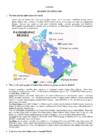
2. Geographical position 3. Mountains, lowlands 4. Rivers, lakes 5. The territories and provinces 6. Towns, economy, agriculture 7. Climate 8. Animals, plantlife 9. Population 10. Sports 11. Culture 12. History 13. Political system, symbols 14. Conclusion 15. Materials 1. Introduction If you had to use two words to describe Canada, they might be large and diverse. Canada is the second largest country in the world, bordered by three oceans, and across the country, Canadians experience many different landscapes from rolling plains and mountains to the cold tundra of the north. Despite Canada's great size, it is one of the world's most sparsely populated countries. This fact, coupled with the grandeur of the landscape, has been central to the sense of Canadian national identity. 2. Geographical position Canada is the second largest country in the world after Russia. In the Arctic, Canada reaches almost as far north as Greenland. To the south it extends to the same latitude
 annaabi.ee