 10 punkti
Autor soovib selle materjali allalaadimise eest saada 10 punkti.
10 punkti
Autor soovib selle materjali allalaadimise eest saada 10 punkti.
 ~ 1 leht
Lehekülgede arv dokumendis
~ 1 leht
Lehekülgede arv dokumendis
 2009-12-14
Kuupäev, millal dokument üles laeti
2009-12-14
Kuupäev, millal dokument üles laeti
 142 laadimist
Kokku alla laetud
142 laadimist
Kokku alla laetud
 3 arvamust
Teiste kasutajate poolt lisatud kommentaarid
3 arvamust
Teiste kasutajate poolt lisatud kommentaarid
 diantska
Õppematerjali autor
diantska
Õppematerjali autor
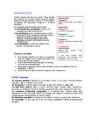
oppose, contrary to popular belief To express personal opinion in my opinion/view, to my mind, personally I believe, it strikes me that, I feel very strongly that, I am inclined to believe that, it seems to me that, as far as I am concerned To conclude finally, lastly, all in all, taking everything into account, on the whole, all things considered, in conclusion, as I have said, as was previously stated, to sum up Additional linking words To refer to other sources according to, with reference to To express cause because of, owing to, due to, for this reason To express effect therefore, thus, as a result, consequently, so, as a consequence To emphasize what you say clearly, obviously, of course, needless to say, in particular To express reality in fact, actually, as a matter of fact, in practice, the fact of the matter is that
Usually the task contains points you have to discuss. Make sure they are all covered! Keep in mind! Formal language – no slang, so contracted forms, colloquialisms, try to avoid repetition of words. Indented lines! Clear paragraphs with one central idea. Avoid strong feelings 8everybody hates... it is absurd to believe...) and strong personal expressions Use generalization (children assume…), but do not use overgeneralizations (all children assume…) At least 2 linking words per paragraph (separate them from the rest of the sentence by commas!) that show the connection between paragraphs. Make references to other sources (Police officials believe that…) Give examples, not personal thoughts (expressive intake of alcohol can damage liver) if you use statistics, be sure of the source! Avoid clichéd introductions, make it more original (hook) Consistent personal pronoun use (if you use “we” or “you”, do it throughout the essay) Punctuation (NB
An essay should end with a conclusion that briefly takes together what has been said before. If for and against arguments were given earlier, this is the place where the writer can give his own opinion. If the writer feels there are more arguments for than against the topic, it is advisable to give those before the final paragraph to lead the reader to a proper conclusion. If giving support to an opinion throughout the essay, the opinion should be restated here. There are a lot of linking expressions that are useful for connecting the separate sentences and paragraphs into a logical cohesive text and are considered absolutely necessary in a good essay. The following are some examples of these. To introduce points: Firstly/To begin with/In the first place; One point in favour of/against is/One advantage of ... is/One disadvantage of ... is, etc. To add more points: Secondly/Thirdly/What is more/Furthermore/both ... and/not only ..
* you may include more · First decide whether you agree or disagree viewpoints, and therefore more with the subject of the topic and make a list paragraphs in the main body of your points and reasons. · Write well-developed paragraphs consisting of more than one sentence. · Begin each paragraph with a topic sentence which summarises what the paragraph is about. · Linking words should be used throughout your composition. Useful Language To express opinion: I believe, In my opinion, I think, In my view, I strongly believe, The way I see it, It seems to me (that) To list points: In the first place, first of all, to start with, Firstly, to begin with To add more points: what is more, another major reason, also, furthermore, moreover, in addition to this/that, besides, apart from this, not to mention the fact that
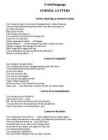
Useful language FORMAL LETTERS Letters objecting to someone's plans I am writing to express my concern /disappointment / alarm at hearing ... I was extremely alarmed/sorry/distressed to hear about your plans to ... As I think you know, ... May I point out that ... I feel I really must object to ... I am extremely concerned at the thought that ... It must be very clear that ... If these proposals go ahead, ... will happen. Another threat to ... , if these proposals go ahead, would come from ... I dread to imagine what damage this will cause. May I respectfully suggest that you ... I was wondering if you had considered this alternative? Would it not be possible to ... ? Letters of complaint I am writing to complain about ... I am writing to tell you how disappointed/annoyed I feel about ... I was amazed/distres
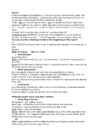
Report A report is based on facts/data etc. The writer knows more than the reader. The reader needs the information. A report should be clear and easy to follow. The person who reads it should find the information quickly. THINK: why you are writing the report, why the reader needs your report and what she might be interested in. Think about the best way to present the facts. If it’s a report of events (e.g. a traffic accident), describe them in chronological order. It should NOT be written like a letter! NO salutation/sign-off. Impersonal style (PASSIVE!), unless you make suggestions or give personal opinion – then you can use “I”. Formal language –no contractions, slang, etc. You can use the following format at the beginning of the report: To: From: (DO NOT write your own name. A member of the student committee etc. is fine) Subject: Basic structure 200 (+/- 10%) Introduction: Aim of the report Status of the writer (who you are – not your name – to write
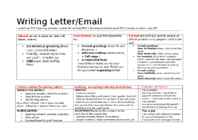
Writing Letter/Email [ greeting- PH1 Opening remarks, reason for writing-PH2,3 developments(arengud)-PH4 closing remarks- sign off] Informal- are sent to people you know well. Semi-formal- to your friend parents Formal-are normally sent to people an (friends, relatives) ect.. official position or to people u dont know well An informal greeting (Dear Formal greetings (Dear Mr and Formal greetings: Dear Sir/Madam-when u dont know the Lucy, Uncle Bill,Mum) Mrs Jones, ) name. Friendly, relaxed style (How
Keith Donnellan notes that, even if Russell is right about some uses of descriptions, he has ignored a common sort of case in which a description is used "referentially," merely to indicate a particular person or thing, regard- less of that referent's attributes. Finally, there are further uses of descriptions, called "anaphoric" uses, which may defy Russellian treatment. 10 Reference and referring Singular terms In English or any other natural language, the paradigmatic referring devices are singular terms, expressions that purport to denote or designate particular individual people, places, or other objects (as opposed to general terms such as "dog" or "brown" that can apply to more than one thing). Singular terms include proper names ("Jane," "Winston Churchill," "Djakarta," "7," 3:17 p.m."), definite descriptions ("the Queen of England," "the cat on the mat," "the last department meeting but one"), singular personal pronouns ("you,"
 annaabi.ee






Kõik kommentaarid