 50 punkti
Autor soovib selle materjali allalaadimise eest saada 50 punkti.
50 punkti
Autor soovib selle materjali allalaadimise eest saada 50 punkti.
 ~ 2 lehte
Lehekülgede arv dokumendis
~ 2 lehte
Lehekülgede arv dokumendis
 2013-05-27
Kuupäev, millal dokument üles laeti
2013-05-27
Kuupäev, millal dokument üles laeti
 1 laadimist
Kokku alla laetud
1 laadimist
Kokku alla laetud
 0 arvamust
Teiste kasutajate poolt lisatud kommentaarid
0 arvamust
Teiste kasutajate poolt lisatud kommentaarid
 andresmirzojev
Õppematerjali autor
andresmirzojev
Õppematerjali autor
YOU WILL HEAR: To get to the post office, cross the street, go three blocks, and you'll see it right on the corner. YOU WILL SEE: (A) The post office is right on the corner. (B) The post office is at the next corner. (C) The post office has a cross near it. (D) The post office is three blocks away. The correct choice is, which most closely gives the same meaning as the sentence you heard. It is important for you to know that if similar sounding words or the same words appear in an answer choice, that answer choice is seldom correct. Short Dialogs Part B contains short dialogs followed by a question about what the people said in their conversation. Generally, key information is found in the second speaker's sentence. You will need to understand the meaning of the conversation and also the context , such as the time or place in which it could occur. The correct choice directly answers the question. YOU WILL HERE: (Man Did you get to go shopping last night'
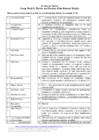
EU Internal Market Group Work I: History and Purpose of the Internal Market Please connect terms (numbers) with correct description (letter), for example 17 M 1 Common Market A ... is characterized by free movement of goods between the participating countries, but autonomous external trade policies in relation to non-participants. 2 Comparative B A top-down approach to integration that can be best Advantage explained by market failure. 3 Customs Union C Allows for specialization, specialization leads to competiti
" The effectiveness of this request plus- reason was nearly total: 94 percent of those asked let her skip ahead of them in line. Compare this success rate to the results when she made the request only: "Excuse me, I have five pages. May I use the Xerox machine?" Under those circumstances only 60 percent of those asked complied. At first glance, it appears that the crucial difference between the two requests was the additional information provided by the words because I'm in a rush. However, a third type of request tried by Langer showed that this was not the case. It seems that it was not the whole series of words, but the first one, because, that made the difference. Instead of including a real reason for compliance, Langer's third type of request used the word because and then, adding nothing new, merely restated the obvious: "Excuse me, I have five pages. May I use the Xerox machine because I have to make some copies?" The re-
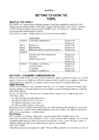
Challenges of children`s “participation”: A Case Study of active citizenship in Cadle Primary School Gerli Orumaa – 662974 9th of May 2014 Word Count: 8,800 `Submitted in partial fulfilment of the requirements for the degree of B.A. International Relations` Table of Contents Abstract 3 Introduction 4 Chapter 1: Citizenship, Children`s Rights and Participation: from the UN to the UK 6 Chapter 2: Citizenship Education in Wales………………………………………………14 Active Citizenship in Cadle Primary School: A Case Study 20 Conclusion 29 Bibliography 32 Appendices Appendix 1: The United Convention of the Rights of the Child Appendix 2: Interview with Jamie Richards, the Head Teacher of Cadle Primary School 2 Abstract: Children inherently h
beings grasp those meanings without even thinking about it, are very strik- ing facts. A philosophical theory of meaning should explain what it is for a string of marks or noises to be meaningful and, more particularly, what it is in virtue of which the string has the distinctive meaning it does. The theory should also explain how it is possible for human beings to produce and to understand meaningful utterances and to do that so effortlessly. A widespread idea about meaning is that words and more complex lin- guistic expressions have their meanings by standing for things in the world. Though commonsensical and at first attractive, this Referential Theory of meaning is fairly easily shown to be inadequate. For one thing, comparatively few words do actually stand for things in the world. For another, if all words were like proper names, serving just to pick out individual things, we would not be able to form grammatical sentences in the first place. Meaning and understanding
First, you liked what they said, and your fondest wish was for them to be true for you. But your second response was probably one of skepticism and disbelief. Even though you deeply xiii ccc_tracy_fm_i-xviii.qxd 7/7/03 3:23 PM Page xiv xiv ➤ INTRODUCTION desire to live a wonderfully healthy, happy, prosperous life, when you read those words, your doubts and fears arose immediately to remind you of reasons why these dreams and goals may not be pos- sible for you. Well, join the crowd! This is exactly how I felt many years ago. Even though I wanted to be a big success in life, I was unskilled, uneducated, and unem- ployed. I had no idea what I could do to improve my situation. I felt trapped between big ideas on the one hand and limited resources
regime that he doesn't agree with. Or information in the recording. Tell by their respective users. The fact that he might be an economic migrant who them to prepare for the listening Latin was the official alphabet of the has come here in search of a better by reading the sentences carefully Roman Empire, which at one point standard of living. and underlining any key words. covered most of Europe, helped to Encourage them to eliminate the 6 wrong answers as well as identifying establish this alphabet as the accepted way of writing across the continent.
Yet Anna contends the whole thing really wasn't her fault. Dolly makes an important note at this point: Anna denies blame in the same way Stiva does. This makes Anna, quite frankly, a liar. "'Yes,' Anna went on. 'Do you know why Kitty didn't come to dinner? She's jealous of me.... I've been the cause of that ball being a torture to her instead of a pleasure. But truly, truly it's not my fault, or only my fault a little bit,' she said, daintily drawling the words 'a little bit.'" Anna leaves, laden with shame and guilt. She knows she's running from Vronsky, but she also knows she doesn't want to return to her husband. This haunts her. At one of the train stops, she needs to step outside for air to clear her head of guilt. Instead of a clean conscience, her head is filled with the sharp sounds of a worker hammering on the metal tracks. When Anna arrives at the St. Petersburg station she immediately sees her husband
 annaabi.ee







Kõik kommentaarid