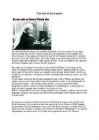
The history of the English Language Kristin Klaus, 10a Short history · Started with the arrival of three Germanic tribes who invaded Britain during the 5th century AD · The tribes: the Angles, the Saxons, the Jutes · At that time the inhabitants spoke a Celtic language · The invadors pushed them west and north Germanic invaders entered Britain on the east and south coasts in the 5th century. Old English · 450-1100 AD · The Germanic tribes spoke similar languages which developed into Old English · Did not sound or look like English today · About half of the most commonly used English words have Old English roots
15 March 44 BC Why did Julius Ceasar call the land Albion ? Because there are white cliffs. Why and who built the Hadrian Wall? it was built on the orders of the Emperor Hadrian. The primary function of Hadrian's Wall was to keep out the Picts. When did the Saxons settle in Britain? The Saxons settle in Britain from the early 5th century AD When did the Vikings first raid Britain? The Vikings first invaded Britain in AD 793 (last invaded in 1066) . they come from the three countries of Scandinavia: Denmark, Norway and Sweden. Who were the Normans? The Normans were the people who gave their name to Normandy, a region in northern France When was the Battle of Hastings? in1066 The Bayeux Tapestry is a long embroidered cloth - not an actual tapestry - which depicts the events leading up to the Norman conquest of
Kingship: a family business After William's death in 1087, the land went to his elder son Robert who gave England to his son William II Rufus when he went to the holy land to fight the Muslims. When William Rufus died, he had no son to take the crown. At the time of William's death, his father was on his way back from the holy land. Their younger brother Henry acted quickly and took the crown for himself. That made Robert very angry and tried to invade England. In 1106 Henry invaded Normandy and captured Robert. The two countries were now reunited under one king. Henry hoped to give the throne to his son, who unfortunately drowned. He hoped for another son, but got a daughter Matilda instead. Matilda married to a great French noble to make the family stronger. When Henry died, there were to heirs. One was Henry's nephew Stephen who was in England and Matilda who was in France. Stephen acted quickly and claimed the throne to himself
politically, but was, however an important crossing point for the romans over the river Thames. Londinium was at a very good place, so it soon became a trading centre. In AD 61 the city was devastated by Boudicca, who led a revolt againt the Roman conquest of Britain. The city was burned down and its inhabitants massacred. London was rapidly rebuilt, becoming the capital of the province Britannia. AD 122 Roman walls were built around it as a Around AD 400 the Anglo-Saxons invaded Britain. They destroyed the roman towns and formed many kingdoms that were hostile to one another. London fell into ruins. King Egbert united all the small kingdoms and formed one kingdom named Englad. Later king Alfred the Great chose London to be the capital of the country. During the reign of Edward the Confessor Westminster Abbey and the royal palace were built. In 1066 The Normans invaded an William the Conqueror took the British throne as William I.
The Germanic Invasions Anglo-Saxon invasion During the 5th c. a number of Germanic tribes invaded The Angles, the Saxons, the Jutes Different peoples, but common language and customs Advance halted by King Arthur Distortions of popular history In folklore, myth (and films) a great English hero, an example of medieval nobility and chivalry In fact a Romanized Celt, lived before medieval times, fought the Anglo-Saxons (people who became "the English")
the red maple leaf centred on the white band. ▶ Goat of Arm: ▶ Plant: Maple tree ▶ Animal: Beaver and Canadian horse Geography ▶ Canada is the second-largest country in the world, after Russia ▶ Between the North Pacific Ocean to the west and the North Atlantic Ocean to the east and the Arctic Ocean to the north Interesting facts ▶ Canada is home to the longest street in the world ▶ Canada has twice been invaded by the USA, first in 1775 and again in 1812 ▶ Canada has more lakes than the rest of the world’s lakes combined ▶ Licence plates in the Canadian Norhtwest Territories are shaped like polar bears
the Viking King Harald III of Norway, known as Harald Hardraada. Battles · William decides to invade England ....because of the contest for the throne. William organized a council of war at Lillebonne and openly began assembling an army in Normandy. Offering promises of English lands and titles, he amassed at Saint-Valery-sur-Somme a considerable invasion force. · Harold Hardraada invaded northern England. Harold assembled a large army on the south coast and a fleet of ships to guard the English Channel. Then came the news that the other contender for the throne, Harald III of Norway, allied with Tostig Godwinson, had landed ten miles from York; Harold was forced to march against them. · Duke William landed at Pevensey Before Harold could return from York to south south William landed his army at Pevensey Bay
He rode to Winchester and took charge of the king's treasury. He then rode to Westminster, where he was crowned king three days later. Henry I (1100 - 1135) Henry I was an ambitious and unscrupulous politician. Early in his reign, he set out to convince his subjects that he would not be as ruthless as his brother had been. He proved himself an effective king. He maintained good order and kept his barons in check. In 1101, Duke Robert of Normandy invaded England to claim the throne as the eldest of William the Conqueror's sons. Henry made terms with him, and Robert renounced his claim in return for a pension. Five years later, Henry invaded Normandy, and captured Robert at the Battle of Tinchebrai. Normandy and England were reunited under one ruler. Henry had two legitimate children, William and Matilda (also called Maud). William was drowned in 1120 while crossing from Normandy to England in a vessel called the White Ship.
„The Host“ The book was written by Stephenie Meyer. The book is about Earth, in a post apocalyptic time, being invaded by a parasitic alien race, known as "Souls", and follows one Soul's predicament when the consciousness of her human host refuses to co-operate with the takeover of her body. It describes what happens when Earth has been overrun by an alien species called Souls, which invade human bodies and erase personalities. There are one film based on the book. The main characters are Wanderer or 'Wanda' for a nickname, Melanie Stryder, Ian O'Shea,
say that they have no skills in Welsh. HISTORY! Neanderthals lived in what is now Wales at least 230,000 years ago. Homo sapiens had arrived by about 31,000 BC. The first people from outer world to step their foot on Wales' area were Celts about 1000 BC. The first recorded information about people in Wales is when Romans came in the 48AD. At that time people talked in Celtic language, which later on was evolved to Welsh. When Kingdom of Mercia invaded England it the was the most powerful from 650800. The Welsh people didn't want to surrender so they kept fighting back but they sadly lost their land to this powerful new kingdom. In an effort to defend their new territory in 784 King of Mercia built an earthwork barrier, known as Wat's Dyke. It reached from sea to sea. Wat's Dyke was the first permanent boundary between the Welsh and English people. In England the period from 800-1000 AD is often called the late Anglo-Saxon period. Anglo-
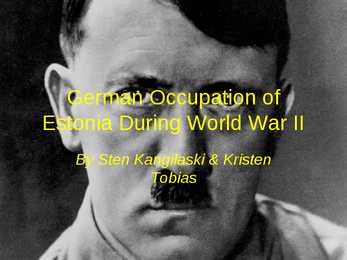
German Occupation of Estonia During World War II By Sten Kangilaski & Kristen Tobias The Beginning · WWII began with the invasion of Poland · Poland was an important regional ally to Estonia · On september 24th, 1939, the Moscow press and radio started attacking Estonia as "hostile" to the Soviet Union. Summer War · After Germany invaded the Soviet Union on June 22, 1941, Finland sided with Germany in the Continuation War. · Thousands of people including a large portion of women and children were killed. · Dozens of villages, schools and public buildings were burned to the ground. German Occupation · Most Estonians greeted the Germans with relatively open arms. · In April 1941, Alfred Rosenberg laid out his plans for the East. · Rosenberg felt that Estonians were the
His marriage in the 1050s to Matilda of Flanders provided him with a powerful ally in the neighbouring county of Flanders. By 1062 William was able to secure control of the neighbouring county of Maine. Conquests In the 1050s and early 1060s William became a contender for the throne of England, then held by his childless first cousin once removed Edward the Confessor. William built a large fleet and invaded England in September 1066, decisively defeating and killing Harold at the Battle of Hastings on 14 October 1066. He made arrangements for the governance of England in early 1067 before returning to Normandy. Several unsuccessful rebellions followed, but by 1075 William's hold on England was mostly secure, allowing him to spend the majority of the rest of his reign on the continent. Thank you for litsening
Security Directive (NSD) 26, mandating closer links with Iraq and $1 billion in agricultural loan guarantees. These guarantees freed for Iraq hard cash to continue buying and developing the weapons of mass destruction. 1990s Between July 18 and August 1 the Bush Administration approved $4.8 million in advanced technology sales to Iraq's weapons ministry and to weapons labs that were known to have worked on biological, chemical and nuclear weapons. On 2 nd August 1990, Iraq invaded Kuwait despite warnings from the US and Egypt, it conquered and annexed Kuwait. Iraq did not respond to US, to Arabian and to UN warnings to withdraw from Kuwait. The United Nation's allies led by the USA launched operation Desert Storm in February 1991, successfully reversing the invasion of Kuwait. However, the US did not try to remove Saddam Hussein from power and allowed him to suppress Kurdish and Shi'a revolts. According to former U.S. intelligence officials, the CIA orchestrated a
Old English ( 450-1100 AD) The invading Germanic tribes spoke similar languages, which in Britain developed into what we now call Old English. Old English did not sound or look like English today. Native English speakers now would have great difficulty understanding Old English. Old English was spoken until around 1100. Middle English (1100-1500) In 1066 William the Conqueror, the Duke of Normandy invaded England. The new conquerors brought with them a kind of French and there was a period where the lower classes spoke English and the upper classes spoke French. In the 14th century English became dominant in Britain again, but with many French words added. Modern English Early Modern English (1500-1800) Towards the end of Middle English the change in pronunciation started, with vowels being pronounced shorter and shorter
United Kingdom AT115 Martin Pillai Early history • In 1066, the Normans invaded England from France • In 1603, the kingdoms of England, Scotland and Ireland were united in a personal union when James VI, King of Scots, inherited the crowns of England and Ireland and moved his court from Edinburgh to London • In the mid-17th century, all three kingdoms were involved in a series of connected wars, which led to the temporary overthrow of the monarchy and the establishment of the short-lived unitary republic of
for example the famous chalkhorse. · There were taken place the rituals and the site is considered to be connected with the sun and the passing of the seasons. · The ruins consists of two stone circles and two stone horseshoes. · The Bronze Age reached Britain between 2100-1650 BC. · The basic unit of Celtic family life · European Celts invaded Britain in 2 was the clan-was bound together very waves: Gales around 600 BC and then loosely with other clan into tribe. Cymri or Britons around 300 BC. · Celts were great warriors. · The Iberians were unable to fight · Unfortunately each tribe was out back the attackts of the Celts who were for itself-this cost them control of armed with metal spears, swords, Britain. daggers and axes.
Europe. The country has a temperate seasonal climate. Latvia and Estonia share a long common history. As a consequence of the Soviet occupation both countries are home to a large number of ethnic Russians (26.9% in Latvia and 25.5% in Estonia). Latvia was found on 18th November 1918. However, its independence was interrupted at the outset of World War II. In 1940, the country was forcibly incorporated into the Soviet Union, invaded and occupied by Nazi Germany in 1941, and re-occupied by the Soviets in 1944 to form the Latvian for the next fifty years. The peaceful Singing Revolution, started in 1987. Lithuania Capital city: Vilnius Total area: 65 200 km² Population: 3.5 milion Language: Lithuanian Lithuania, officially The Republic of Lithuania, is the biggest country of the Balic region. Lithuania is a Catholic county and almost 80% of the people belong to the church
The structure was gradually erected as the bronze form was fortified with an iron and stone framework. To reach the higher parts, an earth ramp was built around the statue and was later removed. When the Colossus was finished, it stood about 33 metres (110 ft) high. A strong earthquake hit Rhodes at around 226 BC. The city was badly damaged, and the Colossus was broken at its weakest point - the knee. For almost a millennium, the statue lay broken in ruins. In AD 654, the Arabs invaded Rhodes. They disassembled the remains of the broken Colossus and sold them to a Jew from Syria. It is said that the fragments had to be transported to Syria on the backs of 900 camels.
wise men. So William had no chance at all. Harold was crowned the King of England on January 5 th, 1066 . William was more than angry when he heard this. He gathered an army all over Europe and started the battle for the crown. William landed in the south of England near a town called Hastings. The Battle of Hastings took place on the 14th of October, 1066 .The Normans outnumbered the Anglo-Saxon forces and were better armed. Normans won the Battle and King Harold was killed, England was invaded. It took several years to conquer the whole England. The Normans encircled London and the Anglo-Saxon nobility had to acknowledge William as the rightful king of England. In 1071 the invasion was completed. He divided the country into seven parts making one of it the royal domain. He built many castles all over England. William replaced the council of noblemen by a Great Council which consisted of bishops and barons.
republic divided into fifteen counties, with its capital and largest city beingTallinn. With a population of 1.3 million, it is one of the least-populous member states of the European Union. The Estonians are a Finnic people, and the official language, Estonian, is a Finno-Ugric language closely related to Finnish The history of Estonia is a part of the history of Europe. Estonia was settled near the end of the last glacial era, beginning from around 8500 BC. Before the Germans invaded in the 13th century proto-Estonians of the Ancient Estonia worshipped the spirits of nature Starting with the Northern Crusades Estonia became a battleground for centuries where Denmark, Germany, Russia, Sweden and Poland fought their many wars over controlling the important geographical position of the country as a gateway between East and West. Estonia is often seen as the world’s leading innovator against the backdrop of untouched nature and rich medieval heritage
The Foundation of Estonia Estonia The history of Estonia The history of Estonia is a part of the history of Europe. Estonia was settled near the end of the last glacial era, beginning from around 8500 BC. Before the Germans invaded in the 13th century proto-Estonians of the Ancient Estonia worshipped the spirits of nature. Since the Northern Crusades Estonia became a battleground for centuries where Denmark, Germany, Russia, Sweden and Poland fought their many wars over controlling the important geographical position of the country as a gateway between East and West. Being conquered by Danes and Germans in 1227, Estonia was ruled initially by Denmark in the north, by the Livonian
was not the largest empire in total territory in world history until 27 BC the Roman Empire was a Republic Julius Caesar declared war on the Roman Senate itself became sole ruler Brutus, Cassius and others assasinated Julius Caesar Octavius declared himself "Caesar Augustus" and first Emperor of Rome 200 years of peace followed by 100 years of warfare in 284 AD Diocletian divided the Roman empire into two halves: East and West in 306 Constantine I declared Christianity in 401 the Visigoths invaded Italy the last emperor in Rome was deposed in 476 Ancient Egypt one of the oldest in the world and began more than 5000 years ago lasted for over 3000 years was divided into two kingdoms - Upper and Lower Egypt King Menes had conquered Lower Egypt - 'King of Upper and Lower Egypt` the age of the 1st Dynasty had begun new capital city at Memphis the 3rd Dynasty the Old Kingdom was a time of prosperity and peace by the 6th Dynasty the pharaohs had lost their influence
ships calling, merchants will inevitably set up shops. 3) The Celtic warrior queen Boudicca and her tribesmen fought against the Roman conquest and devastated Londinium. The city was burned down and its inhabitants massacred. 4) London was rapidly rebuilt and in AD 122 the Roman walls were built around it as a defence. 5) The Romans left Britain early in the 5th century because they had to cope with troubles elsewhere in the Empire. 6) Around AD 400 the Germanic tribes invaded Britain. 7) London fell into ruins because the Anglo-Saxons destroyed the Roman towns and formed many kingdoms that were hostile to one another. 8) All the small Anglo-Saxon kingdoms were united by king Egbert at the beginning of the 9th century. He formed one kingdom called England. 9) The powerful Saxon king Alfred the Great made London the capital of the country at the end of the 9th century. 10) In the 9th century the Vikings attacked London.
They were tall and had fair or red hair and blue eyes. They knew how to work with iron. They are the ancestors of many people living in Britain today. Celtic languages are still spoken today. The Celts lived in tribes which were ruled by a chief. They did a lot of trading and the main trading centres were the capitals of England and Scotland. The Celtic tribes were ruled over druids who memorised religious teaching, tribal laws, history etc. The Romans The Romans invaded Britain because The Celts of Britain helped the Celts of Gaul to fight the Romans and because Britain had become a great food producer. Romans brought reading and writing skill to Britain. In 43AD they occupied Britain but they couldn't conquer Scotland and built a wall to it's border Hadrian's wall. 409AD the last roman legions left the island. Roman Life There were 3 types of towns in Roman Britain. Two of them were established by
English began as a west Germanic language which was brought to England bt the Saxons around 400 AD. The spoken and written laguage berween 400 and 1100 AD is referred to as Old English. Many words used today come from Old English. In the 9th and 10th centuries, when Vikings invaded England, Old Norse words entered the language English from about 1300 to 1500 is known as Middle English. It was influenced by French and Latin. French brouht many words connected with goverment. Modern English eas greatly influenced by the English used in London and changed a great deal until the end of the 18th century. Many words were introduced from Greek and Latin to express new ideas, especially in science, medicine and philosophy. Nowadays 80 percent of the word-stock is foreign-born
By the early Middle Ages most Estonians were small landholders, with farmsteads primarily organized by village. With the collapse of the Russian empire in World War I, Russia's provisional government granted national autonomy to Estonia. A popularly elected assembly (Maapaev) was formed but was quickly forced underground by opposing extremist political forces. The Committee of Elders of the underground Maapaev announced the Republic of Estonia on February 24, 1918, 1 day before German troops invaded. After the withdrawal of German troops in November 1918, fighting broke out between Bolshevik and Estonian troops. On February 2, 1920, the Treaty of Tartu was signed by the Republic of Estonia and Soviet Russia. The terms of the treaty stated that Soviet Russia renounced in perpetuity all rights to the territory of Estonia. Independence lasted 22 years. This period was one of great cultural advancement.Estonia underwent a number of
of Roman Empire. Latin gave some terms to English and now it is a scientific language. Romans stayed for half a century, when they left, different Germanic tribes came and estabilished new kingdoms. They brought a new language with them. The Old English is developed from their Germanic dialects. After that, came Christians and brought new words like martyr, bishop etc. The second and last conquest was in 1066, when the Duke of Normandie, also known as William the Conqurer, invaded England to claim his right to the throne. He was the one who estabilished the House of Normandy. He brought Old French to England making it the official language. It gave many new terms to English, like pig and pork etc. After the hundred years' war, English took over as the official language. Also many writers and scientist influenced the language a lot. More than 2000 were invented by Shakespeare. He gave us words like eyeball, lachluster, alligator etc. In addition, the
History The history of England began with the arrival of humans thousands of years ago In AD 43 the Roman conquest of Britain began; the Romans maintained control of their province of Britannia through to the 5th century. The Roman departure opened the door for the Anglo-Saxon invasion Raids by the Vikings were frequent after about AD 800, and the Norsemen took control of large parts of what is now England In 1066, the Normans invaded and conquered England. 1348 was the Blach Death, which killed half on England population During the Renaissance, England was ruled by the Tudors England had conquered Wales in the 12th century and was then united with Scotland in the early 18th century to form the Kingdom of Great Britain Following the Industrial Revolution, Great Britain ruled a worldwide Empire, the largest in the world in the 20th century the vast majority of the empire became independent
Latin became the language of the Church. From the end of the 8th cent. and during the 9th & 10th centuries Western Europe was attacked by new barbarians who came from the North Norway, Sweden & Denmark and were called Northmen. In different countries they were known as the Vikings, the Normans, the Danes. As England was more often raided from Denmark, the new invaders came to be known in English history as the Danes, the Norwegians invaded Ireland & Scotland. The Danes were of the same Germanic race as the Anglo-Saxons, but they still lived in tribes, were pagans. The Danes were well armed with long swords, spears, daggers, axes, bows, iron helmets & chain armour. Their ships were sailing-boats, but they were also provided wiht oars. The sails were often red & blue & green. At the prow of the ship there was usually a carved dragon's head which rose high out of the water. The Danes were bold & skilful seamen.
London about 50 AD. Its name is derived from the Celtic word Londinios, which means `the place of the bold one'. The Romans brought with them forts, roads and the rule of law. Then in 61 AD Queen Boudicca led a rebellion against the Romans. Her army marched on London. No attempt was made to defend London. Boudicca burned London but after her rebellion was crushed it was rebuilt. By the end of the 2nd century, a 6metre stone wall was erected around London. The Danes invaded London in 842 and again in 851, burning most of the town. Then in 878, the Danes were defeated by King Alfred the Great and they split the country between them. On the 25th of December, 1006, William was crowned King of England, after winning the Battle oh Hastings. In 1349 the Black Death killed thousands of citizens. During the reign of Elizabeth I, the map of London was published. In plagues (in 1603; 16641665) thousands of people died
The Romans came to Britain nearly 2000 years ago and changed our country. The Romans lived in Rome, a city in the centre of the country of Italy .One day, some years before Jesus Christ was born, the Romans came to Britain. First invasion - Caesar's first raid In August 55 B.C. (55 years before Jesus was born) the Roman general, emperor Julius Caesar invaded Britain. He took with him two Roman legions. After winning several battles against the Britons in South-East England he returned to France. Second invasion - Caesar's second raid In 54 B.C. Julius Caesar came to Britain again landing at Walmer near Deal in Kent. This time he brought with him five legions (30,000 foot soldiers) and 2,000 cavalrymen (horse riders). This time the Romans crossed the River Thames. After more fighting, the British tribes promised to pay tribute to Rome and were
During the archeological excavations in 1954 the Roman Temple of Mithras was revealed. It was a pagan temple dedicated to the Persian Sun-god. The Temple was later reconstructed only a short way from its original site and the relics are displayed in the Museum of London in the Barbican. At the end of the fourth century AD the Roman Empire began to crumble and the Roman armies were recalled from Britain to defend Rome itself. Once they had left Anglo-Saxons invaded and settled in Britain. They were farming people who preffered to live outside towns. For a while London probably lay in ruins, but it eventually developed again, partly because of its position on the river was good for trading. The Tower of London There is more of London's history in the Tower than anywhere else in London. It is the oldest surviving building in the capital. The Tower of London was begun by William the Conqueror in 1078 as a castle and a palace but even before the site
The Treaty of Versailles which was signed at the end of WWI and it is often said that it eventually lead to the beginning of World War II in 1939. World War II In late 1938, Britain tried to avoid another world war by signing the Munich Pact. The pact gave Germany ,,permission" to invade Sudetenland in Czechoslovakia. In March 1939, Britain announced that it would be supportive to Poland when Germany would invade it, but German invaded anyway. Hitler and Stalin had secretely signed an agreement dividing up Poland between the two powers. On 3rd September 1939, when many people were already preparing for war, Neville Chamberlain, Prime Minister of the United Kingdom at that time, broadcast to the nation, announcing the declaration of war in Germany from Britain. People dig air-raid shelters, or sew blackout curtains. In May 1940, when Winston Churchill replaced Neville Chamberlain as Prime Minister got
(on jätnud iirimaa haavatavaks tänu rahvusvahelistele hindande muutumisele ) There have been recent efforts in Ireland to use renewable energy such as wind energy with large wind farms being constructed in coastal counties such as Donegal, Mayo and Antrim. Flora Because of Irelands mild climate , many tropic species such as palm trees grow in Ireland. Much of the land is now covered with pasture(karjamaa) and there are many species of wild-flowers The country has been "invaded" by some grasses, such as Spartina anglica which you can see on the picture. Gorse (Ulex europaeus) is commonly found growing in the uplands, and ferns( sõnajalg) are plentiful in the more moist (niiske) regions, especially in the western parts of Ireland. Transport There are 3 main ways to travel around in Ireland : by plane , by railway or by road . Motorists must drive on the left in Ireland and due to that tourists driving in the wrong side of the road
tribe settled near a fordable point of the Thames. L achieved real importance following the Roman conquest under Claudius (43AD). The Romans build a bridge, somewhat east of the present city. This bridge soon was part of a trade road and attracted more and more traders. Soon the flourishing city Londinium came into existence. The Romans rebuilt the town into a centre of great importance. After the Romans withdrew from Britain in the Picts, Scots, Jutes, Angles and Saxons invaded London. It started to expand again under the Saxon kings. London was described as a commercial centre into which goods from all parts of the world flew by land and sea. King Alfred the Great repopulated and fortified the city. Edward the Confessor started to build a new royal palace at Westminster and raised London to the level of capital. William the Conqueror started the construction of the Tower of London and his successor William II enlarged it and constructed Westminster Hall
Danes Improved the army and navy, bought vessels bigger than vikings The first town planner By 880s Wessex was covered with public strongholds, grid of streets, planned fortified towns where landowners, traders and crafters started marketing First English king who worte books More learned laity Danelaw, Viking territories in the British Isles During 9th C all Scottish Islands and the Isdle of Man went to the Vikings The Danes invaded East Anglia, Northumbria, Mercia and established their kingdom- Danelaw Even being christianized, they retained their systems of manorial organization, land measurement, law and social differentiations. Norwegians captured Dublin and established ther kingdom, which lasted 35 years Ethelred the Unready and Danegeld Ethelred was the king of England Notorious for payments for attacking Vikings- danegeld, based on the angient method of
Shakespeare's plays. The city also contain many cinemas, concert halls, museums and art galleries. Royal residence English (later British) kings and queens have lived in London for almost 1,000 years. There are several royal palaces in the capital. St James's Palace was built by King Henry VIII in the 16th century. Since 1837 the monarch has lived in Buckingham Palace LONDON'S EARLY HISTORY The Romans invaded England in 43 AD. They landed in Kent, made their way to the River Thames and sailed up it. Then they settled in a place on the north bank, where the river was not to wide. This settlement was called Londinium. A bridge was later built across the Thames. Roman London Tribes in England fought the Romans. The Iceni tribe, led by Queen Boudicca, burned down Londinium in 61 AD. The Romans later defeated the tribes and restored Londinium. It became the capital of Roman Brittan
· A-S poetry was fatalistic in its nature (fate controls you, not you it) · The greatest known A-S song, the epic Beowulf. The oldest epic poem in Europe. Composed at the end of the 7th century, the only manuscript that has survived is from the 10th century. Contains references to real people and real events. Scene of the poem: Denmark, southern Sweden (the A-S tribes came from these places). The poem records the history of the A-S tribes and the Jutes, before they invaded the British Isles. It is written in Old English, the language is lofty (very poetic, formal), it has many supernatural elements and is filled with heroic warriors and their deeds. The hero of the story Beowulf is almost an ideal A-S warrior, the champion of freedom and justice, courageous, has supernatural strength, is loyal to his king and has a very strong sense of duty. http://en.wikipedia.org/wiki/Beowulf · A-S were converted to Christianity
THE ANGLO-SAXON PERIOD English literature came when the Angles, the Saxons, the Jutes and the Frisians invaded Britain. During this time English was called Anglo- Saxon or Old English. In the chronicles of Roman history (composed in Latin) is said that Britain makes its first appearance in written language when Romans invade the England. BEOWULF most important poem, surviving in a 10th-cent manuscript. The historical period of the poem's events can be dated in the 6th to 8th century. Much of the material of
group of people called the Iberians. These Stone Age people lived in limestone caves, used stone axes and bones as tools. Later groups of people from what are now Germany, the Netherlands and France also settled there. During the Bronze Age they mined tin, gold and copper and made bronze tools. The descendants of the Iberians are thought to have built spectacular megaliths including the world-famous Stonehenge on Salisbury Plain. The Celts invaded the British Isles in the 5th century BC. One of the Celtic tribes was called the Brythons from whom the name Britain derived. The Celts were miners, traders and cattle farmers. They brought the knowledge of smelting iron with them. The Celtic language still lives in the Welsh language. While the Celts were still living in tribes, the Romans were the most powerful people in the world. The already a common law system that united the people who
The Netherlands became part of Lotharingia (Lorraine) and still later, in 925, part of the Holy Roman Empire. At that time a Dutch nation did not exist, and the immediate loyalties of the inhabitants were to local lords. Gradually over the next centuries the whole region came to be called the Low Countries, or Netherlands, including present-day Belgium. (3) 7 During the 9th and 10th centuries Scandinavian raiders, called Vikings, frequently invaded the coastal areas, sailing far up the rivers in search of loot. The need for a stronger system of defenses against such marauders gradually led to an increase in the power of the local rulers and their vassals, the nobles, who were largely a warrior class. Concurrently, the towns began to grow in importance, as artisans and merchants settled in them and improved their defenses. The gradual development of powerful towns was a notable feature of Dutch history during the 12th,
Britain 1066 1485: The Middle Ages. Anglo-Saxon Britain was divided into many small kingdoms. King Alfred the Great of Wessex united most of them under his reign. England became the most powerful kingdom on the Island of Great Britain. Constant warfare with Wales and Scotland till 13th century. Edward the Confessor reigned 1042-1066. No male heir to the throne. William I, Duke of Normandy, later William the Conqueror reigned 1066-1087. Invaded Britain in 1066. The Battle of Hastings. The Bayeux Tapestry is a 50 cm by 70 m long embroidered cloth which depicts the events of the invasion itself. Importance of the Norman Conquest: 1) Norman influence to Anglo Saxon culture 2) New buildings and fortification of England 3) French influences to the English language. French as the language of the ruling classes for nearly 300 years. 4) Adoption of the European feudalism
centuries ago collecting berries and seeds, hunting kangaroos and other animals. Most of them live in very poor conditions and their children are taught more about their own culture than general knowledge in schools. In conclusion I would say that in a way the Aborigines and the Maori are very similar. They both had quite a savage way of life (savage to our minds) and invaders tried to bring them out of it. Both the people had their land invaded and they had to cope with the difficulties followed. They also used to gather food in a similar way. I would still say that the Aborigines were more spiritual people, their own religion and land played a more important role in their interpretation of the world. Maori people were of course spiritual as well and had different gods but my opinion is still that they tried to adapt more to the way of life of the British. On the other hand I think that the Maori have a much better
King James I King James I was already King of Scotland when he got the English crown. King James I was the first ruler to call himself King of Great Britain, as he ruled England, Scotland and Wales. King James was the first King of Great Britain. King William I, the Conqueror King William I, otherwise known as William the Conqueror was born in France on 1028. He became friendly with the current English King, Edward the Confessor. He invaded and attacked England on Edward's death, as he was promised the English crown, but then denied it by the Saxon Harold. King George VI King George VI did not expect to become king, he was the shy brother of Edward VIII who only took the thrown when Edward abdicated. King George VI ruled during World War two and bravely refused to leave London during the blitz. The two princesses; Elizabeth and Margaret, spent the war years in Windsor Castle away from harm. King Henry VI
Milestones in Estonian History The Estonians are a Finno-Ugric people who came from the area near the Urals and the Volga and Oka rivers. They migrated westward to the Baltic shores some 5, 000 years ago. In the ninth century A.D. Viking ships invaded Estonia and the country became a vital link in the sea-trade between East and West. By the 12th century, the Arabian geographer al-Idrisi had placed the city on his maps. In the 13th century, Tallinn joined the Hanseatic League, the union of European commercial towns that stretched from London to Novgorod. Pärnu, Viljandi and Tartu were also members. Estonia became a vital link in the sea-trade between East and West. The oldest preserved book written in Estonian, a catechism, dates from 1535
So it is not surprising that south-east Britain has always been the most populated part of the island. For this reason it has always had the most political power. Protected by the Sea Britain is an island, and the sea has helped shape the character and history of the British people. More than once it has helped protect the island from invasion, and it has given the people a feeling of security. Since 1066, no enemy has crossed the Channel and invaded the country. 8 The Age of the Island Britain has not always been an island. It became one only after the end of the last ice age, by about 5000 BC. The temperature rose and the ice sheet melted, flooding the lower-lying land that is now under the North Sea and the English Channel. The improving climate changed the environment. Vast forests covered most of the lowlands and highlands, which were rich in various animals. Rivers teemed with fish
the local tribes were difficult to subdue. Hadrian ordered to build the Hadrian’s Wall in 121 or 122, a 117km wall from sea to sea, to protect their territory from the Scots. The Roman rule was more of a colonial control rather than a large-scale settlement. They left very little behind. 9. The Anglo-Saxon Invasion. The Angles, Saxons and Jutes came from present-day Northern-Germany and Denmark in 449. A number of tribes from the European mainland invaded and settled in large numbers; however, they were not always victorious. These Anglo- Saxons soon had the south-east of the country in their control. In the west, their advance was temporarily halted by an army of (Celtic) Britons under the command of the legendary King Arthur. By the 7th century the Anglo-Saxons were ruling most of Britain. 10. Scandinavian raids. In 789 three Viking ships landed on the coast of the kingdom of West Saxon. They
The climate in the UK is variable. The weather changes so frequently that it is difficult to forecast. It is not unusual for people to complain that the weathermen were wrong. Fortunately there is no extreme weather conditions, it is never very cold or very hot. The first inhabitants were Iberians and Celts who settled on the land and were often at war with each other. In AD 43 the Roman Emperor Claudius invaded, and made Britain a Roman province. They stayed for three hundred years, and built villas, roads and towns. Many Roman remains can be visited in Britain today. The Romans finally abandoned Britain in AD 410 and a long period of invasion by Nordic peoples (from northern Germany and Scandinavia) started. The Angles, Saxons and Jutes began to settle from the sixth to the eighth centuries, and the Angles gave England its name
re coquinaria was published with 470 recipes calling for heavy use of spices and herbs. The Romans employed Greek bakers to produce breads and imported cheeses from Sicily as the Sicilians had a reputation as the best cheese makers. The Romans reared goats for butchering, and grew artichokes and leeks. Middle Ages With culinary traditions from Rome and Athens, a cuisine developed in Sicily that some consider the first real Italian cuisine. Muslims invaded Sicily in the 9th century. The Arabs introduced spinach, almonds, rice and perhaps spaghetti. During the 12th century, a Norman king surveyed Sicily and saw people making long strings made from flour and water called atriya, which eventually became trii, a term still used for spaghetti in southern Italy. Normans also introduced casseroles, salt cod (baccalà) and stockfish which remain popular.
Dealing with the Celts. William I had allowed his lords to win land in Wales. These Normans built castles, mixed with the Welsh. It was a new class, mixture of Norman & Welsh rulers who spoke Norman French & Welsh but not English. They became vassals of the English king. The Welsh who lived around Snowdon were free from English rule. They were led by Llywelyn ap Gruffyd, who tried to be independent. Ed I was determined to bring Wales completely under his control. The English army invaded Wales in 1277. Llywelyn was killed & in 1284 he united Wales with England. Split Wales into 6 counties, encouraged English settlers to go there. In 1301 gave his own baby son Edward (later Edward II) the title of Prince of Wales. From that time the eldest son of the ruling king or queen has been made Prince of Wales. Ireland had been conquered by Norman lords in 1169. Henry II was afraid his lords might become too independent & went to Ireland himself. He forced the Irish chiefs & Norman
 annaabi.ee