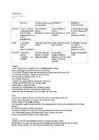
Leidsid 33 sarnast õppematerjali, mis on seotud failiga "Inglise keele passiivi vormid". Need materjalid aitavad sul teemat sügavamalt mõista.
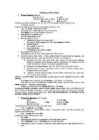
room, cleaned, perfect, present, simple, arrived, hours, already, shall, built, 1895, aunt, looks, nice, finished, lunch, clock, reading, could, might, letters, corner, aktiiv, passiiv, tegusõna, algvorm, forget, forgotten, before, modaalverbidPassive (=passiiv ehk umbisikuline tegumood) This house was built in 1935. Was built on passiiv. Võrdle isikulist (active) ja umbisikulist tegumoodi (passive): Somebody built this house in 1935. (aktiiv house on lauses sihitis (=object)) This house was built in 1935. (passiiv house on lause aluseks (=subject)) Kui me kasutame isikulist tegumoodi (aktiiv), siis ütleme, mida lause aluseks olev isik (subject) teeb: My grandfather was a builder. He built this house in 1935. It's a big company. It employs two hundred people. Kui kasutame umbisikulist tegumoodi (passiiv), siis ütleme, mis juhtub lause alusega: This house is quite old. It was built in 1935. Two hundred people are employed by the company. Passiivi kasutatakse siis, kui tegija on teadmata, ebaoluline või selgub kontekstist: A lot of money was stolen in the robbery. (Keegi varastas selle, kuid me ei tea, kes) Is this room cleaned every day? (Kas keegi seda koristab
7. Verb: The principal forms of the verbs: Verbil on 4 põhivormi: Regular verb Irregular verb 1. the base form Talk Speak üldoleviku tüvivorm 2. the past form/ -ed form Talked Spoke üldmineviku vorm 3. the past participle (-ed Talked Spoken participle) mineviku kesksõna 4. the present participle (- Talking Speaking ing participle) oleviku kesksõna The tenses: Expressing the future: Simple Perfect Continuous Perfect Continuous Present Base Have / has + to be + base+ ing has/ have been +s + pariticiple base+ -ing
Golden Grammar rules 1. Don't use an with own. Sue needs her own room. (NOT Sue needs an own room.) I'd like a phone line of my own. (NOT ... an own phone line.) 2. Use or rather to correct yourself. She's German or rather, Austrian. (NOT She's German or better, Austrian.) I'll see you on Friday or rather, Saturday. 3. Use the simple present play(s), rain(s) etc to talk about habits and repeated actions. I play tennis every Saturday. (NOT I am playing tennis every Saturday.) It usually rains a lot in November. 4. Use will ..., not the present, for offers and promises. I'll cook you supper this evening. (NOT I cook you supper this evening.) I promise I'll phone you tomorrow. (NOT I promise I phone you tomorrow.) 5. Don't drop prepositions with passive verbs. I don't like to be shouted at. (NOT I don't like to be shouted
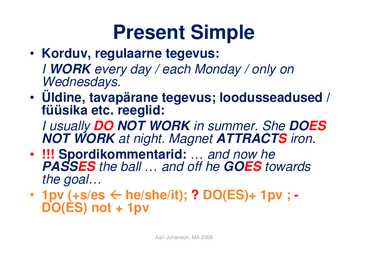
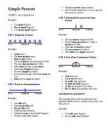
Present Simple · Korduv, regulaarne tegevus: I WORK every day / each Monday / only on Wednesdays. · Üldine, tavapärane tegevus; loodusseadused / füüsika etc. reeglid: I usually DO NOT WORK in summer. She DOES NOT WORK at night. Magnet ATTRACTS iron. · !!! Spordikommentarid: ... and now he PASSES the ball ... and off he GOES towards the goal... · 1pv (+s/es Å he/she/it); ? DO(ES)+ 1pv ; - DO(ES) not + 1pv Aari Juhanson, MA 2008 Present Progressive · Hetkel toimuv, pooleliolev tegevus: S/he IS TALKing on the phone now. I AM READing an interesting book. · Ajutine, regulaarsele ja tavapärasele vastanduv tegevus (tulevikku viitav): This summer they ARE not GROWing cucumbers as usual. They'RE GROWing tomatoes instead. · !!! Halvakspanu väljendus harjumuspärase tegevuse kohta: He IS always COMPLAINing! · BE (am/is/are) + 1pv-ing Aari Juhanson, MA 2008 Present Perfect ON -NUD
Will + infinitive (will go) Am/is/are going to + infinitive (is going to rain) 1.A decision at the moment of 1.Future plans made before the speaking: moment of speaking: A: 'I'm cold'. A: 'We've run out of milk.' B: 'I'll close the window'. B: 'I know, I'm going to buy some.' 2.Prediction based on opinion: 2.Prediction based on present I think the Conservatives will win the evidence: next election. Look at those boys playing football! 3.A future fact: They're going to break the window. He will be ten next year. 4.Promises / requests / refusal / willingness: I'll help you with your homework. Will you give me a hand? 5.In the same way as the future continuous, but with state verbs: I'll be at the station when you arrive. 'Shall' is used mainly in the forms 'shall I
We are going to the theatre. Pane tähele! Kestvat olevikku kasutatakse tegevusverbides (I am dancing, you are eating etc.). Mõned verbid on mitte tegevusverbid, näiteks ei saa öelda I am liking või you are knowing, vaid I like ja you know. Järgmiseid verbe ei kasutata tavaliselt kestvas olevikus. like love hate want need prefer know realise suppose mean understand believe remember belong contain consist depend seem Past Simple Lihtmineviku moodustamine Jaatav vorm Eitav vorm Küsiv vorm I asked I did not ask Did I ask? He/she/it went He/she/it did not go Did he/she/it go? We/you/they made We/you/they did not make Did we/you/they make?
Windows are not made of wood. Simple Present · · New York is a small city. It is not important that this fact is untrue. [VERB] + s/es in third person USE 3 Scheduled Events in the Near Examples: Future · You speak English. · Do you speak English?
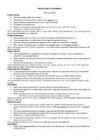
.............................................................................................................................................. 13 Ajavormid Present simple (The earth goes round the sun) Reeglid, absoluutsed tõed Rutiin ja harjumused Püsivad situatsioonid või olukorrad Tabelid, ajagraafikud Present continuous (She is driving to work) Käsil olev tegevus Ajutine tegevus; pooleli olev Ettekorraldatud tegevus tulevikus Ärritus Present perfect (He has lost his key) Sündmus minevikus, tagajärg olevikus Üksik või korduv tegevus, mille aeg ei ole oluline (I have been in the USA)
TENSES. ACTIVE VOICE. 1. Present Simple (üldolevik) I (he, she, it s) he works Eitav,küsiv do (I, you, we, they) he does not work does (he, she, it) does he work? Verbidele, mis lõpevad infinitiivis ss, -sh, -ch, -x või o, lisatakse ainsuse 3. pöördes es he touches, she goes Verbidel, mis lõpevad y-ga, mille ees on konsonant, muutub y->ies
1. Active/Passive Active - the professor teaches the students. Passive - The students are taught by the professor 2. Present Simple [VERB] + s/es in third person. Tegevus on korduv või tavapärane. You speak English. I play tennis. Cats like milk. The train leaves tonight at 6 PM. I am here now. Active= Once a week, Tom cleans the car. Passive= Once a week, the car is cleaned by Tom. 3. Present Continuous [am/is/are + present participle]. Tegevus toimub/ei toimu praegusel hetkel. You are watching TV. You are learning English now. I am studying to become a doctor. I am meeting some friends after work. Active= Right now, Tom is writing the letter. Passive= Right now, the letter is being written by Tom. 4. Past Simple [VERB+ed] or irregular verbs. Tegevus algas/lõppes minevikus täpsel ajal. . You called Debbie. I saw a movie yesterday. I finished work, walked to the beach, and found a nice place to swim
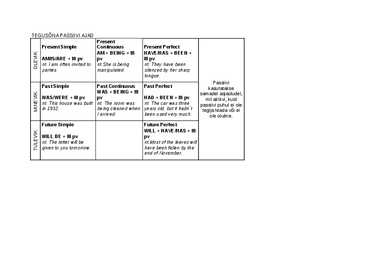
TEGUSÕNA PASSIIVI AJAD Present Present Simple Continuous Present Perfect AM + BEING + III HAVE/HAS + BEEN + OLEVIK AM/IS/ARE + III pv pv III pv nt. I am often invited to nt.She is being nt. They have been parties. manipulated. silenced by her sharp tongue. Passiivi
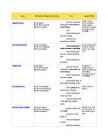
3 TALLEGG 11 MIZDE 4 VESITERM 12 LADA 5 STOW 13 SCHWUNG 6 KALEV 14 MAIASMOKK 7 YAMAHA 15 ISKU 8 ESTRAVEL 2 Affirmative tense Use Signal Words Negative/Questions · action in the present taking always, Present Simple A: He speaks. place once, never or several every ..., N: He does not speak. normally, often, Q: Does he speak? times seldom, · facts sometimes,
The telephone was invented by Bell. NB! The object of an active sentence becomes the subject of a passive sentence. The doer of the action is indicated by a by phrase. When the doer of the action is not important, the ’by phrase’ is omitted: Active: Someone locks the office every evening. Passive: The office is locked every evening. Tenses in the Passive Voice A passive verb is the verb be in the right tense + a Past Participle (PP) • Present Simple: am/are/is + PP The office is locked every evening. • Past Simple: was/were + PP My car was stolen last night. • Future Simple: will be + PP No disciplinary action will be taken against you. • Present Continuous: am/are/is being + PP The house is being painted at the moment. 2 • Past Continuous: was/were being + PP
Has he been working hard? He has not been working har He has worked here since 1987. He always works hard. He is working in his room now. Has he worked here long? Did he work much yesterday? Is he working now? He has not worked here long. He does not work hard. He is not working now. Lihtminevik Kestev minevik Perfekti minevik Perfekti kestev m
They are building a new bridge in our town. 2. Changes happening around now. The population of the world is increasing fast. 3. Arrangements for the future. I am flying to Toronto next Friday. Negative form: We aren't (are not) working at the moment. I am not enjoying this show very much. Question form: Are they playing football in the park right now?Why is she laughing? Signal words: at the moment, now, right now, Listen!, Look! etc. PRESENT PERFECT (täisminevik) Form: have/has + past participle (3. põhivorm) Use: 1. An action in the past, where the fact, not the time, is important. I have been to England four times. 2. An action in the past that has a result now. She has lost her keys. 3. Something that began in the past and still continues now. He has been in hospital since Monday. Negative form: We haven't (have not) done our homework yet. He hasn't (has not) visited his granny since August.
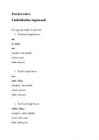
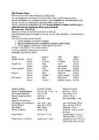
Cali 2005 Was Born Traveled to Europe Husband 1978 School graduates @ Oxford 1999 Started Got married School 1983 2008 2 The Six English Verb Tenses Three Simple Tenses Simple continuous Present You walk. You are walking I run. I am running. Past You Walked You were walking. I ran. I was running. Future You will walk. You will be walking. I will run. I will be running. Three Perfect Tenses Perfect continuous Present perfect you have walked
ni-cíux `He did it long ago.' na-ciúxw-a `He did it recently.' i-cíux `He just did it.' - aspect: He was writing a letter to Tom. He has written a letter to Tom. - mood: He goes to Tallinn tomorrow. He would go to Tallinn tomorrow if he had time. German: the subjunctive Wenn du Zucker hättest, könnten wir jetzt Tee trinken. `If you had sugar, we could drink tea now.' English: They demanded that he leave the room. If I were you, I wouldn't buy this car. - transitivity: sleep, kiss Manam (a Kairiru-Manam language; Malalyo-Polynesian) dang i- aka- gita i water be hot `he heated the water' II. Relational categories for verbs: voice The workers painted the house. The house was painted by the workers. Das Buch wird von zwei Autoren geschrieben. `The book is being written by two authors.' Heute Abend wird viel getanzt
Get/ Have something TENSE ACTIVE PASSIVE WHEN? done Present Simple Am/is/are + Every day, year, often, I pv + do/does Have/ get + sth+ III pv Lihtolevik III pv usually, always Past Simple Yesterday, last year,
PAST TENSES Past Simple Used to talk about a completed past action which happened at a completed time in the past. We went to Tallinn yesterday. I saw him a long time ago. We met last week. Used to talk about a series of events that happened one after another. He walked to school, took off his coat, went to class and fell asleep. Used to report what people said. He said that he was tired. He asked to go home.
Present tenses : 1) Present simple regular actions and routines especially with frequency(kordumine ) adverbs(määrsõna) N: Do you go to school by car every day ? I don't often watch TV. 2)Present continuousbe + verb + ing. Actions happening now N; Look! It's snowing. I'm meeting Jane tonight. You're always losing things. 3)keep + ingto describe habitual actions which may be irritating. N: my uncle keeps making silly jokes. Present perfect: 1) Present perfect simple: have/has + past participle. N: I've been here for ten minutes .The phone has rung ten times today. Look at this cheque,'I've won first prize. They have made a new star wars film. I've just got home. How long have you been here ? Have you ever been to Paris? It's the best book I've ever read. It's the first time I have ever been abroad. 2)Present perfect continious : have/has + been + ing. N:I've been living in this flat since 2000
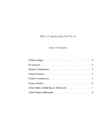
sentences. All students of English, be they native speakers or those who are studying English as a second language, will profit from the fundamental introduction and review of grammar provided by SADDLEBACK'S BASIC ENGLISH GRAMMAR 1 and 2. Helpful marginal notes throughout the books have been provided to reinforce existing skills and call attention to common problem areas. We wish you every success in your pursuit of English proficiency. 1 What is Grammar? 5 The Simple Past Tense 98 Regular and Irregular Verbs 99 Was and Were 104 2 The Capital Letter 6 The Past Progressive Tense 106 The Future Tense 108 Can and Could 112
INGLISE KEELE KORDAMINE TIME CLAUSES Present Simple · Permanent states, facts (Tom works..) · Repeated and habitual actions, routines (She usually goes..) · Laws of nature and general truths (The sun sets in the west) · Timetables and programmes · Sporting commentaries, rewiews (Beckham wins the ball, crosses and Owen scores) · Feelings and emotions (I love Tallinn..) TIME EXPRESSIONS USED WITH PRESENT SIMPLE: usually, often, always, every day/week etc, in the morning/evening
Tests Superstar 1 Luke Prodromou Test 1 Name____________________ Class_______ Use your English 1 Complete these sentences using the correct form (present simple or present continuous) of the verb in brackets. _ 1 She is in a band and she _________________________________ (record) a CD at the moment. _ 2 She is an actress and often _________________________________ (appear) on television. _ 3 At the moment she _________________________________ (have) a rest because she is tired. _ 4 Mike is a doctor and he _________________________________ (live) in Manchester. _ 5 I _________________________________ (start) work at 8.30 every morning.
tense Affirmative/Negative/Question Use Signal Words always, every ..., action in the present Simple Present A: He speaks. never, normally, N: He does not speak. taking place once, never or often, seldom, Q: Does he speak? several times sometimes, usually if sentences type I
on Christmas Day (but at Christmas) We use at in these expressions: at night - at Christmas - at the moment / at present - at the same time - at weekends - at the age of... IN DURING
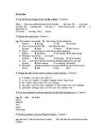
1) Ann is my best friend! We........each other for years A know B knew C knows D have known 2) Nicky........to San Francisco when the accident happened. A flies B has flown C was flying D has been flying 3) Why don`t you let her........her story? A finish B to finish C finishing D have finished 4) Tim........in a cafe at present, but he has already applied for a new job A work B have worked C is working D worked 5) My father........already worked for two years before he went to University. A was B had C has D is 3. Change the order of the words to make a correct sentence. ( 5 points ) 1) I wonder / can / you / me / help / if 2) a / my / to / written / I / mother / already / letter / long / have 3) the / watch / often / they / TV / in / evening
Passive voice Umbisikuline tegumood Kui tegija pole oluline või pole teada. · The Present Simple Passive am is + III pv are Examples: I am watched. A book is read. Marks are given. · The Past Simple Passive was were + III pv Examples: I was watched. A book was read. Marks were given. · The Future Simple Passive will be + III pv Examples: I will be watched. A book will be read. Marks will be given. · The Future Simple Passive in the Past would be + III pv Examples: I would be watched. A book would be read. Marks would be given. · The Present Progressive Passive am is + being + III pv are Examples: I am being watched. A book is being read. Marks are being given. · The Past Progressive Passive was were + being + III pv Examples: I was being watched. A book was being read. Marks were being given. · The Present Perfect Passive have has been + III pv
till the evening after the visit was paid she had no knowledge of it. It was then disclosed in the following manner. Observing his second daughter employed in trimming a hat, he suddenly addressed her with: "I hope Mr. Bingley will like it, Lizzy." "We are not in a way to know what Mr. Bingley likes," said her mother resentfully, "since we are not to visit." "But you forget, mamma," said Elizabeth, "that we shall meet him at the assemblies, and that Mrs. Long promised to introduce him." "I do not believe Mrs. Long will do any such thing. She has two nieces of her own. She is a selfish, hypocritical woman, and I have no opinion of her." "No more have I," said Mr. Bennet; "and I am glad to find that you do not depend on her serving you." Mrs. Bennet deigned not to make any reply, but, unable to contain herself, began scolding one of her daughters. "Don't keep coughing so, Kitty, for Heaven's sake
UNIT 4 4.1 Like and as Kasutame like, et öelda, et asjad on sarnased. He looks like his father. Ametlikumas vormis kasutame as, et öelda, et asjad on sarnased (esineb enne alust) The exam starts at 9.30 as I have already said. Kasutame as, et rääkida ametitest ja töödest, mida inimesed teevad She works as a teacher in a primary school. Kasutame as, kui me viitame informatsioonile, mida nii rääkija kui kuulaja juba teavad As you know, I'm starting a new job next month. 4.2 Narrative tenses 4.2a Lihtminevik Kasutame: et rääkida sündmustest minevikus, mis on nüüdseks lõppenud I went to the zoo last weekend.
Ways of expressing the Future Table of Contents Future Simple ...................................................................... 2 Be going to ........................................................................... 3 Present Continuous .............................................................. 3 Present Simple ..................................................................... 4 Future Continuous ............................................................... 4 Future Perfect....................................................................... 6 Other ways of referring to the future ..................................... 7 Other future references......................................................... 8 Future Simple In Future Simple we use the modal verb will + the verb
at the moment He's working. He isn't working. Is he working? Present to be (am/are/is) + Progressive future meaning: when you have Infinitive + ing Look! I'm going. I'm not going. Am I going? already decided and arranged to do it (a fixed plan, date) Listen! He's going. He isn't going. Is he going? last ... I worked. I didn't work. Did I work? regular: ..
..), siis jäetakse by- fraas ära. Aktiivlause muutmine passiivlauseks: 1. Leiame sihitise ja muudame ta aluseks. 2. Määrame öeldise ajavormi ja asendame ta passiivi vastava ajaga 3. Leiame aluse ja muudame ta eessõna by abil sihitiseks. Example: Jane baked a cake.-active sentence A cake was baked by Jane.-passive sentence Exampple: My bike was stolen. Tence Subject Verb Object Simple Present Active: Rita writes a letter Passiv: A Letter is written by Rita Simple Past Active: Rita wrote a letter Passiv: a letter was written by Rita Present perfect Active: Rita has written a letter
Tenses 27. jaanuar 2012. a. 9:24 SIMPLE CONTINUOUS -ing PERFEFCT PERFECT on alati sees! CONTINUOUS PRESEN I work in school. I am working in I have worked in I have been working T loodusseadused school. school. in school for/since 5 pidev korduv lähituleviku plaanid Surnute kohta EI SAA years. tegevus(hommiku ÖELDA! siiamaani kestab kohvi) aja-graafikud
 annaabi.ee