Leidsid 33 sarnast õppematerjali, mis on seotud failiga "English in my Life". Need materjalid aitavad sul teemat sügavamalt mõista.
english, other, language, here, europe, languages, russian, estonians, quite, speak, even, work, often, times, mother, tongue, commonly, almost, formed, besides, those, good, finland, sweden, latvia, places, important, goes, around, traveling, further, mainly, years, grown, channels, abroad, working, conditions, there, jobs, require, marketing, sportsTallinna Mustamäe Humanitargümnaasium Valeria Jefremenkova ENGLISH AS A GLOBAL LANGUAGE INGLISE KEEL KUI ÜLEMAAILMNE KEEL Research work Supervisor: Jevgenija Kozlova Tallinn 2016 1 Table of Contents СONTENT…………………………………………………………………………………...2 INTRODUCTION…………………………………………………………………………...3
Me and languages. To begin with, language is a congrecation of thoughts and feelings through a system of signals, such as voice sounds, gestures, or written symbols. Communication or language is a process every child learns from birth and during our life we will usually learn many different languages. Due to the fact that both of my parents are Estonians , my mother tongue is Estonian, therefore I can speak and write in it very fluently. I also prefer read the books in Estonian. I know that some people like to do it in some other languages, in English for instance. I am really amused by the Estonian literature. I like to read books and stories from Andrus Kivirähk and F.R. Kreutzwald. English is one of the world most spoken language. You can hear it everywhere, no matter which part of the world are you in. In the third grade of elementary scool I started to
Essey How does the United States influence Estonia? The United States of America with it's global economic and political superpower is one of the most influential countries in the world and therefore it’s influence can also be felt in Estonia. Fluctuations in Estonia’s status as an independent country have had significant impact on the amount of influence from other countries, whether it is the language, eating habits or lifestyle. But how has United States influenced Estonia after we gained our independence? Estonia is not economically dependent on the United States as they are not one of our most important trading partners, but as the economics of the United States has a great influence on the world economy, they can still indirectly have an influence on Estonian economy. In Estonian politics the influence of the United States can be seen the most in relations with NATO
My languages I love different languages. I mean, I really, really love different languages. I also believe and have been told that I pick them up rather easily. That might be true, although I did not pick any Greek up in Greece but that might have been because they spoke so damn fast that I could not tell if it was a word or an entire sentence. The first foreign language I learned was Russian. Considering I was ten when Estonia became a Republic, it makes sense. We began studying Russian in first grade, though it was simplified – "koška" instead of "kot", "medvešonok" instead of "medved", "saichik" etc. Did not make much sense and we mostly played some games in Russian (Tare-tareke etc). Learned as much playing outside, since we had Estonian-Russian kids around as well. Not that we played with them. It's sad to say but it was not a nice time to be a Russian kid
Roman politician, philosopher & translator. Theory ‘‘word-for-word’’ & ‘‘sense-for-sense’’. • Martin Luther – his role in the history of translation studies. Lived during the 15th century. He was a priest, theologian & translator. During that time, the Bible’s were only available in either Latin or Hebrew, which made it very difficult for common people to understand. He came out with a radical plan to translate the Bible into local languages (the first language was German – translated by Martin Luther). This inspired many other translators during that period. • What happened in the 19th and 20th century in translation studies? When and who created the term ‘translation studies’? Translation Studies – James S. Holmes - 1972 Ferdinand de Saussure – Lived during the 19th and 20th century. He was a Swiss linguist and a semiotician. He is widely considered one of the
Tallinn English College Topic Estonia Tallinn 2008 1. Introduction Estonia is a small country about the size of Switzerland, or New Hampshire and Massachussetts combined. Estonia is named after the people called "Ests" who lived in the region in the 1 st century AD. The Republic of Estonia is one of the three countries commonly known as the "Baltic States". The other Baltic States are Latvia and Lithuania. 2. Geographical position Estonia is situated in northeastern Europe. Estonia is bounded on the north by the Gulf of Finland, on the east by Russia, on the south by Latvia and on the west by the Baltic Sea. In the north it borders on Finland. The coastline of the Baltic Sea in Estonia is characterized by numerous gulfs and bays, the biggest of them being the Gulf of Finland, the Gulf of Riga and the Gulf of Pärnu. Bays include the
To Protect or not Protect Minor Languages Minor language is a language that is spoken in a minor area in a territory. For example Estonian is a minor language, because it has so little amount of speakers, just over a million comparing to German that has at least 100 million native speakers. Many minor languages have been mixed together or been developed from other languages. I think that the minor languages should be protected, because with languages come with a part of culture and if we terminate the variety of cultures that have developed throughout the evolution of mankind then the world would be boring. There would be no languages to learn, no foreign songs to sing and no joy of knowing that you can speak to a foreigner in his mother tongue. Also people are more friendly and open to you if they can speak freely in their mother language. But not protecting the minor languages can also be a good thing. As we know the world is
Private School of Audentes Links between English speaking countries and Estonia Author: Kristin Liiv Supervisor: Mari Martma Tallinn 2006 2 Table of contents Introduction..........................................................................................................................4 First links............................................................................................................................. 5
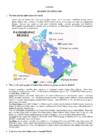
REVISION QUESTIONS 2010 1. The main physiographic regions of Canada. Canada may be divided into seven physiographic regions: Arctic Lowlands, Cordilleran Region, Interior Plains, Hudson Bay Lowlands, Canadian Shield (Forest Lands), St Lawrence Lowlands and Appalachian Region. Divisions are based on each area's relatively similar physical geography and landforms. Physiographic regionalization is defined here as the process by which regions with relatively homogeneous physical geography are determined 2. Who are the native people of Canada? Into which three groups can they be divided? Canada's constitution specifies three categories of aboriginal peoples: Indian (First Nations), Métis, Inuit. According to Canadian census 2011, 1.4 mln people of Aboriginal origin (4.3%): 852,000 First Nations persons, 452,000 Métis, 59,000 Inuit.
They say it's unimaginable, boring, tasteless, it's chips with everything and totally overcooked vegetables. The basic ingredients, when fresh, are so full of flavour that British haven't had to invent sauces to disguise their natural taste. What can compare with fresh pees or new potatoes just boiled and served with butter? Why drown spring lamb in wine or cream and spices, when with just one or two herbs it is absolutely delicious? If you ask foreigners to name some typically English dishes, they will probably say "Fish and chips" then stop. It is disappointing, but true that, there is no tradition in England of eating in restaurants, because the food doesn't lend itself to such preparation. English cooking is found at home. So it is difficult to a good English restaurant with a reasonable prices. In most cities in Britain you'll find Indian, Chinese, French and Italian restaurants. In London you'll also find Indonesian, Mexican, Greek..
1) Standard and non-standard varieties of English Standard varieties of English are the varieties of the English language that are considered to be a norm and are spoken and written by the minority (educated people). This is the optimum for educational purposes. The standard varieties of English are: BrEng (British), EngEng (English), NAmEng (North-America), USEng (United States), CanEng (Canada), AusEng (Australia), NZEng (New Zealand). Standard English (British English) is the most widely accepted and understood among native speakers, learned by foreigners. It is used in broadcasting, TV, news etc. It doesn't concern pronounciation (accent), but grammar and vocabulary. It includes formal and informal styles. British Standard English grammar and vocabulary, together with the RP accent should be called English English. RP (Received Pronounciation) is an accent that originates from South-East of England. A
influence. Juri Fiodorovitsch Samanarin, for example, strove to explain to the Russians its mission and identity as the ruling people, not merely a minority, 1 Johann Renner, "Liivimaa ajalugu 1556-1561" (Tallinn: Olion, 2006), 2-13. and to show to the native peoples that they were second rate citizens. Jefgraf Vassilievitsch Tscheshikhin also displayed such partiality when he wrote, "There can be no place in Russia . . . for any patriotism other than Russian patriotism."2 Their and other histories raised the place of Russians to that of victor and liberator, contrary to the truth that this was not always the case. This rewriting of history occurred again during the Soviet period, when de facto control of Estonia was in Russia's hands. When Estonia became an independent nation in 1918 (1920 from the perspective of some people, such as Russians), and again in 1990 (1993 from the perspective of some people, such as Russians), Estonians had the
SOCIETY AND CULTURE OF ENGLISH-SPEAKING COUNTRIES Introduction 1. Nowadays, English is so widely spoken that it can hardly be considered "a one nation's" language. The main countries where English is spoken are: the U.K, the U.S, Canada, Australia, the Republic of Ireland, New Zealand, West Indies 2. There are approx. 300-400 million speakers of English in the world. English occupies the 3rd place by its number of speakers; it is right behind Mandarin and Spanish. 3. ESL (English as a Second Language) used in your own country (e.g. India) EFL (English as a Foreign Language) used in a foreign country ESP (English for Specific Purposes) used in business, airlines, hotels etc. 4. Settlement colonies people migrated into them from Britain and started their own
warehousing and communications, commerce and estate, rental and letting, as well as business services, agriculture, construction and government, education and health care. In order to be able to import all the products and services, something must be exported, that's why export holds such a prominent position for the Estonian economy and its growth. A couple of generations ago agriculture was the main occupation of the Estonians. Nowadays only about 4% of the workforce is engaged in agriculture. The 1990s was a hard time for agriculture competition with cheap imported products became an issue, enterprises had no money for new equipment and vehicles. Although today the situation in agriculture isn't perfect, some enterprises, including farms who use modern production methods, have cropped up. Joining the European Union has had a positive effect on Estonian agriculture as
ESTONIAN BUSINESS ENVIRONMENT Estonia is a country with the population of just a little over 1.3 million people. It has been estimated though, that by the year of 2040 the number will have decreased by 125,000 people. It means that the population of Estonia is decreasing. As young Estonians often like to go study or live abroad, the population is aging as well – young people move away, while older stay there. Many different nationalities live there: besides Estonians there are Russians, Ukrainians, Belarussians, Finnish, Tatars, Latvians, Poles, Lithuanians, Jews, Germans and others. Due to this fact, the most popular languages spoken as a mother language are Estonian, Russian and Ukrainian. Nevertheless, there is still just one official language of
· How do they differ? · Which extracts are examples of formal letters? · How is the reader addressed in a formal letter? · What are the closing remarks for formal letters? · What is the salutation in a friendly letter? · How would you end extracts 1,2,3 ? · How would you begin the extracts 4 and 5? 1. Dear Mr Miller, I received your kind invitation to the reception. Unfortunately, owing to other commitments. I will be unable to attend ... 2. Dear Ralph, l just got your invitation to the company's event. l `m afraid I can't make it because I've a/ready made plans which l can "t change ... 3. Dear Sirs, I am writing to complain about the poor quality of the items which I received from your company. I have no other alternative but to cancel the order which 1 placed earlier this week ... 4. ... thus, I recommend that you accept this advice on the matter
Me and languages Nowdays it is very common that one person can speak more than one language. There are people who have to learn different languages at school and people who do it , beacause they want to educate themselves. I think that every person should speak at least 3 languages. My mother tongue is Estonian. I can speak and write it very fluently. I like to read books in estonian and listen songs in Estonian. I know some people who prefer to do it in English. But for me it is more enjoyable to do it in my mother tounge. English is one of the most common languages in the world. Therefore it is very important to speak it. I started learning English in the third grade like most of the students. Before the lessons at school I had already learned the basic of English. My sister is older than me and I was really interested in studying with her. Also very helpful things were cartoons and hollywood films. In everyday life I use English very
As there would not be any duplicating, allowing much faster development of new technologies and faster production. In addition recourses would not pile up in one place because they would be diverted to places where the need is greatest. But there is a downside to a world government. Through unification of people and countries, smaller nations would lose their identity. It means smaller nationalities would simply fade away, they would be dissolved. Because the influence of other cultures would be too great. A world government is necessary if we wish to thrive in the future. Although it comes with the cost of losing the identity of smaller nations. Problems of 21th century city The cities of the 21th century are the biggest mankind has created besides incorporating newest technological innovations, however, even despite all the advanced technological applications, modern metropolises have many of the same problems as cities 200 years ago.
Society and culture of english-sspeaking countries Introduction 1. The countries of the world where the English language is spoken. 2. Approximate number of mother tongue speakers of English approximately 350-400 million native speakers. Which place does English occupy in the world by its number of speakers?After which language? English occupies second place by its number of speakers after Mandarin Chinese. 3. What is the difference between English as a Second Language, English as a Foreign Language and English for Specific Purposes? Give examples of situations where they are used. English as a Second Language (ESL or TESL) is a traditional term for the use or study of the English language by non-native speakers in an English-speaking environment. That environment may be a country in which English is the mother tongue (e.g., Australia, the U.S.) or one in which English has an established role (e.g., India, Nigeria)
English structure revision for the exam 1. Terms Language → A systematic, conventional (tavakohane) use of sounds, signs or written symbols in a human society for communication and self-expression. Human language at all levels is rule- or principle- governed (valitsema) meaning that language corresponds to the grammar. Natural language is usually spoken, while language can also be encoded into symbols (such as letters, morse etc) For example: Estonian, English. Linguistics → The scientific study of human natural language. Broadly, there are three aspects to the study which are Pragmatics (studies the use of language → interested in the gap between the sentence’s meaning and the speaker’s meaning). Semantics (concerned with the meaning of the language aspects and the way they change, also how objects and language and thinking and language are related).
http://www.tandfonline.com/loi/rmps20 When `we' are `the other'. Travel books on Romania as exercises in intercultural communication a Rodica Dimitriu a Department of English , Alexandru Ioan Cuza University of Iaþi , Romania Published online: 06 Aug 2012. To cite this article: Rodica Dimitriu (2012) When `we' are `the other'. Travel books on Romania as exercises in intercultural communication, Perspectives: Studies in Translatology, 20:3, 313-327, DOI: 10.1080/0907676X.2012.702400 To link to this article: http://dx.doi.org/10.1080/0907676X.2012.702400 PLEASE SCROLL DOWN FOR ARTICLE
'How are you?' Very often people expect you to say something positive. Here's a breakdown of how you can express how you really are without complaining too much. · Fine, thanks. / On top of the world, thanks. · OK, thanks · Not so bad, thanks. / Can't complain, thanks. · So so, thanks. / So and so, thanks. · Not so good, actually 1 The English alphabet Spelling Work with your partner and spell out first your name and then some names of places. Write down each letter as you hear it, and then say the word. The English alphabet on the phone: You might find the following alphabet (used by international airlines) useful when trying to spell a word on the telephone. A Alpha O Oscar Ä Alpha-Echo Ö Oscar-Echo
again to keep the noise down. between Paul and Joe. 1D Sporting origins page 67 2 She recognised him at once. 2 Phobias can be genetically 3 He's working at his father's shop inherited. 1 1 staunchly / resolutely for the time being. 3 When it comes to politics, 2 By and large 4 They'll be here any moment now. Edward and his dad have a lot in 3 swiftly 5 Everybody makes mistakes once common. 4 loosely in a while. 4 Luke is the spitting image of Matt 5 categorically 6 My brother was still a baby at the Damon. 6 widely time
Estonia. Estonia, officially the Republic of Estonia is a country in Northern Europe. It is the smallest of the three Baltic countries. Estonia has land borders with Latvia (339 km) to the south and Russia (229 km) to the east. It is separated from Finland in the north by the narrow Gulf of Finland and from Sweden in the west by the Baltic Sea. Estonia has been a member of the European Union since May 1, 2004 and of the NATO since March 29, 2004. The area of Estonia is about 45000 square kilometres and the population is about 1.4 million people
Style The term style is a polysemantic one. The latin word ,,stilus" meant a writing instrument used by the ancients for writing on waxed tablets. Already, in classical latin the meaning of style was extended to denote the manner of expressing one's ideas in written or oral form. One of the abts/the best was given by Jonathan Swift: ,,Proper words in proper places." In present- day english, the world style is used in about half a dozen basic meanings. 1. the characteristic manner in which a writer expresses his ideas. Some speak about the style of Hemingway, Dickens etc. 2. the manner of expressing ideas, characteristic of a literary movement or period. Style of symbolism, romanticism 3. the use of language to pick a literary genre-comedy, novel, drama, O.D (poetic form) etc. 4
Although the extremely vigorous period of economic reforms is now over, the changes that Estonia is presently going through are far more extensive than those in the developed countries. The Estonian economy is diverse industry and transport, as well as commerce and different branches of services are all equally important. Due to the available natural resources Estonian economy largely relies on the branches related to the forest; Estonian energy sector is based on oil shale, a resource quite rare elsewhere in the world. Finland and Sweden are the most important trade partners. The Estonian economy profits significantly from the business generated by more than 2 million tourists a year, most of whom come from Finland. More than 67% of the Estonian GDP is derived from the service sectors, industrial sectors yield over 28% and primary branches (including agriculture) approximately 5.5% of the overall output.
backpacking. Backpacking is instead extended to an ongoing lifestyle practice that on a micro level provides both a unique sense of self to its practitioners and on a macro level comprises a distinct and recognisable social identity. Lifestyle travel in a broader sense can take on different forms, whether, for instance, through backpacking, ocean yacht cruising (Macbeth, 2000) or caravanning (White & White, 2004). What these forms of travel have in common that distinguishes them from many other lifestyle choices is sustained physical mobility. Whilst social scientists dispute just how ‘new’ mobilities are to our lives (Creswell, 2010; Sheller & Urry, 2006), less disputable is that globalisation, with mobility as a crucial characteristic, is leading to different ways of understanding identities and relating to place. As such, the current paper not only contributes the first empirical material to advance past
ENGLISH IN MY LIFE The British, defeated Bonaparte at the battle of Waterloo and peace settled across Europe after many years of war, the defeat of France saw the rise of Britain upon the world stage and the beginnings of the wholesale export of the English language across the globe, in the last century Britain an America again defeated tyranny in Europe the English language has evolved through popular culture , movies, music , sport , business and especially with the shrinking of the world through use of the internet to become what it is now a truly international language. Here in Estonia with our history of domination by foreign powers the last being the former soviet union an having our own language suppressed an languages imposed on us , it is a relief to see the importance of the English language an people have embraced it as a second language of Estonian
References: Kahny, Jim. Classroom dynamics: An interview with Jill Hadfield. Available at http://ltprofessionals.com/journalpdfs/vol1no1/features/winter2000kahny.pdf accessed 27.12.2012 ESOL Teaching Skills TaskBook. Classroom dynamics: unit 1 a). Available at http://akoaotearoa.ac.nz/download/ng/file/group-4/n2431-esol-teaching-skills- taskbook-unit-1-a---classroom-dynamics.pdf accessed 27.12.2012 III Language teaching methods. · (Traditional: the grammar-translation method/ classical method.) · Traditional: the direct method Youtube: http://www.youtube.com/watch?v=XiQvG-fvzLM Kids lesson (direct method) Language is primarily speech Reading skills are developed through practice with speaking Realia is used to convey the meaning Demonstration instead of translation or explanation Complete sentences instead of vocabulary lists The purpose of language learning is communication
giant of Africa. In the last 32 years, I have watched with horror and outright helplessness as the downward slide of the African race continues to escalate. But rather than address the problems, we resort to blaming the Caucasians, Asians and others for our misfortune. We are not men enough to accept responsibility for our actions. Africans blame either the British, French or little Portuguese/Spanish for their problems. Africans in America blame the Caucasians for all their problems, or any other ethic group they have allowed to take over their neighbours, a frequently recurring phenomena. Africans blame the International Monetary Fund, the World Bank, the Group of 7, the former colonial masters for the abject poverty in our respective countries. We blame the wars ravaging several African sectors on the interference of our former colonial masters on “our internal affairs.” Ha! – some kind of independence!
hundred performers appeared at more than ten stages. The selection of music varies from jazz to rock and disco. It is a great Estonian party which cannot be found anywhere else in the world. Estonian Song Festival (Laulupidu) The AllEstonian Song Festival (Laulupidu) happens in Tallinn every five years, and gives a privileged insight into Estonian music and culture. Its aim is to bring together all the traditional songs and singers from across the country, as well as guest singers from other countries. The first AllEstonian Song Festival was held in 1869 in the town of Tartu , near the centre of Estonia. Around 870 singers took part, along with 76 musicians. Things have changed a lot, and today, the average festival gathering involves 25,000 participants, including large, joint choirs from all over Estonia
My Town I live in Tallinn. It's the capital and main seaport of Estonia. Tallinn is a very beautiful city that lies on the Baltic Sea. It covers 158 square kilometres. The Mayor of Tallinn is Jüri Ratas. The population of our capital is about 400000 people. About 55% of them are Estonian, 37% Russians and the other 8% are from different nations. The people here are mostly engaged in industry- mainly the food industry (23%), trade (16%) and transport and communication (14%). History. Tallinn has a great history. It was first marked on a map of the world by the Arab geographer al-Idrisi in 1154, its name then being Kolyvan. In the 13 th- century chronicle of Henricus de Lettis the town was called Lyndanise. Then it was called Reval for some time and finally Estonians started to call the town Tallinn from
As both asian and European markets use the internet more and more to conduct business, there will be an increasing need for language choice for the different markets.English is so often used on the internet that it might make you think everyone in the world speaks English, or at least give you the impression that it is the worlds most widekyspoken language.If this were true, it would, off course, bring benefits for worldwide communication and understandig, thought it could also possibly become a threat to cultural diversity.English certainly seems to be everywhere, from films to pop music and TV, and from 15 business to science and other fields. Information varies, but suggests that about 75% of the pages on the web are in english.Yet English is the mother tongue for only 5,4% of the worlds population,
 annaabi.ee