Leidsid 33 sarnast õppematerjali, mis on seotud failiga "Dog Communication". Need materjalid aitavad sul teemat sügavamalt mõista.
dogs, other, position, communication, part, body, different, express, mean, tail, usually, shows, sign, kristjan, comes, variety, forms, foundation, social, behaviour, bodies, emotions, things, excitement, happiness, anxiety, ritual, meets, another, walk, around, even, bark, something, attention, mouth, expressions, inform, tongue, stamp, legs, exitedBody language Body language means communication with the movement or position of the human body. It can be conscious or unconscious. It is something that is noticed by everybody but is not always given enough attention. We sometimes ignore it and try to hide behind words, but we should never forget that we cannot fool everyone! Children react to body language because they experience the world through intuition. The same can be true for adults when feelings are involved. People who are in bad shape emotionally will often place great importance in it. In fact, they often pick up the smallest hint of a lapse in attention in the person they are speaking to. And they frequently jump to the conclusion that they are boring or a nuisance - thus compounding any sense of depression or poor self-esteem.
English structure revision for the exam 1. Terms Language → A systematic, conventional (tavakohane) use of sounds, signs or written symbols in a human society for communication and self-expression. Human language at all levels is rule- or principle- governed (valitsema) meaning that language corresponds to the grammar. Natural language is usually spoken, while language can also be encoded into symbols (such as letters, morse etc) For example: Estonian, English. Linguistics → The scientific study of human natural language. Broadly, there are three aspects to the study which are Pragmatics (studies the use of language → interested in the gap between the
Many modern programming languages now support OOP. Class Defines the abstract characteristics of a thing (object), including the thing's characteristics (its attributes, fields or properties) and the thing's behaviors (the things it can do, or methods, operations or features). One might say that a class is a blueprint or factory that describes the nature of something. For example, the class Dog would consist of traits shared by all dogs, such as breed and fur color (characteristics), and the ability to bark and sit (behaviors). Classes provide modularity and structure in an object-oriented computer program. A class should typically be recognizable to a non- programmer familiar with the problem domain, meaning that the characteristics of the class should make sense in context. Also, the code for a class should be relatively self-contained (generally using encapsulation). Collectively, the properties and
signals could not be easily recognized. The NGOs concerned publicized the study and then, with the help of supporters, by the way of legislative initiative proposed a law draft prohibiting breeding, sale and import of pit bulls, Rottweilers, and close mixes of both. The parliament of Member State A ordered an additional scientific study, which largely confirmed the statistics. It also noticed, “Children are normally at greatest risk from dog bite because they play with dogs more often, have less experience in reading dog behavior, are more likely to engage in activity that alarms or stimulates a dog, and are less able to defend themselves when a dog becomes aggressive”. Scientific studies in dog psychology were not conclusive on direct causation between a dog breed and aggressiveness. They pointed out other influential factors such as individual character and disposition of an animal, resulted, among other things, from its training, living surroundings etc.
It is a specialized area of the Engl lg learning and teaching largely attributed to non-native English speakers Aim to enhance their chances of doing business with companies from English speaking countries. BE can refer to the study of business Engl voc used in the fields of trade, business, finance, or international relations. If the study focuses on techniques on business presentations, negotiations, correspondence, writing and other skills needed for business communications, then it can be classified as the study of Business English communication skills in the workplace. Both are important and used usually together. Culture. Barriers to Intercultural communication Synergy (from Greek for "working together") means that the combined effect is more than the effect of the sum of the individual parts. Culture: Could refer to literature, music, art. Here: refers to the system of shared attitudes, beliefs, values and behavior.
3. the use of language typical of a literary genre (e.g. the style of a comedy, drama, novel). 4. the selective use of language that depends on spheres / areas of human activity (e.g. style of fiction, scientific prose, newspapers, business correspondence, etc.). STYLISTICS Stylistics is the study of style. The very term "stylistics" came in more common use in English only some 45 years ago. Stylistics is a part of style; it studies principles of selecting and using different linguistic means (grammatical and phonetic) that serve to render shades of meaning. The Stylistics of language studies stylistic devices and expressive shades of linguistic units (words, construction of phrases). The Stylistics of speech studies individual texts viewing the way the message or content is expressed.
apposition a grammatical construction in which two usually adjacent nouns having the same referent stand in the same syntactical relation to the rest of a sentence (as the poet and Burns in “a biography of the poet Burns”) back-reference In grammatical analysis, the term reference is often used to state a relationship of identity which exists between grammatical units, e.g. a pronoun 'refers' to a noun or noun phrase. When the reference is to an earlier part of the discourse, it may be called a 'back-reference' (or anaphora); collective noun Collective noun is the name we give to a group of nouns to refer to them as one entity. A crew of sailors. A flock of birds. A range of mountains. conjunction any member of a small class of words distinguished in manylanguages by their function as connecto rs between words, phrases,clauses, or sentences, as and, because, but, however. content words Content words are words that have meaning
Psychology Gleitman Blood flow in the brain during different activities: the rate of blood flow is measured by special radiation counters that are placed at various points of the skull and that monitor radiation from mildly radioactive gas injected into the bloodstream. Blood flow pattern depends on what the patient does ( different pattern is found when person is reading aloud, yet another when he watches a moving light and so on). Ambiguous sights and sounds: The way ambiguous figures are perceived often depends on what we have seen just before. For example, if we are first shown an unambiguous figure of a rat, the ambiguous picture will be seen as a rat. If we are first exposed to an unambiguous face, we see the ambiguous figure as a face. What holds for visual patterns also holds for language
These are called functional styles or registers (fiction, newspaper) Stylistics is the study of style. However, for some reason, English stylistics is less developed than French, German or Russian. The term ,,stylistics"came into more common use in English only some 35 years ago. It was recorded much earlier; in 1882 as "the study of literary style, the study of stylistic features" Stylistics is a branch of linguistics that studies principles of selecting different linguistic means for passing on thoughts and emotions. It studies: · Different functional styles, styles of genres, individual styles · Expressive, emotional features of different language units Stylist--a writer or a speaker skilled in a literary style Stylistition--a scholar who studies stylistics The word "style" is applied to many things. A linguistic style is a variety of subsystem of lg with its peculiar vocabulary, phraseology, grammatical and phonetic features that are
language, diachronic approach to language, linguistic competence, linguistic performance, what is grammar?, prescriptive grammar vs. descriptive grammar; phonology, phonetics, phone, allophone, phoneme; morphology, morphemes (types of morphemes), morphs, allomorphs, types of affixes, derivational affixes, inflectional affixes; open vs closed class words; syntax. Language: a systematic, conventional use of sounds, signs or written symbols in a human society for communication and self-expression. - human language at all levels is rule- or principle-governed. Linguistics: the scientific study of human natural language Synchronic approach to language: Diachronic approach to language: Linguistic competence: Linguistic performance: What is grammar?: "The sounds and sound patterns, the basic units of meaning, such as words, and the rules to combine them to form new sentences constitute the grammar of a language" Prescriptive grammar vs
Stylist is a writer / speaker skilled in a literary style (e.g. Hemingway is considered a peculiar stylist used a lot of repetitions). Stylistician is a scholar (a student). Style is applied to many things: clothing, architecture, hairstyles, etc. A linguistic style (style in language) is a variety of subsystems of language with its peculiar vocabulary, phraseology, grammatical and phonetic features that are used selectively to express ideas in a given situation. Stylistics is a part of style; it studies principles of selecting and using different linguistic means (grammatical and phonetic) that serve to render shades of meaning. Stylistics studies different styles (4) and expressive emotional evaluative features of different linguistic units. Stylistics of language and of speech is not the same. The Stylistics of language studies different
Japanese festivals Japanese festivals are traditional festive occasions. Some festivals have their roots in Chinese festivals but have undergone dramatic changes as they mixed with local customs. Some are so different that they do not even remotely resemble the original festival despite sharing the same name and date. There are also various local festivals (e.g. Tobata Gion) that are mostly unknown outside a given prefecture. It is commonly said that you will always find a festival somewhere in Japan. Matsuri is the Japanese word for a festival or holiday. In Japan, festivals are usually sponsored by a local shrine or temple, though they can be secular.
species as can be imagined and any serious consideration of their cognitive, social and general mental faculties deemed futile. I can give example about sheep memory. Every summer, just about time when apples are cooked, my mothers sheep flock goes to find appletrees. They could go there every season and after winter in barn it would be obvious that they wouldnt even remeber but they do. What senses do you think sheep has? Sensory discrimination abilities and their uses Sheep like other species have adapted thier senses to achieve remarkable discrimination skills. These allow them to identify importnant individuals and objects in their environment and communication of social signals. Popular belief tends to emphasise the absolute importance of smell for sheep in line with many other mammals, however as we shall see this another misconception with all three major senses playing essential roles. Vision Sheep depend heavily on their vision
Cats C.Karus 2015 Cat independent Free Graceful the cat will always fall on his feet If the host has / owns a dog, a cat owns the master where the head goes through, there also goes the body through History It is known that people have been living with cats harmonically since 3000 BC in Ancient-Egypt. Cats, living along with humans, started to have sympathetic connection with humans. Probably thanks to cats' usefulness in protecting food, ancient Egyptian started to treats cats as saint animals. Cat was called "miw". Egyptian mourned and embalmed dead cats. They also made special wooden coffins for cats. Cat expressions Friendly
Cats C.Karus 2015 Cat independent Free Graceful the cat will always fall on his feet If the host has / owns a dog, a cat owns the master where the head goes through, there also goes the body through History It is known that people have been living with cats harmonically since 3000 BC in Ancient-Egypt. Cats, living along with humans, started to have sympathetic connection with humans. Probably thanks to cats' usefulness in protecting food, ancient Egyptian started to treats cats as saint animals. Cat was called "miw". Egyptian mourned and embalmed dead cats. They also made special wooden coffins for cats. Cat expressions Friendly
............................................................24 Identification with Things........................................................................25 The Lost Ring...........................................................................................26 The Illusion of Ownership........................................................................29 Wanting: The Need for More....................................................................31 Identification with the Body.....................................................................33 Feeling the Inner Body.............................................................................34 Forgetfulness of Being.............................................................................35 From Descartes's Error to Sartre's Insight...............................................36 The Peace that Passes All Understanding................................................37
AMBER AND RUSSET - LATE COLOUR CHANGE GENES Copyright 2014, Sarah Hartwell The ancestors of the domestic cat were nondescript black/brown striped tabbies. Over the centuries, mutation produced a wide array of colours based on 2 different pigments. Eumelanin gives the blacks, browns and blues while phaeomelanin gives the reds, fawns and creams. A few other genes give further variations on those colours such silvers, colourpoints and solids/selfs. Mutations continue to occur and unexpected colours also turn up due to inbreeding where recessive genes, hidden for generations, start showing up. AMBER AND LIGHT AMBER During the 1990s, some purebred Norwegian Forest Cats in Sweden produced chocolate/lilac and cinnamon/fawn offspring. However, those colours are not found in the purebred Norwegian Forest Cat gene pool
"Not that he deserves any sympathy. The man's an ass." "Nothing of the kind. A most intelligent young man, as young men go." "Young? Would you call him young? Fifty, I should have said, if a day." "Are you out of your senses? Heacham fifty?" "Not Heacham. Smithers." 4) "Are you employed on a farm?" "I was employed on a farm." "Pigs?" said Lord Emsworth in a low, eager voice. "Among other things." Lord Emsworth gulped. His fingers clutched at the tablecloth. 5) "Hullo, guv'nor" "Well, Frederick?" "How are you feeling?" "Extremely ill." "Might have been worse, you know." "Bah!" "Watery grave and all that." "Tchah!" 6) "I'll er I'll think it over, McAllister." "Mphm." "I have to go to the village now. I will see you later." "Mphm." Meanwhile, I will er think it over." "Mphm." 7) "Well, McAllister
earth. The Dingo Fence is a barrier that was built in Australia during the 1880s and finished in 1885.This fence was built only on one purpose: to stop dingoes (Australia’s wild dogs) from killing sheep. It is one of the longest structures on the planet, and the world's longest fence. it’s 3,307 miles long. That makes about 5,320 km. That is about two and a half times longer than the Great Wall of China. The fence starts near the coast of Great Australian Bight and ends up in the eastern part of Queensland in the Bunya Mountains, not far from the Pacific Ocean. At the time, it was the longest man-made structure in the world. It was only partly successful; Dingoes can still be found in parts of the southern states to this day, but although the fence helped to reduce losses of sheep. The fence is 2 meters high and it extends about 30 cm underground to keep the dingoes from digging under it. There is a gate approximately every 19 km s.
Today Australia is a modern developed country with a diversified economy. Australia is an island continent of 7.7 million square kilometres, which makes it a little smaller than the USA. Located in south of Asia, between The Pacific and Indian Oceans, Australia is the World's driest continent. Although large areas of the centre are desert, Australia has a wide range of climate from tropical in the north to temperate in the south east, where it frequently snows in winter. Geographical position The coasts of Australia are surrounded by the Pacific Ocean, the Indian Ocean and the Southern Ocean. Four seas are surrounding Australia, which are the Timor Sea and Arafura Sea in the north of Australia, the Coral Sea in the north-east of Australia and the Tasman Sea, near the island of Tasmania, in the south-east of Australia. Government The full name of the county is the Commonwealth of Australia. Its territory is 7.7 million square kilometres and population is about 19.7 million.
Vocabulary: to criticize - tasteless overcooked - ingredient - to invent - sauces - to disguise - spice herb - delicious - disappointing - to lend cuisine British Youth (2) Most 18 and 19 year-olds in Britain are quite independent people. English people say that children grow up more quickly now. Relationships within the British family are different now. Children have more freedom to make their own decisions. For example, children aged 13 may be employed part time in Great Britain. Age 15 is legally a "young person" not a "child". Age 16 is a school leaving age. They can leave home, drive a moped, marry with "parents' consent" buy beer. Age 17 can drive a car. Age 18 can vote, get married, drink in pubs. Education is a very important part in the life of British youth. One can't become an independent person without it. When time comes to enter a college a young Englishman chooses one far away from home. It is a necessary part of becoming adult.
The late 19th and and early 20th centuries witnessed a utilitarian approach to stylistics. The tendency to regard stylistics as an applied science has been particularly marked in english- 1 speaking countries. It was believed here that the main aim of stylistics is to improve the style of the writer and of a textbook, that is to show how better to express one's thoughts. Of foreign linguists, it is the french Ch.Balley, G.Marduzeon who in the 20th century made a definite contribution. This happened because of the centuries-old tradition in France of interest in style. The classical works on english stylistics are those by the german scholars: Ph.Aronstein, M.Deutschbein, I.Galperin. In the 50's and 60's of the previous century there was a rapid growth of interest in stylistics throughout the word. In the 70's and 80's, the
ideas. 40. Science is like country music--those guys can't resist a clever turn of phrase. 41. Some of the worst warmongers are frustrated peacemakers. 42. Stuff that's "over your head" is only a problem if you don't look up. 43. Technology should be made idiot-proof but it should not thereby be made genius-proof. 44. The bullshit isn't all in one place. 45. The fact that there's demand for your stuff does not mean that it's true, beautiful, or ethical. 46. The heart must go out but it must not bleed. 47. The mind must be used to navigate through the complications of the mind. 48. The only animal in the forest that deserves to be hunted is the hunter. 49. The only real superpower is the power to pay attention. 50. The only thing wrong with strong epithets is their misapplication. 51. There's a stupid way of thinking that would make doing the right thing contingent on
Philosophy of Language Philosophy of Language: a Contemporary Introduction introduces the student to the main issues and theories in twentieth and twenty-first-century phi- losophy of language, focusing specifically on linguistic phenomena. Topics are structured in four parts in the book. Part I, Reference and Referring, includes topics such as Russell's Theory of Descriptions, Donnellan's distinction, problems of anaphora, the description theory of proper names, Searle's cluster theory, and the causalhistorical theory. Part II, Theories of Meaning, surveys the competing theories of linguistic mean- ing and compares their various advantages and liabilities. Part III, Pragmatics and Speech Acts, introduces the basic concepts of linguistic pragmatics,
LEXICOLOGY 1. Size of English vocabulary 1) Old English – 50,000 to 60,000 words Vocabulary of Shakespeare OE – homogeneous; 1/3 of the vocabulary has survived • 884,647 words of running text About 450 Latin loans (Amosova) • 29,000 different words (incl. work, working, Viking invasions added 2,000 worked, which are counted here as separate 2) Middle English – 100,000 – 125,000 words) English becomes heterogeneous (Norman French, • 21,000 words English, Latin), hybrid of Germanic and Romance languages Norman French influence – about 10,000 words, 75 % are still in use (Baugh) Latin influence continues
Andra Pant NT-32 GETTING PHYSICAL Tallinn 2012 "Delivery is more important than content." Arch Lustberg, speech trainer According to wellknown social anthropologist Edward T. Hall, 60% of our communication is nonverbal. That means whenever we stand before an audience, our stance, our posture, our facial expressions, our hand gestures, our whole body dynamic communicate more than our actual spoken words. A stiff, immobile speaker is often a boring and usually ineffective speaker as. It is therefore essential to know how to be physically relaxed, which will allow your actions to complement your words.
Ameerika Kirjandus 30.01.13 Naturalism · France, Emile Zola · Put down his theory in 1879: Le Roman Experimental, attempt to explain the development of human society throuch biological laws · Outlook is deterministic, pessimistic, fatalistic (fate or biology) · Man as an animal-clever than other beasts, still explainable within the framework · Man is not a free agent, is govern by something · Unable to determine his own faith · Hereditary · Naturalists tried to apply in fiction the processes of natural sciences · Writers task is to record facts, systems of behaviour, living conditions, never revealing any natural unbiased (completely natural) · Point of view: amoral-outside the category of morality, neither good or bad
de/a_an_some_ex3.htm balls ◦ *some eggs*some oranges *some umbrellas *some 3. http://www.english-4u.de/a_an_some_ex6.htm eagles We us the • when we talk about a specific thing. • when it is clear which thing or person we mean. A – AN - THE • when there is only one of something. Examples: What is the highest building in the world?
...25 APPENDIX………………………………………………………………………………….26 2 INTRODUCTION Today more and more disputes are caused by the enormous spread of the English language throughout the world. Some scholars claim that it has already become the first global language. And this statement isn't far from truth. But what does it mean to say that a language is a global language? Why is English the language which is usually cited in this connection? How did the situation arise? And could it change? Or is it the case that, once a language becomes a global language, it is there for ever? [1, pg.2] These are fascinating questions to explore, whether your first language is English or not. A global language is a language that is spoken internationally and is learned and
BODY LANGUAGE Denis Horenzenko What is Body Language? Body Language is the communication of personal feelings, emotions , attitudes(), thoughts through body movements gestures(), postures() , facial expressions, walking styles, positions & distance - either consciously(c) or involuntarily( ) .Its not only your tongue you communicate with but also you speak with your body movements and gestures. The Main Aspects of Body Language Gestures: A gesture is the verbal or non-verbal body movement used to express or emphasize() an idea , an emotion or a state of mind. Body Movements: This includes the head, eyes, eyebrows , lips , neck , shoulders, fingers and so on. One can distinguish() four main kinds of gesticulation(): Emblem, illustrators, regular and self-touching. Behavior : This refers quite simply , to everything we do which is overt or observable()
The elliptical sentences convoy/render carelessness, familiarity, harshness. It makes the utterance tens and emotional or helps to stress most important elements. NT: I went to Oxford, as one goes to exile; she to London. APOSIOPESIS (Greek - silence) it is called break-in-the-narrative. APOSIOPESIS is an unfinished sentence where the speaker or writer suddenly stops in the middle, as if unable or unwilling to proceed. A indicates strong emotions, paralyzing the speaker or his desire to conceal part of information. NT: she must leave or better yet drown herself make away with herself at some way or The speaker's strong emotions therefore inability to finish. NT: And it was so unlikely that she had stolen his wallet that... well. NOMINATIVE SENTENCES NOMINATIVE SENTENCES are just a noun-sentence, containing a noun or a nominal-noun-phrase sentence. NOMINATIVE SENTENCES strengthen the dynamic nature of the narrative. NT: London. Parks. Horse rides. Noisy streets. Noisy traffic
It comes from the Old English word ãn, which meant one. The Definite Article is the. It comes from the Old English word ţis, which meant this. Thus, in most general terms, a and an cannot be used with countable nouns in the plural and with uncountable nouns. Countable nouns are names of the things you can count (one elephant, two elephants, three elephants, etc). Uncountable nouns are names of the things you cannot normally count (love, air, philosophy, etc). The can usually be used when we mean this. The Indefinite Article – a/an (= one!) can only be used with singular countable nouns. a child, a book, an elephant, an apple On the other hand, singular countable nouns cannot be used without any determiner. Determiners are both articles (a/an and the) and different pronouns (e.g., one, another, each, every, this, that; personal pronouns: my, your, his, her, its, our, their). Only one determiner can be used at a time: My house was deserted
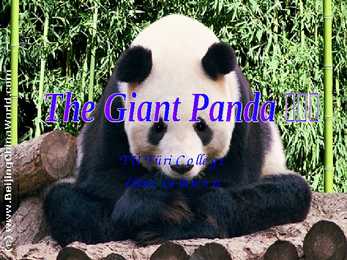
T Ü T üri C o lle g e Liina Le inm e ts Introduction · Panda (Ailuropoda melanoleuca) is a mammal classified in the bear family, native to centralwestern and southwestern China. It is easily recognized by its large, distinctive black patches around the eyes, over the ears, and across its round body. · The Giant Panda lives in a few mountain ranges in central China. · It once lived in lowland areas, but farming, forest clearing, and other development now restrict the Giant Panda to the mountains. In the wild · The Giant Panda is a · Pandas communicate terrestrial animal and through vocalization primarily spends its life and scent marking such roaming and feeding in as clawing trees or the bamboo forests. spraying urine. It is able · Though generally alone, to climb and take each adult has a shelter in hollow trees
 annaabi.ee