Leidsid 33 sarnast õppematerjali, mis on seotud failiga "Deforestation". Need materjalid aitavad sul teemat sügavamalt mõista.
forest, defores, deforestation, land, causes, agriculture, wood, global, warming, economic, randla, fourth, reason, farming, logging, other, geography, effect, cycle, erosion, asia, years, arbor, foundation, economics, easter, island, europe, massive, charcoal, engine, forestsMargit Tepner k0848752 Sustainability aspects of biofuels 1. Introduction The literature review will discuss the sustainability aspects of biofuels. Food production will be the main concern as it is the most debated issue, but other aspects, such as land use change and water consumption will be also considered as they are essential aspects in the biofuels sustainability criteria. The review will discuss the viability of biofuels based on the current technologies. Second-generation biofuels are not yet commercially viable and therefore will not be discussed; although they could significantly improve the sustainability of biofuels when they break through to the industrial scale. 2. The scale of biofuels production 2.1
Biomass energy Renewable energy Renewable energy comes from sources that naturally renew, or will not run out in our lifetimes. Includes sunlight, wind, water, geothermal heat and various forms of biomass. Renewable energy cannot be exhausted and is constantly renewed. Does not harm the environment. Saves money. Solar energy Solar energy is the technology used to harness the sun's energy and make it useable. Every hour the sun beams onto Earth more than enough energy to satisfy global energy needs for an entire year. Solar energy use has surged at about 20 percent a year over the past 15 years, thanks to rapidly falling prices and gains in efficiency. Solar energy is inexhaustible. Noise free. Does not harm the environment. Click to edit Master text styles Second level Third level Fourth level Fifth level Negative aspects of solar energy
grown on the African oil palm tree. Oil palms are originally from Western Africa, but can flourish wherever heat and rainfall are abundant. Today, palm oil is grown throughout Africa, Asia, North America, and South America, with 85% of all palm oil globally produced and exported from Indonesia and Malaysia; but most of the time not using sustainable measures. The industry is linked to major issues such as deforestation, habitat degradation, climate change, animal cruelty and indigenous rights abuses in the countries where it is produced, as the land and forests must be cleared for the development of the oil palm plantations. According to the World Wildlife Fund, an area the equivalent size of 300 football fields of rainforest is cleared each hour to make way for palm oil production. This large-scale deforestation is pushing many species to extinction, and findings show that if nothing hanges, species like the
..........................................16 3. Conclusion............................................................................................................ ....18 4. Sources............................................................................................................... .......19 Renewable energy Renewable energy is energy generated from natural resources--such as , wind, rain, tides and geothermal heat--which are renewable (naturally replenished). In 2006, about 18% of global final energy consumption came from renewables, with 13% coming from traditional biomass, such as wood-burning. Hydroelectricity was the next largest renewable source, providing 3% (15% of global electricity generation),followed by solar hot water/heating, which contributed 1.3%. Modern technologies, such as geothermal energy, wind power, solar power, and ocean energy together provided some 0.8% of final energy consumption.
Industry and motor vehicle exhaust are the number one pollutants. Heavy metals, nitrates and plastic are toxins responsible for pollution. While water pollution is caused by oil spill, acid rain, urban runoff; air pollution is caused by various gases and toxins released by industries and factories and burning of fossil fuels; soil pollution is majorly caused by industrial waste that deprives soil from essential nutrients. FIND OUT 5 WAYS HOW TO STOP POLLUTION. 2. Global Warming: Climate changes like global warming is the result of human practices like emission of Greenhouse gases. Global warming leads to rising temperatures of the oceans and the earth surface causing melting of polar ice caps, rise in sea levels and also flash floods, excessive snow or desertification. FIND OUT 5 WAYS HOW TO STOP GLOBAL WARMING. 3. Overpopulation: The population of the planet is reaching unsustainable levels as it faces shortage of resources like water, fuel and food
Scientists first discovered acid rain in 1852, when the English chemist Robert Agnus invented the term. From then until now, acid rain has been an issue of intense debate among scientists and policy makers. Acid rain, one of the most important environmental problems of all, cannot be seen. The invisible gases that cause acid rain usually come from automobiles or coal-burning power plants. Acid rain moves easily, affecting locations far beyond those that let out the pollution. As a result, this global pollution issue causes great debates between countries that fight over polluting each other's environments. For years, science studied the true causes of acid rain. Some scientists concluded that human production was primarily responsible, while others cited natural causes as well. Recently, more intensive research has been done so that countries have the information they need to prevent acid rain and its dangerous effects. The levels of acid rain vary from region to region
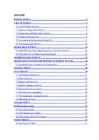
5 Geothermal power plants..........................................................................................45 13.6 Geothermal heat pumps............................................................................................ 46 13.7 Geothermal energy and the environment..................................................................46 BIOMASS............................................................................................................................46 14.1 Wood and wood waste..............................................................................................47 14.2 Municipal solid waste, landfill gas, and biogas........................................................48 14.3 Biofuels - ethanol and biodiesel............................................................................... 48 2 14.4 Biomass and the environment..........................................
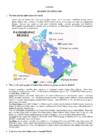
Climate Canada's climate varies wildly based on geography, from perma-frost in the north to four distinct seasons towards the equator. In this region the temperature can climb up to 35 degrees Celsius in the summer and descend to a chilly -25 degrees Celsius during winter. Canada's climate and environment are one of the main reasons that Canada is such a succesful country. The blend of natural resources and climate sustains us. The seasons dictate the look of the land: according to whether the natural environment is in a state of dormancy or growth. Canada's climate is characterized by its diversity, as temperature and precipitation differ depending on where you are and what time of year it is. Other than the North where it's above freezing for only a few months a year, most Canadian cities are within 300 km of the southern border, where mild springs, hot summers and pleasantly crisp autumns are common during the majority of the year.
what is currently considered waste into energy. As of 2005, nuclear power provided 6.3% of the world's energy and 15% of the world's electricity, with the U.S., France, and Japan together accounting for 56.5% of nuclear generated electricity. As of 2007, the IAEA reported there are 439 nuclear power reactors in operation in the world, operating in 31 countries. In 2007, nuclear power´s share of global electricity generation dropped to 14%. According to the International Atomic Energy Agency, the main reason for this was an earthquake in western Japan on 16 July 2007, which shut down all seven reactors at the Kashiwazaki-Kariwa Nuclear Power Plant. There were also several other reductions and "unusual outages" experienced in Korea and Germany. Also, increases in the load factor for the current fleet of reactors appear to have plateaued.
Topic Australia Tallinn English College 2006 Australia 1 . Introduction The name Australia is derived from the Latin Australis, meaning of the south. In land area, Australia is the sixth largest nation, its territory is 7,686,850 sq km and its population reaches today over 20,5 million people. It is the only nation to govern an entire continent and its outlying islands. Australia's capital is Canberra, the only city with its own territory. It was built in the early 1900s just to be the capital. The official language is English and the official name of Australia is the Commonwealth of Australia.
held in an anaerobic area, which can range from a storage tank which is not ventilated to a device which is specifically designed to produce gases. The conditions attract anaerobic bacteria, which start to break down the organic material, producing methane and carbon dioxide as a by-product. Another type of biogas which includes hydrogen, nitrogen, and carbon monoxide can be obtained through the gasification of biomass such as wood or rice husks, a technique which is used to manufacture gas industrially. The gases produced through anaerobic fermentation or gasification are combustible in addition to having a strong smell which makes them stand out to the human nose. Methane leaks from landfills are an ongoing problem, as is the production of biogas in poorly maintained compost piles, manure lagoons, and outhouses. Spontaneous fires and explosions caused by build-ups of gas have
3 control of Jamaica), succeeded in organizing frequent uprisings against the European landowners. The sugar industry declined in the 19th cent., partly because of the abolition of slavery in 1833 (effective 1838) and partly because of the elimination in 1846 of the imperial preference tariff for colonial products entering the British market. Economic hardship was the prime motive behind the Morant Bay rebellion by freedmen in 1865. The British ruthlessly quelled the uprising and also forced the frightened legislature to surrender its powers; Jamaica became a crown colony. Poverty and economic decline led many blacks to seek temporary work in neighboring Caribbean areas and in the United States; many left the island permanently, emigrating to England, Canada, and the United States. Indians were imported to meet the labor shortage on
ENGLAND General overview England is part of the United Kingdom Land borders with Scotland to the north and Wales on to the west The English Channel on south separates it form continental Europe The country includes over 100 smaller islands Capital and largest city is London Its has consitutional monarchy Monarch is Elizabeth II Total area is 130,395 km2 Population is 51,446,000 million, around 84% of the population of the UK Currency is Pound stearling(GBP) Has left-hand traffic Patron saint is ST. George Geography England comprises the central and southern two-thirds of the island of Great Britain, in addition to a number of small islands of which the largest is the Isle of Wight Much of England consists of rolling hills, but it is generally more mountainous in the north with a chain of mountains, the Pennines, dividing east and west Other hilly areas in the north and Midlands are the Lake District, the North York Moors, and the Peak Di
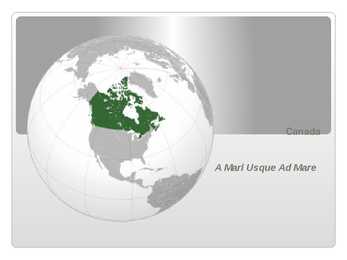
Languages in Canada North American country consisting of ten provinces and three territories located in the northern part of the continent, it extends from the Atlantic Ocean in the east to the Pacific Ocean in the west, and northward into the Arctic Ocean spanning over 9.9 million square kilometers, Canada is the world's second largest country by total area its common border with the United States is the longest land border in the world. Some facts The land that is now Canada was inhabited for millennia by various groups of Aboriginal peoples beginning in the late 15th century, British and French France ceded nearly all of its colonies in North America in 1763 after the Seven Years' War Historical Background in 1867, with the union of three British North American colonies through Confederation, Canada was formed as a federal dominion of four provinces
In the northeast of the country a few km off the coast there is the Great Barrier Reef. It extends about 2000 km along the coast of Queensland. Made of coral, it is the world’s largest structure created by living organism. . 4 Climate & Time Zones Australia is the driest continent in the world except Antarctica. It has low average rainfalls. About 70 per cent of the country is arid or semi arid and cannot support agriculture. The north part of the country gets about 300 mm of rain a year. Much of the rain soaks into the ground and does not form any rivers or lakes. Monsoon winds bring moist air during summer. This is the time of high rainfall. It’s known as “the wet “season. High temperature also means hat a lot of moisture evaporates or is used by plants. In the southern two thirds of the country the climate is temperate to cool. Winter temperatures can be low but not freezing. There are four seasons
Further to the south the climate gets warmer, with warmer winters and hotter summers. The south western part of the country is the driest and the hottest. Death Valley is also located there. The second highest temperature on earth 55.5C was recorded in the valley. The place got its name because of gold seekers. Hoping to find a shorter way to gold fields, many of them died crossing the valley during the 1849 Gold Rush. 6 Economy, Agriculture The United States is a country of highly developed economy. Most American industry is located in the eastern and Midwestern parts, around the Great Lakes and also on the Pacific coast. The U. S. engineering products are known all over the world the country produces planes, rockets, spaceships, cars, agricultural machinery, ships etc. Electronics has become a major industry. The role of service and leisure industries has also grown. Canned fish and timber are the chief products of the
and on this day every year Australia day is celebrated. In all, about 160 000 en and women were brouth to Australia as convicts. The transportation was ended in 1868. by this time many settlements were established. In 1901 all the separate parts of Australia were united into one country. In 1851 gold was discovered in eastern Australia. This brought along the great gold rush. Thousands of people went to the new land to find fortune. Forty years later the gold was found in the west. The miners of the east had a very hard time, the water was scarce and the roads were bad. But then the railway was built. Many of people who came to Australia to find gold stayed on to do other kinds of work. The found that Australia has other riches too, such as coal, copper, ironore, nickel, natural gas and more. The forests had good timber. Along seashorepearls and tortoise shells could be gathered. Some
There are declining amounts of these benchmark oils being produced each year, so other oils are more commonly what is actually delivered. While the reference price may be for West Texas Intermediate delivered at Cushing, the actual oil being traded may be a discounted Canadian heavy oil delivered at Hardisty, Alberta, and for a Brent Blend delivered at Shetland, it may be a Russian Export Blend delivered at the port of Primorsk. Petroleum industry The petroleum industry is involved in the global processes of exploration, extraction, refining, transporting (often with oil tankers and pipelines), and marketing petroleum products. The largest volume products of the industry are fuel oil and petrol. Petroleum is also the raw material for many chemical products, including pharmaceuticals, solvents, fertilizers, pesticides, and plastics. The industry is usually divided into three major components: upstream, midstream and downstream. Midstream operations are
06.05.2012 Abstract 06.05.2012 Experience and Wellness management Author Group Girli Vasiljev RB1X Title of report Number of pages Economic Country Review: Finland, Estonia 20 and Hungary Teacher Kalevi Torunen The goal of this paper is to compare the economic performance of Finland, Estonia and Hungary. First, a general overview on the countries will be given. After, economic indicators (real GDP growth rate, inflation, unemployment, household consumption, investment, current account, government budget and deficit) of the three countries will be compared to draw a conclusion. Keywords GDP, inflation, unemployment, household consumption, investment, current account, government budget, deficit, surplus Table of contents 1 Introduction
of New Britain. To the north and south of this central mountain range on the main island lie vast stretches of mangrove swamps and coastal river deltas. /1/ Volcanoes and thermal pools are also found in the southeast of other islands. Papua New Guinea offers the greatest variety of terrestrial ecosystems in the South Pacific, including five types of lowland rainforest, 13 types of montane rainforest, five varieties of palm and swamp forest and three different mangrove forests. Two-thirds of the world's species of orchids come from New Guinea. /1/ Birds include 38 species of the bird of paradise, and the megapode and cassowary. Marsupials and mammals include cuscus, tree kangaroos, wallabies, bandicoots, spiny anteaters and, in the coastal waters, the dugong. There are between 170 and 200 species of frog and 450 species of butterfly. /3/ 4 The forests of New Guinea
Nordic invaders to be united in the 9th century. The Vikings first raided England to plunder it, then in the days of Alfred of Wessex. They began to win wide lands `to plow and rule'. In the 10 th century England fell under Danish rule with King Canute finally managing to unite the Anglo-Saxons and Danes at the beginning of the 11 th century. After defeating the Anglo-Saxon king Harold at the battle of Hastings in 1066, William of Normandy introduced the Norman feudal system, with land in return for the continued support, and French remained the language of the upper classes and administration until the 14 th century. The origins of Parliament are to be found in the region of John's successor, Henry III. It was a meeting of the king and his barons and servants at which various administrative and financial problems were discussed. In order to make it easier to put the decisions taken into practice, each
etc. 3. Relief Lying in the north-western part of the East-European Plain, Estonia is mostly flat with an average elevation of about 50 metres above sea level. South-eastern and eastern parts of Estonia are higher than the western parts. The relief of the present-day landscape was shaped during the Ice Age. Ice sheet has carried large boulders and limestone blocks here, not to mention that the hilly terrain in Estonia was also shaped by the continental ice and the melting water. The land is rising 25 cm every one hundred years. In folklore, many features of the relief are explained by the activities of giants such as the legendary national hero Kalevipoeg. The Haanja and Otepää Uplands are particularly rich in Hills. It is here that You find Big Egg Hill, the highest point in the Baltic states with 318 metres above sea level. 4. Land regions The northern coast features a steep limestone bank, the Baltic glint, which is one
3. Relief The USA is situated in the central part of the North American continent. Its western coast is washed by the Pacific Ocean and its eastern coast is washed by the Atlantic Ocean and in the south its coast is washed by the Gulf of Mexico. The coastline is even. There are no big islands belonging to the USA except the Hawaiian Islands which lie halfway the continents of America and Asia. The biggest peninsulas are the Florida Peninsula and Alaska. 4. Land Regions Mountains The Appalachian Mountains are a vast system of North American mountains, partly in Canada, but mostly in the United States, forming a zone, from 100 to 300 miles wide, running from the island of Newfoundland some 150 miles south-westward to central Alabama in the United States. The Rocky Mountains, often called the Rockies, are a broad mountain range in western North America. The Rocky Mountains stretch more than 4800 km. The Rocky Mountain System within
Bretange' = Great Britain, 'Bretagne' = Brittany. Climate Britain has a variable climate. The weather changes so frequently that it is difficult to frecast. It is not unusual fo people to complain that the weathermen were wrong. Fortunately, as Britain does not experience extreme weather conditions, it is never very cold or very hot. The temperature rarely rises above 32°C in summer, or falls below -10°C in winter. Summers are generally cool, but due to global warming they are starting to get drier and hotter. Hot weather causes terrible congestion on the roads as Britons rush to the coastal resorts. Winters are generally mild, with the most frequent and prolonged snowfalls in the Scottish Highlands, where it is possible to go skiing. If it does snow heavily in other parts of Britain, the country often comes to a standstill. Trains, buses and planes are late. Contrary to popular opinion, it doesn't rain all the time. There is certainly steady rainfall
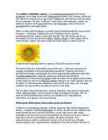
and food manufacturers alike for a healthy and high performance non-transgenic vegetable oil. Sunflower plantings, production, and supply and disappearance activities throughout the world are ever- changing. Statistics provide persons with a vested interest in the industry a foundation of where we've been in order to help us understand where we need to go. Use the Sunflower Statistics section as a resource for data on a global, national, and state-level perspective. Meal/Wholeseed Feeding Sunflower meal is the by-product of the oil extraction process. Oil is the majority value of sunflower seed and meal is considered a by-product. Sunflower meal is an excellent livestock feed, especially for ruminants. For the last several years, the supply of U.S. sunflower meal has been somewhat inconsistent. That is changing as the domestic market for sunflower oil increases.
that go back that far. Many scientists now believe that some of the First Peoples may have been here for much longer than that. For a long time, scientists believed that the ancestors of all North American First Nations people crossed over on foot to North America from Asia at the end of the last ice age, about 12,000 years ago. At that time Asia and North America were joined, and what is now the bottom of the Bering Sea between Russia and Alaska was dry land, (a "land bridge) because sea levels were much lower than they are now. The earliest man-made artifacts tools or ornaments that archaeologists have found date from that time. The theory is that nomadic hunting people followed the big animals (moose, deer, elk, buffalo) for food, and eventually moved south and spread out as the ice sheets melted back. Then they evolved different cultures to suit different environments.
Table of contents 1. Introduction 2. Geographical position 3. Mountains, lowlands 4. Rivers, lakes 5. The territories and provinces 6. Towns, economy, agriculture 7. Climate 8. Animals, plantlife 9. Population 10. Sports 11. Culture 12. History 13. Political system, symbols 14. Conclusion 15. Materials 1. Introduction If you had to use two words to describe Canada, they might be large and diverse. Canada is the second largest country in the world, bordered by three oceans, and across the country, Canadians experience many different landscapes from rolling plains and mountains to the cold tundra of the north. Despite Canada's great size, it is
Ukraine; even Moldova and Turkmenistan, generally regarded as very poor Soviet republics, were ahead of Ukraine. Ukraine's economy contracted annually between 9.7 and 22.7 percent in 19911996. The country experienced hyperinflation and an exceptionally huge production decline for a country not ravaged by a major war. Official GDP collapsed by almost half from 1990 to 1994, and slow decline continued throughout the decade. Economic growth would not resume again until 2000. The budget deficit was, at 14.4 percent of GDP, exceptionally large. Barter and the use of surrogate moneys and foreign currencies prevailed. Ukraine had introduced a sovereign currency, the Hryvnia, but it was little used. A shadow economy swelled and compensated for an unknown share of the economic collapse. 2001-2008 Between 2001 and 2008, the Ukrainian economy picked up significantly. Many of Ukraine's
The currency used in Estonia is Eesti kroon. The Estonian national flag is blue-black-white. It was originally the flag of the Estonian Students' Society. The flag was first consecrated in Otepää Church in 1884. For a while, during the Soviet occupation, the flag was banned but it was again seen in public in Tartu in May 1988. The national flower is cornflower, the national bird is barn swallow and the national stone is limestone. The Estonian national anthem called "My Native Land, My Pride and Joy" was composed in 1848 by Friedrich Pacius. The Estonian language words were written by J. V. Jannsen. It was officially adopted after the War of Independence in 1920.The same melody with different words is also Finland's national anthem. The current coat of arms of Estonia is a golden shield which includes three slim, blue leopards (or lions) in the middle, with oak branches along the side of the shield. It originates from Denmark. It was officially adopted in 1925.
Scotland ! Scotland (Gaelic: Alba) is a country in northwest Europe that occupies the northern third of the island of Great Britain. It is part of the United Kingdom, and shares a land border to the south with England. It is bounded by the North Sea to the east, the Atlantic Ocean to the north and west, and the North Channel and Irish Sea to the southwest. In addition to the mainland, Scotland consists of over 790 islands including the Northern Isles and the Hebrides. Edinburgh, the country's capital and second largest city, is one of Europe's largest financial centres. It was the
European Union Research Compose: x X School 2009/10 What is European Union? The European Union (EU) is an economic and political partnership between 27 democratic European countries. EU population is almost a half milliard European union stands for caring and fair community. All EU members are devoted to peace, democracy, human rights respecting and working together to spread these values all the world. History The beginning of EU might consider the year 1951, when European Coal and Steel Community (ECSC) was constitute. Six countries joined with it for peace: Belgium,
bordered by the Atlantic Ocean to the west and south and by Spain to the north and east. The Atlantic archipelagos of the Azores and Madeira are Portuguese territory as well. The country is named after its second largest city, Porto, whose Latin name was Portus Cale. SETTLEMENT The land within the borders of the current Portuguese Republic has been continuously settled since prehistoric times. In the 8th century most of the Iberian Peninsula was conquered by Moorish invaders professing Islam, who were later expelled by the Knights Templar. During the Christian Reconquista, Portugal established itself as an independent kingdom from León in 1139, claiming to be the oldest European nation-state. In the 15th and 16th centuries, as the
The United Nations officially came into existence on 24 October 1945, when the UN Charter had been ratified by a majority of the original 51 Member States. The day is now celebrated each year around the world as United Nations Day. The purpose of the United Nations is to bring all nations of the world together to work for peace and development, based on the principles of justice, human dignity and the well-being of all people. It affords the opportunity for countries to balance global interdependence and national interests when addressing international problems. There are currently 192 Members of the United Nations. The Aims of the United Nations: -To keep peace throughout the world. -To develop friendly relations between nations. -To work together to help people live better lives, to eliminate poverty, disease and illiteracy in the world, to stop environmental destruction and to encourage respect for each other's rights and freedoms.
 annaabi.ee