Leidsid 33 sarnast õppematerjali, mis on seotud failiga "Classical music powerpoint". Need materjalid aitavad sul teemat sügavamalt mõista.
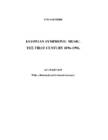
classical, period, century, 1400, 1910, 11th, present, times, term, until, early, 19th, reference, 1836, haydn, mozart, known, medieval, renaissance, baroque, romantic, sonata, opera, dance, suite, poem, nowadays, postmodernismUNO SOOMERE ESTONIAN SYMPHONIC MUSIC. THE FIRST CENTURY 1896-1996. AN OVERVIEW With a Historical and Cultural Summary IN MEMORY OF THE GREAT ESTONIAN COMPOSERS CONTENTS ESTONIA AND THE ESTONIANS FOREWORD IN THE FOLD OF TSARIST RUSSIA. EMERGENCE AND FIRST STEPS ON THE CLASSICAL-ROMANTIC PATH. HISTORICAL INTRODUCTION I. MUSICAL LIFE IN TARTU AT THE TURN OF THE CENTURY. TRAILBLAZERS: ALEKSANDER LÄTE, RUDOLF TOBIAS, ARTUR KAPP. II. THE FIRST DECADE OF THE 20TH CENTURY. ARTUR LEMBA: THE BEGINNING OF ESTONIAN SYMPHONY AND OPERA. III. NEW DEVELOPMENTS IN CULTURAL AND MUSICAL LIFE: THE END OF THE TSARIST PERIOD. THE INDEPENDENT REPUBLIC OF ESTONIA: THE INTRODUCTION OF INNOVATIONS FROM WESTERN ART AND THE EVOLUTION OF NATIONALLY ORIENTED MUSICAL TRENDS. IV. THE TWENTIES. ARTUR KAPP: ROMANTICIST AND DRAMATIST. V
The interior design process follows a systematic and coordinated methodology, including research, analysis, and integration of knowledge into the creative process, whereby the needs and resources of the client are satisfied to produce an interior space that fulfills the project goals. Baroque Baroque (pronounced /brok/ b-ROHK in American English or /brk/ in British English) is an artistic style prevalent from the late 16th century to the early 18th century in Europe.[1] It is most often defined as "the dominant style of art in Europe between the Mannerist and Rococo eras, a style characterized by dynamic movement, overt emotion and self-confident rhetoric". The popularity and success of the Baroque style was encouraged by the Roman Catholic Church, which had decided at the time of the Council of Trent, in response to the Protestant Reformation, that the arts should communicate religious themes in direct and emotional involvement. The
In 80s, flute player Hubert Laws collaborated with J.P.Rampal and performing several live concerts. The Eighties also saw a memorable series of recordings by trumpeter C.Baker , whos sideman Nicola Stilo established himself as one of the leading bebop flute players of the modern era. In modern era, techniques from east and different forms of ethnic music has developed jazzflute playing even further and along with western classical music, there is much investigation in this category by both parties. A flute player Robert Dick has done some serious research in the field of multiphonics and having released a book "The Other Flute", he was set as one of the founders of modern jazz playing. Sources used: www.flutehistory.com https://en.wikipedia.org/wiki/jazz_flute members.chello.nl/guidiflute/history.html https://www.youtube.com/watch?v=3usDmsqkdb0
Its tastes were at first pretty simple, the favourite genres being folk comedy and romantic melodrama, although both also transmitted halfhidden social and political attitudes. In less than forty years, in 1906, the leading amateur companies, the "Vanemuine" in the university town Tartu and the "Estonia" in Tallinn, could become professional, and in 1911 the "Endla" of P ärnu joined them. Theatre became especially popular amongst Estonians in the second half of the 19th century. Before that time, theatre had mostly been staged in German for the benefit of the local nobility and merchants. Theatre in Estonian emerged in various song and drama societies, the strongholds of national thought. In the early 20th century, these societies turned into professional theatres, some of which, the national opera Estonia for example, function even today. The scheme from society to theatre is a general phenomenon, because all the present state theatres
Introduction I choose this topic because I want to get know more about local Theatres I hoped to get more information about their location, for whom each theatre is designed and a little overview about their history. The history of Estonian theatre does not differ much from that of the neighbor countries. The first play was performed in the 16th century at the Tallinn Town Hall. The town school children, who were Germans, staged Terence's The Andria in Latin. The first theatre house in Tallinn was mentioned in written materials which date from the late 17th century; the house was used by travelling theatre groups. Tallinn was already known then as a theatre-loving city. The first prominent name in Estonian history of theatre, August von Kotzebue, dates from the same period. The Russian authorities sent him from St
The Renaissance 1500 1650: background 1. What does the word ,,renaissance mean? Characterize briefly the period called the Renaissance. "The rebirth" from French Renaissance, meaning "rebirth"; Italian: Rinascimento, from re- "again" and nascere "be born") Rebirth of scholarship based on classical learning and philosophy. The Renaissance was a cultural movement that spanned roughly the 14th to the 17th century, beginning in Italy in the late Middle Ages and later spreading to the rest of Europe. It encompassed a revival of learning based on classical sources, the development of linear perspective in painting, and gradual but widespread educational reform. (wikipedia)Bridge between Medieval Ages and Modern Era. 2. Where did the Renaissance start and why? In the opening years of the 14th century, there began to develop in Italy and
United Kingdom AT115 Martin Pillai Early history • In 1066, the Normans invaded England from France • In 1603, the kingdoms of England, Scotland and Ireland were united in a personal union when James VI, King of Scots, inherited the crowns of England and Ireland and moved his court from Edinburgh to London • In the mid-17th century, all three kingdoms were involved in a series of connected wars, which led to the temporary overthrow of the monarchy and the establishment of the short-lived unitary republic of the Commonwealth of England, Scotland and Ireland. Acts of Union • On 1 May 1707, the united Kingdom of Great Britain came into being, the result of Acts of Union being passed by the parliaments of England and Scotland to ratify the 1706 Treaty
advocate of women's rights. Wollstonecraft is best known for A Vindication of the Rights of Woman (1792), in which she argues that women are not naturally inferior to men, but appear to be only because they lack education. Caroline Norton English feminist, social reformer, and author of the early and midnineteenth century. She divorced her husband, because the marrige was very unhappy and Caroline was a victim of regular beatings. His husband claimed that Caroline was guilty of adultery with the home secretary Lord Melbourne and sued Melbourne for seducing his wife. Norton lost the case but Caroline's reputation was ruined. Norton refused Caroline access to
Elizabethan one nation culture, now cultural polarisation between the new courtly culture and the rest of the country. Court in cultural isolation. Ben Jonson. King and courtiers were close to universally recognised ideal types (conflict with the reality). Mysticism. Emergence of perspective view, stage machinery, artificial light, revolution. The stage cast the monarch in the focal point (the lines of perspective of the stage met there. Inigo Jones. Masque an educative vehicle, towards classical antiquity and architecture. Tide towards absolute monarchy. Masque – linked poetry and moral philosophy into art. Music, dance, poetry, lavish illusionistic scenic display to express the doctrines of divine kingship. Great impact. Like gods come down to earth. 2. The Caroline masque Charles decided on subject matter, and acted and danced in masques. Now the regal divinity even more obvious. Ben Jonson. Divine minds of this incomparable pair
In 1801, under a new Act of Union, this kingdom merged with the Kingdom of Ireland to create the United Kingdom of Great Britain and Ireland. After the Irish War of Independence most of Ireland seceded from the Union, which then became the United Kingdom of Great Britain and Northern Ireland. The relatively limited variety of fauna and flora on the island is due to its size and the fact that wildlife has had little time to develop since the last glacial period. The high level of urbanisation on the island has contributed to a species extinction rate that is about 100 times greater than the background species extinction rate. 2 The History of the Great Britain The island was first inhabited by people who crossed over the land bridge from the European mainland. Traces of early humans have been found (at Boxgrove Quarry, Sussex) from some
Cromwell’s dictatorship. In 1660, monarchy restored under Charles II. 1668 the Glorious Revolution + constitutional monarchy, i.e. constitution added to restrict the power of the monarch and divide obligations and power with the Parliament. Beginning of the century, literature, especially drama flourished. Emergence of puritanism – poetry becomes leading form. Puritanism – purification of religion, of all unnecessary rituals and decorations, in essence, all pleasure equals sin. Closed theatres and denounced all drama, dance, rural festivals, even country sports
ancient strongholds in Valjala, Lihula and Soontagana. The churches in Muhu, Valjala, Mustjala, Karja and Kihelkonna are honorable and elderly because Straitland was the one to bring Christianity to Estonia. The castle of Kuressaare is still standing proudly, but in Lihula only ruins can be seen. The patterns of national dresses and the churches bring memories of secret sign cultures of Medieval Times. Good knowledge of singing and facility of speech of the people of Straitland have given Estonia a big number of writers and poets. Character of the landscape The area of Straitland contains Pärnumaa county and some of the islands such as Saaremaa, Muhu, Kihnu, Ruhnu and Abruka. Straitland is low-lying and flat. It was flooded by the sea for much longer than the rest of mainland Estonia. The climate is maritime and greatly influenced by the Baltic Sea
Test on Romantic Poetry and Prose 1. Approximate dates of romanticism: in the second half of the 18th century. Major events on world history at that time: · Industrial revolution · In America the Declaration of Independence, July 4, 1776 · The French Revolution, 1789 · The King of England was George III, after him George IV and then Queen Victoria Outcomes: · Revolution did not bring welfare · Lives of the lower-classes worsened · Extended the distance between the lower and upper class
The Renaissance Between 14th and 16th century in Europe From French word rebirth It was an age of growth in Europe. New, powerful city states emerged. A new middle class had more and more money to spend. Great artists, writers and thinkers lived during this time. During the Middle Ages many people who lived in the countryside worked on the land that they got from the noblemen. In return, they were protected by them Between the middle and the end of the 14th century, the plague, also called "Black Death" killed almost half of Europe's population. It spread most rapidly in the larger cities where many people lived. This led to economic depression. When the plague slowly decreased in the 15th century, the population in Europe began to grow. A new middle class emerged --bankers, merchants and trades people had a new market for their services. People became wealthier and had more than enough money to spend
Use each word once only. current electric humorous modern public special dull gripping live popular readable still a) No recording can be as good as a live concert in my opinion. b) It was a very…… story and made me laugh a lot. c) I couldn't put that book down, it had such a…… plot. d) Most people find it difficult to understand …… art. e) My favourite television programmes are about …… affairs. f) Of course it's possible to like both classical and …… music. g) Everyone enjoyed the effects in the…… Star Wars films. h) I don't buy books because there's a good…… library nearby. i) We both found it a very…… film I'm afraid. j) George doesn't paint people, but mainly does…….. life paintings. k) It was an interesting book, and very…… 1) Unfortunately the boy upstairs is learning the …… guitar. Task 5. Choose the most suitable word or phrase to complete each sentence.
festival tradition moved to Tallinn. It began in 1947, during the first song festival (Laulupidu) held after the Soviet occupation, when a centuryold national poem, forbidden by the Soviets, was set to music. "Mu Isamaa on minu arm" ("Lands of My Fathers, Land That I Love") was set to music and the song became the unofficial Estonian national anthem that miraculously slipped by the Soviet censors. In 1969, more than a hundred thousand participants gathered for the century anniversary of a national song festival and, in a spontaneous act of nonviolent resistance, sang this song. For fifty years, it was a musical statement of every Estonian's desire for freedom. http://www.blogto.com/events/3626 Pärnu Hanseatic Days 2008 June 27th 28th Pärnu prepares for the International Hanseatic Days of 2010 by holding handicraft fairs every summer. Traditionally, the
...................................... 11 47 Lai Street............................................................................ 12 50 Lai Street............................................................................ 13 Summary................................................................................. 15 References.............................................................................. 16 2 Introduction Pikk Street as the longest and also the main street from medieval times is well-known, but Lai Street that runs parallel to it is not. The aim of the report is to be helpful for the students of Tallinna Mustamäe College who study the history of Tallinn and would like to get additional information about Lai Street, as they need to pass the guide practice exam in form eleven. The report is divided into chapters so that each chapter deals with one of the important houses in Lai Street. In the beginning there are also two introductory chapters about Lai Street in
Russian philology The meaning of the word "philology" is "love for word". This is love that unites teachers and researchers of modern and Classical languages and literature, interpreters and diplomats, journalists and publishers, writers and poets. Russian philologis are highly demanded in various spheres of scholarly research and education, in the mass media, in civil service at the Ministry of Foreign Affairs, in archives, libraries, museums, in travel agencies, as well as Russian and international companies. Curriculum within in philological faculty includes courses of Russian and European
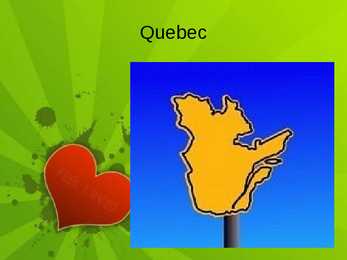
cold, and snowy. Summers are warm but very short. History At the time of first European contact and later colonization, Algonquian, Iroquoian and Inuit tribes were the peoples who inhabited what is now Quebec. Hélène Desportes, born July 7, 1620, to the French habitants (settlers) Pierre Desportes and his wife Françoise Langlois, was the first child of European descent born in Quebec. The Quiet Revolution from 1944 to 1959 was a period of dramatic social and political change Population In 2006 the population of Quebec was 7,546,131 people Canadian 4,474,115 people60.1% French 2,151,655 people 28.9% Irish 406,085 people 5.5% Italian 299,655 people 4.0% English 245,155 people 3.3% North American Indian 219,815 people 3.0% Language The official language of Quebec is French. English is not designated an official language by Quebec law
approximately 350-400 million native speakers. Which place does English occupy in the world by its number of speakers?After which language? English occupies second place by its number of speakers after Mandarin Chinese. 3. What is the difference between English as a Second Language, English as a Foreign Language and English for Specific Purposes? Give examples of situations where they are used. English as a Second Language (ESL or TESL) is a traditional term for the use or study of the English language by non-native speakers in an English-speaking environment. That environment may be a country in which English is the mother tongue (e.g., Australia, the U.S.) or one in which English has an established role (e.g., India, Nigeria) English as a foreign language A traditional term for the use or study of the English language by non-native speakers in countries where English is generally not a local medium of communication.
1. Introduction The official name of Great Britain is `the United Kingdom of Great Britain and Northern Ireland (or short United Kingdom)' The population is about 60.4 million. The capital is London. Other biggest cities include Birmingham, Bristol, Portsmouth, Glasgow and Swansea. English is the main language of Great Britain, but Welsh is officially recognized in Wales and Gaelic in Scotland. 2. Geographical position The British Isles is the geographical term for a group of about 5000 islands off the coast of mainland Europe. The largest island is Great Britain, which is also the largest island in Europe. It consists of England, Wales and Scotland. The next largest island is Ireland, which is made up of Northern Ireland and the Irish Republic. Britain and Northern Island together form the United Kingdom. When referring to Britain or Great Britain in everyday life, the names are used to mean the United Kingdom.
Foreword Bridging rivers, gorges, narrows, straits, and valleys always has played an important role in the history of human settlement. Since ancient times, bridges have been the most visible testimony of the noble craft of engineers. A bridge can be defined in many ways, but Andrea Palladio, the great 16th century Italian architect and engineer, hit on the essence of bridge building when he said "...bridges should befit the spirit of the community by exhibiting commodiousness, firmness, and delight." In more practical terms, he went on to explain that the way to avoid having the bridge carried away by the violence of water was to make the bridge without fixing any posts in the water. Since the beginning of time, the goal of bridge builders has been to create as wide a span as possible
town of London, surrounded by the wall first built by Romans. The Romans also built a bridge over the Thames and there has been one in the same area ever since. The Roman Londinium grew up on the northern side of the bridge. In AD 61 the native Celtic tribe, led by Queen Boudicca, rose up against the Romans. They burnt down Londinium to the ground and killed most of its inhabitants. Roman armies eventually defeated Boudicca and Londinium was rebuilt. At the end of the fourth century AD the Roman Empire began to crumble and the Roman armies were recalled from Britain to defend Rome itself. Once they had left, tribes such as Angles, Saxons and Jutes invaded and settled in from Holland, Germany and Denmark. Together they are known as Anglo-Saxons. They were farming people who preferred living outside towns. For a while London probably lay in ruins, but it eventually developed again, partly because its position on the river was good for trading
Johann Sebastian Bach Johann Sebastian Bach was born on 31 March and died on 28 July 1750. was a German composer, organist, harpsichordist, violist, and violinist whose ecclesiastical and secular works for choir, orchestra, and solo instruments drew together the strands of the baroque period and brought it to its ultimate maturity. Although he did not introduce new forms, he enriched the prevailing German style with a robust contrapuntal technique, an unrivalled control of harmonic and motivic organisation, and the adaptation of rhythms, forms and textures from abroad, particularly from Italy and France. Bach's abilities as an organist were highly respected throughout Europe during his
In my case, I’m doing it because of all the above. [2] What is „A Dance“? Dance is the art of movement of the body, usually rhythmically and to music, using prescribed or improvised steps and gestures. "A dance" is any one prescribed sequence of such movements, or the music to which it is performed, or an event at which it takes place. It can be categorized and described in various ways. Still there’s many generic similarities in dances from many different times and places. Theatrical dance, also called performance or concert dance, is intended primarily as a spectacle, usually a performance upon a stage by virtuoso dancers. It often tells a story, perhaps using mime, costume and scenery, or else it may simply interpret the musical accompaniment. Examples are western ballet and modern dance, Classical Indian dance and Chinese and Japanese song and dance dramas. [3]
1 hits. He has won five Grammy awards and one Academy Award. His success has had a profound impact on popular music and has contributed to the continued popularity of the piano in rock and roll. In 2004, Rolling Stone ranked him #49 on their list of the 100 greatest artists of all time. Some of the characteristics of John's musical talent include an ability to quickly craft melodies for the lyrics of songwriting partner Bernie Taupin, his former rich tenor (now baritone) voice, his classical and gospel-influenced piano, the aggressive orchestral arrangements of Paul Buckmaster among others and the flamboyant fashions, outlandishly excessive eyeglasses, and on-stage showmanship, especially evident during the 1970s. John was inducted into the Rock and Roll Hall of Fame in 1994. He has been heavily involved in the fight against AIDS since the late 1980s, and was knighted in 1998. He entered into a civil partnership with David Furnish on 21 December 2005 and
History of English literature Periods: 1. Anglo-saxon or early literature (499 - 1066) 2. Second or Norman or late Medieval period (1066 - 13/14 century) 3. Renaissance or Modern period (13-14 century present) Anglo-Saxon period · All of the literature had its roots in folklore · Texts were orally transmitted, the anglosaxons had no written language · Two types of singers: 1) scop (attached to the royal court, wrote poetry and songs, performed them); 2) gleeman (travelled, mostly sang other peoples' songs, not their own songs; performers of scop songs) · The oldest known song Widsith (The Far Traveller/Wonderer); tells of a gleeman
The Beatles were an English rock band, formed in Liverpool in 1960 and one of the most commercially successful and critically acclaimed acts in the history of popular music. From 1962 the group consisted of John Lennon (rhythm guitar, vocals), Paul McCartney (bass guitar, vocals), George Harrison (lead guitar, vocals) and Ringo Starr (drums, vocals). Rooted in skiffle and 1950s rock and roll, the group later worked in many genres ranging from folk rock to psychedelic pop, often incorporating classical and other elements in innovative ways. The nature of their enormous popularity, which first emerged as the "Beatlemania" fad, transformed as their songwriting grew in sophistication. The group came to be perceived as the embodiment of progressive ideals, seeing their influence extend into the social and cultural revolutions of the 1960s. With an early five-piece line-up of Lennon, McCartney, Harrison, Stuart Sutcliffe (bass) and
Filmikunsti ajalugu 31.01.12 The age of pioneers: the early history of film How the horses helped to ivent the cinema. Cinema was invented by accident. 1872, west coast: leland standford, party, rich people, end of the 19 century, bored. Stanfrod talks friends about horses: problem: question is, what happens with the hooves while its moving, running. Bet, with eyes, can't settle this. Cannot ever see if the hooves touch the ground. Stanford has enough money, hires most famous photographer. Eadwerd muybridge, comes to usa. Tells him to settle this with photography. That time with photography you cannot get any informatio either. Started to install boxes, in each box, there was a camera
1. STYLE The term "style" is polysemantic (has many meanings): a Latin word "stilus" originally meant a writing instrument used by ancient people. Already in classical Latin the meaning was extended to denote the manner of expressing one's ideas in written or oral form. Jonathan Swift defined style as "proper words in proper places". In present day English the word "style" is used in about a dozen of principle meanings: 1. the characteristic manner in which a writer expresses his/her ideas (e.g. style of Byron) 2. the manner of expressing ideas, characteristic of a literary movement or period 3. the use of language typical of a literary genre (e.g. the style of a comedy, drama, novel). 4. the selective use of language that depends on spheres / areas of human activity (e.g. style of fiction, scientific prose,
The Ancient Egyptians would often write on papyrus, a plant grown along the Nile River. At first the words were not separated from each other (scriptura continua) and there was no punctuation. Texts were written from right to left, left to right, and even so that alternate lines read in opposite directions. The technical term for this type of writing is 'boustrophedon,' which means literally 'ox-turning' for the way a farmer drives an ox to plough his fields. 1/15 Scroll Egyptian papyrus showing the god Osiris and the weighing of the heart. Papyrus, a thick paper-like material made by weaving the stems
7. Complete each sentence with one suitable word. a) You should be ashamed … your behaviour! f) I don't believe… spending a lot of money on b) Do you like chocolate cake? I am very fond… it. clothes. c) Young David has got … trouble as usual. g) You look a bit fed… Is anything the matter? d) Are you laughing… me? Do I look funny? h) I'm very keen… classical music, actually. e) That was a terrible thing to do! I'm extremely cross… i) In reply to Jack's questions, Sue shook … head. you! j) Cheer …! Try laughing for a change. 8. Decide which answer (A, B, C or D) best fits each space. Noisy neighbours Julie always thought of herself as an easy going and (1) person, who put up with people's differences. She hardly ever
sobriquet "Emerald Isle". The island's area is 84,412 km². Ireland is divided into four provinces: Connacht, Leinster, Munster and Ulster. Ireland's least arable land lies in the south-western and western counties. These areas are largely spectacularly mountainous and rocky, with beautiful green sights. Ireland is sometimes referred to as being part of the British Isles. However, notwithstanding the level of acceptance of the term within Northern Ireland, exception is taken by many Irish people to the extension of this nomenclature to include Ireland due to the perception that it implies an identity at odds with historical, cultural and political reality. For this reason, "Britain and Ireland" is sometimes used as a neutral way of alluding to the archipelago of which the two islands are the essential constituents. Another suggestion, although much less frequently used, is the Islands of the North Atlantic (IONA).
 annaabi.ee