 50 punkti
Autor soovib selle materjali allalaadimise eest saada 50 punkti.
50 punkti
Autor soovib selle materjali allalaadimise eest saada 50 punkti.
 ~ 1 leht
Lehekülgede arv dokumendis
~ 1 leht
Lehekülgede arv dokumendis
 2009-02-03
Kuupäev, millal dokument üles laeti
2009-02-03
Kuupäev, millal dokument üles laeti
 12 laadimist
Kokku alla laetud
12 laadimist
Kokku alla laetud
 0 arvamust
Teiste kasutajate poolt lisatud kommentaarid
0 arvamust
Teiste kasutajate poolt lisatud kommentaarid
 exekillan
Õppematerjali autor
exekillan
Õppematerjali autor
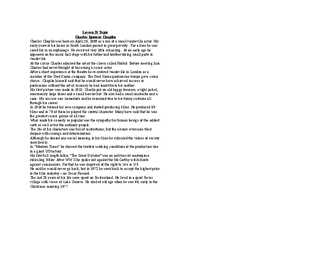
The local pagan priests used all their magic on him and they were very powerful. Once they poisoned his wine but Patrick removed the poison miraculously and drank the wine. One of the legends says that St. Patrick got rid of all the reptiles by beating his drum. He also used the three leaves of the Shamrock to illustrate the idea of the Trinity, pointing out Father, Son and the Holy Ghost. People wear green on St. Patrick's Day and sing and hum along the marchers. 13) CHARLIE CHAPLIN small man with a big message or something... Charles Spencer Chaplin was born on the 16 th of April, in 1889. He received very little schooling. At an early age he appeared on the music hall stage with his father and his brother Sydney, taking small parts in vaudeville. At first Charlie danced in circus performances. He was training to be an acrobat, but he injured his hand. He was small and plump. At the circus Charlie admired the art of the clown called Rabbit. At the age of eight he
Charlie Chaplin Early years · Charles Spencer Chaplin was born in London on 26 April 1889. · Chaplin's childhood was fraught with poverty and hardship. Because of this poverty, Chaplin was sent to a workhouse at seven years old. · He was briefly reunited with his mother at age of nine, before Hannah was forced to readmit her family to the workhouse in July 1898. · In September 1898, Hannah Chaplin was committed to Cane Hill mental hospital. So Charlie and his brother had to live with their father who soon passed away. · For a while Charlie's mom was in good health but in 1903 she became ill again and was readmitted.Charlie was 14 years old at that time. · His mother was released eight months later but in 1905 her madness returned, this time permanently and she remained in care until her death in 1928. Young performer · Chaplin's first stage
"If--". In a 1995 BBC opinion poll, it was voted the UK's favourite poem. This exhortation to self- control and stoicism is arguably Kipling's most famous poem. Many have wondered why he was never made Poet Laureate. (A poet laureate is a poet officially appointed by a government and is often expected to compose poems for State occasions and other government events. In the United Kingdom the term has for centuries been the title of the official poet of the monarch, since the time of Charles II )Some claim that he was offered the post during the interregnum of 1892-96 and turned it down. At the beginning of World War I, like many other writers, Kipling wrote pamphlets which enthusiastically supported the UK's war aims. Death and legacy Kipling kept writing until the early 1930s, but at a slower pace and with much less success than before. He died of a perforated duodenal ulcer ( perforeeritud kaksteistsõrmiksoole haavand ) on 18 January
From "Easy Street" (1917) to "Modern Times" (1936), he made many of the funniest and most popular films of his time. He was best known for his character, the naive and lovable Little Tramp. The Little Tramp, a well meaning man in a raggedy suit with cane, always found himself wobbling into awkward situations and miraculously wobbling away. More than any other figure, it is this kind-hearted character that we associate with the time before the talkies. Born in London in 1889, Chaplin first visited America with a theater company in 1907. Appearing as "Billy" in the play "Sherlock Holmes", the young Chaplin toured the country twice. On his second tour, he met Mack Sennett and was signed to Keystone Studios to act in films. In 1914 Chaplin made his first one-reeler, "Making a Living". That same year he made thirty-four more short films, including "Caught in a Cabaret", "Caught in the Rain", "The Face on the Bar-Room Floor", and "His Trysting Place"
Ameerika Kirjandus 30.01.13 Naturalism · France, Emile Zola · Put down his theory in 1879: Le Roman Experimental, attempt to explain the development of human society throuch biological laws · Outlook is deterministic, pessimistic, fatalistic (fate or biology) · Man as an animal-clever than other beasts, still explainable within the framework · Man is not a free agent, is govern by something · Unable to determine his own faith · Hereditary · Naturalists tried to apply in fiction the processes of natural sciences · Writers task is to record facts, systems of behaviour, living conditions, never revealing any natural unbiased (completely natural) · Point of view: amoral-outside the category of morality, neither good or bad · Naturalist find it absurd to blame the wicked. These criminals are doing what nature, environment, their unconscious tells them to do. Naturalists do not judge their characters, they sim
Chekov Lady and the Lapdog Reid about Chekov: The characters in Chekhov's plays are never fully "known" as a writer, he seems to delight in maintaining a sense of indeterminacy, and unknowability, about them. The bare facts are always laughably inadequate to the complexity of "real" people. Anton Pavlovich Chekhov was born on 29 January (New Style), 1860, in Taganrog, a small port on the Sea of Azov, in southern Russia. As the son of a grocer and grandson of a serf, Chekhov was a first-generation intellectual. His modest background and upbringing are crucial to his development as a writer. Chekhov always felt that he missed out on childhood. It was a very hard lifeand it may have contributed to his poor health: he succumbed later on to the"family disease", tuberculosis, which led to his early death at the age of 44.His mother was a quiet, gentle soul who was full of stories of her early life. In later years, Chekhov would say that "we inherited our talent from our father,but mother
First science-fiction film. It was also first pirated film. Melies 400th film. Became a worldwide success, pirated in the usa. Europeans was showed violent, ww1. Melies mocks the scientists. Barbe-bleue-sinihabe. Fairytale/horror. He invented the fiction film and profounfly influenced specific film genres: · German expressionism(set design) · Surrealism(playfulnessm spontanitym sybolism) · Comedies · d.w. griffith · charlie chaplin 13.02.12 D.W.Griffith(1875-1948) The birth of hollywood Born in Kentucky, osn of a condeferate officer. Kept a life-long nostalgia for the values of ,,The Old South". Initially actor, lot of peopleat that time credited him for his good looks. Real burning intension was to become a writer. Inspired by Charles Dickens. 1907 hired the ,,biograph" film company as a script-writer. Film making wasn't something glamorous, filmbusiness didn't have structure
Why, when, how + Thanksgiving. 5. Thomas Moore and utopia. 6. The development of drama. Mysteries and mirscles, morality plays, etc. Who were the actors? Where were thet performed? Subject? 7. Shakespeare and his three periods. Sonnets, R/J etc. 8. Hamlet's soliloqui. Civil War and Restoration (1642-1702) James I died in 1625 and his successor was Charles I, a king even more foolish and arrogant than dear old Jamesy. He was in constant conflict with Parliament, which he was financed by. At one point he even dissolved the Parliament, however, he was soon forced to reassemble it. In 1628 the king was orced to agree to the Petition of Rights, which gave inancial power to the Parliament. In 1637 he enraged the Puritans by appointing their enemy as the Archbishop o canterbury. In 1638 he aced the rebel Scottish army.
 annaabi.ee







Kõik kommentaarid