Leidsid 33 sarnast õppematerjali, mis on seotud failiga "Castles and museums". Need materjalid aitavad sul teemat sügavamalt mõista.
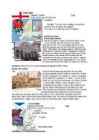
castle, wales, cardiff, river, south, museum, welsh, border, castles, built, roman, lies, there, stone, museums, leading, heritage, during, years, victorian, times, gothic, fairytale, fantasy, west, village, super, east, suburb, station, crossing, cricket, club, mary, church, battle, took, place, close, located, cliffs, oldest, britain, constructionEdinburgh Castle is an ancient stronghold which dominates the sky-line of the city of Edinburgh from its position atop Castle Rock. It is Scotland's second most visited tourist attraction. Human habitation of the site is dated back as far as the 9th century BC. As it stands today though, few of the castle's structures pre-date the Lang Siege of the 16th century, with the notable exception of St Margaret's Chapel, the oldest surviving building in Edinburgh, which dates from the early 12th century.As with all castles, Edinburgh's fortress has been a centre of military activity
Area: 30414 sq mi (78772 km2) Location: Symbols: Tartan Thistles Interesting plase: Edinburgh's Royal Mile Edinburgh's Royal Mile (it is actually one mile and 107 yards from entrance to Edinburgh Castle to the gates of the Palace of Holyrood House) is not only a popular tourist attraction but also provides a fascinating insight into the history of the City and of Scotland itself. It was described by Daniel Defoe as the "Largest, Longest and Finest Street in the World" Edinburgh Castle
London History The Romans AD 43- AD 410 The Romans finally invaded Britain in AD 43 from Kent. The Romans lead by Julius Caesar attempted to invade Britain twice before that in 55 and 54 BC but the invasions were unsuccessful. They made their way to the river Thames and sailed up it. The Romans knew it was important to control a crossing point at the river Thames, so they decided to build a settlement on the north bank. Although small settlements had been built on the banks of the Thames, the Romans were the ones who built the first city. They called their city Londinium. The Roman engineers noticed that the point where the swampy river narrowed would make an ideal crossing point, they built London Bridge. Less than 20 years later the native Iceni tribe, led by Queen Boudicca, rose up against the Romans in revenge for mistreatment and burnt Londinium to the ground. The well disciplined Roman army defeated her forces and Londinium was rebuilt
United Kingdom is a political name of the United Kingdom of Great Britain and Northern Ireland. These political names include the countries of England, Scotland and Wales. Every country has its own capital and language. The capital of England is London, the people there are english and the language spoken is English. In scotland live the scots, capital is Edingburg and the languages spoken are English and Scottish. The capital of Wales is Cardiff, the people tehre are welsh and the languages spoken are welsh and English. N. Ireland is the home for the Irish, the capital is Belfast and the language is Irish. The first inhabitants were Iberians and Celts who settled on the land and were often at war with each other. In AD 43 Britain was made a Roman province. The romans stayed there for three hundred years. After the romans left came the Angles, Saxons and Jutes. Angles gave England its name. The population nowadays is about 60 million people
· Suuremõisa Castle. Suuremõisa Castle was built in the second half of the 18th century on the initiative of Countess EbbaMargaretha Stenbock (17041776). The wings are erected in 1772. There are 64 rooms in the Castle. 6 ponds were dug in the grounds of the Castle and a park and a garden established. In 1796 the Castle was sold to Baron UngernSternberg. The attic of the Castle has doubleceiling, where the Baron used to hide the treasures stolen from ships that had sunk in the Näkimadalad. On 19 October 1802 the Baron killed Karl Johannes Malm, the Captain (of Swedish origin) of his ship "Brig Morian", in this Castle. For this the baron was deported to Siberia. There are currently two schools in the Castle: Suuremõisa Gymnasium and Suuremõisa Technical School. In the latter one can also study how to become a ship's captain.
The UK & London The United Kingdom (or the UK) is a short way of saying the United Kingdom of Great Britain and Norther Ireland. The UK is situated north-west of the European continent between the Atlantic Ocean and the North Sea. The UK consists of England, Wales, Scotland and Northern Ireland. Its highest point is Ben Nevis in Scotland followed by Snowdon in Wales. The Severn is the longest river in the United Kingdom. Other important rivers are the Trent, the Mersey, the Tyne, etc. Lough Neagh which lies in the centre of Northern Ireland is thr UK's largest freshwater lake. The climate in the UK is variable. The weather changes so frequently that it is difficult to forecast. It is not unusual for people to complain that the weathermen were wrong. Fortunately there is no extreme weather conditions, it is never very cold or very hot.
various English kings, London once again prospered as an international trading centre. However, Viking raids began in the late 10 th century and reached a head when they took the city under Danish king Canute and forced the then-English king to flee. Years later, following a victory at the Battle of Hastings, William the Conqueror was crowned King of England in the newly-finished Westminster Abbey in 1066. William granted the citizens of London special privileges while building a castle in the corner of the city to keep them under control. This castle was expanded by later kings and is now known as the Tower of London. The city grew in wealth and population during the Middle Ages. In 1100 its population was around 18,000 but after 200 years it had grown to nearly 100,000. However disaster struck during the Black Death, when London lost nearly a third of its population. After the defeat of the Spanish Armada, stability in politics allowed the city to grow even more
1. Ancient Britain: the Celtic tribes. 2000 years ago there was an Iron Age Celtic culture throughout the Br Isles. It seems that the Celts, who had been arriving from Europe from the 8th cent BC onward, intermingled with the peoples who were already there. The Celts were extremely talented people, creative and artistic. More than 1 Celtic tribe invaded Br. The descendants of ancient Celts live in Wales, Scotland, Cornwall and Ireland. They lived in primitive society. Druids priests, more powerful than chiefs. Acted like prophets. 2. Stonehenge From prehistoric period. Was built on Salisbury plain between 2500 and 1500 bc. One of the most famous and mysterious archaeological sites in the world. One of the mysteries is how it was built at all with the technology of the time. Another is its purpose. It appears to function as a kind on
Legend has it that one day, when the Danes were about to lose a bloody battle, the sky suddenly opened and a red flag with a white cross on it dropped down upon them from the heavens. This is allegedly how the Danes obtained their national flag, the Dannebrog in a battle against the Estonians. In the middle of the 14th century Denmark sold its possessions in Estonia to the German Teutonic Order. Toompea became the seat of the German-born gentry. A wall was built to separate the Upper Town and the Lower Town. In 1285 Tallinn joined the Hanseatic league and became a junction of trade between East and West. Tallinn is said to be built on salt, as it was an important trading commodity. In the 16th century Tallinn had a population of about 7,000 8,000 making it one of the biggest cities in northern Europe. In 1629 Sweden took control of the whole of Estonia. Though hard times
The City of London History The City of London occupies one square mile in the middle of the capital. It once made up the entire town of London, surrounded by the wall first built by the Romans. The Roman Londinium grew up on the northern side of the "London Bridge" in the past. Products such as olive oil, wines and fruit were brought by ships from different parts of the Roman Empire and unloaded onto wooden quays along the river. In AD 61 the native Celtic Iceni tribe, led by Queen Boudicca, rose up against The Romans. They burnt Londinium to the ground but Roman armies eventually defeated Boudicca. The city was rebuilt and was gradually surrounded with a wall
The United Kingdom The United Kingdom consists of England, Scotland, Wales and North Ireland and it is situated in the Atlantic Ocean near the mainland of Europe. The population of the UK is 58.6 million and area is 244,110 sq km. Britain has a temperate humid climate. Its characteristic features are mild winters, warm summer, no temperature extremes, abundant rain all year round and frequent changes of weather. The mild climate is partly due to the warm Gulf Stream and partly to the south westerly winds. Occasional winds from the east in winter may
1. What are the capitals of the 4 constituent countries? England- London; Northen Ireland- Belfast; Scotland- Edinburgh; Wales- Cardiff 2. Order the invaders in correct chronological order: Anglo-Saxons, Normans, Romans, Celts. Romans Anglusaxons , Norman 3. How did the Celts influence Britain? Language. Wars. Engand and Scotland eventually became 1 contry 4. How many people approximately speak English? Approximately 600 million 5. Who (which tribes) gave the base of the English language?Germanic tribes- Anglo-Saxons. 6. Describe Wales
The clock first ticked on 31 May 1859. The pendulum is installed within an enclosed windproof box sunk beneath the clockroom. It is 3.9m long, weighs 300 kg and beats every 2 seconds. The clockwork mechanism in a room below weighs 5 tons. · Buckingham Palace is the official London residence of the British monarch. Originally known as, the building which forms the core of today's palace was a large townhouse built for the Duke of Buckingham in 1703 on a site which had been in private ownership for at least 150 years. During the 19th century it was enlarged, principally by architects John Nash and Edward Blore, forming three wings around a central courtyard. Buckingham Palace finally became the official royal palace of the British monarch on the accession of Queen Victoria in 1837.
They are Dublin, Galway, Limerick, Cork and Waterford Where to go? Ireland features wild coastlines, sandy beaches, lush valleys, dark peat lands and unruffled lakes. The island may be divided into the following parts: * Southeast Ireland * Cork and Kerry * the Lower Shannon * the West of Ireland * Northwest Ireland * the Midlands * Northern Ireland Southeast Ireland Kilkenny the country's loveliest inland city Kilkenny castle The Irish parliament often met in the castle in the 13th century. It was in the possession of the AngloNorman Butler family for 500 years The Irish National Heritage Park an openair museum. Provides a good introduction to the country's history Cork and Kerry Lakes of Killarney one of the main attractions Splendid scenery Rich in ruined castles and abbeys The town of Cork a city built on water. Boasts the lively October jazz festival and a bohemian spirit
Main Sights England is known for its many world-famous sightseeings and people all around the world come to see them. Some of them are even like symbols of England. The most famous ones are: Stonehenge is one of the greatest national icons of Britain. That prehistoric monument is located in the plain of Salisbury, in the county of Wiltshire in the south-west of England. It is built of 150 enormous stones which are set in a purposive circular pattern. Stonehenge was probably built to mark the longest and shortest day of the year because it lies on the line of the midsummer sunrise and the midsummer sunset. That would have enabled people to keep a record of changing of seasons. Although it is still unclear who built it. Hadrian’s Wall is an ancient wall which was built in 2nd century by Hadrian, the emperor of Rome from AD 117 to 138, and it marked the northern border of the Roman Empire in Britain
8. Independence 9. Main sights 10. the Czech Republic 11. List of famous people from Prague 12. Geography 13. Weather and climate 14. Population 15. Culture 2 INTRODUCTION The Czech Republic lies at the heart of Central Europe and at its center is the beautiful and historic city of Prague. With a population of some 1.3 million residents, the city lies on either side of the Vltava River in the middle of Bohemia that is one of the three historic Czech territories; the others being Moravia and Silesia. The city has seven "Chapter Divisions" or districts. 3 I read one girl blog and she described Prague so beautifuly. She talked about her adventures. When i was reading that it seemed so real, that i was there to.
Then it was called Reval for some time and finally Estonians started to call the town Tallinn from Taanilinn (Danish town) after the Danish conquest in the 13th century. The Knights of the Sword took Tallinn from the Danes in 1227 and made Toompea their fortress. In the middle of the 14th century Denmark sold its possessions in Estonia to the German Teutonic Order; Toompea became the seat of German-born gentry. A fortified wall was built between the Toompea (the Upper Town) and the Lower Town (inhabited by people of a lower social standing), as there were conflicts between the two. The doors and the gates of the wall were locked at night, a procedure which carried on until the end of the 19th century. Tallinn joined the German-dominated Hanseatic League in 1285 and became a junction of trade between East and West: furs, honey, leather and seal fat moved west,
It alone possesses legislative supremacy and thereby ultimate power over all other political bodies in the UK and its territories. Its head is the Sovereign of the United Kingdom (currently Queen Elizabeth II) and its seat is the Palace of Westminster in the City of Westminster, one of the Boroughs of the British capital - London. Tower of London The Tower of London, officially Her Majesty's Royal Palace and Fortress of the Tower of London, is a historic castle located on the north bank of the River Thames in central London. It lies within the London Borough of Tower Hamlets, separated from the eastern edge of the square mile of the City of London by the open space known as Tower Hill. It was founded towards the end of 1066 as part of the Norman Conquest of England. St. Paul`s Cathedral St Paul's Cathedral, London, is an Anglican cathedral, the seat of the Bishop of London and the mother church of the Diocese of London.
technological developments. A World Heritage bridge, like other properties, must meet the test of authenticity in design, materials, workmanship, or setting (the Committee has stressed that reconstruction is only acceptable if carried out on the basis of complete and detailed documentation of the original artefact and to no extent on conjecture). The criteria of authenticity may apply to Japanese bridges like the Kintaikyo spanning the Nishiki River in Iwakuni or Palladio's bridge over the River Brenta at Bassano a Grappa near Venice (Italy). In the same context, some bridges have been moved when unable to function at their original location. It is not unusual in the USA, for example, to relocate a metal truss bridge to a less travelled road when it can no longer handle the traffic; the same probably holds true for other countries. This is within the functional tradition of some bridge types and should
THE U.K Different Parts The United Kingdom is a short way of saying the United Kingdom of Great Britain and Northern Ireland. The UK is the political name for those countries which share a parliament in London. All of them were at one time independent kingdoms with their own monarch. Now they are all part of the same kingdom and share the same monarch. The UK consists of Northern Ireland, Scotland, England and Wales. The peoples of these countries are British subjects; they hold British passports and therefore their nationality is British. The british Isles is the geographical name for all the islands off the west coast of Europe. These islands also include The Republic of Ireland, which is politically independent of the Britsh government. Many people refer to the inhabitants of the British isles as 'the English', but England is only one of the countries. The other countries are Scotland, Wales and
There is little or no direct evidence for the construction techniques used by the Stonehenge builders. *The Celts in Britain and their legacy The Cets lived in Britain in The Iron Age. They were warring tribes who were battleful amongst themselves as well as inter-tribal war. They were not centrally governed. The Celts brought iron working, iron ploughs and metal swords, horses, wheels and chariots - all these things gave them an instant superiority over the native tribes. The Celts built a number of hill forts throughout the region. The society was divided into warrior aristocracy, agricultural commons and the priests, the druids. *Caesar in Britain - Britain was very rich in minerals but that wasn't the main reason Caesar wanted to defeat it. He could clearly see that Britain was a threat to his latest and greatest conquest - France. He invaded Britain twice, in 55 and 54 BC. The first invasion was
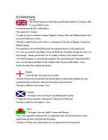
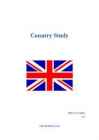
1) General facts The UK: * the United Kingdom of Great Britain and Northern Ireland was formed in 1801 * it covers 243,610 sq km * everybody from the UK is called British * the capital city is London * is made up of four constituent countries: England, Scotland, Wales and Northern Ireland which in turn are divided into counties * the flag is called the Union Jack which is a combination of the flags of England, Scotland and Northern Ireland * the population is about 60,000,000 people, the population density is 242 people/sq km * its coasts are washed by the Atlantic Ocean, the North Sea, the English Channel, the Celtic Sea, Saint George's Channel, and the Irish Sea. It is linked to France by the Channel Tunnel * the United Kingdom is a constitutional monarchy
THE CITY OF LONDON History The City of London occupies one square mile in the middle of the capital. It once made up entire town of London, surrounded by the wall first built by Romans. The Romans also built a bridge over the Thames and there has been one in the same area ever since. The Roman Londinium grew up on the northern side of the bridge. In AD 61 the native Celtic tribe, led by Queen Boudicca, rose up against the Romans. They burnt down Londinium to the ground and killed most of its inhabitants. Roman armies eventually defeated Boudicca and Londinium was rebuilt. At the end of the fourth century AD the Roman Empire began to crumble and the Roman armies
Years 1154-1485 Henry I was the first unquestioned ruler. One of the most important kings in the Middle Ages. He had lands in Britain & France. Then the government was the monarch, a person, not a place. He had more land than any pervious king. After his marriage to Eleanor of Aquitaine, he also ruled the lands south of Anjou. His empire stretched from the Scottish border to the Pyrenees. England provided most of its wealth, but the heart was Anjou. Henry II began to regain royal control. During the war some barons had become very powerful. He pulled down some of their castles. He tried to restore law & order. He wanted the same kind of justice to be used everywhere. He appointed his own judges to travel around the country. They dealt with crimes & disagreements over poverty. Serious offences were tried in the king's court
items of government legislation. Discusses domestic matters with the Master of the Household. Towards the end of the day, there is always another pile of official papers and reports waiting to be read or acted upon. The business on constitutional monarchy never ends. 3. Who is the present heir to the throne? Speak about his education. Who are the 2nd and 3rd in line? Present heir is Prince Charles, The Prince of Wales. Has been an exchange student in Australia. Graduated from the university of Cambridge with BA (honors). 2nd and 3rd in line are Prince William of Wales and Prince Henry of Wales, respectively. 4. Make up your list of 5 top British people. Give your motivation. The Queen, Adele, Elton John, Shakespeare, JK Rowling. 5. Which 5 places attract visitors in Wales and Scotland? Edinburgh, Loch Ness, The Highlands, Snowdonia, Cardiff. 6
Great Britain Across / 'krs / risti, läbi, põiki Locality / l'kælt / asukoht, paikkond Inland body / 'nlænd 'bd / sisemaine osa Inlet / 'nlet / merekäär, laht Headland / 'hedlnd / neem Scour / 'ska / küürima Foreshore / 'f:: / tõusu ja mõõna vaheline rand Recreational / rekr'enl / lõõgastumis-, vabaaja- Scenery / 'si:nr / maastik Juxtaposition / dkstpz'in / kõrvuti asetsev GB consists of England, Scotland and Wales. GB is only a dot on the world map. It offers a great variety and scenic contrasts are often within easy reach. The coastline is washed by the tidal system twice a day. Britain´s speciality is the man-made scenery. Each part of the country has its peculiar geographical features. England Indented / n'dentd / sakiline Estuary / 'estjr / suudmelaht
Like most cities with an eight-hundred-year-old past, Tallinn is a patchwork of historic areas. The city's pride and joy is without a doubt its Medieval Old Town, but equally enchanting is the Kadriorg district, a throwback to the time when Estonia was ruled by the Russian Tsars. Tallinn is the capital and largest city of Estonia. It occupies an area of 159.2 km2 with a population of 416,470. It is situated on the northern coast of the country, on the shore of the Gulf of Finland, 80 km south of Helsinki, east of Stockholm and west of Saint Petersburg. Tallinn's Old Town is in the list of UNESCO World Heritage Sites. It is ranked as a global city and has been listed among the top 10 digital cities in the world.The city was a European Capital of Culture for 2011, along with urku, Finland.Tallinn is the oldest capital inNorthern Europe. The city was known as Reval from the 13th century until the 1920s. http://en.wikipedia.org/wiki/Tallinn Old Tallinn
Every five years national song and folk dance festivals take place in Tallinn. The yachting regatta of the 1980 Moscow Olympic Games was held at Pirita. History Tallinn means in English "Danish town". The place is believed to have been settled by Finno-Ugric people about 2500 BC. It was first marked on a map of the world by the Arab geographer al-Idrisi in 1154. The Estonians were the first to build a stronghold on the spot of the Toompea Hill, but the real Tallinn was built by the Danes who conquered the north of Estonia in 1219. Legend has it that one day, when the Danes were about to lose a bloody battle, the sky suddenly opened and a red flag with a white cross on it dropped down upon them from the heaven. This is how the Danes obtained their national flag. In 1346 the Danish king sold his Estonian lands to the Teutonic Order, who a year later resold them to the Livonian Order. The Germans renamed Tallinn and called it Reval.
..............................................................................................23 During the first questionnaire 30 students of the 9th and 10th class of Gymnasium were questioned about the British national symbols...........................................................................23 Surprisingly, according to the results, more than 50 percent of students are aware of the national flags of Great Britain, Scotland, Northern Ireland and Wales. As can be seen, quite a lot of children also know the name of the Great Britain flag. However, almost all of the students have no idea about other names of the British flags, as well as about the patron saints. In addition, almost 90 percent of students are also unaware about the national holidays..........23 All things considered, we see that there is a need for students to pay more attention to
After thorough reforms in Estonian economy the people living in villages and small towns are searching for new possibilities for self-realisation and one of the outputs is tourism. This can also be seen in Southern Viljandimaa as there are continuously more establishments providing accommodation, caterers and organisers of active holidays. Many tourism maps have been put beside the road as well as many hiking trails have been built and marked. History of Estonia Human settlement in Estonia became possible 11,00013,000 years ago, when the ice from the last glacial era melted away. The oldest known settlement in Estonia is the Pulli settlement, which was located on the banks of the river Pärnu, near the town of Sindi, in southern Estonia. According to radiocarbon dating, it was settled around 11,000 years ago, at the beginning of the 9th millennium BC
Stonehenge One of the best known ancient wonders of the world, 5000 years old Megalith monument, built by western mediterraneans during 3000-1600 BC Circular structure, large standing stones, aligned with rising sun at teh solstice Attlers and bones were sued to dig pits that hold the stones The Celts in Britain and their legacy 700-200 BC celts invade Britain Gaels or Goehls(Ireland and Scotland),Cymri(Wales) and Brythons(gave name to Brittany) Fierce fighters,superb horsemen.Most of them farmers, lived in thatched houses Good at art, craftmanship, used iron
Topic Australia Introduction Many people know Australia as the land down under because it is the only continent except for Antarctica that is all on the southern hemisphere. Its name means ,,Southland". The official name of the country is the Commonwealth of Australia. It's capital is Canberra. Australia is the sixth largest country in the world but the smallest continent. Australia has 6 states and 2 territories (New South Wales, Victoria, Tasmania, Queensland, Western Australia , South Australia, The Australian Capital Territory and the Northern Territory). The Australian people are culturally the same as the Anglo Americans. There also live aborigines. Aborigines are the ancestors of the people. Like the US and Canada, Australia was an English speaking colony of Great Britain. Today Australia is a modern developed country with a diversified economy. Australia is an island continent of 7.7 million square kilometres, which makes it a little smaller than the USA.
Report of SCOTLAND Maiki Joakit 10. klass 2008 Etymology Scotland is from the Latin Scoti, the term applied to Gaels. The Late Latin word Scotia (land of the Gaels) was initially used to refer to Ireland. By the 11th century at the latest, Scotia was being used to refer to (Gaelic-speaking) Scotland north of the river Forth, alongside Albania or Albany, both derived from the Gaelic Alba. The use of the words Scots and Scotland to encompass all of what is now Scotland became common in the Late Middle Ages. History Repeated glaciations, which covered the entire land-mass of modern Scotland, have destroyed any traces of human habitation that may have existed before the Mesolithic period. It is believed that the first post-glacial
 annaabi.ee