Leidsid 33 sarnast õppematerjali, mis on seotud failiga "Animals shrinking in the heat". Need materjalid aitavad sul teemat sügavamalt mõista.
animals, change, plants, warming, deer, birds, warmer, years, body, types, fish, species, affected, size, percent, heat, daily, author, tamara, cohen, global, scientist, such, sheep, temperatures, survive, while, others, struggling, mammals, getting, miniature, today, could, force, extinct, university, singapore, tortoises, even, polar, bears, alreadyDuring the summer the sun shines almost 24 hours a day. Summer are usually warm. Average summer temperatures range from 3° to 16°C. TaigaTaiga is the Russian word for forest and is the largest biome in the world. It stretches over Eurasia and North America. The taiga is located near the top of the world, just below the tundra biome. The winters in the taiga are very cold with only snowfall. The summers are warm, rainy, and humid. Some of the animals in the taiga hibernate in the winter, some fly south if they can, while some just cooperate with the environment. GrasslandsGrassland biomes can be found in the middle latitudes. They can have either moist continental climates or dry subtropical climates. There are two different types of grasslands; tall-grass, which are humid and very wet, and short-grass, which are dry, with hotter summers and colder winters than the tall-grass prairie
Tundra Tundra is the world's youngest biome. It was formed 10 000 years ago. Located at latitudes 55° to 70° North. Almost all tundras are located in the Northern Hemisphere, encircling arctic desert and extending south to the coniferous forests of the taiga. The ecotone (ecological boundary region) between the tundra and the forest is known as the tree line or timberline. Tundra comes from the Finnish word tunturi, meaning treeless plain. It is noted for its frost-moulded landscapes, extremely low temperatures, little precipitation, poor
situated directly beneath the islands and also It is the point where major ocean currents meet. These circumstances combine to make an area that truly is like no other place on earth. Galapagos is comprised of 13 major islands, more than 120 smaller islets and rocks, and the surrounding ocean. The total land mass is almost 8,000 sq. km. Highest peak is Wolf Volcano reaching 1707m. The present islands are all younger than 4 million years and were formed separately from other land masses as a result of volcanic eruptions. The Galapagos were discovered in 1535 by Fray Toms de Berlanga, the Bishop of Panama. He was sailing from Panama to Peru when he accidentally discovered the islands. Islands became a favorite hideout for Pirates and the favorite location for whale hunters. After whales were locally cleared the whalers went there for tortoises, an estimated 200 000 or more adults had been removed. The island of Floreana was
middle latitudes typically have between 25 cm and 50 cm of precipitation a year. Much of this falls as snow, serving as reservoir of moisture for the beginning of the growing season. Warm to hot summers are experienced, depending on latitude. In the winter, grassland temperatures can be as low as -40° C, and in the summer it can be as high 20° C. There are two real seasons: a growing season and a dormant season. The growing season is when there is no frost and plants can grow (which lasts from 100 to 175 days). During the dormant (not growing) season nothing can grow because it's too cold. Taiga- Long, cold winters, and short, mild, wet summers are typical of this region. In the winter, chilly winds from the arctic cause bitterly cold weather in the taiga. The length of day also varies with the seasons in the taiga. Winter days are short, while summer days are long. The average temperature is below freezing for six months out of the year
In the southern the climate ranges from warm temperate to cool temperate. Winter temperatures can be low but rarely freezing in the southern states. Australia is a land of droughts and floods. The droughts are caused by the EL Nino, a weather pattern which happens when the Southern Pacific Ocean heats up. This causes the wind direction to reserve. Instead of bringing moist air towards eastern Australia, the rain bearing clouds are blown away. An EL Nino occurs every four or five years causing droughts and bushfires. Droughts are often followed by floods. Plant Life A long time ago Australia was separated form other countries. This movement caused the difference of species, plants and animal form the other countrys. The water controls the type of vegetation in a country. The two main types of vegetation are the eucalyptus or gum trees and acacia or wattles. The eucalypts are found all over Australia. There are more than 500 varieties of gum trees in Australia
Global Warming One of the biggest issues our planet and its inhabitants are facing nowadays is global warming. Global warming, also often referred to as the greenhouse effect, has not always been a problem. However, over the last centuries, since the Industrial Revolution things have changed. Polar regions are melting, species are dying, climate zones are shifting, migration patterns for animals such as polar bears and birds are being disrupted our world as we know it is changing. Some scientists believe that the climate will reach a tipping point, a point at which even a tiny additional increase would throw the system into violent change. We started doing harmful things and only now do we realize what we have done and what we are doing. At this current rate by the middle of next century the Earth's temperature may rise a predicted from 2 to 6 degrees Celsius. This may not seem as much but with the Earth's
ENVIRONMENTAL PROBLEMS Our environment is constantly changing. However, as our environment changes, so does the need to become increasingly aware of the problems that surround it. With a massive influx of natural disasters people need to be aware of what types of environmental problems our planet is facing. Current environmental problems make us vulnerable to disasters and tragedies, now and in the future. Unless we address the various issues seriously we are surely doomed for disaster. Current environmental problems require urgent attention. 1. Pollution: Pollution of air, water and soil require millions of years to recoup. Industry and motor vehicle exhaust are the number one pollutants
TARTU VEERIKU KOOL New Guinea animals and plants Koostaja: Tauri-Viljar Vahesaar Juhendaja: Priit Pensa Tartu 2009 Table of content Introduction................................................................................................................................................3 The forests of New Guinea ..................................................................................
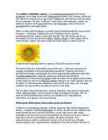
The sunflower (Helianthus annuus) is an annual(iga aastane) plant in the family Asteraceae, with a large flower head (inflorescence(õiekobar, õisik, õitseaeg, õidumine)). The stem(tüvi) of the flower can grow up to 3 metres tall, with the flower head reaching 30 cm in diameter. The term "sunflower" is also used to refer(nimetama, viitama, üle andma) to all plants of the genus(perekond, sugu) Helianthus, many of which are perennial(alaline, aastaringne) plants. What is usually called the flower is actually a head (formally(ametlikult) composite(liit-, komposiit- ; korvõieline, komposiit) flower) of numerous flowers (florets) crowded(täistuubitud, tunglev, rahvarohke) together. The outer flowers are the ray florets(pähik (õisiku osa) and can be yellow, maroon, orange, or other colors, and are sterile(steriilne, viljatu). The florets inside the circular head are called disc florets.
SISUKORD ENERGY STORY................................................................................................................4 USES OF ENERGY............................................................................................................. 4 2.1 Uses of energy in homes...............................................................................................5 2.2 Types of energy used in homes.................................................................................... 6 2.3 Energy use in different types of homes........................................................................ 6 2.4 Commercial Energy Use...............................................................................................9 2.5 Industrial and Manufacturing Energy Use..................................................................11 2
various purposes such as transportation, fishing, exploration and many more. However, the deep part of the sea is still remains untouched. Seeing the situation majority of the scientist thought that life would be scant in the deep sea, but almost each search has discovered that life is plentiful in this reason. The deepest layer of ocean has lots of unthinkable stories, secrecy and legends that make mankind more curious about the life that is surviving bottom of the sea. Deep sea animals Deep sea animals live in the marine ecosystem or in oceans. If you look at the marine biology, you will find millions of species of sea animals. The marine life is a large resource that offers tourism, research and recreation for many countries across the globe. Marine life helps to determine the very nature of our planet. All the Deep Sea Animals along with other organisms such as algae and corals contribute to the oxygen cycle and regulate our earth's
Nikita Naumov Tallinn 2009 Contents: 1. Renewable energy 1.1. Costs................................................................................................................... 2 1.2. Potential future utilization..............................................................................4 1.3. Why Don't We Use More Renewable Energy? ...........................................5 2. Energy Types 2.1. Wind Energy.......................................................................................................6 2.1.1. Annual Generation........................................................................................7 2.1.2. Growth and cost trends................................................................................8 2.1.3. Theoretical potential.....................................................................................9 2.1.4. Benefits of wind energy.........
Tundra animals Reindeer Reindeer were first domesticated in Norway and northern Asia. When it was seen how valuable they were, they were brought to Alaska in 1887 and later to parts of Canada. These North American reindeer became known as caribou. Although they are called by different names, they are both considered to be a single species. Unlike deer, both the male and female have antlers. The antlers of the male are long, branched and massive, and they are a little flattened at the ends. The antlers of the female are much shorter, simpler and more slender and irregular. Their large, spreading hooves support the animal in snow in the winter and marshy tundra in the summer. Reindeer are also great swimmers and use their feet as paddles.
The Iberians brought their metal working skills and the first real civilization to Britain in the 3rd millennium B.C. And were then overrun by the various Celtic tribes that begun in the 8th century B.C. The Celts introduced the tribal organization and an early form of agriculture before they were forced westwards to Cornwall, where the Celtic language still exists in different forms, by the Roman invasion begun in 43. AD. The Romans ruled Britain for over two hundred years and left behind three things of importance: their roads, the sights of important cities notably London, and the seeds of Christianity. The Latin way of life villas, arts, language and political organization all vanished, however after the invasions from Northern Europe by the Anglo-Saxons and Jutes from the 5th century onwards. These pagan peoples' were easily converted to Christianity and the preachers from Rome brought with them learning and civilization.
Table of contents 1. Introduction 2. Geographical position 3. Mountains, lowlands 4. Rivers, lakes 5. The territories and provinces 6. Towns, economy, agriculture 7. Climate 8. Animals, plantlife 9. Population 10. Sports 11. Culture 12. History 13. Political system, symbols 14. Conclusion 15. Materials 1. Introduction If you had to use two words to describe Canada, they might be large and diverse. Canada is the second largest country in the world, bordered by three oceans, and across the country, Canadians experience many different landscapes from rolling plains and mountains to the cold tundra of the north. Despite Canada's great size, it is
The coat of arms features a kangaroo and an emu (the national animals of Australia), golden wattle (the national floral emblem), a shield with the coats of arms of the six states of Australia and a star for all states and territories. Australia's national anthem is "Advance Australia Fair", which replaced "God Save The Queen" in 1984. the unofficial anthem is "Waltzing Matilda". As said before Australias national animals are kangaroos and emus. Often coalas are mentioned too, its floral emblem is the golden wattle and its national colours are the colours of its flag red, white and blue. Head of state Head of state is Queen Elizabeth II, who is queen of United Kingdom and also queen is Australia. In practice, Governor General performs her functions in queen's absence. Since 1989 Bill Hayden has been the Governor General Government
..........................................................................................................3 Geographical Position.....................................................................................................3 Relief...............................................................................................................................4 Climate & Time Zones....................................................................................................5 Plants...............................................................................................................................5 Animals...........................................................................................................................6 Population.......................................................................................................................6 The Native Australians..............................................................................
MIINA HÄRMA GYMNASIUM Deserts Saudi-Arabia Tartu 2007 Deserts In geography, a desert is a landscape form or region that receives very little precipitation. Generally, deserts are defined as areas that receive an average annual precipitation of less than 250 mm (10 inches). Deserts cover at least one-fourth of the Earth's land surface. Desert biomes can be classified according to several characteristics. There are four major types of deserts: · Hot and dry · Semiarid · Coastal · Cold Location The four major North American deserts of hot and dry deserts are the Chihuahuan, Sonoran, Mojave and Great Basin. Others outside the U.S. include the Southern Asian realm, Neotropical (South and Central America), Ethiopian (Africa) and Australian. The major deserts of semiarid deserts include the sagebrush of Utah, Montana and Great Basin
The 2nd layer: saplings and shorter kinds of trees The 3rd layer, or understorey: shrubs. The 4th layer: forest herbs, such as wildflowers and berries. In spring, before the leaves develop on the deciduous trees, these herbs bloom and grow quickly while they are getting a lot of sunlight. The 5th layer: mosses and lichens that grow on tree trunks. Lianas such as wild grape, poison ivy, and Virginia creeper climb the trees to flower and fruit high in the forest canopy. Plant adaptations: The plants have adapted so that they can survive in this biome. The leaves of deciduous trees are broad and quite light. This gives the leaves a bigger surface to capture sunlight to help produce food for the plant. This is called photosynthesis. When the weather gets cold, broad leaves are not good for the plant, as they lose too much moisture and get damaged. So the trees cut off the water supply to the leaves and seal off the leaf stems where they join onto the tree trunks. The leaves are not able
are characterized by widely spaced, scattered trees, however in many savanna communities tree densities are higher and trees are more regularly spaced than in forest communities. The open canopy allows sufficient light to reach the ground to support an unbroken herbaceous layer consisting primarily of C4 grasses. Savannas are also characterised by seasonal water availability, with the majority of rainfall being confined to one season of the year. Savannas can be associated with several types of biomes. Savannas are frequently seen as a transitional zone, occurring between forest and desert or prairie. Although the term savanna is believed to have originally come from a Native American word describing "land which is without trees but with much grass either tall or short", by the late 1800s it was used to mean "land with both grass and trees". It now refers to land with grass and either scattered trees or an open canopy of trees. Changes in fire management
an island but rather small for a continent. Australia is 1,800 miles from the mainland of Asia and almost half way round the world from Europe. More than 6,000 miles of ocean separate in from the America. Australia is the only continent except for Antarctica that lies all south of the equator. The natural zones of Australia are very various. There are deserts, semi deserts, grasslands, savannas, bushlands and rainforests. The wet forests occupy the narrow region in the east. Most of the animals, birds and insects live in that region, because there is enough food. The savannas which are grasslands with some trees are mostly in the west. Farther west are the bushlands. The real deserts occupy the centre of the Western Plateau. In the very south west there are thin forests of evergreens trees. Australia is the driest inhabited continent, the flattest, and has the oldest and least fertile soils. Only the south-east and south-west corners of the continent have a temperate climate
Estonia is a small country in Northern Europe with an area of about 45 000 sq km. The country's climate is determined by the proximity of the Atlantic Ocean. The summer temperatures are a little lower than the average of that latitude, but the winters are considerably warmer. As a part of the East-European Plain, the country has a rather flat surface. The highest and most topographically variagated region in Estonia is in the south-eastern part of the country. The Sakala Upland plains offer contrast to the hills of Ottepää, Karula and Haanja. At 318 metres, Suur Munamägi ('Great Egg Hill') is not only the highest point in Estonia, but of all the Baltic countries. The country has 3974 km of coastline, while the land border, in comparison, is only a mere 633 km
The ship spilt only 5% of the oil spilt that year, and oil is just one of many pollutants that people dump into the water every year. Every year, 14 billions pounds of sewage, sludge, and garbage are dumped into the world's oceans. 19 trillion gallons of waste also enter the water annually. The problem of ocean pollution affects every nation around the world. This is especially true because water is able to transport pollution from one location to another. For many years, chemicals were dumped into bodies of water without concern. While many countries have now banned such behavior, it continues to go on today. As the world has industrialized and its population has grown, the problem of water pollution has intensified. The simple fact that millions of people live along coastlines and near rivers means that these bodies of water are likely candidates for heavy and destructive pollution. It is hard to know now what our oceans will look like in the future
The nearest neighbor may be a hundred kilometers away. The nearest city may be more than one thousand kilometers away. Many people in this area live on sheep stations which are enormous farms. Uluru One of the most beautiful things in Australia is Uluru (Ayers Rock) in the outback. It is an enormous rock alone in the middle of the desert. It is three kilometers long and 348 metres high. There is another 2000 meters under the ground. Uluru is 600 000 000 years old and it is the largest rock in the world. The Great Barrier Reef. One of the natural wonders of the modern world is the Great Barrier Reef. It is located off the northeast coast of Australia. It is the biggest coral reef in the world extending 2000 kilometers along the coast of Queensland. It consists of more than 600 coral islands. Some of them are true coral islands, other are the tops of submerged mountain ranges covered with lush tropical growth
were not satisfactory. With the passage of time, paper was first invented in China and later mushroomed in the rest of the world. The above inventions were worth mentioning to interpret the fact that how man moulded himself in accordance with his needs. As the need arose, man came up with new ideas, new thoughts, and forcefully pushed his mind to run on that particular line of action. Even in the modern era, man has been found to observe the same behavioral patterns. Some years ago, TB and cancer were regarded as incurable diseases, man conducted massive research on them and finally came up with effective solutions. Whether it is the old age or modern era, man has been found too efficient to satisfy his needs and has set numerous examples of it. No matter whether it was a political issue, scientific concern, or even day-to-day chores of life man has reacted in a flexible mood to create a way for himself whenever he realized his needs
151,480 miles of coastline. Most of Canada's human population lives along its southern border. 3. Relief Canada's geography is very diverse. It has huge lakes, evergreen forests, prairies, meadows and beautiful mountains. There are thousands of miles of coastline with beaches, fjords and wild rivers flowing to the oceans. Canada is a country of wide open spaces and beautiful landscape where traveling visitors can unexpectedly bump into wild animals like bears or be struck by unusual sight like the scarecrows on the Cabot Trail. Canada is rich in natural wonders, one of them, the Niagara Falls between lakes Erie and Ontario, which is the second biggest waterfall in the world is one of the greatest attractions in the world. About twelve million tourists come to see the beauty of the falling waters on the border between the United States of America and Canada
grown on the African oil palm tree. Oil palms are originally from Western Africa, but can flourish wherever heat and rainfall are abundant. Today, palm oil is grown throughout Africa, Asia, North America, and South America, with 85% of all palm oil globally produced and exported from Indonesia and Malaysia; but most of the time not using sustainable measures. The industry is linked to major issues such as deforestation, habitat degradation, climate change, animal cruelty and indigenous rights abuses in the countries where it is produced, as the land and forests must be cleared for the development of the oil palm plantations. According to the World Wildlife Fund, an area the equivalent size of 300 football fields of rainforest is cleared each hour to make way for palm oil production. This large-scale deforestation is pushing many species to extinction, and findings show that if nothing hanges, species like the
....................................................................................................5 Queen Victoria.............................................................................................................5 Relief............................................................................................................................6 Climate ........................................................................................................................7 Plants............................................................................................................................7 Animal life................................................................................................................... 7 Natural Resources........................................................................................................ 8 Economy..........................................................................................................
It's the driest inhabited continent, only its south-east and south-west corners have a temperate climate. · The climate of Australia is significantly influenced by ocean currents, which is correlated with periodic drought, and produces cyclones in northern Australia. · Much of the northern part of the country has a tropical summer rainfall (monsoon) climate. The southwest corner of the country has a Mediterranean climate. Much of the southeast is temperate. · Climate change has become an increasing concern in Australia in recent years, with many Australians considering protection of the environment to be the most important issue facing the country. Australian nature · Eastern Australia is marked by the Great Dividing Range and it consists of low hills and the highlands are typically no more than 1,600 metres. There are large areas of grassland. · The landscapes of the northern part of the country, with their
4 lactose binds to repressor; 5 changes shape of protein molecule; 6 unable to bind (to operator); 7 RNA polymerase binds (at promoter) / transcription occurs / genes switched on; 8 AVP; e.g. production of lactose permease / production of beta- galactosidase; max 5 [5] 4. a change in the genetic material; unpredictable / AW; extra detail; e.g. addition / substitution / deletion / frame shift / small part of chromosome / may code for different protein / may code for no protein [2] 5. 1 mark max for general effect of mutations: mutation may give different, amino acid / primary structure; A ref stop codon
St. Lawrence River as far downstream as the city of Québec, the climate is characterized by relatively warm summers and cool winters, moderated by surrounding water bodies. These conditions are suitable to the development of mixed wood and broadleaf forests. Mineral Resources Mining and fuel extraction and production accounted for 4.5 percent of Canada's GDP or some US$36.1 billion. Fuel exploration and production dominate this sector, but the processing of other types of mineral resources has grown significantly. In 1996, the top non-fuel minerals were gold with production of US$2.05 billion, copper US$1.47 billion, nickel US$1.45 billion, and zinc US$1.25 billion. There was also significant production of lead and iron. There are about 50 major gold mines in Canada and the country leads the world in technologies which extract gold from rock and soil. The nation is the world's largest producer of zinc and the fifth largest producer of lead
threatened bear species. • A very high risk of extinction (väljasuremine) in the wild. • Despite "the establishment of nearly 60 panda reserves, a ban on logging (metsaraie keeld), and widespread reforestation programmes," habitat destruction and degradation are still the panda's greatest enemies. 2. SUN BEAR • The world's smallest bear species. • We estimate that sun bears have declined by at least 30 percent over the past 30 years and continue to decline at this rate. • Sun bears live mostly in the tropical forests of mainland Southeast Asia. • The two major threats to the species are habitat loss and commercial hunting. 3. ASIATIC BLACK BEAR • Found in forests in every country in mainland Southeast Asia, except Malaysia • The species suffer from habitat loss due to logging (metsaraie) and expanding human settlements. • Japan is the only country that has 4. SLOTH BEAR
encompasses 14 states, including many of the states of the south eastern U.S. through its largest tributary, the Tennessee River. During the eighteenth century, it was the southern boundary of the Northwest Territory, thus serving as the border between free and slave territory. Other The Great Plains is the board expanse of prairie and steppe which lies east of the Rocky Mountains in the United States and Canada. Grand Canyon created by Colorado River cutting a channel over millions of years, is about 227 miles long, and attains a depth of more than a mile. Nearly two billion years of Earth's history has been exposed as the Colorado River and its tributaries cut through layer after of sediment as the Colorado Plateaus have uplifted. 5. Climate Due to its large size and wide range of geographic features, the United States contains examples of nearly every global climate. The climate is temperate in most areas, tropical in Hawaii and
 annaabi.ee