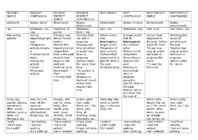
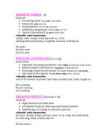
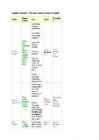
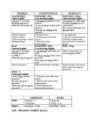
Leidsid 33 sarnast õppematerjali, mis on seotud failiga "Active voice, passive voice". Need materjalid aitavad sul teemat sügavamalt mõista.
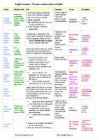
voiceActive Present Past Future Simple I work II (-ed) Will + I usually Don’t work Didn’t work Will not work Continuous am/is/are + V-ing Was/were + V-ing Will+be+V-ing Продолжитель. Isn’t working now Wasn’t working Won’t be working Perfect Have/has + III Had + III Will have +
ought to shall shan't should will won't would wouldn't Can and be able to: · Can you play the piano? · I'm not able to come to the game on Friday. Must and have to: · The tennis match must be over by now. (I'm sure it is). · I have to get up early tomorrow to catch the train to the office. 9. The passive voice: The Passive uses the SUBJECT + TO BE + PAST PARTICIPLE Subject verb `to be' past participle Simple present: The house is cleaned every day. Present continuous: The house is being cleaned at the moment. Simple past:
Passiv: A letter has been written by Rita Future 1 Active: Rita will write a letter Passiv: A letter will be written by Rita Past Perfect Active: Rita had written a letter Passiv: A letter had been written by Rita TENCE FORM ACTIVE VOICE PASSIVE VOICE Present Simple/Indefinite I pv (he, she, it I pv + -s) am/is/are + III pv Past Simple/indefinite II pv. or -ed was, were + III pv Future Simple/Indefinite will+I pv will be + III pv Present am/is/are + -ing am/ is/are being + -ing Progressive/continuous
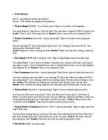
work is well known today. One of the reasons Dickens remained so popular is that so many of his stories are remains available not only as books but also as movies, plays, and television productions. We all knew from our childhood the famous story of uncle Scrooge and Tiny Tim. know We often saw a television version of A Christmas Carol at see holiday time. Voice: Passive v. Active (pg 225) In the active voice, the subject is doing something. Subject Verb The committee made the decision. _________ _____ In the passive voice, something is being done to the subject. Subject Verb The decision was made by the committee. _______ _________ Why choose one over the other? In general, choose the active voice to achieve direct, economical, and forceful writing. Most writing should be in the
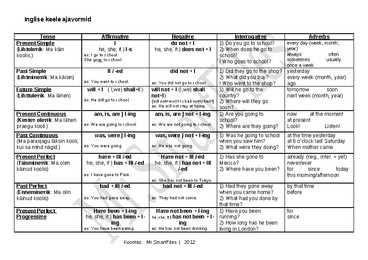
Inglise keele ajavormid Tense Affirmative Negative Interrogative Adverbs Present Simple I do not + I 1) Do you go to school? every day (week, month, (Lihtolevik: Ma käin he, she, it } I-s he, she, it } does not + I 2) When does he go to year) koolis.) ex: I go to school. school? always often She goes to school. ! Who goes to school? sometimes usually once a week Past Simple II / -ed did not +
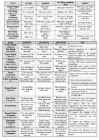
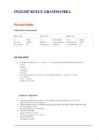
englisch-hilfen.de LEARNING ENGLISH ONLINE Examples Examples Examples Tense Signal words Use Form affirmative negative interrogative every day something happens repeatedly sometimes how often something happens always I work. I don't work. Do I work? one action follows another often Infinitive He works. He doesn't work. Does he work? Simple Present things in gene
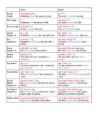
Get/ Have something TENSE ACTIVE PASSIVE WHEN? done Present Simple Am/is/are + Every day, year, often, I pv + do/does Have/ get + sth+ III pv Lihtolevik III pv usually, always Past Simple Yesterday, last year, II pv(-ed)+ did Was/ were + III pv Had/got + sth + III pv Lihtminevik last week Present
TENSES. ACTIVE VOICE. 1. Present Simple (üldolevik) I (he, she, it s) he works Eitav,küsiv do (I, you, we, they) he does not work does (he, she, it) does he work? Verbidele, mis lõpevad infinitiivis ss, -sh, -ch, -x või o, lisatakse ainsuse 3. pöördes es he touches, she goes Verbidel, mis lõpevad y-ga, mille ees on konsonant, muutub y->ies carry - he carries Vrdl: play he plays 1. Harjumuspärane, korduv tegevus või seisund olevikus. Tom drinks tea every day. He lives in Brussels. 2. Üldtuntud tõed, loodusseadused The earth goes round the sun. 3. Tulevikus toimuv tegevus a) Sõiduplaanid, planeeritud programmid. The train for Tallinn leaves at 10. The course begins on Monday. b) Tingimuslausetes
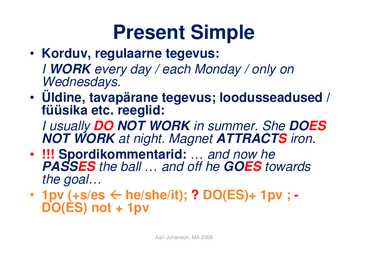
Present Simple · Korduv, regulaarne tegevus: I WORK every day / each Monday / only on Wednesdays. · Üldine, tavapärane tegevus; loodusseadused / füüsika etc. reeglid: I usually DO NOT WORK in summer. She DOES NOT WORK at night. Magnet ATTRACTS iron. · !!! Spordikommentarid: ... and now he PASSES the ball ... and off he GOES towards the goal... · 1pv (+s/es Å he/she/it); ? DO(ES)+ 1pv ; - DO(ES) not + 1pv Aari Juhanson, MA 2008 Present Progressive · Hetkel toimuv, pooleliolev tegevus: S/he IS TALKing on the phone now. I AM READing an interesting book. · Ajutine, regulaarsele ja tavapärasele vastanduv tegevus (tulevikku viitav): This summer they ARE not GROWing cucumbers as usual. They'RE GROWing tomatoes instead. · !!! Halvakspanu väljendus harjumuspärase tegevuse kohta: He IS always COMPLAINing! · BE (am/is/are) + 1pv-ing Aari Juhanson, MA 2008 Present Perfect ON -NUD ·
PRESENT PRESENT PRESENT PRESENT PAST SIMPLE PAST PAST PERFECT PAST PERFECT SIMPLE CONTINIOUS PERFECT PERFECT CONTINUOUS SIMPLE CONTINUOUS SIMPLE CONTINUOUS Lihtolevik Kestev olevik Täisminevik Kestev Lihtminevik Kestev minevik Enneminevik Kestev täisminevik enneminevik I pv Am/is/are, I pv, Has/have, III Has/have, II pv, -ed Was/were, -ing Had, III pv Had, been, -ing -ing pv/-ed been, -ing *Recurring *Action *(Giving new *Actions that *Short action *Longer actio
PRESENT SIMPLE [s] lihtolevik · kestvad tegevused. Tom works in the market. · rutiinid. He works every day. · loodusseadused. The sun sets in the west. · ajatabelid ja programmid. The buss leaves at 7 am. · (spordi) kommentaarid. Ben passes ball to Tom. väljendid, mida kasutatakse: usually, often, always, every day/week etc, in the morning/afternoon/evening, at night/the weekend, on Friday etc. He works He don't work Does he work PRESENT CONTINUOUS [ is + ing] kestev olevik · tegevused, mis praegu leiavad aset. Karl is doing his homework at the moment. · plaanitud tegevus lähitulevikus. I am going to school tomorrow. · kui midagi toimub/muutub praegu. The number of burglaries is increasing. · alati sama korduv tegevus. You are always eating, when i wake up. väljendid, mida kasutatakse: now, at the moment, at present, these days, nowdays, still, today, tonight etc. He is working He isn't working Is he working PRESENT PERFECT
English Grammar - The most common tenses in English Signal Example Tense Use Form words s something happens repeatedly how often something happens every one action day follows sometim another es I work always infinitive Present things in he/she/it he works often Simple general + s I go usually he goes seldom after the never
SIMPLE CONTINUOUS PERFECT I (-s) DO/DOES AM/IS/ARE + ING HAVE/HAS + III pv. I learn English I am learning English I have learned English. I get up at 7 every day. I'm reading a good book at the I've learned 10 words today. He doesn't get up at 7. moment. He hasn't learned any new What time do you get up? He isn't reading anything at the words today. moment. How many words have you What are you reading at the learned today? moment? 1 Korduv tegevus. 1 Praegu toimuv. 1 Äsja lõppenud 2 Püsiv olukord. 2 Praeguse perioodi vältel 2 Täna/sel nädalal toimunud 3 Tulevikus toimuv, seotud toimuv. 3 Elavate inimeste koht
Simple Continious Perfect to be + ing to have + III pv/ -ed I pv. is/am/are + ing Present -s (3 pööre) have/has + III pv/ -ed -/? Do, Does II pv. / -ed Past was/were + ing had -/? Did + I pv. Future Will + I pv. will be + ing will have
Olevik: PS He/she/it + -s /Does I/you/we sama /Do PC am/is/are + -ing PP ... + Have/has + III PPC ... + Have/has been + -ing Minevik: PS -ed/III PC Was/were + -ing PP I/she/it/you/they + Had + -ed/III PPC - ... + had + been + -ing PPS - ... + have/has + III Olevik: Present Simple Lihtolevik: Tegijale harjumuspärane, tihti korduv tegevus, loodusseadused, sõiduplaanid, püsiv olukord. Eevery day/month/ year/once twice a week /often/ usually/ always/seldom/never. Tulevikku väljendades pärast: when, after, as soon as, until. Olekut väljendavate tegusõnadega: Like, love, hate, enjoy, prefer, adore; See, hear, smell, taste, feel, look, sound; Know, believe, understand, realise, remember, forget, notice, recognise, think, seem; Be, contain, include, belong, need, cost, mean, want, have, wish, own. He/she/it + -s /Does I/you/we sama /Do Present Continuous Kestev olevik: Tegevus toimub praegu. Tegevus toimub lähiajal. Ajutine olukord. Plaanid ja kok
English Grammar - The most common tenses in English Tense Signal words Use Estonian Form Examples · something happens repeatedly *korduv tegevus every day · how often something happens *püsiv olukord sometimes, *tulevikus · one action follows another I work Present twice a week toimuv, seotud · things in general infinitive he works Simple always, often sõiduplaanidega · after the following verbs (to love, he/she/it + s I go lihtolevik usually
Tense Form Use Hints Example + I pv ((e)+s) Present Simple 1. daily routines, habits or repeated actions Every hour/day/week etc , I always play football in -? do/does not+I pv 2. permanent states usually, always, in the the evenings morning/evening/night, at night Present Am/is/are+Iing 1. actions happening now, at the moment of speaking Now, at the moment, these I am writing a lettesat Continuous 2.actions happening around the time of speaking days,
INGLISE KEELE PÕHITÕED C.K 2017 A – AN – SOME Singular: a or an Use some for things you can't count ◦ *a banana *a car *a monkey *a football ◦ *some milk *some water *some coffee ◦ *an egg*an accident *an umbrella *an *some sugar eagle ◦ *some tea *some juice*some money *some butter Plural: some Exercises: 1. http://www.english-4u.de/a_an_some_ex1.htm ◦ *some bananas *some cats *some monkeys *some 2. http://www.english-4u.de/a_an_some_ex3.htm balls ◦ *some eggs*some oranges *some umbrellas *some 3. http://www.english-4u.de/a_an_some_ex6.htm eagles We us the
1. Active/Passive Active - the professor teaches the students. Passive - The students are taught by the professor 2. Present Simple [VERB] + s/es in third person. Tegevus on korduv või tavapärane. You speak English. I play tennis. Cats like milk. The train leaves tonight at 6 PM. I am here now. Active= Once a week, Tom cleans the car. Passive= Once a week, the car is cleaned by Tom. 3. Present Continuous [am/is/are + present participle]. Tegevus toimub/ei toimu praegusel hetkel. You are watching TV. You are learning English now. I am studying to become a doctor. I am meeting some friends after work. Active= Right now, Tom is writing the letter. Passive= Right now, the letter is being written by Tom. 4. Past Simple [VERB+ed] or irregular verbs. Tegevus algas/lõppes minevikus täpsel ajal. . You called Debbie. I saw a movie yesterday. I finished work, walked to the beach, and found a nice place to swim. I lived in Brazil for two years. I studied French when I was a child. Active
........................................................................................................10 Otsekõne Direct speech..............................................................................................11 Kaudkõne Reported speech........................................................................................11 Kaudküsimused Reported questions..........................................................................12 Passiiv Passive voice .................................................................................................12 Loendatavad nimisõnad Countable nouns.................................................................12 Loendamatud nimisõnad Uncountable nouns............................................................13 Mitmuse moodustamine................................................................................................13 Siduvad asesõnad.............................
Sufiksid ehk järelliited 9 Artikkel the pärisnimedega 10 Artikkel the geograafiliste nimedega 10 Artikkel a, an 10 Muu 11 Otsekõne Direct speech 11 Kaudkõne Reported speech 11 Kaudküsimused Reported questions 12 Passiiv Passive voice 12 Loendatavad nimisõnad Countable nouns 12 Loendamatud nimisõnad Uncountable nouns. 13 Mitmuse moodustamine 13 Siduvad asesõnad 14 Omastav kääne 14 Käskiv kõneviis 15 Omadussõnad 15 Viisimäärsõnad 16
· Passiivi kasutatakse siis, kui tegija on teadmata või tema mainimine ei ole oluline. MOODUSTAMINE Passiivi ajavormid moodustatakse be pöördelistes vormidest antud ajas ja lisatakse põhiverbi mineviku kesksõna (Past Participle). Kui tegija on teada ja tahetakse teda ära mainida, siis kasutatakse eessõna by, millele järgneb tegija. Ajavorm Aktiiv Passiiv Tense form Active voice Passive voice Present simple Mary teaches me. I am taught by Mary. Present cont. Mary is teaching me. I am being taught by Mary. Present perf. Mary has taught me. I have been taught by Mary. Present perf. cont. Mary has been teaching me. I have been taught by Mary.
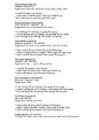
Present Simple (lihtolevik) Infinitive + He/she/it+-s Signal words: Every day, sometimes, always, often, usually, never + I work. He works. I go. He goes. - I don't work. He doesn't work. I don't go. He doesn't go. ? Do I work? Does he work? Do I go? Does he go? Present Continuous (kestev olevik) To be (am/are/is) + infinitive + -ing Signal words: now, at the moment, look!, listen! + I'm working. He's working. I'm going. He's going. - I'm not working. He isn't working. I'm not going. He isn't going. ? Am I working? Is he working? Am I going? Is he going? Present Perfect (täisolevik) Have/has+ infinitive + -ed / 3rd IRW Signal words: yet, never, ever, already, so far, since, for, recently + I have worked. He has worked. I have gone. He has gone. - I haven't worked. He hasn't worked. I haven't gone. He hasn't gone. ? Have I worked? Has he worked? Have I gone? Has he gone? Past Simple (lihtminevik) Infinitive+ -ed (/ 2nd IRW) Signal words: last.. , .. ago, in 1990, yesterday + I w
active I (-es) writes is + III II (-ed) wrote was + III has + III has written has been + III is/was + ing is writing is/was being + III had + III had written had been + III will have + III will have written will have been +III will/can + I will write will/can be + III active passive I (-es) is + III II (-ed) was + III has + III has been + III is/was + ing is/was being + III had + III had been + III will have + III will have been +III will/can + I will/can be + III active writes wrote has written is writing had written
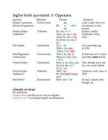
Inglise keele ajavormid: 5. Õppeaasta Ajavorm Tähendus Vormid Abisõnad Present Continuous Kestev olevik am Look! Listen! Now! At (Present Progressive) BE is +ING the moment. At the are present. Present Simple Üldolevik He, she, it + S Always, usually (Indefinite) They, we, you, I (s) Sometimes, every ?does (he, she, it) (s) often Do (they, we, you, I) (s) Past Simple Lihtminevik II pv/ -ed Last, yesterday, ago ?Did + I pv (ed) In 1950 -Didn´t +I pv (ed) Past Progressive Kestev olevik Was
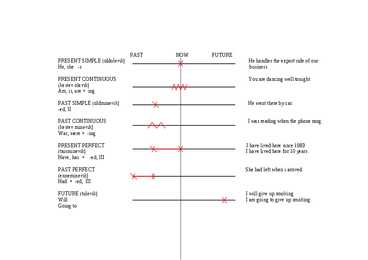
PAST NOW FUTURE PRESENT SIMPLE (üldolevik) He handles the export side of our He, she -s business. PRESENT CONTINUOUS You are dancing well tonight. (kestev olevik) Am, is, are + ing PAST SIMPLE (üldminevik) He went there by car. -ed, II PAST CONTINUOUS I was reading when the phone rang. (kestev minevik) Was, were + -ing PRESENT PERFECT I have lived here since 1983. (täisminevik) I have lived here for 10 years. Have, has + -ed, III PAST PERFECT She had left when i arrived. (enneminevik) Had + -ed, III FUTURE (tulevik) I will give up smoking. Will I am going to give up smoking. Going to
He would go to Tallinn tomorrow if he had time. German: the subjunctive Wenn du Zucker hättest, könnten wir jetzt Tee trinken. `If you had sugar, we could drink tea now.' English: They demanded that he leave the room. If I were you, I wouldn't buy this car. - transitivity: sleep, kiss Manam (a Kairiru-Manam language; Malalyo-Polynesian) dang i- aka- gita i water be hot `he heated the water' II. Relational categories for verbs: voice The workers painted the house. The house was painted by the workers. Das Buch wird von zwei Autoren geschrieben. `The book is being written by two authors.' Heute Abend wird viel getanzt. `There will be a lot of dancing tonight.' III. Agreement categories for verbs: I am/he is/they are sleeping he sleeps Grammatical categories for adjectives I
FUTURE SIMPLE BE GOING TO Will + infinitive (will go) Am/is/are going to + infinitive (is going to rain) 1.A decision at the moment of 1.Future plans made before the speaking: moment of speaking: A: 'I'm cold'. A: 'We've run out of milk.' B: 'I'll close the window'. B: 'I know, I'm going to buy some.' 2.Prediction based on opinion: 2.Prediction based on present I think the Conservatives will win the evidence: next election. Look at those boys playing football! 3.A future fact: They're going to break the window. He will be ten next year. 4.Promises / requests / refusal / willingness: I'll help you with your homework. Will you give me a hand? 5.In the same way as the future continuous, but with state verbs: I'll be at the
Aktiiv Passiiv Present Tegusõna algvorm be + 3.v Simple Somebody cleans this room every day. This room is cleaned every day. Past Simple 2.v was/were + 3.v Somebody built this house in 1895. This house was built in 1895. Future Simple will/shall + 1.v will/shall + be + 3.v People will forget this soon. This will be forgotten soon. Present be + -ing be + being + 3.v Progressive Somebody is cleaning the room right now. The room is being cleaned right now. Past was/were + -ing was/were + being + 3.v Progressive Somebody was cleaning the room when I The room was being cleaned when I arrived.
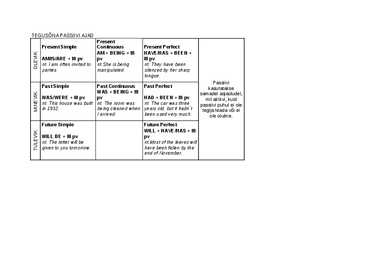
TEGUSÕNA PASSIIVI AJAD Present Present Simple Continuous Present Perfect AM + BEING + III HAVE/HAS + BEEN + OLEVIK AM/IS/ARE + III pv pv III pv nt. I am often invited to nt.She is being nt. They have been parties. manipulated. silenced by her sharp tongue. Passiivi Past Simple Past Continuous Past Perfect kasutatakse WAS + BEING + III samadel asjaoludel, MINEVIK WAS/WERE + III pv pv HAD + BEEN + III pv mil aktiivi, kuid nt. This house was built n
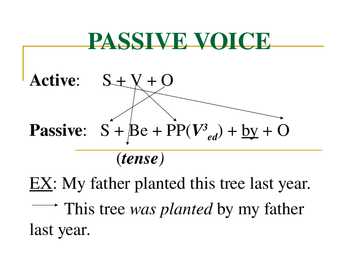
PASSIVE VOICE Active: S + V + O Passive: S + Be + PP(V3ed) + by + O (tense) EX: My father planted this tree last year. This tree was planted by my father last year. TABLE OF ENGLISH TENSES IN PASSIVE VOICE The Simple Present Tense Active: S + V(s/es) + O Passive: S + am/is/are + PP + by + O EX: He reads books every day. Books are read (by him) every day. TABLE OF ENGLISH TENSES IN PASSIVE VOICE The Present Continuous Tense Active: S + am/is/are + Ving + O Passive: S + am/is/are + being +PP + by + O EX: He is writing a novel at the moment. A novel is being written (by him) at the moment. TABLE OF ENGLISH TENSES IN PASSIVE VOICE The Present Perfect Tense Active: S + Has/Have + V3ed + O Passive: S + has/have + been +PP + by + O EX: He has just finished a novel. A novel has just been finished (by him). TABLE OF ENGLISH TENSES IN PASSIVE VOICE
Future Tenses Will-future and going to-future Andrea Terasväli Future forms Will-future Going to- Simple Present Future Future future presen progressi progressi perfect t ve ve • • Planned Future Planned Action Sth. Will Prediction, action in action action in will already assumptio the future is fixed the near definitely have n (assur future happen happene • logical ed/de (it d before • conseque ffinite) usually a certain spontaneo nce (sth. happens) time in us action Is goint to the happen) future Form Will-future Going to- Simple Present Future
Pr.S. He writes the letters The letters are written (by him) Pr.C. He is writing the letters The letters are being written Pr.P. He has written the letters The letters have been written P.S. He wrote the letters The letters were written (by him) P.C. He was writing the letters The letters were being written P.P. He had written the letters The letters have been written F.S. He will write the letters The letter will be written by him. F.C. He is writing the letters The letters will being written F.P. He will have written the letters The letters will have been written Modal He should write the letters The letters should be written am/is/are + V ed/IIIpp am/is/are + being + pp have/has + been + pp was/were + pp was/were + being + pp had + been + pp will be + pp will + being + pp will have + been + pp modal + be + pp
 annaabi.ee