Leidsid 33 sarnast õppematerjali, mis on seotud failiga "Tingimuslaused (conditionals) tüübid O ja I". Need materjalid aitavad sul teemat sügavamalt mõista.
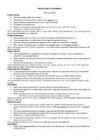
clause, condition, clauses, late, call, present, conditional, simple, unless, tomorrow, result, there, rains, cloudy, examples, father, takes, doesn, calls, know, studies, good, grade, weather, nice, beach, gets, raise, spoke, chinese, work, guide, china, faster, race, results, someone, turn, around, first, note, comma, between, happen, verb, instead............................................................ 2 B. Unreal Conditionals ......................................................... 3 Linking words used in Conditionals ...................................... 4 Conditionals Conditions deal with imagined situations: some are possible, some are unlikely, some are impossible. A. Real Conditionals Real Conditionals refer to situations that are true, have happened, generally happen or are likely to happen. The First Conditional expresses a possible condition and a probable result: If I have time, I will help you. In the if-clause we use the Present Simple, in the main clause will + the verb. We can also use the Present Continuous or Perfect in the if-clause and a Modal Verb in the main clause. If we are having a party tomorrow, we shouldn’t go out tonight. If you have finished with the computer, you should turn it off. It can also be used in offers and suggestions, or warnings and threats.
(proper nouns, common nouns), abstract vs concrete nouns, one class or more?; grammatical categories: number, gender, case. Identifying nouns: meaning, function, form The noun phrase (NP): The NP consists of the head, which is typically a noun, and other elements which (either obligatory or optional) determine the head and (optionally) modify the head or complement another element in the phrase. The NP typically functions as the subject, object or complement of clauses and as complement of prepositional phrases. Peter likes the girl (determiner: def. article + head) the small girl (det + premodifier: adjective + head) the small girl in a black skirt (det + prem + head + postmodifier: prepositional phrase) the small girl wearing a black skirt (det + prem + head + postmodifier: non-finite clause) the small girl who is wearing a black skirt (det+prem+head + postmodifier: relative clause)
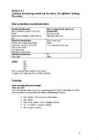
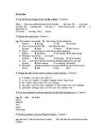
Tests Superstar 1 Luke Prodromou Test 1 Name____________________ Class_______ Use your English 1 Complete these sentences using the correct form (present simple or present continuous) of the verb in brackets. _ 1 She is in a band and she _________________________________ (record) a CD at the moment. _ 2 She is an actress and often _________________________________ (appear) on television. _ 3 At the moment she _________________________________ (have) a rest because she is tired. _ 4 Mike is a doctor and he _________________________________ (live) in Manchester. _ 5 I _________________________________ (start) work at 8.30 every morning.
Golden Grammar rules 1. Don't use an with own. Sue needs her own room. (NOT Sue needs an own room.) I'd like a phone line of my own. (NOT ... an own phone line.) 2. Use or rather to correct yourself. She's German or rather, Austrian. (NOT She's German or better, Austrian.) I'll see you on Friday or rather, Saturday. 3. Use the simple present play(s), rain(s) etc to talk about habits and repeated actions. I play tennis every Saturday. (NOT I am playing tennis every Saturday.) It usually rains a lot in November. 4. Use will ..., not the present, for offers and promises. I'll cook you supper this evening. (NOT I cook you supper this evening.) I promise I'll phone you tomorrow. (NOT I promise I phone you tomorrow.) 5. Don't drop prepositions with passive verbs. I don't like to be shouted at. (NOT I don't like to be shouted
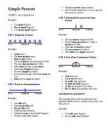
Windows are not made of wood. Simple Present · · New York is a small city. It is not important that this fact is untrue. [VERB] + s/es in third person USE 3 Scheduled Events in the Near Examples: Future · You speak English. · Do you speak English?
3 TALLEGG 11 MIZDE 4 VESITERM 12 LADA 5 STOW 13 SCHWUNG 6 KALEV 14 MAIASMOKK 7 YAMAHA 15 ISKU 8 ESTRAVEL 2 Affirmative tense Use Signal Words Negative/Questions · action in the present taking always, Present Simple A: He speaks. place once, never or several every ..., N: He does not speak. normally, often, Q: Does he speak? times seldom, · facts sometimes,
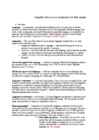
Conditionals: II and III II CONDITIONAL • to imagine a different reality • An unreal situation • If I were a parent, I would give candy to my kids every day. • If he won the lottery, he would quit his job. • If I had wings, I would fly to Africa. How to use it? • IF + PAST SIMPLE, + WOULD + VERB • If I were a parent, I would give candy to my kids every day. • If he won the lottery, he would quit his job. • If I had wings, I would fly to Africa. • NB! The verb „be“ is always „were“ with this conditional. • If I were you,... • If he were here,... Wou can also turn it around: The result first and then the condition. • WOULD + VERB+ IF +PAST SIMPLE • Note: There is no comma when the „IF“ is between the two clauses.
Extended Rules for Using Commas Comma Use 1. Use commas to separate independent clauses when they are joined by any of these seven coordinating conjunctions: and, but, for, or, nor, so, yet. The game was over, but the crowd refused to leave. The student explained her question, yet the instructor still didn't seem to understand. Yesterday was her brother's birthday, so she took him out to dinner. 2. Use commas after introductory a) clauses, b) phrases, or c) words that come before the main clause. a. Common starter words for introductory clauses that should be followed by a comma include after, although, as, because, if, since, when, while. While I was eating, the cat scratched at the door. Because her alarm clock was broken, she was late for class. If you are ill, you ought to see a doctor. When the snow stops falling, we'll shovel the driveway. However, don't put a comma after the main clause when a dependent (subordinate) clause follows it (except for cases of extreme contrast).
INGLISE KEELE KORDAMINE TIME CLAUSES Present Simple · Permanent states, facts (Tom works..) · Repeated and habitual actions, routines (She usually goes..) · Laws of nature and general truths (The sun sets in the west) · Timetables and programmes · Sporting commentaries, rewiews (Beckham wins the ball, crosses and Owen scores) · Feelings and emotions (I love Tallinn..) TIME EXPRESSIONS USED WITH PRESENT SIMPLE: usually, often, always, every day/week etc, in the morning/evening
L can be palatalised or not. Phoneme is a smallest unit in language which distinguishes meaning. With other phonemes it can form morphemes and words. For example: The difference between words in English call and fall is a result of the exchange of the phoneme c and f. Morphology - The study of word formations and the internal structure of words. Morphemes – the smallest units of language that have their own meaning or
Conditionals Sentences with if are used to express possibilities. 0 Zero conditional If-clause present (past) simple Main clause present (past) simple Sometimes sentences with if express certainty rather than possibility. The zero conditional is used to talk about sth. that is always true (such as a scientific fact), or that was always true in the past. In this type of conditional we can use when instead of if. E.g., If/When you mix blue and red, you get purple. If/When you don't water flowers, they die. (present simple in both parts of the sentence) If/When I asked her to come with us, she always said no. (past simple in both parts of the sentence) 1 First conditional If-clause present simple; Main clause future tense (or: can, must, may, etc., + bare infinitive) Used to talk about the consequences of a possible action (a real or very probable situation in the
adjectives, adverbs, prepositions, conjunctions, and interjections--as well as the standard patterns of English sentences. All students of English, be they native speakers or those who are studying English as a second language, will profit from the fundamental introduction and review of grammar provided by SADDLEBACK'S BASIC ENGLISH GRAMMAR 1 and 2. Helpful marginal notes throughout the books have been provided to reinforce existing skills and call attention to common problem areas. We wish you every success in your pursuit of English proficiency. 1 What is Grammar? 5 The Simple Past Tense 98 Regular and Irregular Verbs 99 Was and Were 104 2 The Capital Letter 6 The Past Progressive Tense 106
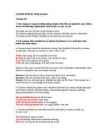
Exercises 1. Use the Present Simple of the verb be or have. ( 10 points ) Mary........blue eyes and blond hair, but her brother ........dark hair. He ........in his late twenties. He........married and........two sons. I........short, but my sister........tall. We........a dog and a cat. Our uncle........two dogs. They........brown. 2. Choose the correct item. ( 5 points ) e.g. The residents were made...D....their homes by the authorities. A leave B leaving C left D to leave 1) Ann is my best friend! We........each other for years A know B knew C knows D have known
Ways of expressing the Future Table of Contents Future Simple ...................................................................... 2 Be going to ........................................................................... 3 Present Continuous .............................................................. 3 Present Simple ..................................................................... 4 Future Continuous ............................................................... 4 Future Perfect....................................................................... 6 Other ways of referring to the future ..................................... 7 Other future references......................................................... 8 Future Simple In Future Simple we use the modal verb will + the verb
I haven't worked. Have I worked? you say that sth. has happened or have/has + past is finished in the past and it has a participle* Simple already He has worked. He hasn't worked. Has he worked? connection to the present Present Perfect *(infinitive + -ed) or so far, I have gone. I haven't gone. Have I gone? action started in the past and (3rd column of table continues up to the present of irregular verbs)
Indirect force 168 Summary 170 Questions 171 Further reading 171 Part IV: The dark side 173 14 Metaphor 175 Overview 175 A philosophical bias 175 The issues, and two simple theories 176 Davidson's causal theory 177 The Naive Simile Theory 179 The Figurative Simile Theory 180 The Pragmatic Theory 183 Metaphor as analogical 187 Summary 189 Questions 190 Further reading 190
First Conditional: A real possibility in the future A First Conditional sentence is for future actions dependent on the result of another future action or event, where there is a reasonable possibility of the conditions for the action being satisfied. Formation: if + present simple, + will For example: If she gets good grades, she will go to university. We are talking about the future, but we use a present tense for the condition and will for the result. In this case, the person is sure about going to university. We can use other modal verbs in the result part of the sentence. For example: I Condition Result Possibility F she gets good she will go to If the condition is met, then she definitely If grades, university. will go he gets good he may go to
You must do your homework regularly. (A teacher talking to students) Must is also associated with a formal, written style: Candidates must answer four questions. (Instructions on an exam paper) Books must be returned on or before the date due. (Instructions in a library) 4 • Have to expresses a general obligation based on a law or rule, or based on the authority of another person: I can’t play tennis tomorrow. I have to go to the dentist. (I have an appointment.) Children have to go to school until they are 16. (A law) Mum says you have to tidy your room before you go out. (Mother’s order!) Must and have to are sometimes interchangeable: I must be home by midnight. I have to be home by midnight. Have to is used more often than must. If you are unsure which to use, it is probably safer to use have to. • NB
what you are going to learn in the pages ahead. It changed their lives, as it will change yours. ■ THE GREAT PRINCIPLE Perhaps the most important mental and spiritual principle ever dis- covered is that you become what you think about most of the time. Your outer world is very much a mirror image of your inner world. What is going on outside of you is a reflection of what is going in inside of you. You can tell the inner condition of a person by looking at the outer conditions of his or her life. And it cannot be otherwise. ■ THOUGHTS ARE THINGS Your mind is extraordinarily powerful. Your thoughts control and determine almost everything that happens to you. They can raise or lower your heart rate, improve or interfere with your digestion, change the chemical composition of your blood, and help you to sleep or keep you awake at night.
......................................117 Chaos and Higher Order.............................................................................118 Good and Bad.............................................................................................119 Not Minding What Happens.......................................................................120 Is That So?..................................................................................................121 The Ego and the Present Moment .............................................................122 The Paradox of Time...................................................................................124 Eliminating Time.........................................................................................125 The Dreamer and the Dream.......................................................................127 Going Beyond Limitation...........................................................................128
The Asian elephant has smaller ears and only males develop tusks. Conditional statements of the form “if...then…”. ● If it rains, then I will take my umbrella. Conditional itself is not an argument. Conditionals are formed by an Antecendent (‘it rains’) and a Consequent (‘I will take my umbrella’). The antecendent is a sufficient condition for the consequent while the consequent is a necessary condition for the antecendent. A (antecendent) then B (consequent). If A happens, B has to happen! Umbrella is necessary for the rain. If I take my umbrella, it’s not necessary that it rains. Even if an inferential relationship might be found, no claim is made about proving the consequent of the conditional. So, conditionals are not arguments. However, Conditionals are important because they offer a pattern for antecendent and prepare us to infer the consequent when the antecendent is asserted.
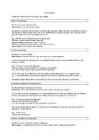
CONDITIONALS 0 or 1? TYPE 0 ZERO CONDITIONAL In 'zero' conditional sentences, the tense in both parts of the sentence is the simple 'IF' CLAUSE (CONDITION present: ZERO CONDITIONAL (TYPE 0) 'IF' CLAUSE MAIN CLAUSE (CONDITION) (RESULT) If + simple present If + simple present If you heat ice, it melts. If it rains, you get wet TYPE 0 'IF' CLAUSE MAIN CLAUSE (CONDITION) (RESULT) If + simple present If + simple present If plants don't get they die. enough water, If you mix red and blue, you get purple Make sentences (type 0) Heat water/ boil Mix yellow and red/get orange Conditional Type 1 · First Conditional: real possibility · We are talking about the future. We are thinking about a particular condition or situation in the future, and the result of this condition. There is a real possibility that this condition will happen. For example, it is morning
seen which can easily catapult an economy like ours out of its indolent state. I feel totally librated. I feel free. I feel I am in charge. I am in control. From here on, whatever happens is because I allowed it to happen. I have made what I believe is my own major contribution to the debate on the state of the Black Race. Whether you agree with me or not is immaterial. The only important point is that we must stop the blame game and accept responsibility for the present state of the Black Race. Truth shall set you free, it has set me free. RAPE OF A RACE Let’s take slavery for instance. We attribute everything that has happened to the Black race to slavery. We delude ourselves about African Kingdoms which had thrived before the onslaught of first the Arabs, and later the Caucasians. We talk about the Pyramids of Egypt, the great empire of Mali and the learning capital of Timbuktu
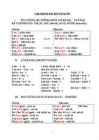
CONDITIONALS ZERO CONDITIONAL If you don't water flowers, they die. If you have a headache, stop watching TV. If clause: Main clause: PRESENT SIMPLE PRESENT SIMPLE or IMPERATIVE With zero conditional we express a general truth or we give advice. FIRST CONDITIONAL If the weather is nice, we will go for a walk. If you don't apologize, she will never trust you again. If clause: Main clause: PRESENT SIMPLE FUTURE SIMPLE The first conditional refers to the present and future. It expresses a possible condition and its probable result in the future. SECOND CONDITIONAL Jack wants to buy a house but he can't do this because he doesn't have any money. If I had a lo t o f m o ne y, I would buy a b ig h o us e . SECOND CONDITIONAL Susan wants to phone Paul but she can't do this
I have always loved plays written by Oscar Wilde. 5. Some adverbs tell us how much. These are called Adverbs of Degree. E.g. definitely, absolutely, obviously, possibly, just, certainly, very, quite, rather: He is definitely the right man for the job. He would certainly have been chosen for the team if he hadn’t injured his knee. 2 6. Some adverbs have the same form as the adjective. This is the case with hard, fast, late. Adjective Adverb Jack is a very fast runner. Jack can run very fast. Ann is a hard worker. Ann works hard. Ann hardly ever works hard. The train was late. Tom got up late this morning. NB! hardly means very little, nearly not; hard means very much 7. Many adverbs end in -ly, because many adjectives can be made into adverbs by adding –ly. E.g
f) Is his new job easier than the one he had in London? g) How does the writer feel about his new situation? Informal (friendly) letters are normally written to relatives, friends or other people we know very well. A good informal letter should be divided into paragraphs. Each paragraph should deal with one aspect of the subject and start with a topic sentence which gives the main idea of the paragraph. Tenses Present Perfect and Past Simple are often used in letters giving news. The Present Perfect is used to refer to recent activities and the Past Simple to refer to activities which happened at a stated time in the past. TASK 7 Read the following letter and correct the mistakes. Write S for spelling, P for punctuation, WO for word order, G for grammar or WW for wrong word. Dear Jenny , How are you ? I hope that you're very well. I've got so many to tell you that I don't know where to begin
1. A generalist is ignorant from the point of view of a specialist and a specialist is stupid from the point of view of a generalist. 2. All great stupidity is created by geniuses. 3. All stereotypes are true; the fact that you recognize a slur proves that it isn't. 4. Anything you're afraid is true is true. 5. Before most people get to the point of being able to tell their ass from a hole in the ground they're already assholes and it's too late. 6. Concentrating on something important can make you lose track of your soap opera. 7. Debunking the bunk is everyone's responsibility. 8. Don't ask me to pay for anyone else's mistakes. I make enough of my own. 9. Even those who possess real magic must beware of being misled by "magical thinking." 10. Everyone knows what shit tastes like. 11. Exclusive occupancy of a private room is a basic human right. 12. Fair compensation for genius is wealth. 13
• we don't use an article: at night, at noon, every We don't usually use an article week, every day, every night, last morning, last • to talk about things in general. • before the names of countries, cities, towns and villages. week, all night, all day, tomorrow, yesterday,... • with plural nouns and uncountable nouns when talking about them • use the with in the morning, in the afternoon, generally. during the night, the winter, the summer, the day Examples: She has got long hair. He wears black shoes. after tomorrow,... • when talking about sports, people's first
The Rule Is Overpowering 23 Politics 26 The Not-So-Free Sample 28 The Rule Enforces Uninvited Debts 31 The Rule Can Trigger Unequal Exchanges 33 Reciprocal Concessions 35 Rejection-Then-Retreat 37 Reciprocal Concessions, Perceptual Contrast, and the Watergate Mystery 40 Damned If You Do, Damned If You Don't 42 Here's My Blood, and Do Call Again 43 The Sweet, Secret Side Effects 44 Responsibility 44" Satisfaction 45 Defense 45 Rejecting the Rule 45 Smoking Out the Enemy 47 Summary 49 Study Questions 50 CHAPTER 3 Commitment and Consistency: Hobgoblins of the Mind 51 Whirring Along 53 The Quick Fix 54 The Foolish Fortress 54
Color-- -1- -2- -3- -4- -5- -6- -7- -8- -9- Text Size-- 10-- 11-- 12-- 13-- 14-- 15-- 16-- 17-- 18-- 19-- 20-- 21-- 22-- 23-- 24 TWILIGHT By Stephenie Meyer Contents PREFACE 1. FIRST SIGHT 2. OPEN BOOK 3. PHENOMENON 4. INVITATIONS 5. BLOOD TYPE 6. SCARY STORIES 7. NIGHTMARE 8. PORT ANGELES 9. THEORY 10. INTERROGATIONS 11. COMPLICATIONS 12. BALANCING 13. CONFESSIONS 14. MIND OVER MATTER 15. THE CULLENS 16. CARLISLE 17. THE GAME 18. THE HUNT 19. GOODBYES 20. IMPATIENCE 21. PHONE CALL 22. HIDE-AND-SEEK 23. THE ANGEL 24. AN IMPASSE EPILOGUE: AN OCCASION twilight STEPHENIE MEYER LITTLE, BROWN AND COMPANY New York Boston Text copyright © 2005 by Stephenie Meyer All rights reserved. Little, Brown and Company Time Warner Book Group 1271 Avenue of the Americas, New York, NY 10020 Visit our Web site at www.lb-teens.com First Edition: September 2005 The characters and events portrayed in this book are fictitious.
100 % always almost always very often often quite often usually / normally sometimes occasionally not very often seldom /rarely 0% hardly ever never 5 Adverbs of freguency normally stand in front of the main verb but after the verb to be: They always read newspapers in the morning. Jim almost always sleeps late on Sunday. Mary often visits her parents. She usually gets up at 7. My grandmother sometimes goes to the theatre. I hardly ever write letters nowadays. He has always lived in London. They don’t very often go abroad. He can never remember my name. I have never been to Australia. He is always on time. She is sometimes sad. They are usually very helpful.
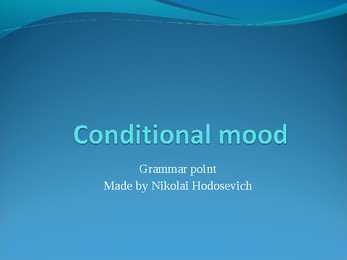
Grammar point Made by Nikolai Hodosevich Conditional mood The conditional mood is the form of the verb used in conditional sentences to refer to a hypothetical state of affairs. Conditional verb forms can also have temporal uses, often for expressing "future in the past" tense. Condition sentences are often entered with conjunction IF Real events Structure: Additional clause Present Indefinite Main clause Future Indefinite If I have a lot of money, I will buy a car , Almost unreal events *In additional and main clauses usually use Subjunctive I and II *When you translate into Russian these sentences, you should use conjunction * This type of unreal conditional sentence use, when speaker wants to underline small probability of condition realization Almost unreal events Structure: Additional clause Past Simple
VÕIMALIKEST SÜNDMUSTEST JA OLUKORDADEST JA NENDE TAGAJÄRGEDEST. If _________________, ______________. ___________________ if _____________. ! alati ei pruugi IF-i lauses olla! 2 4 conditionals: Zero cond. käibetõed, sagedased sündmused First cond. üsna tõenäolised sündmused Second cond. ebatõenäolised sündm. Third cond. miski, mis oleks võinud minevikus toimuda, aga ei toimunud. if-clause main clause 0 present simple + present simple 1 present simple + will future 2 past simple + would (could, might) ja I.pv. 3 past perfect + would (could,...) ja present perfect VII. TAG QUESTIONS. ____________main clause_____ , ___tag ___ . Positive verbs turn to negative and negative verbs change to positive!!! Names change to pronouns! EXAMPLES: You are going to Spain, aren´t you? She isn´t pretty, is she? It is a nice day, isn´t it? I am seeing you tomorrow, aren´t I
 annaabi.ee