Leidsid 33 sarnast õppematerjali, mis on seotud failiga "The Navajo People". Need materjalid aitavad sul teemat sügavamalt mõista.
navajo, language, land, native, mountains, tribe, sacred, never, comes, phrase, meaning, highly, largely, mexico, arizona, originally, tribes, considered, region, focuses, beliefs, protect, religion, tells, developed, between, gave, these, other, peoples, revive, languages, southwestern, states, until, complex, alphabet, symbols, artists, women, weaveUrsula 10. klass Navajo Artwork Navajo Artwork The Navajo are well-known for their many crafts including weaving of blankets and rugs, silversmithing, basketry and sandpainting. Authentic Navajo art or handcraft consists of handmade items produced by a Native American craftsperson, using high-quality, natural materials that are not machine stamped. The Navajo people are regarded as being the pioneers of Native American art. They are particularly renowned for their rugs and unique silversmithing techniques. They were also pioneers when it came to basketry and are recognized the world over for their basket weaving skills. Rug Weaving Commercial production of handwoven blankets and rugs has been an important element of the Navajo economy. Rug weaving is another traditional Navajo art form. Navajo women believe the
wagons, in comparison to the use of dogs. Iron and other metals brought to Alaska were prized for trading and making tools. Russia left a footprint in Alaska by establishing its first library and museums, as well as introducing Russian Orthodoxy to the locals(Alaska natives) (Russian Orthodox Church in Ninilchik, Alaska and also Chapel in Fort Ross, California). Some of the religious books were further translated into native languages. However, the Russians did great damage to the local environment by depleting the sea otter population. 4. Significance of the Jewish element in Russian immigration to the US. Immigration from Russia to the US in 18811914: Nearly 3.2 million immigrants from the Russian Empire. The most prominent Russian groups that immigrated in this period were the groups seeking freedom from religious prosecution. Nearly half of the immigrants were Jews
SOCIETY AND CULTURE OF ENGLISH-SPEAKING COUNTRIES Introduction 1. Nowadays, English is so widely spoken that it can hardly be considered "a one nation's" language. The main countries where English is spoken are: the U.K, the U.S, Canada, Australia, the Republic of Ireland, New Zealand, West Indies 2. There are approx. 300-400 million speakers of English in the world. English occupies the 3rd place by its number of speakers; it is right behind Mandarin and Spanish. 3. ESL (English as a Second Language) used in your own country (e.g. India) EFL (English as a Foreign Language) used in a foreign country
Native Americans. ¤ over 500 nations/tribes ¤ closeness to nature ¤ europeans came for the free land ¤ less civilized ¤ they lived in teepee's ¤ they hunted buffalos for food, clothing BERENGIA- Land Bridge connecting Asia (Siberia) to Alaska 1500 km wide North to South 65 000 B.P (before the present) rised out of the sea to 40 000 B.P a wave when people came from west. 36 000-32 000 B.P arrived people CHEROKEE. Southeast U.S- their heartland, not on the ocean. Lanuage + customs + weapons-> related to IROQUIS family of nations (Iroquis lived around Great Lakes) 1300 A.D. established in South East U.S Classical Cherokee Civilization 16th-19th centuries
Resources – page 11 Appendix – page 11-14 2 Introduction I selected this theme because it was the most interesting one for me. Aborigines have interested me for a long time now so doing this essay is really fun for me. Australian Aboriginal culture is one of the world's longest surviving cultures. Australian Aborigines, also known as Indigenous Australians , are the native people of Australia . Many of them suffered when white people from Britain arrived in Australia, because of disease, the loss of their hunting lands, and unfair laws. Australian Aborigines are those people regarded as indigenous to the Australian continent. In the High Court of Australia, Australian Aborigines have been specifically identified as a group of people who share, in common, biological ancestry back to the original occupants of the continent. History
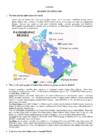
Canada may be divided into seven physiographic regions: Arctic Lowlands, Cordilleran Region, Interior Plains, Hudson Bay Lowlands, Canadian Shield (Forest Lands), St Lawrence Lowlands and Appalachian Region. Divisions are based on each area's relatively similar physical geography and landforms. Physiographic regionalization is defined here as the process by which regions with relatively homogeneous physical geography are determined 2. Who are the native people of Canada? Into which three groups can they be divided? Canada's constitution specifies three categories of aboriginal peoples: Indian (First Nations), Métis, Inuit. According to Canadian census 2011, 1.4 mln people of Aboriginal origin (4.3%): 852,000 First Nations persons, 452,000 Métis, 59,000 Inuit. Indian (First Nations) - No written history before the contact with Europeans. Chief historical sources European
He met no living man there and soon returned to England. About 40 years later, Jacques Cartier, a French explorer, made two voyages from France. He found Indians in Canada. There are many place names in Canada that come from the Indians. The first people who came to live there were the French. It became a French colony. But soon the English also became interested in this rich country and so for many years England and France fought for the right to be the masters of the new land. In 1759 the English captured the French fortress of Louisbourg. Then Quebec lay unprotected. After the winning of Quebec they conquered Montreal and the French rule came to an end. The English allowed the French to keep their Roman Catholic religion, civil law system and language so they would not try to break away from Britain. After the American War of Independence immigrants from Britain began to arrive, among them there were also poor Irishmen and Scotsmen. Indeed, all the
Tallinn English College Topic The United States of America Tallinn 2007 1. Introduction The United States of America's territory is over 3.7 million square miles (over 9.6 million km²) and population more than 300 million people. The capital city is Washington D.C. Although the United States has no official language at the federal level, English is the de facto national language. English is the most common language for daily interaction among both native and non-native speakers. Spanish is the second language. The largest city is the New York City. The Government is Federal constitutional republic and the president is George W. Bush. 2. Geographical position The United States of America is located on the continent of North America. It has borders with two countries Mexico and Canada. There are also the Atlantic Ocean, the Pacific Ocean and the Gulf of Mexico surrounding the big country
Society and culture of english-sspeaking countries Introduction 1. The countries of the world where the English language is spoken. 2. Approximate number of mother tongue speakers of English approximately 350-400 million native speakers. Which place does English occupy in the world by its number of speakers?After which language? English occupies second place by its number of speakers after Mandarin Chinese. 3. What is the difference between English as a Second Language, English as a Foreign Language and English for Specific Purposes? Give examples of situations where they are used. English as a Second Language (ESL or TESL) is a traditional term for the use or study of the English language by non-native speakers in an English-speaking environment. That environment may be a country in which English is the mother tongue (e.g., Australia, the U.S.) or one in which English has an established role (e.g., India, Nigeria)
Indigenous People in Australia Class 12a Contests: 1. Indigenous peoples: an overview.................................................................. 3 2. Language......................................................................................................... 3 3. Spirituality...................................................................................................... 3 4. Art and culture.............................................................................................. 4 5. Traditional recreation.................................................................................... 4 6. Aboriginal food....................
aborigines. I will divide the essay in 3 parts the Maori people, the aborigines and their comparison. Maori are the host people of New Zealand. Their name is derived from Ma-Uri which means the children of heaven. The arrival of the Maori people to New Zealand is considered to be somewhat of a mystery. It is known that first Polynesians arrived to New Zealand about 1000 years ago, when navigator Kupe discovered the land in 950 AD. He named it Aotearoa The Land of the Long White Cloud. Although these facts can be debatable, I will focus my attention on this interpretation of Maori history. After the Maori arrived to New Zealand, they started to develop into tribes and sub tribes, this tribal system is still in use. Their culture had almost no influence from the rest of the world. They evolved a culture endorsed by agriculture and hunting. Of course the Maori were warriors as well. They had inter-tribal battles, mostly over territory and the losers
Compiler: Maiki Joakit Instructor: Mailis Teppo Misso 2011 New Zealand is an island country in the south-western Pacific Ocean comprising two main landmasses (the North Island and the South Island), and numerous smaller islands, most notably Stewart Island/Rakiura and the Chatham Islands. The indigenous Mori language name for New Zealand is Aotearoa, commonly translated as land of the long white cloud. Population (1998): 3,801,000.New Zealand is notable for its geographic isolation; it is situated about 2,000 kilometres (1,200 mi) southeast of Australia across the Tasman Sea, and its closest neighbours to the north are New Caledonia, Fiji and Tonga. During its long isolation New Zealand developed a distinctive fauna dominated by birds, a number of which
Notions for The New World Native Americans Origin of Native Americans Nearly one-third of Native American genes come from west Eurasian people linked to the Middle East and Europe, rather than entirely from East Asians as previously thought, according to a newly sequenced genome. Native peoples of North and South America descended from ancestors who arrived via land bridges from East Asia, possibly in a single migration. Different tribes and their way of life The men were hunters, warriors, and protectors, while the women tended to the children, their homes, and farmed. It depended on the tribe when it came to artwork. In some tribes, the men would actually weave baskets and blankets. Natural foods were consumed and hunted. Deer, buffalo, fish, and various birds were the game of choice
The U.S.A. consists of 51 states and the District of Columbia. The state of Alaska is separated from the rest of the U.S.A. by Canada. Hawaii, which became the fiftieth state in 1959, is in the Pacific Ocean, halfway between the continents of America and Asia. The area of the United States of America is over nine million square kilometres. The continental part of the U.S.A. consists of two highland regions and two lowland regions. The highland regions are the Appalachian Mountains in the east and the Cordilleras in the west. The Appalachian Mountains run parallel to the Atlantic coast almost from the Gulf of Mexico into Canada. The highest peak is 2000 metres high. The Cordilleras stretch along the Pacific coast with the Sierra Nevada in the south and the Rocky mountains continuing into Canada and Alaska in the north. Their highest point in the U.S.A. is 4540 metres in Sierra Nevada. The five Great lakes, between U.S.A
At Easter, rabbits come out at night. The children try to stay up as late as possible, but they don't see the rabbits. The rabbit's nests are found filled with colored eggs both outside and inside the house. When the children find all the eggs, they have a contest of egg breaking. The child who breaks the egg takes it. The child with the most eggs at the end of the game is the winner. Non-religious customs of the Creoles can be illustrated by two activities: 1) lagniappe, which comes from the Spanish word la napa meaning a sweetening. Grocery stores in Louisiana give a small addition to one's purchase, such as candy or small cakes as a token of appreciation to a customer; and 2) chiavari, which is a kind of cerebration of the remarriage of a widow or widower. 5 Creole culture It has been handed down through the years that Creoles are both BLACK and FRENCH in
white and represent the Thirteen Colonies. The 50 small, white stars represent the 50 U.S. states. The U.S. flag is commonly called ,,the Stars and Stripes". The Statue of Liberty, that is locatd in New York,is a gift from the France. The Libety Bell, that is a bronze bell that symbolizes freedom in the United States of America. It is located in Pennsylvania,U.S. Capital: Washington D.C Biggest city: New York National language: English Location U.S is located in North America, bordering both the North Atlantic Ocean and the North Pacific Ocean. United States neighbour countries are Canada and Mexico. The USA has the 8th longest coastline in the world at ~20 000 km. 62% of the perimeter of the USA is coastline. The USA's coastline is made up of beaches, cliffs, mangroves, and urban and developed areas, which make America very versatile country. Political division
Table of contents 1. Introduction 2. Geographical position 3. Mountains, lowlands 4. Rivers, lakes 5. The territories and provinces 6. Towns, economy, agriculture 7. Climate 8. Animals, plantlife 9. Population 10. Sports 11. Culture 12. History 13. Political system, symbols 14. Conclusion 15. Materials 1. Introduction If you had to use two words to describe Canada, they might be large and diverse. Canada is the second largest country in the world, bordered by three oceans, and across the country, Canadians experience many different landscapes from rolling
The capital of Canada is Ottawa. Other large cities are Montreal, Toronto, Vancouver, Winnipeg and Quebec. 2. Geographical position Canada is a huge country in the continent of North America. It is bordered with the Atlantic Ocean in the east, the Pacific Ocean in the west, the United States of America in the south and the Arctic Ocean in the north. Canada is a vast country, with a territory of 3.8 million square miles of land and fresh water it is the second biggest country in the world after Russia. Canada covers most of the northern part of North America. Canada has over 151,480 miles of coastline. Most of Canada's human population lives along its southern border. 3. Relief Canada's geography is very diverse. It has huge lakes, evergreen forests, prairies, meadows and beautiful mountains
Australia Fact file: Australia comprises a land area of 7 686 850 square kilometres. Its population is about 21,3 million people. Australia's capital is Canberra. The national language is English. The official name of it is the Commonwealth of Australia. It's divided into six states and two territories: New South Wales, Queensland, South Australia, Western Australia, Tasmania, Victoria, Australian Capital Territory (ACT) and Northern Territory. Symbols: Australia had the British flag as their official flag until 1901, when the Commonwealth of Australia was formed. Over 30 000 entries attracted the official competition
inhabitants. The majority of them live within 300 kilometres of Canada's southern border. Much of the rest of Canada is uninhabited or thinly populated, because the country has a rugged terrain and severe climate. Canada extends across the continent of North America, from Newfoundland on the Atlantic coast to British Columbia on the Pacific coast and northward into the Arctic Ocean. Canada shares land borders with the United States to the south and north-west. Canada is a land of great variety. Towering mountains, crystal-clear lakes, and lush, green forests make Canada's far west a beautiful region. Farther inland, fields of wheat and other grains cover Canada's vast prairies. Thes fertile farmlands contrast vividly with the Arctic wastelands to the north. Most of the largest towns and industrial areas lie near the Great Lakes and the St Lawrence River in central Canada. In the east, fishing villages and sandy beaches dot the Atlantic coast
Canada is the second largest country in the world. Situated to the north of the United States, in North America, it has both English and French as its official languages. Even though its area is bigger than that of the United States, its population is only about 11% of that of the USA some 35 million. Because of that, Canada has one of the lowest population densities in the world. The capital of Canada is Ottawa the name of whose comes from the old Algonquin language, with the original word meaning `to trade'. Due to the country's huge size and position, it is very diverse. It is bordered by the Pacific Ocean to the west, the Atlantic to the east, and the Arctic to the north. The landscapes differ greatly from rolling plains and mountains to the cold tundra in the northern part of the country. Geographically, the country's split into 5 major regions the Pacific, the Prairie Provinces,
Australia, then, is both a country and a continent. If someone wants to make clear that he is speaking of the country, he may call it by its full name of Commonwealth of Australia. Sixty million years ago Australia and its nearby islands were separated from the rest of the world by a great upheaval. They were cut off from Asia by the ocean. Very few people and almost no animals visited Australia before English colonists began to settle there in 1788. During all those 60 million years the native Australian mammals developed by themselves, undisturbed by the animals developing elsewhere. Australia is the only continent except Antarctica that is all south of the equator. It's name means "southland". Since it is south of the equator, its seasons are just the opposite of ours. It has summer while we have winter and the other way round. Sometimes Australia is called the island continent. There is a good reason why. It is an island.
taxi, also fig. to praise highly, to acclaim, as in "critics hailed her new book"), WASSAIL; German "Heil!" not used any more ("Heil Hitler! and the associated shame (just as with Reich) Germanic *hailitho > Old English hælth HEALTH Germanic *hailjan > Old English hælan TO HEAL Germanic *hailagaz > Old English halig HOLY Germanic *hailigon > Old English halgian to consecrate, to bless, halga sacred, a saint, Middle English halwe (see Prologue to the Canterbury Tales: ferne halwes distant shrines metonymic from the meaning "saint" TO HALLOW (as in "Our Father who art in heaven,hallowedbe thy name"), HALLOW meaning "saint" (the latter is a French loan (ALL HALLOWS' DAY, HALLOWEEN). The metonymic link between "being in one piece" and "being healthy" is fairly universal (cf. the two meanings of the Estonian word "terve" a Finno-Ugric, i.e. a non-Indo European word
Drawing upon his travel experiences and his life as a farmer, Crevecoeur was the first to seriously attempt a definition of American character with his Letters. The key word for Crevecoeur was "new," which separated and distinguished Americans from things European. In Letters, Crevecoeur thus blended his collection of facts and observations into a fictional portrait of an industrious farmer, one whose natural response to the land became identified with the general character of a new American people. Yet while Crevecoeur echoed Jefferson, Thomas's agrarian ideals, his letters also acknowledged the realities of frontier savagery and southern slavery. After taking a post as a French consul in 1783, Crevecoeur published little in English, though he did publish a French revision of Letters (1787) and a final book on his American experiences: Voyage dans la Haute Pensylvanie et dans l'état de NewYork (1801).
the past century. Geography Inuit communities are found in the Arctic, in the Northwest Territories, Labrador and Quebec in Canada, above tree line in Alaska (where people are called the Inupiat and Yupik), and in Russia (where people are called the Yupik people). In some areas, Inuit people are called "Eskimos" however many Inuit find this term offensive. The word "Inuit" means "the people" in the Inuktitut language. Inuit Homes In the tundra, where Inuit communities are found, there are not many building materials. No trees grow in the tundra so houses can not be made from wood unless it is transported from elsewhere. However, during a large part of the year, the cold part, there is a lot of snow in the tundra. And it turns out that snow can be a very good construction material. In the winter, Inuit lived in round houses made from blocks of snow called "igloos". In the summer, when the snow melted, Inuit
development of human society throuch biological laws · Outlook is deterministic, pessimistic, fatalistic (fate or biology) · Man as an animal-clever than other beasts, still explainable within the framework · Man is not a free agent, is govern by something · Unable to determine his own faith · Hereditary · Naturalists tried to apply in fiction the processes of natural sciences · Writers task is to record facts, systems of behaviour, living conditions, never revealing any natural unbiased (completely natural) · Point of view: amoral-outside the category of morality, neither good or bad · Naturalist find it absurd to blame the wicked. These criminals are doing what nature, environment, their unconscious tells them to do. Naturalists do not judge their characters, they simply report. Try to describe facts like they are. Naturalists depict the lower, coarser forms of life. · Drab, squallid set of scene
Topic Australia Introduction Many people know Australia as the land down under because it is the only continent except for Antarctica that is all on the southern hemisphere. Its name means ,,Southland". The official name of the country is the Commonwealth of Australia. It's capital is Canberra. Australia is the sixth largest country in the world but the smallest continent. Australia has 6 states and 2 territories (New South Wales, Victoria, Tasmania, Queensland, Western Australia , South Australia, The Australian Capital Territory and the Northern Territory).
of years before they managed to build up a country which was based on recognizing the cultural diversity of different nations in Canada. All the communities living in the country are encouraged to remember their origins and hold their own ethnic events and national festivals. Cultural diversity makes Canada even more interesting. In spite of this, in recent years there is a strong movement in French-speaking Quebec to become an independent country. There are many different native people throughout Canada like the Crees, Mohawks, Troquois and Sioux. In the north of the country, the Inuit (Eskimos) now have a self-governing homeland called Nunavut, meaning our land. It is over two million square kilometers and it is inhabited by 17,500 Inuits. The national symbol of Canada is the maple leaf. The national tree is the maple. Canada is also the most tolerant societies in the world because only 13% of
from each state and 2 from each territory. The executive power in Australia is in the hands of the Prime Minister. Today the Prime Minister is John Howard. History. The first inhabitants in Australia are the Aborigines who came there about 60000 years ago. The first known Europeans to arrive in Australia were the Dutch. William Jaanzsoon tried to reach the East Indies, but landed in western Australia in 1611. The Dutch gave a poor account of Australia considering it to be and arid land inhabited by fierce savages. Abel Tasman was also a Dutch sailor and he discovered Tasmania. Captain James Cook discovered the fertile eastern coast in 1770 and had a more favourable outlook. He explored the coast and named some most important features, such as Botany Bay, for instance. Australia was called Terra Australis Incognita before 1770 and it means `southland'. After the disgraceful loss in the American War of Independence, Britain
etc. 3. Relief Lying in the north-western part of the East-European Plain, Estonia is mostly flat with an average elevation of about 50 metres above sea level. South-eastern and eastern parts of Estonia are higher than the western parts. The relief of the present-day landscape was shaped during the Ice Age. Ice sheet has carried large boulders and limestone blocks here, not to mention that the hilly terrain in Estonia was also shaped by the continental ice and the melting water. The land is rising 25 cm every one hundred years. In folklore, many features of the relief are explained by the activities of giants such as the legendary national hero Kalevipoeg. The Haanja and Otepää Uplands are particularly rich in Hills. It is here that You find Big Egg Hill, the highest point in the Baltic states with 318 metres above sea level. 4. Land regions The northern coast features a steep limestone bank, the Baltic glint, which is one
the fabliau (a comic, often anonymous tale that is characterised by an excess of sexual and other types of obscenity) and (3) literature on religious topics – either moralistic (teach right from wrong) or ecclesiastical (biblical subject). Middle ages – English becomes a literary language. Geoffrey Chaucer (1343–1400) – Father of English literature, The Canterbury Tales in English, increased the prestige of the language, provided a standardised form. The Canterbury Tales: frame story. Majority in verse, some prose. Intended to contain 124 stories, only finished 24
Louise Erdrich Love Medicine Assignment 2 (pp. 4384) 1. Define the following words and expressions (considering the context) and reproduce (in your own words) the situations in which they appear in the book: the marrow of something (44) - The soft stuff inside of a bone is called marrow. ... From this biological kind of marrow comes a figurative meaning of marrow -- the essence of something. S The convent is on top of the high hill and from its window the Sisters can see the marrow of the town. to be privy to something (46) - If you're privy to something, you've been let in on a secret or know about something that most people don't. ... The adjective privy comes from the Latin privatus, meaning "private," and describes someone who has knowledge of secret or confidential information
S.A. The biggest cities are New York, Washington, Chicago, Los Angeles, San Francisco, etc. The flag of America was adopted on 14 th June 1777. It is called the "Stars and Stripes". It is said that Betsy Ross sewed the first flag. It features 13 horizontal red and white stripes (for the first colonies which formed the U.S.A.) and 50 stars on the blue background. Red means courage, blue justice and white innocence. There is a star for every state of the USA. The official language of the USA is English; Spanish is also widely spoken. The currency of the USA is the United States Dollar. The government of the USA is composed of three coordinate branches: the executive, legislative and the judicial. All the three branches are equal. The executive power is vested in the president, who holds office for a term of four year. At the moment George W. Bush is the president. The president is elected together with a vice-president
 annaabi.ee