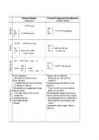
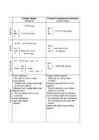
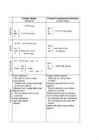
Leidsid 33 sarnast õppematerjali, mis on seotud failiga "Tenses - Ajavormide tabel". Need materjalid aitavad sul teemat sügavamalt mõista.
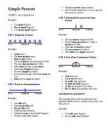
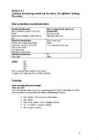
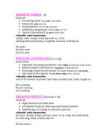
work, working, worked, year, years, shed, clock, arrived, already, went, travel, finish, study, continuous, since, build, around, evening, rise, finished, studying, hours, yesterday, wait, twenty, find, known, night, begin, coffee, please, tenses, simple, perfect, loodusseadused, hommiku, graafikud, going, kindlam, present, garden, building, scotland· Do pigs like milk? Examples: · California is in America. · California is not in the United Kingdom. · You only speak English. · Windows are made of glass. · Do you only speak English? I am not reading any books right now. Present Continuous · · Are you working on any special projects at work? [am/is/are + present participle] · Aren't you teaching at the university now? Examples: USE 3 Near Future · You are watching TV. · Are you watching TV? · You are not watching TV. USE 1 Now Examples:
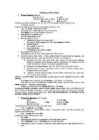
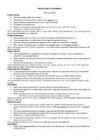
TENSES. ACTIVE VOICE. 1. Present Simple (üldolevik) I (he, she, it s) he works Eitav,küsiv do (I, you, we, they) he does not work does (he, she, it) does he work? Verbidele, mis lõpevad infinitiivis ss, -sh, -ch, -x või o, lisatakse ainsuse 3. pöördes es he touches, she goes Verbidel, mis lõpevad y-ga, mille ees on konsonant, muutub y->ies carry - he carries Vrdl: play he plays 1. Harjumuspärane, korduv tegevus või seisund olevikus. Tom drinks tea every day. He lives in Brussels. 2. Üldtuntud tõed, loodusseadused The earth goes round the sun. 3. Tulevikus toimuv tegevus
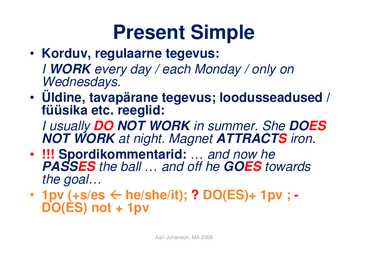
Present Simple · Korduv, regulaarne tegevus: I WORK every day / each Monday / only on Wednesdays. · Üldine, tavapärane tegevus; loodusseadused / füüsika etc. reeglid: I usually DO NOT WORK in summer. She DOES NOT WORK at night. Magnet ATTRACTS iron. · !!! Spordikommentarid: ... and now he PASSES the ball ... and off he GOES towards the goal... · 1pv (+s/es Å he/she/it); ? DO(ES)+ 1pv ; - DO(ES) not + 1pv Aari Juhanson, MA 2008 Present Progressive · Hetkel toimuv, pooleliolev tegevus: S/he IS TALKing on the phone now. I AM READing an interesting book. · Ajutine, regulaarsele ja tavapärasele vastanduv tegevus (tulevikku viitav): This summer they ARE not GROWing
in brackets. _ 1 She is in a band and she _________________________________ (record) a CD at the moment. _ 2 She is an actress and often _________________________________ (appear) on television. _ 3 At the moment she _________________________________ (have) a rest because she is tired. _ 4 Mike is a doctor and he _________________________________ (live) in Manchester. _ 5 I _________________________________ (start) work at 8.30 every morning. _ 6 He is a good cook but she _________________________________ (prefer) to eat out. _ 7 English tests _________________________________ (get) more and more interesting. _ 8 They _________________________________ (have) a party because it's her birthday. _ 9 I sometimes _________________________________ (ride) my bicycle to school. 10_ She usually _________________________________ (go) to the gym on Friday evenings.
Get/ Have something TENSE ACTIVE PASSIVE WHEN? done Present Simple Am/is/are + Every day, year, often, I pv + do/does Have/ get + sth+ III pv Lihtolevik III pv usually, always Past Simple Yesterday, last year, II pv(-ed)+ did Was/ were + III pv Had/got + sth + III pv
today, tonight etc. Present Perfect · Action happened at an unstated time in the past. Emphasis on the action, time is unimportant or unknown. (I have washed the car) · Action started in the past and continues up to the present, especially with stative verbs (I have known her for six years) · Recently completed action (I have finished my essay) TIME EXPRESSIONS USED WITH PRESENT PERFECT: for, since, already, always, just, ever, never, so far, today, this week/month etc. lately, recently, still (in negations) etc. Present Perfect Continuous · To put emphasis on the duration of an action which started in the past and continues up to the present (We have been cleaning the house all morning) · To express anger, irritation or annoyance (She has been using my computer without asking) · Fo repeated actions in the past continuing to the present
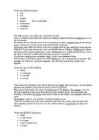
.......blue eyes and blond hair, but her brother ........dark hair. He ........in his late twenties. He........married and........two sons. I........short, but my sister........tall. We........a dog and a cat. Our uncle........two dogs. They........brown. 2. Choose the correct item. ( 5 points ) e.g. The residents were made...D....their homes by the authorities. A leave B leaving C left D to leave 1) Ann is my best friend! We........each other for years A know B knew C knows D have known 2) Nicky........to San Francisco when the accident happened. A flies B has flown C was flying D has been flying 3) Why don`t you let her........her story? A finish B to finish C finishing D have finished 4) Tim........in a cafe at present, but he has already applied for a new job A work B have worked C is working D worked
2. Present Simple [VERB] + s/es in third person. Tegevus on korduv või tavapärane. You speak English. I play tennis. Cats like milk. The train leaves tonight at 6 PM. I am here now. Active= Once a week, Tom cleans the car. Passive= Once a week, the car is cleaned by Tom. 3. Present Continuous [am/is/are + present participle]. Tegevus toimub/ei toimu praegusel hetkel. You are watching TV. You are learning English now. I am studying to become a doctor. I am meeting some friends after work. Active= Right now, Tom is writing the letter. Passive= Right now, the letter is being written by Tom. 4. Past Simple [VERB+ed] or irregular verbs. Tegevus algas/lõppes minevikus täpsel ajal. . You called Debbie. I saw a movie yesterday. I finished work, walked to the beach, and found a nice place to swim. I lived in Brazil for two years. I studied French when I was a child. Active = Tom repaired the car. Passive= The car was repaired by Tom. 5
Past Perfect You had walked. You had been walking. I had run. I had been running. Future Perfect You will have walked You will have been walking. I will have run. I will have been running. The Simple Present Tense Expresses a habit or often repeated action. Adverbs of frequency such as, often, seldom, sometimes, never, etc. are used with this tense. She goes to work everyday. They always eat lunch together. On your handout, write one sentence that reflects SIMPLE PRESENT: something you do often, sometimes, never, seldom The Simple Present Tense This tense also expresses general truths or facts that are timeless. Snow falls in the December in Minnesota. Water boils at 100 degrees Celsius. The Present Continuous This tense is used to describe an action that is
Here's a breakdown of how you can express how you really are without complaining too much. · Fine, thanks. / On top of the world, thanks. · OK, thanks · Not so bad, thanks. / Can't complain, thanks. · So so, thanks. / So and so, thanks. · Not so good, actually 1 The English alphabet Spelling Work with your partner and spell out first your name and then some names of places. Write down each letter as you hear it, and then say the word. The English alphabet on the phone: You might find the following alphabet (used by international airlines) useful when trying to spell a word on the telephone. A Alpha O Oscar Ä Alpha-Echo Ö Oscar-Echo B Bravo P Papa
4. Use will ..., not the present, for offers and promises. I'll cook you supper this evening. (NOT I cook you supper this evening.) I promise I'll phone you tomorrow. (NOT I promise I phone you tomorrow.) 5. Don't drop prepositions with passive verbs. I don't like to be shouted at. (NOT I don't like to be shouted.) This needs to be thought about some more. (NOT This needs to be thought some more.) 6. Don't use a present tense after It's time. It's time you went home. (NOT It's time you go home.) It's time we invited Bill and Sonia. (NOT It's time we invite Bill and Sonia.) 7. Use was/were born to give dates of birth. I was born in 1975. (NOT I am born in 1975.) Shakespeare was born in 1564. 8. Police is a plural noun. The police are looking for him. (NOT The police is looking for him.) I called the police, but they were too busy to come. 9. Don't use the to talk about things in general. Books are expensive. (NOT The books are expensive.)
get getting swim swimming · Yga lõppevatel verbidel, y ei kao ära. study studying cry crying · . die / tie / lie muutuvad dying / tying / lying Kestev olevik väljendab: · Tegevust või muutust, mis toimub antud hetkel ega pole veel lõppenud. I am making a cake at the moment. I can´t help you right now, I am working. · Tegevust, mis toimub mingil aja perioodil. He wants to buy a car that is why he is taking driving lessons. · Sageli korduvat tegevust (eriti koos always, continually), mis väljendab kõneleja emotsionaalset hinnangut. Mona is always crying. · Varsti toimuvat tegevust, mis on enne kokku lepitud, ette kavatsetud. We are meeting tonight. We are going to the theatre. Pane tähele!
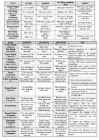
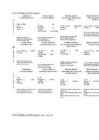
[ ma töötan (igal suvel) ] [ ma töötan (praegu) ] [ ma olen (siin) töötanud (alates [ (täna) olen ma (jub 1987. a.) ] töötanud ] O L I, you, we, they I am E work working I, you, we, they have worked I, you, we they have bee V He, she, it He, she, it is He, she, it has He, she, it has b I works working worked We, you, they are working K He has been working hard al
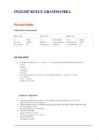
....................................... 4 Future Continuous ............................................................... 4 Future Perfect....................................................................... 6 Other ways of referring to the future ..................................... 7 Other future references......................................................... 8 Future Simple In Future Simple we use the modal verb will + the verb. It is the same in all persons. I will work I’ll work you will study you’ll study he will come he’ll come Negative I/you/he/we/they will not write I/you/he/we/they won’t write Question Will you/he/she/we/they come? 1. We often use will as a neutral way of expressing the future. We use will to say what we know or think about the future. It is known as the predictive future, and describes known facts, or what we suppose is true.
A: 'I'm cold'. A: 'We've run out of milk.' B: 'I'll close the window'. B: 'I know, I'm going to buy some.' 2.Prediction based on opinion: 2.Prediction based on present I think the Conservatives will win the evidence: next election. Look at those boys playing football! 3.A future fact: They're going to break the window. He will be ten next year. 4.Promises / requests / refusal / willingness: I'll help you with your homework. Will you give me a hand? 5.In the same way as the future continuous, but with state verbs: I'll be at the station when you arrive. 'Shall' is used mainly in the forms 'shall I ?' and 'shall we?' in British English. These forms are used when you want to get someone's opinion, especially for offers and suggestions: •Shall I open the window? (=do you want me to open the window). •Where shall we go tonight
........................... 7 Prepositions of Place with the word ‘arrive’.......................................................... 7 Prepositions of Place – in & on with travelling ..................................................... 8 Prepositional Phrases ......................................................................................... 8 Prepositions of Time – in, on & at • in is used with centuries, decades, years, seasons and months, parts of the day, periods of time • on is used with dates, special days, days of week, day of week + part of day, day + of ... • at is used with holidays, exact time, meals and with night in on at • the 20th century • the 29th of November • Christmas / Easter • the Middle ages /August the first • six o’clock / 7.30
topic of school. Both photos show page 4 6 He dropped a leaf into the water students in class. In the first photo I imagine that 1 1 ate and watched it drift under the they're about 13 years old. 2 have/'ve met bridge. It looks like a science lesson 3 have/'ve caught 7 As she got older, her health and judging by the students' 4 lived deteriorated
FOR SINCE We use for + a period of time expressing duration We use since + a starting point, a specific time for six years - for two hours - for a week since April - since 1992 - since 8 o' clock I've lived in this house for six years. They have been watching It has been raining since one o' clock. They've known each other TV for two hours
PRESENT SIMPLE [s] lihtolevik · kestvad tegevused. Tom works in the market. · rutiinid. He works every day. · loodusseadused. The sun sets in the west. · ajatabelid ja programmid. The buss leaves at 7 am. · (spordi) kommentaarid. Ben passes ball to Tom. väljendid, mida kasutatakse: usually, often, always, every day/week etc, in the morning/afternoon/evening, at night/the weekend, on Friday etc. He works He don't work Does he work PRESENT CONTINUOUS [ is + ing] kestev olevik · tegevused, mis praegu leiavad aset. Karl is doing his homework at the moment. · plaanitud tegevus lähitulevikus. I am going to school tomorrow. · kui midagi toimub/muutub praegu. The number of burglaries is increasing. · alati sama korduv tegevus. You are always eating, when i wake up. väljendid, mida kasutatakse: now, at the moment, at present, these days, nowdays, still, today, tonight etc. He is working He isn't working
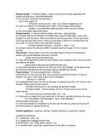
Words that ADD information · also · and · another · besides first, second, third, ... · furthermore · in addition · moreover The little girl put on her yellow shirt and brown overalls. Chris is on the basketball team this semester at Indiana School for the Deaf. In addition, he is on the soccer team. We will be here for one more week so we can finish up our work. Another reason we are staying longer is because we do not want to miss the Deaf Way conference. First of all, pour a half-cup of milk in the bowl; second, add two eggs; and third, stir the mixture. I admire I. King Jordan because he is the first deaf president of Gallaudet. Besides that, I admire him because he is a great long distance runner. Furthermore, he is a dedicated family man. All in all, there ís not much to dislike about the man, except he is too perfect!
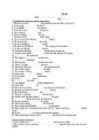
...........the same time 16. The puppy is .................. the trash can. 17. .................. midnight 18. We are going .................. holiday next week. 19. There is a bridge .................. the river. 20. Would you like to go .................. the cinema tonight? 21. The woman's bag is .................. the table. 22. The woman is sitting .................. a table. 23. Some kinds .................. plants 24.To be caused .................. something 25.To last .................. years 26. .................. the stairs 27.I can depend .................. my best friend Paul. 28. Stop! Wait .................. me 29.The letter was written ..................my pen friend in Scotland. 30. Benjamin is really interested ..................history. 31.We were talking ..................you. 32. The girl is standing ..................the two boys. 33. The boy with the green shirt is ..................the right. 34. ..................the picture, there are three kids. 35. He has a gamboy
Future Forms Future Forms · 1) Future Simple will work · 2) Be going to am/is/are going to work · 3) Present Continuous am/is/are working · 4) Present Simple start(s) Future Forms · 5) Future Continuous will be working · 6) Future Perfect will have worked · 7) Future Perfect Continuous will have been working Future Simple · We do our morning exercises and think, "I think we will have a nice day " · Prediction (ennustused kõhutunde põhjal) · verbs think, believe, guess, expect, hope etc · expressions be sure, be afraid etc · adverbs probably, perhaps, certainly Future Simple · You see your little brother carrying a very heavy suitcase and you think, "I will help him carry the suitcase." · on-the-spot decision
recording, or by any information storage and retrieval system, without the written permission of the publisher. ISBN 1-59905-201-6 Printed in the United States of America 13 12 11 10 09 08 07 9 8 7 6 5 4 3 2 1 Introduction Grammar is a very old field of study. Did you know that the sentence was first divided into subject and verb by Plato, the famed philosopher from ancient Greece? That was about 2,400 years ago! Ever since then, students all over the world have found it worthwhile to study the structure of words and sentences. Why? Because skill in speaking and writing is the hallmark of all educated people. Lesson by lesson, this book provides basic instruction in the eight parts of speech--nouns, pronouns, verbs, adjectives, adverbs, prepositions, conjunctions, and interjections--as well as the standard patterns of English sentences. All students of English, be they native speakers or those
They have made a new star wars film. I've just got home. How long have you been here ? Have you ever been to Paris? It's the best book I've ever read. It's the first time I have ever been abroad. 2)Present perfect continious : have/has + been + ing. N:I've been living in this flat since 2000. I've been waiting for ages. I'm hot,I've been running. Past tenses: 1)Past simpleI saw John last week.Agatha Christie wrote detective stories.I got up,had breakfast and went to school. 2)Past continious:was/were+ing N: I was still having dinner when my friend called. I was reading a book while my brother was playing his guitar. 3)past perfect:had+past participle/had+been+ing. N: my brother had gone to bed by the time I got home. By midnight, all the guests had left. We were tired because we had been playing volleyball all morning. Future tenses: 1)Future simplewill/shall + infinitive. N:Ppl will live on the moon one day
etc. PRESENT CONTINUOUS/PROGRESSIVE (kestev olevik) Form: am/is/are + ing Use: 1. Unfinished actions happening at or around the time of speaking. Listen! Somebody is crying. They are building a new bridge in our town. 2. Changes happening around now. The population of the world is increasing fast. 3. Arrangements for the future. I am flying to Toronto next Friday. Negative form: We aren't (are not) working at the moment. I am not enjoying this show very much. Question form: Are they playing football in the park right now?Why is she laughing? Signal words: at the moment, now, right now, Listen!, Look! etc. PRESENT PERFECT (täisminevik) Form: have/has + past participle (3. põhivorm) Use: 1. An action in the past, where the fact, not the time, is important. I have been to England four times. 2. An action in the past that has a result now. She has lost her keys
Tingimuslaused 16 2 Ajavormid Tense vorms Lihtolevik The present simple Korduv, harjumuspärane tegevus. Every day, twice a week, usually, sometimes, often, always. 1. pv (-s) do/does + 1. pv I get up at 7 every day. He always works hard. What time do you go to school? Lihtminevik The past simple Minevikus toimunud tegevus. Yesterday, last week, two das ago, last year, in 1999. 2. pv / -ed did + 1. pv I got up at nine last Saturday. Yesterday he worked much. What time did you go to school yesterday? Lihttulevik The future simple Tulevikus toimuv tegevus, mis ei sõltu meie tahtest või mille suhtes teeme otsuse kõnelemise momendil. Next week, tomorrow, in two years time, in 2020. will + 1. pv (will not = won't) Maria will be thirteen next year. Maybe I won't go to the party tomorrow, I'm too tired. Will you help me with my homework tonight?
..........................16 2 Ajavormid Tense vorms Lihtolevik The present simple Korduv, harjumuspärane tegevus. Every day, twice a week, usually, sometimes, often, always. 1. pv (-s) do/does + 1. pv I get up at 7 every day. He always works hard. What time do you go to school? Lihtminevik The past simple Minevikus toimunud tegevus. Yesterday, last week, two das ago, last year, in 1999. 2. pv / -ed did + 1. pv I got up at nine last Saturday. Yesterday he worked much. What time did you go to school yesterday? Lihttulevik The future simple Tulevikus toimuv tegevus, mis ei sõltu meie tahtest või mille suhtes teeme otsuse kõnelemise momendil. Next week, tomorrow, in two years time, in 2020. will + 1. pv (will not = won't) Maria will be thirteen next year. Maybe I won't go to the party tomorrow, I'm too tired. Will you help me with my homework tonight?
(didn't play / write) not I vorm+ing were (not playing) Did I vorm (Did ... play ... ?) Was NB! I vorm+ing (playing) Who II vorm Were (Who played ... ?) Tegevus minevikus mingil teatud Kirjeldused. ajal: Teatud ajal minevikus toimunud They went camping by the last kestev tegevus: month. At six o'clock they were having Minevikus üksteise järel toimunud dinner. tegevused: Kaks või enam pikka samaaegset First she paid the driver, then she tegevust minevikus: got out the taxi. She was talking on her mobile Praeguseks lõppenud mineviku phone while she was driving to harjumused ja olukorrad: work.
(didn't play / write) not I vorm+ing were (not playing) Did I vorm (Did ... play ... ?) Was NB! I vorm+ing (playing) Who II vorm Were (Who played ... ?) Tegevus minevikus mingil teatud Kirjeldused. ajal: Teatud ajal minevikus toimunud They went camping by the last kestev tegevus: month. At six o'clock they were having Minevikus üksteise järel toimunud dinner. tegevused: Kaks või enam pikka samaaegset First she paid the driver, then she tegevust minevikus: got out the taxi. She was talking on her mobile Praeguseks lõppenud mineviku phone while she was driving to harjumused ja olukorrad: work.
(didn't play / write) not I vorm+ing were (not playing) Did I vorm (Did ... play ... ?) Was NB! I vorm+ing (playing) Who II vorm Were (Who played ... ?) Tegevus minevikus mingil teatud Kirjeldused. ajal: Teatud ajal minevikus toimunud They went camping by the last kestev tegevus: month. At six o'clock they were having Minevikus üksteise järel toimunud dinner. tegevused: Kaks või enam pikka samaaegset First she paid the driver, then she tegevust minevikus: got out the taxi. She was talking on her mobile Praeguseks lõppenud mineviku phone while she was driving to harjumused ja olukorrad: work.
(kestvad ajad) are used when talking about a particular point in time · We were sleeping when the storm began. What were you doing at five o'clock? When I came, the children were sleeping. Perfect Tenses are used when an action or situation in the present is linked to a moment in the past often used to show things that have happened up to now but aren't finished yet to emphasize that something happened but is not true anymore Mary was tired. She had worked hard all day. Perfect Continuous Tenses Tegevus, mis mingil kindlaksmääratud momendil toimub (või toimus) ja mille alguse kohta on meil andmeid. · The child has been sleeping for six hours already. It has been raining for hours. Irregular verbs Here is a HUGE table about · irregular verbs · that you have to know by heart. · http://www2.gsu.edu/~wwwesl/egw/verbs.htm Ajamääruslaused (Adverbs of time)
Kitts is being offered by our agency for only L 3,000. this island satisfies all your requirements, as it is quiet and has little tourism. In addition, transport is available should you wish to explore other islands in the Caribbean. All travel plans can be arranged through our office. Please contact our agency immediately should you require more information. Yours faithfully, Jane Douglas MODEL 2 Dear Jane, A quick note to help you decide where to hang out over the holidays. Bill and I went to St. Kitts last summer and it was great . It's a small, quiet island that hasn't been overrun by tourism yet so you can really get a feel for the local culture. You can hop over to other islands too, because there are boats leaving St. Kitts every few hours. If St. Kitts is too quiet, You can go and party in St. Martin. Happy to give you the number of my travel agent if you're interested. Give me a ring so we can have a chat about it. Love , Patricia TASK 4
A 1.1 Read the text and answer the questions below. Dear Mary-Alice, It's been ages since I last wrote to you, isn't it weird? Yes, so it is, but, I do have a certain reason. Do you remember Sir Thom of the Minquettes'? That fine young man with fascinating blue eyes... Oh, my sweet Mary, you will never guess what happened yesterday! It was about seven o'clock in the evening when Lillian called me out for a walk you know I can't say `no' to my little sis. Anyway we went to the forest near the Swan Lake and, believe it or not, got lost! Awful! I was so scared... We walked and walked, not even knowing the direction we were heading to, until we reached a huge mansion. And the garden around it was so extraordinary... That is something you just must see! But neither the trees nor flowers could be as wonderful as the owner himself! Sir Thom treated us tea and sandwiches, not forgetting to show us way back to the village. He was so kind, don't you think?
 annaabi.ee