 50 punkti
Autor soovib selle materjali allalaadimise eest saada 50 punkti.
50 punkti
Autor soovib selle materjali allalaadimise eest saada 50 punkti.
 ~ 11 lehte
Lehekülgede arv dokumendis
~ 11 lehte
Lehekülgede arv dokumendis
 2017-12-03
Kuupäev, millal dokument üles laeti
2017-12-03
Kuupäev, millal dokument üles laeti
 2 laadimist
Kokku alla laetud
2 laadimist
Kokku alla laetud
 0 arvamust
Teiste kasutajate poolt lisatud kommentaarid
0 arvamust
Teiste kasutajate poolt lisatud kommentaarid
 pinelli
Õppematerjali autor
pinelli
Õppematerjali autor
just plain square and interrupts more than a circle. Circle, because of its round shape is pleasing for an eye to see. Hexagon on the other hand draws attention. Interrupts the view. In this context we can view hexagons from another point of view. Let me explain. In a beehive there are hexagons. When we think of a beehive we can imagine a community, a cluster. When we take technology and its many platforms, there is also a cluster, network. Many devices connected with each other, which in this case need protection, encryption. Therefore hexagon is a perfect symbol for connected devices. All those main elements we see, are used to make the audience feel that the video and technology it hypes is futuristic, to the forward thinking user or company. Main elements In this chapter i analysemain graphical elements which are used to tell the story. 0:12 Denotative look : - We see a house, camera, smartphone and a plane.
As the years went Nokia became the largest manufacturer of mobile telephones and made its way to what it is today. PRESENT-DAY STATE Today Nokia is a well known corporation. In fact Nokia is currently the world's largest manufacturer of mobile telephones and has the number one production in digital 4 technologies and has an estimated 36% share of the global device market. Nokia's headquarters are located in Espoo, which is a neighbouring city of Finland's capital Helsinki. Nokia is not only well known in its home country and its neighbouring countries but also has representation sites in many continents throughout the world. Nokia is selling mobile devices and making enhancements in Brazil, China, Finland, Germany, Great Britain, Hungary, India, Mexico and South Korea and has Networks Technology factories in China, Finland and India.
Even though the principles apply to the design of anything people have to interact with (including things like election ballots and voting booths, and even PowerPoint presentations), its focus was clearly on Web design, and all the examples were from Web sites. Until recently, that’s what most people were working on. But now there are a lot of people designing mobile apps, and even the people working on Web sites have to create versions of them that work well on mobile devices. I know they’re very interested in how all of this applies to them. So I did three things: Included mobile examples wherever it made sense Added a new chapter about some mobile-specific usability issues And the most important one: Added “and Mobile” to the subtitle on the cover And as you’ll see, in some places where it made thingsclearer,instead of“Website” I’ve written“Website or mobile app.” In most cases, though, I
(66MHz), 2X (133MHz), or 4X (266MHz). PCI - Peripheral Component Interconnect - a high speed interface for video cards, sound cards, network interface cards, and modems; runs at 33MHz. ISA - Industry Standard Architecture - a relatively low speed interface primarily used for sound cards and modems; runs at approx. 8MHz. RAM - Random Access Memory - see System RAM Port (serial, parallel, PS/2, USB, sound, LAN, VGA, SCSI) - interface connectors for the associated types of devices Serial - a low speed interface typically used for mice and external modems Parallel - a low speed interface typically used for printers PS/2 - a low speed interface used for mice and keyboards USB - Universal Serial Bus - a medium speed interface typically used for mice, keyboards, scanners, display panels (control features, not data), speakers (control features, not sound), scanners, and some digital cameras. VGA - Video Graphics Adapter - the interface from your video card or integrated video
Misusing and Abusing the IoT - Now and in the Future The Internet of Things is the network of physical objects—devices, vehicles, buildings and other items which are embedded with electronics, software, sensors, and network connectivity, which enables these objects to collect and exchange data [1]. As the amount of devices connected to the internet of things is constantly on the rise, making it innately more secure and protecting those devices from abuse, in a sense of unwanted access , manipulation by third parties and other scenarios, is rapidly turning into a pressing issue. According to some sources there were about 13.4 billion connected devices back in 2015 and the projections show there might be up to 38.5 billion such devices in 2020 [2]. As the number of devices increases, the necessity for a proper security mechanism concerning those devices becomes a priority in order to safely
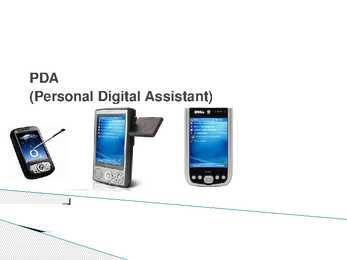
PDA (Personal Digital Assistant) KarlTõnis Truup Aap11 What is PDA A personal digital assistant , also known as a palmtop computer, or personal data assistant, It's a mobile device that functions as a personal information manager. Current PDAs often have the ability to connect to the Internet. A PDA has an electronic visual display, enabling it to include a web browser, but some newer models also have audio capabilities, enabling them to be used as mobile phones or portable media players. touchscreen technology. History The first PDA was released in 1986 by Psion, the Organizer II. Followed by
century festival in China and the Apollo 11 moon landing in 1969. However, there is a link and that is that they both relied on the use of rockets. The Chinese first developed rockets by filling bamboo tubes with an explosive made from saltpetre, charcoal, and sulphur. The sealed tubes would be thrown onto fires during celebrations because it was thought that the loud explosions would protect them. It was not long before the ancient Chinese realised the military potential of these devices and primitive rockets were used to repel a Mongol invasion in 1232 AD. Word of these new amazing weapons quickly spread around the world and soon rockets were being used in military operations in North Africa and Europe. During the 15 th and 16th centuries they were widely used in naval battles to set fire on enemy ships. Around this time they also started being used for more peaceful purposes again. In the 16th and 17th century Europe fireworks displays using rockets became a very popular
Facebook according to Pew research center, 79% of internet users use Facebook in USA. I guess it is a lot when it comes to specific social platform. Since there are over 1,86 billion active Facebook users, a lot of data is generated. Facebook states on their official webpage that they collect all sorts of data. They collect content and information that user provides when using their services(posting, liking, sharing, posting…), location of the device or browser, how users uses their services, for example what type of content is watched or viewed, how does user engage with it and aslo timewise, how frequently or long this or that is beeing watched. Also, the data which other users provide about You is recorded, when you have been tagged on a photo or mentioned in a post. They know in which groups you belong and which friends you most message to. When buying something off from facebook, credit card number and other
 annaabi.ee

















Kõik kommentaarid