Leidsid 33 sarnast õppematerjali, mis on seotud failiga "Sightseeing". Need materjalid aitavad sul teemat sügavamalt mõista.
reserve, nature, haanja, land, cave, situated, protection, highest, waterfall, bank, piusa, caves, baltic, states, deep, colonies, protected, village, south, meter, hill, jägala, limestone, valley, plant, sightseeing, established, region, addition, hills, lakes, customs, cultural, traditions, taken, forest, meadow, species, regime, divided, character· Jägala Waterfall (height 8 m) is one of the highest and fastest flowing. Over thousands of years the falling water has worn out the edge of the limestone banks and as a result a steep-sided valley about 300 m long and 12-14 m deep has been created. The oldest written information about a water mill (the beginning of the 13th century) derives from this place. The best impression of the mightiness of the waterfall can be obtained in the period of high waters in spring and autumn. · Narva Stronghold is the oldest and biggest stronghold in Estonia (built in 13- 17th century) creating with the Ivangorod Stronghold on the opposite shore of the River Narva a unique architectural ensemble in Northern Europe. Three wings of the stronghold and the Tower of Tall Hermann are open to visitors. The historical interiors in the West and North wings have been restored. In the five
coastline is approximately 3 800 km. The longest distance from east to west is 350 km, while north to south Estonia stretches 240 km. THE NAME The name EESTI was apparently derived from the word AISTI, the name given by ancient Germans to the peoples living northeast of the Vistula River. Tacitius, the Roman historian, was the first one to mention it (AESTI), while the Arab scholar alIdrisi was the first one to mark it on a map (as ASTLANDA). To the ancient Scandinavians the land was known as EISTLAND; to modern Scandinavians it is known as ESTLAND. Most contemporary languages use the Latin name ESTONIA. FLAG The Estonian blueblackandwhite national flag was originally the flag of the Estonian Student's Society, consecrated in Otepää Church in 1884. today there is a memorial plaque on the church wall commemorating the event. The Flag Museum attracts tourists who take an interest in the history of the flag.
· Kuressaare Bishop Stronghold is probably the bestpreserved medieval stronghold in all the Baltic States, being erected in the second half of the 13th century. In the center of the building from tooled dolomite bricks is a square courtyard, which is on the second and third floors surrounded by a closed cloister. There is an exposition of the Saaremaa Museum in the Stronghold that introduces the history and local nature of Saaremaa and Kuressaare. · Vilsandi National Park of international importance, belonging to the highest category of the birds' reserves, has been derived from one of the first nature reserves of the Eastern Europe in the Islands of Vaika, established in 1910. In Vilsandi and the islets tens of thousands sea birds halt, feed and nest. · Karja Katariina (Catherine) Church is the smallest medieval church in Saaremaa
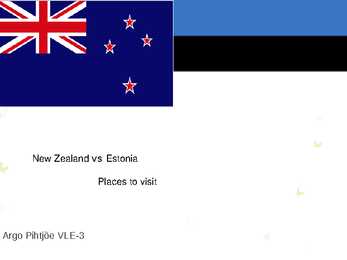
Major religion: Christianity Life expectancy: 69 years (men), 79 Life expectancy: 79 years (men), 83 years (women) (UN) years (women) (UN) Monetary unit: euro Monetary unit: 1 New Zealand dollar Main exports: Machinery, textiles, wood ($NZ) = 100 cents products Main exports: Wool, food and dairy GNI per capita: US $14,060 (World products, wood and paper products Bank, 2009) GNI per capita: US $26,830 (World Bank, 2009) Top ten places to visit in New Zealand Fiordland National Park It is New Zealand's largest national park. The scenery in Fiordland is nothing short of stunning, with deep fiords, steep mountains, raging waterfalls, and lush rain forests. Amazing diving, dolphins, seals, and rare bird life. Abel Tasman National Park New Zealand's smallest national park.
enable the men handle the guns better. Reconstructions in the 16th and 17th century changed the original looks of the tower considerably. 4. Suur Munamägi ("Big Egg Hill") Mountain Suur Munamägi, or Big Egg Hill, is the highest point in Estonia and other two Baltic countries. It is 318 meters high. The mountain is located in the middle part of Haanja uplands. It is in Haanja national park in Võrumaa. On the top of the mountain there is an observation tower the view from 346,7 meters is 50 km in radius. 5. The Town Hall building 3 The building history of the Town Hall
curative sea-mud and holidaymakers are its characteristic features. Pärnu as a summer resort dates back to the 19th century. The first bathing institution started operations in Pärnu in 1838. Pärnu also offers great year-round opportunities for organizing meetings and conferences in addition to relaxation and treatments for restoring one's health. Tori is known for the Estonian Tori Horse, bred at a local stud farm founded in 1856. Tori Hell is a sandstone cave on the Pärnu River. Kurgja is the location of the Farm Museum of Carl Robert Jakobson, a leader of the national movement at the end of the 19th century. The Nigula Nature Reserve preserves the peat-bog ecosystem within its territory of 2771 hectares. Häädemeeste is one of the most important yacht-building centers in Estonia and also famous for its mineral water. The Island of Kihnu is the biggest island in the Gulf of Riga. There are some peculiarities in local
Project ESTONIA MAP OF ESTONIA Southern Viljandimaa The southern part of Viljandi county catches the eye with its sublime scenery. The area today lies in the very heart of the historical Mulgimaa the home of hills, deep valleys and lakes brought together by a beauty spot Halliste primeval valley. According to several folk tales, it is also in these valleys, woods and bogs that Old Nick found refuge.The great variety displayed in the nature is also reflected in the local cultural heritage. At the beginning of the 19th century growing linen spread and became the basis of the legendary wealth of Mulgi farms. The ancient barn-dwellings and decaying manor houses are the mute witnesses of those times. The riches and cultural heritage of Mulgimaa owe to the diligence and tenacity of the local people. Village handicraftsmen and masters have always been honoured. Mulgikapsad (stewed sauerkraut with barley
The currency used in Estonia is Eesti kroon. The Estonian national flag is blue-black-white. It was originally the flag of the Estonian Students' Society. The flag was first consecrated in Otepää Church in 1884. For a while, during the Soviet occupation, the flag was banned but it was again seen in public in Tartu in May 1988. The national flower is cornflower, the national bird is barn swallow and the national stone is limestone. The Estonian national anthem called "My Native Land, My Pride and Joy" was composed in 1848 by Friedrich Pacius. The Estonian language words were written by J. V. Jannsen. It was officially adopted after the War of Independence in 1920.The same melody with different words is also Finland's national anthem. The current coat of arms of Estonia is a golden shield which includes three slim, blue leopards (or lions) in the middle, with oak branches along the side of the shield. It originates from Denmark. It was officially adopted in 1925.
the third largest country in the world. The country consists of 50 states, but two of them lie separately. One of them is Alaska, which is near the Arctic Circle. And the other state is Hawaii, which is a group of island is the Pacific Ocean. The USA shares the border with Canada in the north and Mexico in the south. In the east the coast is washed by the Atlantic Ocean and in the west by the Pacific Ocean. In the south there is the Gulf of Mexico. The highest mountain in the country is Mount McKinley, which is in Alaska. It's about 6 km high. But the lowest point is in Death Valley and its 89 m below sea level. Relief About half of the United States' territory is covered by plateaus and mountains. The eastern part of the country is occupied by the Appalachian Mountains, which in the north come close to the Atlantic coast and in the south are separated from it by the Atlantic Lowland. The Appalachian Mountains are old and worn down.
The Astronomical Clock on Old Town Square. THE CZECH REPUBLIC The Czech Republic made economic reforms such as fast privatizations. Annual gross domestic product growth has been around 6% until the outbreak of the recent global economic 11 crisis. The country is the first former member of the Comecon to achieve the status of a developed country according to the World Bank (2006) and the Human Development Index (2009), which ranks it as a "Very High Human Development" nation. The Czech Republic Ceská republika short form Cesko is a country in Central Europe.The country borders Poland to the northeast, Germany to the west and northwest, Austria to the south and Slovakia to the east. The Czech Republic has been a member of NATO since 1999 and of the European Union since 2004. The Czech Republic is also a member of the
national festivals. Cultural diversity makes Canada even more interesting. In spite of this, in recent years there is a strong movement in French-speaking Quebec to become an independent country. There are many different native people throughout Canada like the Crees, Mohawks, Troquois and Sioux. In the north of the country, the Inuit (Eskimos) now have a self-governing homeland called Nunavut, meaning our land. It is over two million square kilometers and it is inhabited by 17,500 Inuits. The national symbol of Canada is the maple leaf. The national tree is the maple. Canada is also the most tolerant societies in the world because only 13% of Canadians say that they would object their children marrying somebody of a different race, compared with 32% in the USA. Canada's political structure is independent constitutional monarchy and head of state is Elizabeth ll
Topic Australia Tallinn English College 2006 Australia 1 . Introduction The name Australia is derived from the Latin Australis, meaning of the south. In land area, Australia is the sixth largest nation, its territory is 7,686,850 sq km and its population reaches today over 20,5 million people. It is the only nation to govern an entire continent and its outlying islands. Australia's capital is Canberra, the only city with its own territory. It was built in the early 1900s just to be the capital. The official language is English and the official name of Australia is the Commonwealth of Australia.
The capital of Canada is Ottawa. Other large cities are Montreal, Toronto, Vancouver, Winnipeg and Quebec. 2. Geographical position Canada is a huge country in the continent of North America. It is bordered with the Atlantic Ocean in the east, the Pacific Ocean in the west, the United States of America in the south and the Arctic Ocean in the north. Canada is a vast country, with a territory of 3.8 million square miles of land and fresh water it is the second biggest country in the world after Russia. Canada covers most of the northern part of North America. Canada has over 151,480 miles of coastline. Most of Canada's human population lives along its southern border. 3. Relief Canada's geography is very diverse. It has huge lakes, evergreen forests, prairies, meadows and beautiful mountains
Tallinn English College Topic Estonia Tallinn 2008 1. Introduction Estonia is a small country about the size of Switzerland, or New Hampshire and Massachussetts combined. Estonia is named after the people called "Ests" who lived in the region in the 1 st century AD. The Republic of Estonia is one of the three countries commonly known as the "Baltic States". The other Baltic States are Latvia and Lithuania. 2. Geographical position Estonia is situated in northeastern Europe. Estonia is bounded on the north by the Gulf of Finland, on the east by Russia, on the south by Latvia and on the west by the Baltic Sea. In the north it borders on Finland. The coastline of the Baltic Sea in Estonia is characterized by numerous gulfs and bays, the biggest of them being the Gulf of Finland, the Gulf of Riga and the Gulf of Pärnu. Bays include the Narva Bay, Matsalu Bay, Kolga Bay, Kunda Bay, Tallinn Bay etc. Estonia has over
The Legislative branch Congress consists of the Senate and the House of Representatives. There are a hundred people in the Senate (two from each state) and 435 people in the House of Representatives. At the head of the Judicial branch is the Supreme Court, which has nine judges. The leading parties in America are the Democrats and the Republicans but there are also other parties. Location The United States of America is situated in the central part of the North American continent. Its western coast is washed by the Pacific Ocean and its eastern coast is washed by the Atlantic Ocean and in the south its coast is washed by the Gulf of Mexico. The coastline is even. There are no big islands belonging to the U.S. except the Hawaiian Islands which lie halfway the continents of America and Asia. The biggest peninsulas are the Florida Peninsula and Alaska.
This fact, coupled with the grandeur of the landscape, has been central to the sense of Canadian national identity. 2. Geographical position Canada is the second largest country in the world after Russia. In the Arctic, Canada reaches almost as far north as Greenland. To the south it extends to the same latitude as southern France. The distance from Canada's west coast, the Pacific Ocean, to its east coast, the Atlantic Ocean, is farther than from North America to Europe. Canada's total land area includes thousands of adjacent islands, notably Newfoundland in the east and those of the Arctic Archipelago in the north. In longitude Canada extends from approximately 52° to 141° W, a distance that spans six time zones. In latitude it extends from approximately 42° to 83° N. With its vast Arctic and subarctic territories, Canada is often considered a country only of the far north; however, the peninsula of southern Ontario juts deeply south into the heartland
The two-storied hall is decorated with rich stucco work and ceiling paintings. The vestibule and some other rooms in the main building, as well as some of the stoves have retained their 18th-century appearance. The park was named Kadriorg (Catherine's Valley) after the empress Catherine I. Most of the Russian rulers, from Peter's daughter Elizabeth, to the last Romanov emperor Nicholas II, have visited this imperial summer residence. From 1921 the Estonian Museum in Tallinn was situated in the palace. In 1928 it was reorganized into the Art Museum of Estonia. From 1929 the palace served as the residence of the Estonian head of state (from 1938 president). The building was renovated in 1933-34. The banqueting hall after the design of the architect Aleksander Vladovsky was constructed at the back of the palace. Some rooms were refurnished in Estonian national romantic style after the designs of the architect Olev Siinmaa.
Weizenberg that was set up there in1920. The Wismar Ravelline and the filled up moat became a dendrological garden later called the Deer Park. Gates In the Middle Ages there were eight gates in Tallinn. They were the Short Leg Gate, the Long Leg Gate, the Karja Gate, the Viru Gate, the Harju Gate, the Great Coast Gate, the Small Coast Gate and the Nun´s Gate. The Viru Gate was first recorded in 1359 and it was considered one of the major gates. The Harju Gate was situated at the place where Müürivahe Street crosses Harju Street. Museums There are more than 20 museums in Tallinn. The oldest of them is the History Museum. It was founded in 1842. The museum is situated in the Gothic guildhall in Pikk Street built for the Great Merchants` Guild in the 15th century. The Town Museum has a permanent exhibition on the history of Tallinn from the 13th century. The museum is situated in a 14th century dwelling house in Vene Street.
the Gulf of Mexico surrounding the big country. There are 50 states in America. Most of the people live in towns. The biggest state is Alaska; next by size are California, Alaska and Montana. Six states - Maine, Vermont, New Hampshire, Connecticut, Rhode Island and Massachusetts are called New England. They are all small states in the USA that lie in the north- east. The first colony of immigrants settled down in Virginia, in the eastern part of the USA. 3. Relief The USA is situated in the central part of the North American continent. Its western coast is washed by the Pacific Ocean and its eastern coast is washed by the Atlantic Ocean and in the south its coast is washed by the Gulf of Mexico. The coastline is even. There are no big islands belonging to the USA except the Hawaiian Islands which lie halfway the continents of America and Asia. The biggest peninsulas are the Florida Peninsula and Alaska. 4. Land Regions Mountains
from each state and 2 from each territory. The executive power in Australia is in the hands of the Prime Minister. Today the Prime Minister is John Howard. History. The first inhabitants in Australia are the Aborigines who came there about 60000 years ago. The first known Europeans to arrive in Australia were the Dutch. William Jaanzsoon tried to reach the East Indies, but landed in western Australia in 1611. The Dutch gave a poor account of Australia considering it to be and arid land inhabited by fierce savages. Abel Tasman was also a Dutch sailor and he discovered Tasmania. Captain James Cook discovered the fertile eastern coast in 1770 and had a more favourable outlook. He explored the coast and named some most important features, such as Botany Bay, for instance. Australia was called Terra Australis Incognita before 1770 and it means `southland'. After the disgraceful loss in the American War of Independence, Britain
bordered by the Atlantic Ocean to the west and south and by Spain to the north and east. The Atlantic archipelagos of the Azores and Madeira are Portuguese territory as well. The country is named after its second largest city, Porto, whose Latin name was Portus Cale. SETTLEMENT The land within the borders of the current Portuguese Republic has been continuously settled since prehistoric times. In the 8th century most of the Iberian Peninsula was conquered by Moorish invaders professing Islam, who were later expelled by the Knights Templar. During the Christian Reconquista, Portugal established itself as an independent kingdom from León in 1139, claiming to be the oldest European nation-state. In the 15th and 16th centuries, as the
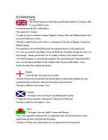
* the United Kingdom is a constitutional monarchy. The current monarch is Queen Elizabeth II, who is also the Queen and Head of State of fifteen other Commonwealth Realms, such as Canada, Australia, New Zealand and Jamaica. England: * it has 50 cities, the capital city is London * despite of the density of population and the high degree of urbanisation, England has many unspoilt rural and coastal areas which have been placed under protection * the flag is called the Saint George's Cross Scotland: * the biggest cities are Glasgow and Edinburgh (the capital) * Stirling has been an important settlement in Scotland for over 800 years * the flag is called the Saint Andrew's Cross Wales: * the biggest cities are Cardiff, Swansea and Newport * these cities depended for their growths on surrounding mines and metal production, which
me for that. The Church of the Holy Ghost became the first Estonian church after the Reformation in 1524, the majority of the of the congregation had been Estonian already before. 4. Kadriorg and Pirita Kadriorg (Catherine's Valley), one of the oldest and largest parks in Estonia, covers about 70 hectares. Originally it was an are on the seashore featuring low meadows, shrub land and a few manor houses. In the 17th century most of the land was in the possession of Fonne, the Town Council's secretary. At the time the park was called Fonnenthal. A century later the name was changed to Yekaterinenthal after Yekaterina, wife of Peter I. Kadriorg Palace was designed in Baroque style by the Italian Niccoló Michetti and built in the 1720s on the order of Peter the Great in honour of his wife. The tsar himself is known to have laid three bricks in the foundation of the building. The palace was also planned to serve as a summer house for
citizenship, or to obtain citizenship of the new state) How one becomes stateless country can take away citizenship, or in some countries marrying someone from another country the person loses citizenship; if a country stops existing, then. Why is international community against stateless persons? Travelling is difficult, getting visas in grey passports; stateless person doesn't have the consulate protection abroad; stateless persons don't have political rights (they have all other rights), that means to elect and to be elected on the parliamentary level and cannot get positions on the state service. Harder to trace criminal. Why is international community against dual-citizenship? People have additional obligations (military obligation, paying taxes) and additional rights. For states it's difficult to trace criminals etc. A defined territory
As the use of coal, petroleum, and natural gas expanded, the United States became less reliant on wood as an energy source. Today, we are looking again at renewable resources to find new ways to use 14 them to help meet our energy needs. Overall consumption from renewable sources in the United States totaled 6.8 quads (quadrillion Btu) in 2007, or about 7 percent of all energy used nationally. Consumption from renewable sources was at its highest point in 1997, at about 7.2 quads. Picture 3.1. The Role of Renewable Energy Consumption in the Nation's Energy Supply, 2007 Over half of renewable energy goes to producing electricity. The next largest use is the production of heat and steam for industrial purposes. Renewable fuels, such as ethanol, are also used for transportation and to provide heat for homes and businesses. Renewable energy plays an important role in the supply of energy
The main aim of the reforms was to boost foreign investments, cre- ate new jobs, stimulate entrepreneurial activities in a variety of fields and increase the welfare of citizens. As a result of economic deregulation policy which was focused on liberalization of the Economy, a number of state regulated spheres were sharply decreased and regulation procedures were sim- plified. Consequently, our achievements have been recognized by a number of international in- stitutions. This year the World Bank and the International Finance Corporation published a joint research Doing Business 2011, under which Georgia ranks 12th among 183 countries in terms of Ease of Doing Business. Moreover, Georgia surpasses 174 counties in terms of reformation of business regulations since 2005. Last but not least, Georgia ranks first in the Post-soviet space, excluding the Baltic countries, in terms of counter-corruption policy. It is worth noting that de-
It is very important that you follow the instructions in this book so that you will use all the allotted time to your advantage. Vocabulary The first questions on this section will test your English vocabulary. There are 30 academic sentences, each containing an underlined word. You must choose the word that has the same meaning from among the four choices. Here's an example. YOU WILL SEE: The United States has instituted a set of forest conservation measures to maintain forest land. (A) accepted (B) published (C) established (D) suggested The word that is closest in meaning to the tested word, instituted, is choice (C). Further hints for vocabulary questions can be found in Chapter 2. Reading Comprehension Your ability to read and understand college level reading material is test on this part of the TOEFL. You will find five or six reading passages, each followed by four to seven questions. You must work quickly and efficiently. Here is a sample passage.
Odesa (Odessa) 1 million. Zaporizhzhya (Zaporozhye) 0.8 million. 5 GDP growth, %: 1.0 (2013 forecast EBRD downward revision from previously projected 2.5%). Official language: Ukrainian (although Russian is widely used in business communication). Currency: Hryvnya (UAH). Government type: republic. Membership: the United Nations, the International Monetary Fund (IMF), the World Bank, the European Bank for Reconstruction and Development (EBRD), the World Trade Organization (WTO), etc. Ukraine is bordered by Russia in the east, the Black Sea in the south, Moldova, Romania, Hungary, Slovakia and Poland in the west, and Belarus in the north. The country is rich in mineral resources: iron ore, coal, manganese, natural gas (shale costly and dangerous to extract), oil, sulfur, graphite, titanium, magnesium, kaolin, nickel, mercury, timber and others.
The definition of authenticity is in the process of being expanded to include intangible values such as a bridge that embodies the spirit or character of a people or place, as New York City is embodied in the Brooklyn Bridge, San Francisco in the Golden Gate, London in Tower Bridge, Sydney (Australia) in the Harbour Bridge, or Bosnia-Herzegovina in the recently destroyed Stari Most in Mostar. Bridges nominated for World Heritage listing also must have legal protection and management mechanisms to ensure their conservation. The existence of protective legislation at the national, provincial, or municipal level is therefore essential and must be clearly stated in the nomination. Guidelines for nominations state that each property should be compared with properties of the same type dating from the same period, both within and outside the nominating State Party's borders.
SCORES OF SYMPHONIC MUSIC PUBLISHED. APPENDIX E. CHRONOLOGY OF ESTONIAN SYMPHONIES. APPENDIX F. SOUND TAPES OF ESTONIAN SYMPHONIES IN THE ESTONIAN MUSIC INFORMATION CENTRE AT THE COMPOSERS UNION. APPENDIX G. SOME PROGRAMMES WITH ESTONIAN MUSIC AND CONDUCTORS. APPENDIX H. INDEX OF PERSONAL NAMES. APPENDIX I. SELECTION OF PHOTOGRAPHS. APPENDIX J. MUSICAL EXAMPLES. PIANO ARRANGEMENTS AND SCORE SAMPLES. APPENDIX K. USEFUL ADDRESSES. ABOUT THE AUTHOR ESTONIA AND THE ESTONIANS Estonia is situated on the southern shore of the Gulf of Finland, between the Baltic Sea and Lake Peipsi. The country is populated by Estonians who belong to the Western Finnish group of nations, a branch of the Finno-Ugric stem, and speak the Estonian language. Estonia is the northernmost of the Baltic States. From west to east the length of the country is 360 kilometres and the width, from north to south, is 255 kilometres. The area is 45,227 square kilometres of which more than 4,000 square
In sunflowers, the ray flowers are usually female and infertile. The disk flowers are both male and female and are fertile. If you look closely at the center of a sunflower you can see that the disk flowers grow in a mesmerizing pattern of two opposite spirals. This is most easily seen either before the disk flowers open up or after the seed has set and all the accessory flower parts have fallen off. This is one of the more interesting patterns in nature. The rough-hairy quality of the Common Sunflower is characteristic of many members of its family. These little bristles probably serve two functions: to discourage plant- eating animals and to conserve water in the plant by limiting evaporation. Members of the sunflower family are popular with butterflies because the wide flower head makes a good "landing platform" and the numerous individual flowers make for a high probability of finding nectar.
The great Enlighteners: Crèvecoeur, Jefferson, Paine, Franklin. The American Enlightenment is the intellectual thriving period in the United States in the midtolate 18th century (17151789), especially as it relates to American Revolution on the one hand and the European Enlightenment on the other. Influenced by the scientific revolution of the 17th century and the humanist period during the Renaissance, the Enlightenment took scientific reasoning and applied it to human nature, society, and religion. American Enlightenment a gradual but powerful awakening that established the ideals of democracy, liberty, and religious tolerance in the people of America. If there were just one development that directly caused the American Revolution and uplifted the intellectual culture of the continent while it was only a British colony, it would be the American Enlightenment. Broadly, the Enlightenment was an intellectual movement that changed the fundamental
Alustaimestikku iseloomustab põdrasambliku ja kanarbiku esinemine ning rohttaimede nappus või siis täielik puudumine. They can be found primarily in nothern Estonia and the islands and to a lesser extent in northeastern, southearsten and southwestern Estonia. Neid võib peamiselt leida Põhja-Eestis ja saartel ning vähesel määral Kirde-Eestis, Kagu-Eestis ja Edela- Eestis. Especially on coastal dunes the heath forests are of great importance from the point of view of soil protection. Eriti rannaluidetel on nõmmemetsad pinnasekaitset silmas pidades suure tähtsusega. They are widely used for recreattion as they are very good as locations of health resorts and holiday homes and they are highly valued as forests where you can pick berries and mushrooms. Nad on laialdaselt kasutuses puhkemajanduses, on väga head asukohad tervisekuurortite või puhkekodudele ja kõrgelt hinnatud metsadega kust saab korjata marju ja seeni.
 annaabi.ee