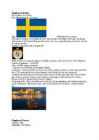
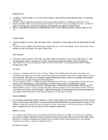
The vikings Ursula 11. kl Who were the vikings? The Vikings were the Norse explorers, warriors, merchants, and pirates who raided, traded, explored and settled in wide areas of Europe, Asia and the North Atlantic islands from the late 8th to the mid11th century. The Vikings came from three countries of Scandinavia: Denmark, Norway and Sweden. The Viking age in European history was about AD 700 to 1100. During this period many Vikings left Scandinavia and travelled to other countries, such as Britain and Ireland. Some went to fight and steal treasure. Others settled in new lands as farmers, craftsmen or traders. ships There were two distinct classes of Viking ships: the longship and the knarr.
Scandinavia tapeedisalong Nipitiri Ettevõtte tutvustus Heade mõtete ja soovidega on koondatud Scandinavia tapeedisalongi parimate tapeeditootjate toodangu, et pakkuda tõeliselt head valikut kõigile, kes hindavad kodusoojust, harmooniat ja rahu, unustamata tervisesõbralikkust ja looduse säästmist. Kuna tänases Eestis on valik ja võimalused tohutult laienenud, on nende sõbralik meeskond valmis soovitama sobivat seinakatet lähtuvalt vajadustest ja arvestades ruumide eripära. Ettevõtte teenused PABERJA FLIISTAPEEDID TOOTED LASTELE PILTTAPEEDID TEKSTIILTAPEEDID ROO JA KORKTAPEEDID
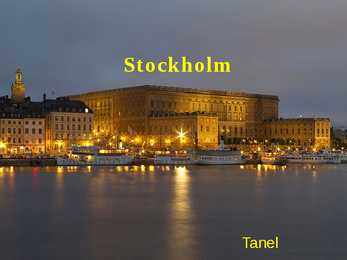
Stockholm Tanel City of islands The capital and the largest city of Sweden Founded possibly in 1187 14 islands first in Scandinavia Venice of the North Buildings Government of Sweden Parliament of Sweden The Riksdag buildning exterior, from the west, at night. Ekerö Municipality Stockholm City Hall Other activities Vasa Museum IKEA of Sweden Thank you for listening!
● 1345 - Danes sold Tallinn to the Teutonic Order ATTRACTIONS ● Toompea Castle ● Old Town ● Town Hall ● Kadriorg - beautiful park ● City Centre - medieval churches, modern towers OLD TOWN ● listed in the UNESCO world heritage list ● built up from the 13th to 16th centuries ● old Hanseatic town ● surrounded by huge walls ● many towers, narrow streets TOWN HALL ● on the Town Hall Square ● built in 1402-1404 ● oldest in the Baltic region and Scandinavia ● tower height is 64 m ATTRACTIONS Old Town Town Hall ATTRACTIONS Park Kadriorg City Centre Thank you for listening!
kahel refuugiumil: Bromme Ibeeria refuugiumil, ja Ahrensburg Ibeeria ja Ukraina 6 Põhjagermaani keel on üks kolmest keelest, mis kuulub germaani keelte hulka. Ülejäänud kahte nimetatakse idagermaani (gooti keel) ja läänegermaani (inglise-, saksa-, hollandi-, friisi -, jidisi-, afrikaani-, alamsaksa-, flaami-, letseburgi keel) keelteks. 7 Ari Siiriäinen. The Stone and Bronze Ages; Michael Barnes. Languages and ethnic groups.The Cambridge History of Scandinavia. Vol. 1, Prehistory to 1520. Koost. Knut Helle. Cambridge University Press. Cambridge 2003, lk94. 8 Elise C Otte, lk10 ; Robert C. Boraker. Uncovering Scandinavian roots. http://www.ensignmessage.com/archives/scandinavianroots.html 9 Elise C Otte, lk13. 10 Kalevi Wiik ,,Eurooplaste juured" Ilmamaa. Tartu 2005, lk.193. 11 Kalevi Wiik, lk.68-69; Refuugium on paik kus elatakse külmadel (jääaeg) perioodidel, Euroopas oli neid kolm: Ibeeria, Ukraina ja Balkan. Kalevi Wiik, lk.69.
Ice hockey Rauno leppik 7.a Ice Hockey Ice hockey is a team sport played on ice. It's a fastpaced and physical sport. Ice hockey is a most popular in areas that are sufficiently cold for natural reliable seasonal ice cover such as Canada, the northern United States, Scandinavia and Russia. History European immigrants brought various versions of hockey: like games to Canada, such as the Irish sport of hurling, the closely related Scottish sport of shinty, and versions of field hockey played in England. Where necessary, these seem to have been adapted for icy conditions; for example, a colonial Williamsburg newspaper records hockey being played in a snow storm in Virginia. Early paintings show "shinney", an early form
Denmark Capital Copenhagen Official language Danish The national flag of Denmark, Dannebrog, is red with a white Scandinavia cross that extends to the edges of the flag; the vertical part of the cross is shifted to the hoist side. Symbols - Bird: Mute Swan, Coat of Arms: The National Coat of Arms features three crowned lions facing left, surrounded by nine red hearts, all placed atop a golden shield. The crown on the shield is the crown of King Christian V. Tree: Beech, Flower: Red Clover Size - 43,075 km2 Population - 2011 estimate 5,564,219 Higest..
INTRODUCTION Tallinn is the capital and largest city of Estonia. It occupies a surface of 159.2 km2 in which 404,000 inhabitants live. It is situated on the northern coast of the country, on the banks of the Gulf of Finland, in north-western Estonia. Tallinn is the location of many institutions of higher education and science. As an important port for trade between Russia and Scandinavia, it became a target for the expansion of the Teutonic Knights and the Kingdom of Denmark. Historically, the city has been attacked, sacked, razed and pillaged on numerous occasions. Although extensively bombed by Soviet airforces during the latter stages of World War II, much of the medieval Old Town still retains its charm. Since independence, improving air and sea transport links with Western Europe and Estonia's accession to the European Union have made Tallinn easily accessible to tourists
red. Kingdom of Norway Capital Oslo Language Norwegian The flag of Norway is red with an indigo blue Scandinavian cross outlined in white that extends to the edges of the flag. Symbols - With elk as the National Animal, purple heather being its National Flower and dipper as its national bird. Size 323,802 square kilometres Population - 4,999,800 Biggest rivers Glomma and Otra Landscape Scandinavia mountains, The rugged coastline, broken by huge fjords and thousands of islands Climate - The southern and western parts of Norway experience more precipitation and have milder winters than the southeastern part. The lowlands around Oslo have the warmest and sunniest summers but also cold weather and snow in wintertime (especially inland). Famous for 19th century, Henrik Ibseni made Norway famous for plays Interesting facts Norway is one of the wealrhiest countries in the world
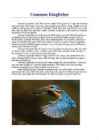
Common Kingfisher is 16-20cm tall and weighs 38-45 grams. It's wings are short and wide and about 7-8cm long. It has short and straight-cut tail. Beak is long, straight and with suddenly outreaching end. Common Kingfisher's head, back and wing feathers are azurite blue, pate has black and light blue stripes. Common Kingfisher is also known as Eurasian Kingfisher or River Kingfisher. Common Kingfisher lives in Eurasia and North-Africa, except for North-Scandinavia. In Finland it lives at south coast, in Africa it lives in north from Sahara. In Asia it lives in North-Turkey, Caucasia, West-Iran, India, East-China and more. It is resident in much of its range, but migrates from areas where rivers freeze in winter. In winter Common Kingfisher travels from north to Mediterranean countries. It is a rare bird in Estonia, up to 1000 birds in summer, and 100 birds in winter.
· 3182 = 80 or 90 pages in book lenght · two parts: 1st - Beowulf's battle with Grendel and Grendel's mother, 2nd - aged Beowulf's victory over a dragon, death and funeral Background of Beowulf: · primitive and harsh environment · great importance · wars - life brief, fate ruled over human beings · Beowulf - sense of fatal doom, dark and sombre tone · fate and fame - vital ideas in the literature of Anglo-Saxon period · Beowulf - monsters slaying in Scandinavia = struggles between good and evil Christian Poetry · 55 B.C. Julius Ceasar - christianity to British Isles · 449 A.D Anglo-Saxons - pagans = christianity declined · 597 A.D. St. Augustine - within 100 years all country into christianity Caedmon and Alfred the Great Ceadmon · first religious poet of British literature · "the father of English song" · Hymn of Creation - between 658 and 680 - the oldest preserved
Because there are white cliffs. Why and who built the Hadrian Wall? it was built on the orders of the Emperor Hadrian. The primary function of Hadrian's Wall was to keep out the Picts. When did the Saxons settle in Britain? The Saxons settle in Britain from the early 5th century AD When did the Vikings first raid Britain? The Vikings first invaded Britain in AD 793 (last invaded in 1066) . they come from the three countries of Scandinavia: Denmark, Norway and Sweden. Who were the Normans? The Normans were the people who gave their name to Normandy, a region in northern France When was the Battle of Hastings? in1066 The Bayeux Tapestry is a long embroidered cloth - not an actual tapestry - which depicts the events leading up to the Norman conquest of England as well as the events of the invasion itself. Who was William The Conquerer?
flight or at rest. Upon hatching, the plumage coloring of the duckling is yellow on the underside and face (with streaks by the eyes) and black on the backside (with some yellow spots) all the way to the top and back of the head. The Mallard is widely distributed across the Northern Hemisphere, North America from southern and central Alaska to Mexico, the Hawaiian Islands, and across Eurasia, from Iceland and southern Greenland and parts of Morocco in the west, Scandinavia to the north, and to Siberia, Japan, and China in the east.It is strongly migratory in the northern parts of its breeding range, and winters farther south. Water depths of less than 1 m are preferred. Mallards avoid areas more than a few metres deep. When the male molts, he ends up losing his distinctive green head of feathers, but still has the white collar ring and rusty-brown chest. Both males and females are unable to
Acid rain is caused by emissions of carbon dioxide, sulfur dioxide and nitrogen oxides, which react with water molecules. Distilled water(doesn't contain CO 2), has pH level 7. Liquids with pH level less than 7 are acidic, liquids with pH level greater than 7 are alkaline. Unpolluted rain has a pH level over 5.7, so it is slightly acidic. Affected areas Places significantly impacted by acid rain around the globe include most of eastern Europe from Poland northward into Scandinavia, the eastern third of the United States and southeastern Canada. Other affected areas include the southeastern coast of China and Taiwan Causes · It is caused when sulfur dioxide and nitrogen oxides are released into the air. In the atmosphere they react with water, oxygen and other chemicals to form more acidic pollutants, known as acid rain. Sulfur dioxide and nitrogen oxides dissolve very easily in water and can be carried very far by wind
The problem of acid rain not only has increased with population and industrial growth, but has become more widespread The use of tall smokestacks to reduce local pollution has contributed to the spread of acid rain by releasing gases into regional atmospheric circulation Often deposition occurs a considerable distance downwind of the emissions, with mountainous regions tending to receive the greatest deposition An example of this effect is the low pH of rain which falls in Scandinavia Effects Many ecosystems are affected by acid rain. Bodies of water, such as lakes and rivers, see many of their inhabitants die off due to rising acidity levels. Acidic water also ruins plant nutrients, hurting plants' ability to survive and to give life to other organisms Human-made products are also experiencing degradation from acid rain. Cars can lose their finishes, and outdoor statues are beginning to rust Acid rain's effects are destructive and long lasting
NORTHERN LIGHTS LIINA VIROLAINEN 12A CLASS KEILA KOOL NORTHERN LIGHTS Northern lights is a common name for the Aurora Borealis in the Northern Hemisphere. Where can we see the northern lights? The Northern Lights, as the name suggests, are especially related to the polar regions. They occur most frequently in a belt of radius 2500 km centered on the magnetic north pole. This so-called auroral zone extends over northern Scandinavia, Island, the southern tip of Greenland and continuing over northern Canada, Alaska and along the northern coast of Siberia. How often can you see the Northern Lights? In Troms and Finnmark, we can see the Northern Lights every other clear night, if not even more frequently. From southern Norway, only a few times a month while in central Europe hardly more than a few times a year and they have even been seen from the Mediterranean but only a few times each century.
more widespread. The use of tall smokestacks to reduce local pollution has contributed to the spread of acid rain by releasing gases into regional atmospheric circulation.[11][12] Often deposition occurs a considerable distance downwind of the emissions, with mountainous regions tending to receive the greatest deposition (simply because of their higher rainfall). An example of this effect is the low pH of rain (compared to the local emissions) which falls in Scandinavia. Many ecosystems are affected by acid rain. Bodies of water, such as lakes and rivers, see many of their inhabitants die off due to rising acidity levels. Acidic water also ruins plant nutrients, hurting plants' ability to survive and to give life to other organisms. Human-made products are also experiencing degradation from acid rain. Cars can lose their finishes, and outdoor statues are beginning to rust. Acid rain's effects are destructive and long lasting. Though scientists have studied
Rahvusvaheline Lennutranspordi Ühendus (IATA, International Air Transport Association) tähistab lennufirmasid. Need moodustavad lennu numbri kaks esimest märki (näiteks OV 177: Estonian Airi lend 177 TallinnBrüssel). IATA koode kasutatakse näiteks sõiduplaanides, piletite reserveerimisel. IATA koodid ei ole unikaalsed, näiteks kood EZ tähistab nii USA firmat Evergreen International Airlines kui Taani firmat Sun Air of Scandinavia. IATA koodid asendatakse aja jooksul kolmetäheliste ICAO lennufirmakoodidega. Näited lennufirmakoodidest OV Estonian Air FR Ryanair AY Finnair MA Malév SK SAS SU Aeroflot Kasutatud kirjandus http://www.etfl.ee/index.php? e_id=51&p_id=36 http://et.wikipedia.org/wiki/IATA_lennufirma kood http://et.wikipedia.org/wiki/IATA_lennujaama kood www.iata.org
Independence lasted 22 years. This period was one of great cultural advancement.Estonia underwent a number of economic, social, and political reforms necessary to come to terms with its new status as a sovereign state. Economically and socially, land reform in 1919 was the most important step. Large estate holdings belonging to the Baltic nobility were redistributed among the peasants and especially among volunteers in the War of Independence. Estonia's principal markets became Scandinavia, Great Britain, and western Europe, with some exports to the United States and Soviet Union. In World War II Estonia suffered huge losses. Ports were destroyed, and 45% of industry and 40% of the railways were damaged. Estonia's population decreased by one-fifth (about 200,000 people).More than 30,000 soldiers were killed in battles. In 1944 Russian air raids destroyed Narva, and one-third of the residential area in Tallinn was destroyed
very hot. The first inhabitants were Iberians and Celts who settled on the land and were often at war with each other. In AD 43 the Roman Emperor Claudius invaded, and made Britain a Roman province. They stayed for three hundred years, and built villas, roads and towns. Many Roman remains can be visited in Britain today. The Romans finally abandoned Britain in AD 410 and a long period of invasion by Nordic peoples (from northern Germany and Scandinavia) started. The Angles, Saxons and Jutes began to settle from the sixth to the eighth centuries, and the Angles gave England its name. These invaders introduced a new culture to Britain, and even today British customs and habits are described as ´Anglo-Saxon`. Anglo-Saxon England was one of the most civilised countries in Europe, with organised systems of agriculture and trade. The Vikings came from Scandinavia in the tenth century; they settled in the north and
English. The poem's composition, however, is considered to date back to about 700 AD, meaning that it is from the Anglo-Saxon literary period. The epic was most probably created by scop(s) who composed it for entertainment and in praise of their master. Over the three centuries the epic was being changed and adapted by them, as it was inherited by word of mouth. The events occurring in the poem are set in Southern Scandinavia, Geatland and Denmark, in the fifth and sixth centuries. It should be observed that the narrative is written in the third person point of view and the narrator is omniscient. The subject matters in this poem are restricted to war and death. This was their present and therefore interesting to them as they could identify with the characters. The restricted variety of themes, flat characters and confrontation are peculiarities of epics
Wild boar (Sus scrofa) Hunting season 01.01-31.12 Wild boar is a typical Klõpsake juhtslaidi teksti laadide redigee fair game in Estonia Teine tase Average weight 80- 150 Kolmas tase kg (max 350 ) Neljas tase Viies tase Life-span 10 years They are native all over Europe, but there are no wild boars in UK and Scandinavia Adult males develop tusks, continiously growing teeth that protude from the mouth, from their upper and lower canine teeth. The tusks normally measure about 6 cm. Wild boar is an omnivore which means that they'll eat about anything they find. Favourite foods are crops (potatoes, peas, corn, rye) Multiplicity of wild boar in 2012 was over 20 000 and there were 24000 caught individuals Wolf (Canis lupus) Hunting season 01.11-28.02
It is exposed, for instance, at Toompea and Lasnamäe. However, Toompea is not a part of the cliff, but a separate hill. Coastline is 46 kilometres long.The highest point of Tallinn, at 64 meters above the sea level, is situated in the district of Nõmme, in the south-west of the city. The first human steps, that archeologists found, are about 5000 years old. Tallinn`s first fortress was built in Toompea, in 1050. As an important port for trade between Russia and Scandinavia, it became a target for the expansion of the Teutonic Knights and the Kingdom of Denmark during the period of Northern Crusades in the beginning of the 13th century when Christianity was forcibly imposed on the local population. Danish rule of Tallinn and Northern Estonia started in 1219. In 1285 the city became the northernmost member of the Hanseatic League - a military alliance of German-dominated cities inNorthern Europe. The Danes sold Tallinn along with their other
In 1991 on the 20th of August we got our independents back. In 1992 Estonian kroons were put in use. In 1994 last Russian troops leave Estonia in 2004 Estonia joined European Union. Tallinn is the capital of Estonia. It is situated on the southern coast of the Gulf of Finland. The territory of Tallinn is 182,4 square kilometers. 46 % of the Tallinns territory has been built up. Parks and forests cover 31% and water-bodies 8% of the land. In Russia Tallinn was called Koluvan. In Scandinavia it was known as Lindanise. The Germans called in Reval and that name was in use until 1917. Estonians themselves called it Tallinn. Tallinn is a very old town, and numerous of legends were connected with it. They spoke about Old Toomas keeping watch on the top of the tower of town hall. Toompea is the oldest part of the city. The toompea Palace was built as the seat of the local government. Today there is the residence of the Parliamnet of Estonia
The Church built in the 14th century has maintained its original look practically without any changes. Decorative ceiling paintings have been preserved partly in the Church; there are magic ceiling marks on the vaults of the choir room, over the vestry there is a unique room with a fireplace, the other fireplace is situated in the attic of the choir. Supposedly so the accommodation possibilities were created for the pilgrims, who traveled through the Scandinavia and the Island of Gotland to Maarjamaa. · Panga Bank is the highest of the banks of the Northern coast of Saaremaa and Muhu. The maximum height of the Bank is 21.3m and the reach about 2.5km. In the highest point of the Bank an ancient sacrifice place is situated, where sacrifices to the sea were made in the old times. · The Field of the Kaali Meteorite Craters in Central Saaremaa is the rarest
into the environment. From the second to tenth day after the accident, some 5000 tonnes of boron, dolomite, sand, clay and lead were dropped on to the burning core by helicopter in an effort to extinguish the blaze and limit the release of radioactive particles. Immediate impact Most of the released gases and fallouts were deposited close by as dust and debris, but the lighter material was carried by wind over the Ukraine, Belarus, Russia and to some extent over Scandinavia and Europe. The casualties included firefighters who attended the fires. All these were put out in a few hours, but radiation doses on the first day were extremely high causing 28 deaths. Also the people involved in the clean-up received high doses of radiation. Environmental and health effects Studies in the Ukraine, Russia and Belarus say that over one million people possibly affected by radiation. By 2000, about 4000 cases of thyroid cancer had been diagnosed in exposed children
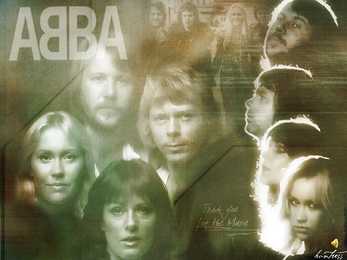
composer of the musicals Chess, Kristina från Duvemåla, and Mamma Mia!. During the last years Björn Ulvaeus has stepped forward as a frontline critic against the free file sharing of copyrighted material on the internet. He has recently coproduced the film "Mamma Mia!" with close-friend Benny Andersson ABBA Björn was a member of the Swedish folk band Hootenanny Singers who had an enormous following in Scandinavia. On 6 July 1971, Björn married Agnetha; The marriage resulted in two children: Linda Elin Ulvaeus (born 23 February 1973), and Peter Christian Ulvaeus (born 4 December 1977). Together with Andersson, Ulvaeus was nominated in the category "Outstanding Music" (for the musical Chess), and a category "Best Orchestrations" (for musical Mamma Mia!). ABBA Benny Andersson (16 December 1946) is a Swedish musician, composer and co-
Another important area is passenger shipping which is directly linked to tourism. The Estonian national air company Estonian Air has also proven successful as it has managed to increase both cargo volumes and the number of passengers. A large part of freight transport is still done by road. Passenger transport is organised with buses for the most part, there are international lines to St Petersburg, Latvia, Lithuania, Poland, Germany and Scandinavia. During the recent years a lot of roads have been repaired and new ones have been constructed, but a considerable number of roads are still in a fairly poor condition. About 3.4 million tourists visit Estonia every year, the majority of them come Finland and stay for a short period. Tourists who come for a couple of days also go to the theatre and other places outside Tallinn. The number of tourists from Sweden and Germany is constantly growing
an attraction, remaining on display until 1897, when he was finally buried. Town Hall Square ● Has been a market place and town centre since the Middle Ages. ● Town Hall Pharmacy - one of the oldest continuously running pharmacies in Europe, having always been in business in the same building since the 15th century. ● The Christmas Tree tradition dates back to 1441. Town Hall ● The oldest townhall in the whole of Baltic and Scandinavia. Construction completed 1404. The city power worked in there until 1970. Meetings and gatherings, concerts sometimes still take place. ● The Old Thomas - nowadays the most important symbols of Tallinn. It’s a wind vane. First placed in 1530. Crossbow competition. Guarding the town. Third Old Thomas.
tends to perform favourably in measurements of civil liberties, education, and press freedom. Living in Estonia has many of its good sides, for instance it is a secure place from nature disasters and it has a beautiful nature. Although, when not to look only through rose-tinted glasses, there are still some minuses in country’s organization. So, what are the beneficial and negative sides of living in Estonia? To start with, a big advantage is a great location between Scandinavia and prosperous Russia which ensures the connections, networks and possible trading options. Close connections and pendulum migration have tightened the cooperation between the countries. For instance, Estonia and Finland have developed common economic space. Right now Estonia's most important trading partners are Finland, Sweden, Russia and Germany which Estonia is mainly influenced by. Maintaining good relations between neighboring countries and being a member
g. Stonehenge, the Avebury ring. The Roman Invasion 55-54 BC, Julius Caesar ruled Rome, Rome built the Hadrian's wall (73 miles long, built in 121 127 AD) against the Picts and Scots, bits have survived till today. The Romans bring along the Christian faith The beginning of Christianization of the Celts. The Romans withdrew their forces together with the fall of the Roman empire. Anglo Saxon Invasion 5th 6th century AD. Germanic tribes from Scandinavia: the Angles, the Saxons and the Jutes settle in what today is known as England and force the Celtic tribes to move to Scotland, Ireland, Wales. The Angles settled in Northumberland, East Anglia, Mercia; The Saxons in Essex, Sussex, Wessex and the Jutes in Kent. 569 AD Pope Gregory the great sends missionaries led by St. Augustine to Britain. The Benedictines establish a chain of monasteries; Britain is linked to the Latin civilization of the roman Church and
Alberta The capital of Alberta is Edmonton. The population is 3.7 million people and there are many nationalities. Besides English and French there are also immigrants from Scotland, Ireland, Wales, Germany, Ukraine and Scandinavia. In Edmonton and Calgary there are also historic Chinatowns, and Calgary has Canada's third largest Chinese community. Geographical features Alberta covers an area of 661,848 square kilometres, an area about 5% smaller than Texas or 20% larger than France. This makes it the fourth largest province after Quebec, Ontario, and British Columbia. To the south, the province borders on the 49th parallel north, separating it from the U.S
Nordic peoples started. The Angles, Saxons and Jutes began to settle from the sixth to the eighth centuries, and the Angles gave England its name. These invaders introduced a new culture to Britain, and even today British customs and habits are described as 'Anglo-Saxon'. Anglo-Saxon England was one of the most civilised countries in Europe, with organised systems of agriculture and trade. The Vikings ca me from Scandinavia in the tenth eentury; they settled in the north and made the town of York the capital of their kingdom. The last successful invasion of Britain was in 1066, which is an important date in history books in British schools. Duke William of Normandy (William the Conqueror) defeated the English at the Battle of Hastings, and the Normans and the French settled in Britain over the next three centuries. French became the language of the nobility and, with Latin, the language
Friday, Thor Thursday, Angle-land England. The Anglo-Saxons divided the cuntry into small warring kingdoms Northumbria, Mercia, Wessex, Sussex, Essex, Kent, East Anglia. Due to constant conflict weakened the kingdoms. The political power was in Wessex, which was the most powerful of the kingdoms. The Anglo-Saxons were farmers and fishermen and lived in small communities. They deployed a crop rotation over three fields; used heavy ploughs. In 787 AD came the Vikings from Scandinavia, who set up their own state Danelaw. Had their own religion, however their rituals did not demand sacrifices. Introduced new words (1800). Placenames withe suffixes -by and -dale. They had their own customs and laws, which we know due to sagas (oral history). They had no written language. Beowulf Beowulf is an epic or a long poem describing the adventures of an hero. It belongs to the
Estonian "vürst" (an old Low German loan). In Old English texts we come across several · runic letters · modified Latin letters. Both used to denote sounds that Old English had and Latin did not. Thorn-letter (runic) and edh-letter (modified Latin d) for the // sound (close to t and d) used indiscriminately for both the voiceless and the voiced variant. Thorn, or orn (, ), is a letter in the Anglo-Saxon and Icelandic alphabets. It was also used in medieval Scandinavia, but was later replaced with the digraph th. The letter originated from a rune in the Elder Fuark, called thorn in the Anglo-Saxon and thorn or thurs ("Thor", "giant") in the Scandinavian rune poems, its reconstructed Proto-Germanic name being *Thurisaz. It has the sound of either a voiceless dental fricative, like th as in the English word thick, or a voiced dental fricative, like th as in the English word the. (In Modern Icelandic the usage is restricted to the former
her sister, that Elixabeth might murder her and come to the throne and that's why she sent her to the tower accusing her of treason. When Mary died Elizabeth come to the throne. The peak of English Renassance. She was the ideal of a beautiful woman. She was very well educated (many foreign languages, Latin). She made peace with Spain and France, built a big fleet considered trade on important matters, in her rule special companies were established to exploit trading possibilities with scandinavia and the far East. The East Indian company was established during her reign. She incourged the .... Of colonies abroad. 1492 Columbus found the centre of America. Elizabeth never got married, she was a virgin.In America state Virgina is named after her. Wales was united with the kingdom, Ireland became the Enlish colony. She had to choose sb to be her hier (troonipärija). James son of Mary Stuart, Elizabeths cousin, daughters James V. Mary came to the throne when she was 6 days old. In her .
approximately 18.5 hours to drive. This is very similar to Great Britain (Land's End to John o' Groats 1,404 kilometres (872 miles) and 16.5 h) Finland is a land of all seasons. Its blue and white flag is said to represent the white snow of winter and the blue lakes of summer. In between the two is the dramatic spring when everything turns green in a week, and autumn, full of reds and browns as the leaves swirl over the city squares.Finland is certainly Scandinavia`s least understood and most culturally remote country. Finland is covered by a mixture of forest and marshland. It seems , for every Finnish family to have an island or lake of its own, with plenty of space for visitors too. Inland lakes cover almost 10 percent of the country`s entire area. None of Finland`s lakes are very deep, however; most of them averae around 100m (330ft). (www.wikipedia.org) Position and size
land. They were looking for a better place to live and support their families. The country was not called Russia at that time, but it was working its way of becoming an empire. During the 9th century the Scandinavian people who were called the Varangians crossed the Baltic Sea and went to the Eastern Europe. They settled in the city of Novgorod. They also gained control over Kiev, which is in modern day Ukraine. This city became a big trading centre between Scandinavia and the big Russian empire. The empire became very well-known and popular.Over the next couple hundred years the Varangians conquer more areas and the empire grows fast. The ruler of the empire, Vladimir, decided that the main religion is going to be Greek Orthodoxy. The next ruler Yaroslav started making basic laws for the empire ( " H i s t o r y a n d c u l t u r e , " ) . Over the next few hundred years, new invaders- Mongols settled in on the Russian territories
· Raamat. Toomla, R. (1999). Eesti erakonnad. Tallinn: Eesti Entsüklopeediakirjastus · Raamat mitme autoriga. Linz, J. J., & Stepan, A. (1996). Problems of democratic trasition and consolidation. London: The John Hopkins Press · Sama autor. Toomla, R. (1999)...; Toomla, R. (2001)... esitatakse ilmu- misjärjekorras. Kui sama ilmumisaasta: Toomla, R. (1999a); Toomla, R. (1999b) · Artikkel teadusajakirjas. Klijn, E. (1999). Policy networks in Scandinavia. Administration and Society, 6 (18), 14-31. (Märkus: "6" siin volume nr.; "18" sulgudes issue nr.; "14-31" tähistavad lk.) · Artikkel kogumikus. Sabatier, P. (1993). Advocacy coalition framework. In H. Jenkins (toim.), Theories in policy analysis (lk. 233-245). Oxford: University Press. · Ajaleheartikkel. Rumessen, V . (1993, 21. juuni). Edasi laarilikul teel! Postimees, lk. 15. · Artikkel populaarteaduslikus ajakirjas. The Economist (2003, June 15 June 22)
The French and Indian War (1754-1763) was the North American theater of the Seven Years' War. The British colonies in America defeated New France, forcing France to cede almost all of its territory to Britain and Spain.Subsequently, most immigrants arrived from Britain, either directly or via US Chinese immigration to British Columbia was extensive in the latter half of C19. In the beginning of 20th century, most immigrants were from Central and Eastern Europe, as well as Scandinavia After World War II,Canada accepted many immigrants from war-torn countries (e.g. Estonia, the Netherlands, and Italy). Since the 1970s, immigrants have mainly been visible minorities from the developing world. Most immigrants currently arrive from South Asia, China, and the Carribean. 7. Which province has the highest percentage of population of British origin? Newfoundland of French origin? New France and One more province that has a large French-speaking population. Québec City 8
The Dome Church The cathedral of Saint Mary the Virgin in Tallinn .http://www.eelk.ee/~eelk109/english.htm St Olaf's Church The St. Olaf's Church is dedicated to King Olaf Haraldsson of Norway (995-1030), who adopted Christianity and established it in Norway. The traditional faith was still strong, however; the king was overthrown and killed in battle. He was canonised after death and the cult of his name spread all over Scandinavia. The earliest written record about the church date back to 1267, when Queen Margarethe of Denmark granted the female Cistercian convent of St. Michael the advowson over the St. Olaf's Church. But major reconstruction followed in the 14 th -15th centuries. The tower standing separate from the church was completed in 1364. The fire of 1433 claimed the St.Olaf's Church besides other buildings. It was consecrated for service
Traditionally, they paint their faces, dress up in old clothes, and go around to neighbors' houses singing national songs and knocking on doors, asking to be let in out of the cold. Once inside, they are supposed to be offered fruit and candy. 25 December Christmas Day Estonians live in Jõulumaa? The Estonian word jõulud (Christmas) is of ancient Scandinavian origin and comes from the word Jul. In Scandinavia and Estonia Jesus Christ's birthday is marked by the preChristian word Jul in Swedish, Norwegian, Danish, Jol in Icelandic, Joulu in Finnish and Yule on the British Isles. So we can say that like Finnish, Swedish, Norwegian, Danish, Icelandic and British people, Estonians live in Jõulumaa. jõulud was celebrated in Estonia also before Christianity and for old Estonians it lasted for 17 days?Old Estonians celebrated winter solstice the birthday of the Sun
2.3.SWOT Analysis of the Organization Strengths Weaknesses SO1: Good reputation on the local market WO1: Not enough qualified employees to SO2: Extensive and varying customer base support numerous customers SO3: Relations with foreign partners in WO2: Project-orientedness implies a Baltic states, Scandinavia and UK multitude of different code to support SO4: Reliable employee base WO3: Unattractive and obscure web SO5: Attractive inspiring office space in the representation and interface of products very heart of the city WO4: Too many areas of services
1. Where did the Vikings come from? 2. What attracted them? 3. Was England the only country they raided and settled? 4. Who was able to halt their southward advance? 5. What kind of agreement did King Alfred make with the Danes? 41 6. Were there many differences (or similarities) in culture and language between the Anglo-Saxons and the Danes? 4. Put a preposition in each gap. Underline the prepositions in your notebooks. A new wave ___ invaders came ____ Scandinavia. They only raided ___ first. They plundered churches and monasteries _____ the coasts ___ Britain and Ireland. ___ 865 they invaded Britain._____ ten years they occupied most ___ England. Their conquest was halted ___ Alfred _____ defeating them ____ a battle ___ 878. It resulted ____ the division ____ England _____ two parts. The agreement recognized Viking rule ____ the north and east. ___ the rest ___ the country Alfred was recognized ___ king
Jarrow In 731 ,,The Great Ecclesiastical History of the English People"- overshaows all other sources of 7th, early 8th C Well-founded scraps of tradition, first work of history, where AD system is used Angles, Saxons, Jutes. Frisians 430´s onwards, Germans settlers arrived in large numbers. Anglo-Saxon invasions in 499 The Saxons- Saxon country to South and West The Angles- Angulus to East Anglia, Jutes in Kent Same culture as southern Scandinavia, Germany, northern France 600 they had founded their 7 kingdoms The Anglo-Saxon kingdoms Kent-JUtes, Essex, Sussex, Vessex- Saxons East Anglia, Mercia, Nothumbria- Angles Series of over-kings from various kingdoms St Patrick Conversion of Irish- 432-461 Patron saint of Ireland, originally pagan, slave He escaped, became a Christian priest and later bishop. Ireland was largely christian by 6th C
driven , glo ba lly co n nected eco no m ies, mem ber na tio n s whose co m bin ed conti n u e to be m in ed , notably in Russia , wh ere m an u factunng and co m me rcial eco no m ic clo ut rivals th e U.S. RUSSIa a n d th e Ukra in e, an d Scandinavia. The ag riculture pr ed onuna cc. C ruc ial to form er Soviet-sa tellite natio ns ar e, in large bo u ntifu l oi l and ga s fields of the North s 365 con tmc n tal eco no m ic Il1 tegr atl on IS t he pan , reachmg ha rm on y with th e rest o f Sea are o ne o f the most im portant and Eur opean UnIOn , a par tn ershi p o f 15
of art was considered as secondary. Several other writers had contact with the movement: August Kitzberg (1855-1927), Aino Kallas (1878-1956) and Anton Hansen Tammsaare. Several painters belonged to the movement: Kristjan Raud, Nikolai Triik (1884-1940), Konrad Mägi (1878-1925) and Aleksander Tassa (1882-1955). The Young Estonians shared broad cultural interests; they studied and translated literary and artistic works from Scandinavia and Europe, and an influential role was played by the journals Noor-Eesti (1910-1911) and Vaba Sõna (Free Word, 1914-1916). This important development was due to a change in the general world-view, and the widening and deepening national consciousness. At its height (the years before the First World War) the Young Estonians immersed themselves in the ideas of Western philosophy and art (Impressionism, Symbolism etc), obviating Russian and German
made using “unusual” meats, among them (6°C), and smoked. This semidry fermented mutton, lamb, horse, and reindeer. The use of sausage has a soft texture due to limited wild animal meat is a common practice all drying (total weight loss of 12%–17%) and over Scandinavia. A large range of so-called is eaten cooked (Pisula 2004). Morr sausages based on old traditional methods is produced, including Fårepølse Russia and Stabbur. In these products, the presence of meat from free-ranging animals and some-
 annaabi.ee