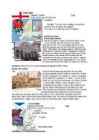
The Romans came to Britain nearly 2000 years ago and changed our country. The Romans lived in Rome, a city in the centre of the country of Italy .One day, some years before Jesus Christ was born, the Romans came to Britain. First invasion - Caesar's first raid In August 55 B.C. (55 years before Jesus was born) the Roman general, emperor Julius Caesar invaded Britain. He took with him two Roman legions. After winning several battles against the Britons in South-East England he returned to France. Second invasion - Caesar's second raid In 54 B.C. Julius Caesar came to Britain again landing at Walmer near Deal in Kent. This time he brought with him five legions (30,000 foot soldiers) and 2,000 cavalrymen (horse riders). This time the Romans crossed the River Thames. After more fighting, the British tribes promised to pay tribute to Rome and were then left in peace for nearly a century. Third and final invasion In 43 A.D. (43 years after Je...
English studies British history Eleri Pärna Form 9 2010 About 1.What is Stonehenge? 2. Who were the Celts and the Druids? 3. When did the Romans invade Britain? 4. Why did Julius Ceasar call the land Albion ? 5.Why and who built the Hadrian Wall? 6. When did the Saxons settle in Britain? 7. When did the Vikings first raid Britain? 8. Who were the Normans? 9. When was the Battle of Hastings? 10. Who was William The Conquerer? What is Stonehenge? a prehistoric monument located in the English county of Wiltshire built in several stages from 2800 - 1800 BC. Druids built Stonehenge. Who were the Celts and the Druids? The Celts were a group of peoples that occupied lands stretching from the British Isles to Gallatia. The Druids were the wise ones, the educated class of the Celts. ( lawyers, doctors, teachers, storytellers, ...
The foundation stones The Island Britain has a mild climate due to the Gulf Stream which brings warm waters from the Gulf of Mexico. The northern part of the island in average 5'C cooler and it's mountainous or hilly and that's why the south has been more populated.. Britain became an island only 5000 years BC after the Ice Age ended. Britain's prehistory The first evidence of human life on the island are dated back to 250 000 BC. 50 000 BC in a milder Ice Age period Britain became habitable again. People from that time were the ancestors of the modern British. 10 000 BC ige age ended and Britain became inhabited by small groups of hunters who probably followed herds of deer. 5000BC Britain became an island and deer died out. 3000BC the Neolithic people came (probably from Spanish peninsula or even North African ...
Country Studies The United Kingdom Test revision questions Form 11 1. What are the capitals of the 4 constituent countries? England London; Wales Cardiff; N-Ireland Belfast; Scotland - Edinburgh 2. Order the invaders in correct chronological order: Anglo-Saxons, Normans, Romans, Celts, Vikings. Celts > Romans > Anglo-Saxons > Vikings > Normans 3. How did the Celts influence Britain? The Celts were in Britain long before the English language existed. Celtic influence on English is minimal. There are more Amerindian words in English than Celtic ones. 4. How many people approximately speak English? 300million as mother tongue, 470million as 2nd language. 5. Who (which tribes) gave the base of the English language? Anglo-Saxons 6. Describe Wales. Part of the United Kingdom and the island of Great Britain, population: 3,064,000, Wales has a distinctive culture including its...
1. What are the capitals of the 4 constituent countries? England- London; Northen Ireland- Belfast; Scotland- Edinburgh; Wales- Cardiff 2. Order the invaders in correct chronological order: Anglo-Saxons, Normans, Romans, Celts. Romans Anglusaxons , Norman 3. How did the Celts influence Britain? Language. Wars. Engand and Scotland eventually became 1 contry 4. How many people approximately speak English? Approximately 600 million 5. Who (which tribes) gave the base of the English language?Germanic tribes- Anglo-Saxons. 6. Describe Wales.- Wales is a mountainous country on the western side of Great Britain. The national game of Wales is Rugby. Flag- Red dragon on a green and white field. They have their own language Cymraeg ( Welsh) . Anthem- Land Of My Fathers. Official animal- Dragon. There used to be a lot of coalmines. 7. What are the symbols of the 4 constit...
Anglo-Saxon period Celts-came from Germany,2000-1200BC began to migrate to Britain,spoke Celtic language,were known as Britons,lived in small villages,round wooden huts-mainly farmers-no towns,organised in tribes with a king/queen as a leader,intertribal wars were very common,the Ancient Britons:one of the Celtic tribes living in Britain 4thBC,believed in different gods,governed by a class of priests-druids who had great power. Romans in Britain:55BC came to conquer Britain(Julius Caesar),brought their own civilization,taught Britons to build roads,bridges,houses,baths,temples,protected Britain for several hundred years,4thBC Romans left Britain,43AD Queen Boadicea of Iceni tribe lost their battle with Romans. Who were the next invaders and where did they come from? Anglo-Saxons came from northern Germany,Denmark and northern Holland. What was their lifestyle like?Anglo-Saxons liked fighting,drinking,gambling,life expectancy not very lo...
Roman Britain 1.Ülesanne 1.Roman empire exited,more then 400 years ago. 2.Colchester was the capital of Britannia for some time,soon London or Londinium became the capital 3. Romans speaked Latin. 4. Roman rules Britannia. 5. Julius Ceasar ,Hadrian 6. Romans rules Britain before the Vikings. 2.Ülesanne a–2 b–5 c- 1 d-3 e–4 3.Ülesanne 1–d 2–g 3- i 4–h 5–j 6–a 7–b 8–f 4.Ülesanne 55- Julius Ceasar first came to Britain in the year 55 BC (before Christ ). 400- Britannia became a part of the Roman Empire for more than 400 years. 20- About 20 large towns grew araund the camps of the Roman army. 2,000,000 – The whole population of Roman Britain was about 2 million. 2000 – There were abaut 2000 villas on the south of Britannia . 12 000 – Romans built abaut 12000 kilometers of road which were wide and straight . 410 – ...
1) General facts The UK: * the United Kingdom of Great Britain and Northern Ireland was formed in 1801 * it covers 243,610 sq km * everybody from the UK is called British * the capital city is London * is made up of four constituent countries: England, Scotland, Wales and Northern Ireland which in turn are divided into counties * the flag is called the Union Jack which is a combination of the flags of England, Scotland and Northern Ireland * the population is about 60,000,000 people, the population density is 242 people/sq km * its coasts are washed by the Atlantic Ocean, the North Sea, the English Channel, the Celtic Sea, Saint George's Channel, and the Irish Sea. It is linked to France by the Channel Tunnel * the United Kingdom is a constitutional monarchy. The current monarch is Queen Elizabeth II, who is also the Queen and Head of State of fifteen other Commonwealth Realms, such as Can...
The United Kingdom The United Kingdom consists of England, Scotland, Wales and North Ireland and it is situated in the Atlantic Ocean near the mainland of Europe. The population of the UK is 58.6 million and area is 244,110 sq km. Britain has a temperate humid climate. Its characteristic features are mild winters, warm summer, no temperature extremes, abundant rain all year round and frequent changes of weather. The mild climate is partly due to the warm Gulf Stream and partly to the south westerly winds. Occasional winds from the east in winter may bring cold and dry weather. The distribution of rainfall is influenced by the Atlantic Stream. The mountainous areas of the north and west have more rain than the lowlands of the south and east. Wales is located on a peninsula in central-west Britain. The entire area of Wales is about 20,779 km². Wales borders by England to the e...
The history of Scotland begins around 10,000 years ago, when humans first began to inhabit what is now Scotland after the end of the Devensian glaciation, the last ice age. Of the Stone Age, Bronze Age, and Iron Age civilization that existed in the territory, many artifacts remain, but few written records were left behind. The recorded history of Scotland begins with the arrival of the Roman Empire in Britain, when the Romans occupied what is now broadly England, Wales and the Scottish Lowlands, administering it as a Roman province called Britannia. To the north was territory not governed by the Romans -- Caledonia, by name. Its people were the Picts. From a classical historical viewpoint Scotland seemed a peripheral country, slow to gain advances filtering out from the Mediterranean fount of civilisation, but as knowledge of the past increases it has become apparent that some developments were earlier and more advanced than previously ...
Towns in Roman Britain Ingrit Roosileht 7.Klass 2013 Roman roads The Romans built Britain's first towns. They built towns all over Britain as centers to administer the people they had conquered. Within 17 years of the invasion, they had several major towns connected by the famous Roman roads. Towns soon became important places for meetings and trade. What were Roman towns like? v The Roman towns were full of fine buildings and temples. v Streets were laid out in neat, straight lines, like on a chess- board. In the middle there was a large square, called the forum v Many towns had running water and sewers. Aqueducts were bridges for bringing water to the towns. Only the rich had water piped to their houses; everyone else used water from public fountains. The only toilets were public lavatories, which were built around the town and connected to underground sewers. Wh...
N. A. Vavilov ASPECTS OF BRITISH HISTORY Н. А. Вавилов КРАТКАЯ ИСТОРИЯ ВЕЛИКОБРИТАНИИ Учебное пособие на английском языке Москва Институт международного права и экономики имени А. С. Грибоедова 2008 2 УТВЕРЖДЕНО кафедрой лингвистики и переводоведения Вавилов Н.А. Краткая история Великобритании: Учебное пособие на английском языке. – 2-е изд., пересмотр. и испр. – М.: ИМПЭ им. А.С. Грибоедова, 2008. – 88 с. Пособие содержит краткий очерк важнейших событий в истории Великобритании – от первых документально засвидетельствованных вторжений на остров (кельтов, римлян и англосаксов) до создания и распада Британск...
Contents Introduction...................................................3 London's early history.....................................45 The people of London......................................6 Buildings and bridges......................................7 Intruduction London is the capital of the united kingdom (UK), which is made up of Great Britain(England, Scotland, Wales) and Northern Ireland. The city lies in the southeast of England and covers an area of about 1,578 square kilometres on either side of the River Thames. With population of seven million, London is by far the largest city in the UK. Birmingham, the second largest, has just over one million inhabitants. Cultural life London is the worldclass centre. It has more than40 theatres, where audiences enjoy everything from musicals to William Shakespeare's plays. The city also ...
London There were some people living on the banks of the Thames, when the Romans came to England in 43 AD. But we don't know much about them. The Romans built houses, a port and a bridge over the river and named the place Londinium. The bridge which was built by the Romans was later known as London Bridge and it was built in stone in 1176. London soon became the largest city in England and by the time of the Norman Conquest in 1066 it had become the most important city in Britain. It grew area and population until September 1666, when the Great fire destroyed four fifths of the wooden buildings in the City. The fire began in the kitchen of the King's baker in Pudding Lane and lasted for five days. By now London is a city of seven million people covering over 1,5 square miles. Nowadays the population of London is made up of the people of very many nationalities. It is a popular...
khTallinn English College The United Kingdom Topic Mari-Liis Pakats Tallinn 2008 2 Table of Contents Introduction..................................................................................................................4 Geographical Position .................................................................................................4 History .........................................................................................................................4 Government..................................................................................................................5 Queen Victoria.............................................................................................................5 Relief...............................................................................................................................
The UK & London The United Kingdom (or the UK) is a short way of saying the United Kingdom of Great Britain and Norther Ireland. The UK is situated north-west of the European continent between the Atlantic Ocean and the North Sea. The UK consists of England, Wales, Scotland and Northern Ireland. Its highest point is Ben Nevis in Scotland followed by Snowdon in Wales. The Severn is the longest river in the United Kingdom. Other important rivers are the Trent, the Mersey, the Tyne, etc. Lough Neagh which lies in the centre of Northern Ireland is thr UK's largest freshwater lake. The climate in the UK is variable. The weather changes so frequently that it is difficult to forecast. It is not unusual for people to complain that the weathermen were wrong. Fortunately there is no extreme weather conditions, it is never very cold or very hot. The first inhabitants were Iberians and Celts who sett...
Scotland ! Scotland (Gaelic: Alba) is a country in northwest Europe that occupies the northern third of the island of Great Britain. It is part of the United Kingdom, and shares a land border to the south with England. It is bounded by the North Sea to the east, the Atlantic Ocean to the north and west, and the North Channel and Irish Sea to the southwest. In addition to the mainland, Scotland consists of over 790 islands including the Northern Isles and the Hebrides. Edinburgh, the country's capital and second largest city, is one of Europe's largest financial centres. It was the hub of the Scottish Enlightenment of the 18th century, which saw Scotland become one of the commercial, intellectual and industrial powerhouses of Europe. Scotland's largest city is Glasgow, which was once one of the world's leading industrial metropolises, and now lies at the centre of the Greater Glasgow conurbation which dominates the Scottish Low...
TEST – The history of London 1) London was definitely not an important place during the Celtic period. It was just a mosquito-infested swamp. 2) London became a trading centre during the Roman occupation. It was an important crossing point for the Romans over the river Thames. Market forces began to operate. With troops stationed and ships calling, merchants will inevitably set up shops. 3) The Celtic warrior queen Boudicca and her tribesmen fought against the Roman conquest and devastated Londinium. The city was burned down and its inhabitants massacred. 4) London was rapidly rebuilt and in AD 122 the Roman walls were built around it as a defence. 5) The Romans left Britain early in the 5th century because they had to cope with troubles elsewhere in the Empire. 6) Around AD 400 the Germanic tribes invaded Britain. 7) London fell into ruins because the Anglo-Saxons destroyed the Roman towns and fo...
Revision questions for the test on Old English and Medieval Literature. 1.) How is literature analysed and studied? What is the difference between the diachronic and synchronic view? Literature is studied and analysed by reading the piece of work profoundly and work on all the aspects of the piece. Diachronic is development in history Synchronic is particular state at any given moment 2.) Give a general overview of Celtic Britain, Roman invasion in 55-54 BC, Anglo-Saxon invasion and the second Roman "invasion" of Great Britain, who were the leaders, what influence did they leave on the culture of Great Britain? Celtic Britain was during the Bronze Age, there were many small tribal kingdoms fighting one another. Many megalithic monuments were built around that time, e.g. Stonehenge, the Avebury ring. The Roman Invasion 55-54 BC, Julius Caesar ruled Rome, Rome built the Hadrian's wall (73 miles long, built in 121 127 AD) agains...
The history of London There were some people living on the banks of the Thames when the Romans came to England in 43 AD. The Romans built houses, a port and a bridge over the river and named the place Londinium. The bridge which was built by the Romans was later known as London Bridge and it was built in stone in 1176. It was London's only bridge until 1729. Now there are about twenty bridges crossing the river within London. London soon became the largest city in England and by the time of the Norman Conquest in 1066 it had become the most important city in Britain. It grew in area and population until September 1666, when the Great Fire destroyed four fifths of the wooden buildings in the City including ST Paul's Cathedral. The fire lasted for five days. By now London has swallowed up many of the small towns and villages that surrounded it. It is a city of seven million pepole covering 1,606 square mile...
HISTORY TEST 5 invasions to Britain until 1066 1) The Celts o Gaels in 600BC; Cymry(Britons) in 300BC o From present-day Austria, Switzerland o The Celtic language survives in the names of many places in England- Dover, Kent, Thames o The Celts are best known for their art- many bronze objects with elaborate designs; brooches; pins; mirrors; Celtic stone crosses o The Celts had 3 social orders: warriors, druids(priests) ordinary people 2) The Romans o (55 BC-Caesar) 43 AD- 410 AD- Claudius o From present-day Italy o Southern Britain became Britannia and was ruled by a roman governor o The Romans built over 20 towns: Colchester, Londinium, Winchester etc. They were good engineers and built roads and villas that had central heating, glass windows and mosaic floors ...
London History The Romans AD 43- AD 410 The Romans finally invaded Britain in AD 43 from Kent. The Romans lead by Julius Caesar attempted to invade Britain twice before that in 55 and 54 BC but the invasions were unsuccessful. They made their way to the river Thames and sailed up it. The Romans knew it was important to control a crossing point at the river Thames, so they decided to build a settlement on the north bank. Although small settlements had been built on the banks of the Thames, the Romans were the ones who built the first city. They called their city Londinium. The Roman engineers noticed that the point where the swampy river narrowed would make an ideal crossing point, they built London Bridge. Less than 20 years later the native Iceni tribe, led by Queen Boudicca, rose up against the Romans in revenge for mistreatment and burnt Londinium to the ground. The well disciplined Roman army defeated her forces and Londinium was r...
The United Kingdom and London United Kingdom is a political name of the United Kingdom of Great Britain and Northern Ireland. These political names include the countries of England, Scotland and Wales. Every country has its own capital and language. The capital of England is London, the people there are english and the language spoken is English. In scotland live the scots, capital is Edingburg and the languages spoken are English and Scottish. The capital of Wales is Cardiff, the people tehre are welsh and the languages spoken are welsh and English. N. Ireland is the home for the Irish, the capital is Belfast and the language is Irish. The first inhabitants were Iberians and Celts who settled on the land and were often at war with each other. In AD 43 Britain was made a Roman province. The romans stayed there for three hundred years. After the romans left came the Angles, Saxons and Jutes...
THE U.K Different Parts The United Kingdom is a short way of saying the United Kingdom of Great Britain and Northern Ireland. The UK is the political name for those countries which share a parliament in London. All of them were at one time independent kingdoms with their own monarch. Now they are all part of the same kingdom and share the same monarch. The UK consists of Northern Ireland, Scotland, England and Wales. The peoples of these countries are British subjects; they hold British passports and therefore their nationality is British. The british Isles is the geographical name for all the islands off the west coast of Europe. These islands also include The Republic of Ireland, which is politically independent of the Britsh government. Many people refer to the inhabitants of the British isles as 'the English', but England is only one of the countries. The other countries are Scotla...
ENGLAND General overview England is part of the United Kingdom Land borders with Scotland to the north and Wales on to the west The English Channel on south separates it form continental Europe The country includes over 100 smaller islands Capital and largest city is London Its has consitutional monarchy Monarch is Elizabeth II Total area is 130,395 km2 Population is 51,446,000 million, around 84% of the population of the UK Currency is Pound stearling(GBP) Has left-hand traffic Patron saint is ST. George Geography England comprises the central and southern two-thirds of the island of Great Britain, in addition to a number of small islands of which the largest is the Isle of Wight Much of England consists of rolling hills, but it is generally more mountainous in the north with a chain of mountains, the Pennines, dividing east and west Other hilly areas in the north and Midlands are the La...
Scotlan History The history of Scotland begins around 10,000 years ago, when humans first began to inhabit Scotland after the end of the Devensian glaciation, the last ice age. Of the Stone Age, Bronze Age, and Iron Age civilization that existed in the country, many artifacts remain, but few written records were left behind.People lived in Scotland for at least 8,500 years before recorded history dealt with Britain. The written history of Scotland largely begins with the arrival of the Roman Empire in Britain, when the Romans occupied what is now England and Wales, administering it as a Roman province called Britannia. To the north was territory not governed by the Romans -- Caledonia, by name. Its people were the Picts. From a classical historical viewpoint Scotland seemed a peripheral country, slow to gain advances filtering out from the Mediterranean fount of civilisation, but as knowledge of the past incr...
London London is one of the world's great cities. Located in the southeast of England, on the River Thames, it is the capital of the United Kingdom and has been the heart of its political, cultural and business life for centuries. London has always been the centre of the world. The origin of the city may be dated around the beginning of the 1st century when a Celtic tribe settled near the Thames. The Romans founded London about 50 AD. Its name is derived from the Celtic word Londinios, which means `the place of the bold one'. The Romans brought with them forts, roads and the rule of law. Then in 61 AD Queen Boudicca led a rebellion against the Romans. Her army marched on London. No attempt was made to defend London. Boudicca burned London but after her rebellion was crushed it was rebuilt. By the end of the 2nd century, a 6metre stone wall was ...
Country Study Mari-Liis Luukas 11c The British Isles Administrative / d'mnstrtv / haldus- Self-governing / self'gvn / isemajandav, iseseisev Legislative assembly/ 'ledsltv 'sembl/ seadusandlik kogu The British Isles is the name of a group of islands washed by the North Sea in the east and the ...
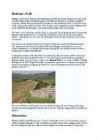
Hadrian's Wall Hadrian's Wall was a stone and turf fortification built by the Roman Empire across the width of Great Britain to prevent military raids by the tribes of Scotland to the north, to improve economic stability and provide peaceful conditions in the Roman province of Britannia to the south, to physically mark the frontier of the Empire, and to separate the unruly Selgovae tribe in the north from the Brigantes in the south and discourage them from uniting. The name is also sometimes used jocularly as a synonym for the border between Scotland and England, although for most of its length the wall follows a line well south of the modern border -- and neither the Scoti tribe nor the English lived in Britain at the time of the wall's construction. The wall was the northern border of the Empire in Britain for much of the Roman Empire's rule, and also the most heavily fortified border in the Empire. In addition to its use as a milit...
Britain History Pre-Norman Britain The Iberians brought their metal-working skills and the first real civilization to Britain in the third millennium B.C and were overrun by various Celtic invasions that began in the 8th century. The Celts introduced their tribal organization and an early form of agriculture before they were forced westward by the Roman invasion. Forms of Celtic language are still spoken in Britain. Romans (with Julius Caesar in the head of them) first tried to occupy Britain in 55 B.C., but there was a rebellion in Gaul so they had to leave to fight against it. Next time they came in 43 A.D. and their leader was Emperor Claudius. Romans brought a lot with them. Their brought paved roads, the sites of important cities, the seeds of Christianity, the Roman law, Roman baths, language and advanced civilization. They also built Hadrian's Wall in 122 A.D. Romans occupied...
REVISION QUESTIONS 1. What do you know about Margaret Thatcher? Winston Churchill? Margaret Thatcher was the first female Prime Minister in Europe. She was a member of the conservative party. She died recently. Winston Churchill was the Prime Minister during WW II. He was excellent in making speeches, but he was a heavy drinker and also smoker. 2. What are the main countries of the UK and their capitals? There are 4: England with London as the capital; Wales with Cardiff as the capital; Scotland with Edinburgh as the capital; and Northern Ireland with Belfast as the capital. 3. What is Remembrance Day all about and why is it celebrated at that time? It is about the men (and women) who lost their lives fighting in the World Wars. It's celebrated then, because that's the day WWI was ended with a treaty. 4. Which powers does the Queen of the UK have? The Queen has to sign all the bills for them to pass. She is the o...
The Importance of English History Essay There is not a single country in the world without a history it can be either long or short, yet still a unique part of the existence. England has had many colourful events throughout the history, but some have dominated over the others and therefore all together formed a country we can see nowadays: the Great Britain. Starting from the beginning, Britain was part of the mainland until about 6000 BC, when it became an island. Ever since then it has been developing slightly different from the other part of the Europe. For example, when two parts separated, some animals had already adopted the life on the island and did not move back to the mainland. They suited their appearance more comfortable for the isolated island and learned how to survive in the wet climate and rather heavy air. The first inhabitants the Iberians also h...
British history Roman Britain Roman Britain was those parts of the island of Great Britain controlled by the Roman Empire between 43 and about 410. The Romans referred to their province as Britannia. Prior to the Roman invasion, Iron Age Britain already had cultural and economic links with Continental Europe, but the invaders introduced new developments in agriculture, urbanization, industry and architecture, leaving a legacy that is still apparent today. Historical records beyond the initial invasion are sparse, although many Roman historians mention the province in passing. Most of the knowledge of the period stems from archaeological investigations and especially epigraphic evidence. The invasion force in AD 43 was led by Aulus Plautius.It is not known how many Roman legions were sent; only one legion, the II Augusta, commanded by the future emperor Vespasian, ...
THE CITY OF LONDON History The City of London occupies one square mile in the middle of the capital. It once made up entire town of London, surrounded by the wall first built by Romans. The Romans also built a bridge over the Thames and there has been one in the same area ever since. The Roman Londinium grew up on the northern side of the bridge. In AD 61 the native Celtic tribe, led by Queen Boudicca, rose up against the Romans. They burnt down Londinium to the ground and killed most of its inhabitants. Roman armies eventually defeated Boudicca and Londinium was rebuilt. At the end of the fourth century AD the Roman Empire began to crumble and the Roman armies were recalled from Britain to defend Rome itself. Once they had left, tribes such as Angles, Saxons and Jutes invaded and settled in from Holland, Germany and Denmark. Together they are known as Anglo-Saxons. They were farming people who pr...
The City of London History The City of London occupies one square mile in the middle of the capital. It once made up the entire town of London, surrounded by the wall first built by the Romans. The Roman Londinium grew up on the northern side of the "London Bridge" in the past. Products such as olive oil, wines and fruit were brought by ships from different parts of the Roman Empire and unloaded onto wooden quays along the river. In AD 61 the native Celtic Iceni tribe, led by Queen Boudicca, rose up against The Romans. They burnt Londinium to the ground but Roman armies eventually defeated Boudicca. The city was rebuilt and was gradually surrounded with a wall of stone and brick which lasted for many centuries. During the archeological excavations in 1954 the Roman Temple of Mithras was revealed. It was a pagan temple dedicated to the Persian Sun-god. The Temple was later reconstructed only a short way...
LONDON The history of the town is very closely linked with the history of the country itself. The name probably comes from the celtic words Llyn, which means a lake, and Dun, which means a fort or a strong place. Although the site was not important during the Celtic period (400 BC 43 AD) During the Roman occupation Londinium, as it was called then, was not influential politically, but was, however an important crossing point for the romans over the river Thames. Londinium was at a very good place, so it soon became a trading centre. In AD 61 the city was devastated by Boudicca, who led a revolt againt the Roman conquest of Britain. The city was burned down and its inhabitants massacred. London was rapidly rebuilt, becoming the capital of the province Britannia. AD 122 Roman walls were built around it as a Around AD 400 the Anglo-Saxons invaded Britain. They destroyed the roman towns and formed many kingdoms that were hostile to one a...
London There were some people living on the banks of the Thames when the Romans came to England in 43 AD. But we don't know much about them. London first called Londinium . In 200 they built a wall around their city, a part of which can still be seen near the Museum of London . London Bridge was built in stone in 1176. It was London's only bridge until 1729. Now there are about twenty bridges . London soon became the largest city in England and by the time of the Norman Conquest in 1066 it had become the most important city in Britain. It grew in are and population until September 1666, when the Great Fire destroyed four fifths of the wooden buildings in the City including St Paul's Cathedral. The fire began in the kitchen of King's baker in Pudding Lane and lasted for five days. London is an exciting city which attracts people from all over the world. It is popular place to live because there is something new to see and do every day. M...
ENGLISH LITERATURE Ancient Britain Lived on the British Isles in the 1st millenium. They most probably came from Eastern Europe and belonged to the Celtic race and also spoke Celtic. They were primitive hunters- gatherers, farmers. Some Celtic words are still used in modern English, however they are used mostly in place names. For example: · avon river · cumb valley · ford shallow place in the river Ancient Britons had their own religion and priests or druids and temples. In the year 55 BC Britain became a Roman province. Romans were highly developed and had their own language latin, which has also greatly influenced English. The military occupation of the Isles ended in 410 AD. The Romans eventually brought Christianity to Britain. Hadrian's wall on the border of Scotland and England. It began constru...
London Topic Tallinn 2008 2 General information London is the capital of the United Kingdom. It covers the area of about 1000 square kilometres and its population is about 7 million. London is located on the river Thames. It is divided into 32 boroughs and the City. Currency used in London is British Pound. London is one of the most popular tourist destination in the world. It is also world's leading business, financial and cultural centre. Subway is commonly used to move around in London. Climate London has a temperate marine climate. It has daily high temperatures during summer. The warmest month is July. The coolest month is January. Winders are seldom below freezing. Rainfall is regular, but most often in the form of drizzle occurring throughout the year. Snow occurs sometimes in winter but rarely settles more than a few millimetres deep. History The origin of London may be dated around the beginning of the...
Population 1. Size, its changes 2. Distribution 3. Towns 4. Ethnic makeup 5. Age breakdown 6. Religion(s) 1. Size. 1 July 2006 population estimates by UK National Statistics: % (mid- Part Population (mid-2006) 2006) England 50,762,900 83.8 Scotland 5,116,900 8.4 Wales 2,965,900 4.9 Northern Ireland 1,741,600 2.9 United Kingdom 60,587,300 100 Although Britain is quite small in terms of land area (245,000 sq km), it has a large population of nearly 61 million, which ranks the 21st in the world (Britain is the 21st most populous state in the world) and the third largest in the European Union. The size of population is chan...
1. Ancient Britain: the Celtic tribes. 2000 years ago there was an Iron Age Celtic culture throughout the Br Isles. It seems that the Celts, who had been arriving from Europe from the 8th cent BC onward, intermingled with the peoples who were already there. The Celts were extremely talented people, creative and artistic. More than 1 Celtic tribe invaded Br. The descendants of ancient Celts live in Wales, Scotland, Cornwall and Ireland. They lived in primitive society. Druids priests, more powerful than chiefs. Acted like prophets. 2. Stonehenge From prehistoric period. Was built on Salisbury plain between 2500 and 1500 bc. One of the most famous and mysterious archaeological sites in the world. One of the mysteries is how it was built at all with the technology of the time. Another is its purpose. It appears to function as a kind on astronomical clock and we know it was used by the Druids for ceremonies marking the passing ...
Scotland Overview Flag-Saltire Royal Standard of Scotland Edinburgh, Glasgow First Minister Alex Salmond 78,387km² 5,222,100 St Andrew History Picts (Celtic tribe) Romans named scotland Caledonia The Scots Queen Mary was forced to abdicate the Scottish throne in 1567. National Symbols Thistle Declaration of Arbroath Tartan Bagpipes Kilt Honours of Scotland Crown, Sword and sceptre are from late fifteenth and early sixteenth century. Crown was made in 1540. Pope Julius II presented the sword to King James IV in 1507. The sceptre was made in 1494 and was presented to King James IV by Pope Alexander VI Honours of Scotland Language Have spoken Pictish, Scottish Gaelic similar Norse, Norman- to Irish, it is French and Brythonic recognised a...
Stonehenge One of the best known ancient wonders of the world, 5000 years old Megalith monument, built by western mediterraneans during 3000-1600 BC Circular structure, large standing stones, aligned with rising sun at teh solstice Attlers and bones were sued to dig pits that hold the stones The Celts in Britain and their legacy 700-200 BC celts invade Britain Gaels or Goehls(Ireland and Scotland),Cymri(Wales) and Brythons(gave name to Brittany) Fierce fighters,superb horsemen.Most of them farmers, lived in thatched houses Good at art, craftmanship, used iron Divided into tribes, ruled by kings, only in face of danger would they choose a single leader Legacy- hill-forts, farms, churches, field system, woodland, pasture, weapons, iron objects, langugae, culture Caesar in Britain The great Roman Emperor Firts came 55 BC to gather information, celts ...
To the west of England, lies a small, almost secret country called Wales. It is a land of green and grey: green fields, valleys and hills, grey mountains and sky, and grey stone castles. · Wales, or Cymru in Welsh, is a small country that is part of the United Kingdom. · it's area is about 21,000 square kilometers, which is less than half Estonia · The population of Wales is 2,92 million · The biggest towns are the capital city Cardiff, Swansea and Newport. · Wales is also called as "The land Of Castles" The Welsh language is one of the oldest languages in Europe. It belongs to the Celtic group of languages and is totally different from English. Welsh, along with English, is an official language and is spoken by half a million people. The flag of Wales, with its red dragon, is one of the oldest in the world. It was brought to Britain by the Romans in 1959, but the red d...
Tallinn English College Topic Great Britain 2007 1. Introduction The official name of Great Britain is `the United Kingdom of Great Britain and Northern Ireland (or short United Kingdom)' The population is about 60.4 million. The capital is London. Other biggest cities include Birmingham, Bristol, Portsmouth, Glasgow and Swansea. English is the main language of Great Britain, but Welsh is officially recognized in Wales and Gaelic in Scotland. 2. Geographical position The British Isles is the geographical term for a group of about 5000 islands off the coast of mainland Europe. The largest island is Great Britain, which is also the largest island in Europe. It consists of England, Wales and Scotland. The next largest island is Ireland, which is made up of Northern Ireland and the Irish Republic. Britain and Northern Island together form the United Kingdom. When referring to Britain ...
ENGLAND Capital: London Flag: Area: 50351 sq (130410 km) Location: Symbol: The red rose is widely recognised as the national flower of England. The oak is the national tree of England. Interesting plases: Royal Opera House The Royal Opera House is the third theatre on the Covent Garden site, the previous two being destroyed by fire. The new building opened in May 1858 becoming known as the Royal Opera House in ...
English a global language Aleksander 10B This essay explores British and English history and its influence to the world. English is spoken all around the world. We can even say that it is a international language. It begun when Great Britain started founding colonies. Empire growed from the 17'th century up to 1920's. It was said that the sun never sets on British empire. It had expanded all over the world. In the colonies, English started to change, it had spread all around the world, just like the empire. It was leading country in the world for a very long time. It had strong economy and the strongest navy that any one had ever seen, so it was till the world wars. The British Isles, because of their good geographical position have been conqured only twice. And both occasions had a great influence...
History exam *Stonehenge - is a monument located in England. It is one of the most famous prehistoric sites in the world and is composed of earthworks surrounding a circular setting of large standing stones. The surrounding circular, earth bank and ditch, have been dated to about 3100 BC. Stonehenge was produced by a culture with no written language. Many aspects of Stonehenge remain subject to debate. There is little or no direct evidence for the construction techniques used by the Stonehenge builders. *The Celts in Britain and their legacy The Cets lived in Britain in The Iron Age. They were warring tribes who were battleful amongst themselves as well as inter-tribal war. They were not centrally governed. The Celts brought iron working, iron ploughs and metal swords, horses, wheels and chariots - all these things gave them an instant superiority over the native tribes. The Celts built a number ...
THE ANGLO-SAXON PERIOD English literature came when the Angles, the Saxons, the Jutes and the Frisians invaded Britain. During this time English was called Anglo- Saxon or Old English. In the chronicles of Roman history (composed in Latin) is said that Britain makes its first appearance in written language when Romans invade the England. BEOWULF most important poem, surviving in a 10th-cent manuscript. The historical period of the poem's events can be dated in the 6th to 8th century. Much of the material of the poem is legendary and paralleled in other Germanic historical-mythological literature in Norse, Old English, and German. GEOFFREY CHAUCER (1340-1400) Politician and writer, fought in France during the 100 years war. He visited Genoa and Florence where he became acquainted with Italian literature and in particular with the works of Dante, Petrarch and Boccaccio. The French period (up to 1370). early works were ba...
Kristi . 8a. klass LONDON History .... There were some people living on the banks of the Thames when the Romans came to England in 43 AD . The Romans built houses , a port and a bridge over the river and named the place Londinium. In September 1666 , when the Great Fire destroyed four fifts of the wooden buildings . The fire began in the kitchen of the King ´s baker in Pudding Lane and lasted for five days . London . London is an exiting city . The population of London is about seven million people and it is made up of the people of very many nationalities . There are nine piers where you can get a boat and enjoy numerous sights like .... The Tower of London Click to edit Master text styles Second level Third level Fourth level Fi...
 annaabi.ee