Leidsid 33 sarnast õppematerjali, mis on seotud failiga "Natural resources - our treasure". Need materjalid aitavad sul teemat sügavamalt mõista.
resource, these, electricity, products, other, solar, such, power, turbines, land, animals, them, years, important, heat, useful, even, petroleum, material, away, price, increase, longer, wise, treasure, materials, fluids, organic, matters, woods, words, essential, survival, while, others, wants, within, radiation, perpetual, danger, lack, term..................................16 SIGNFICANT EVENTS IN THE HISTORY OF ENERGY BY FUEL.......................16 5.1 Signficant Events in the History of Energy Uses....................................................... 18 SAVING ENERGY ........................................................................................................... 20 ELECTRICITY .................................................................................................................20 7.1 The science of electricity............................................................................................21 7.2 Static electricity..........................................................................................................22 7.3 Magnets and electricity...............................................................................................22 7.4 Batteries produce electricity....................................................................................... 23 7
.........................................6 2.1.1. Annual Generation........................................................................................7 2.1.2. Growth and cost trends................................................................................8 2.1.3. Theoretical potential.....................................................................................9 2.1.4. Benefits of wind energy................................................................................10 2.2. Solar Energy........................................................................................................11 2.2.1 Development, deployment and economics................................................12 2.3. Hydroenergy.......................................................................................................13 2.4. Geothermal Energy............................................................................................14 2.5. Biomass Energy...................................
Renewable energy Meriliin Lend Estonian University of Life Sciences Tartu 2013 Topics Renewable energy Solar energy Wind energy Hydroelectric power Geothermal energy Biomass energy Renewable energy Renewable energy comes from sources that naturally renew, or will not run out in our lifetimes. Includes sunlight, wind, water, geothermal heat and various forms of biomass. Renewable energy cannot be exhausted and is constantly renewed. Does not harm the environment. Saves money. Solar energy Solar energy is the technology used to harness the sun's energy and make it useable. Every hour the sun beams onto Earth
- And Just Chadrick Overview- What is Green Energy? Different Types? What is sustainability? German Green Energy Cost and Efficiency Recycling What is Green Energy? -It is energy resources that are renewable -Can be naturally replenished -Clean, Safe and not harmful to the environment (aka mother earth) Types of Green Energy Green Energy going cute Solar Power · Is produced by using photovoltaic cells, which capture sunlight and turns that into energy. Problems ? -The sun has got to shine -The cost of solar panels and the systems range between $20k-40k -The light from the sun produces a very small amount of energy Wind Power -These giant pinwheels spin from strong winds which spins a turbine of a generator to produce energy. Giant Pin Wheels? Any Studies done? · It is said that wind · Bentek Energy did the
Name at least 3 renewable energy sources. What consequence might there be if we use non-renewable energy too much? Which energy technology is the world's fastest growing? With what name is renewable energy also known as? Light Heat Electricity Generated from natural resources. Doesn't harm the environment. Can't be replenished Most of our energy. May cause global warming. Wind energy is the fastest growing. Most renewable energy comes from the sun. Hydroelectric energy is the oldest and largest source. Renewable energy a.k.a "green" energy. Thank you for listening! We use energy every day. It surrounds us in different forms, such as light, heat, and electricity. Our bodies
.......................... Producing process............................................................................................... Nowadays............................................................................................................ Areas where biogas is used in............................................................................. Biogas as replacement of fuel.......................................................................... Other benefits..................................................................................................... Health.............................................................................................................. Economical....................................................................................................... Dangers of biogas............................................................................................... Future prospects
Tallinn 2013 Ott Speek Subject: English Geodesy Study group: GI-21b PETROLEUM PRESENTATION Petroleum (L. petroleum, from Greek: Πέτρα (rock) + Latin: oleum (oil) is a naturally occurring flammable liquid consisting of a complex mixture of hydrocarbons of various molecular weights and other liquid organic compounds, that are found in geologic formations beneath the Earth's surface. The name Petroleum covers both naturally occurring unprocessed crude oils and petroleum products that are made up of refined crude oil. A fossil fuel, it is formed when large quantities of dead organisms, usually zooplankton and algae, are buried underneath sedimentary rock and undergo intense heat and pressure. Petroleum is recovered mostly through oil drilling. This comes after the studies of
It increases risks and financing costs, like in the UK and Ireland, where DH is not established. There are few multi- family houses with central heating and it is expensive to build DH networks in built areas. Most French DH systems are operated according to long-term concessions by companies that sell electricity and gas. No strong actor provides unbiased DH support. In the Czech Republic, gas offers DH severe competition. Much DH is produced at the expense of electricity that is considered more valuable, and waste incineration is not popular. In Romania, DH consumption was reduced by one-half. Distribution losses are enormous. New less polluting plants are needed. Consortia from established DH countries could offer DH systems from fuel to customer if local policies facilitate DH development. Introduction This paper describes barriers to district heating (DH) in various parts of Europe and to Swedish involvement in district-heating business abroad
It's geographical position in co- ordinates is 83°N north, 42°N south, 53°W east, 141°W west. Canada borders with United States of America by land; Pacific Ocean, Arctic Ocean and Atlantic Ocean by coastline. Canada is one of the largest countries in the world, second only to Russia in territorial size. It has a total area of 9.9 million square kilometers. This includes 755,170 square kilometers of water. Toronto is the largest city in Canada with a population of 4.3 million. Other major cities include Montreal (3.3 million people), Vancouver (1.8 million people). Located in the southeast corner of the nation, Ottawa is the nation's capital. Relief Canada is a vast country comprised of a multitude of very different landscapes: Atlantic provinces, the Appalachians, St. Lawrence and Great Lakes lowlands, Canadian Shield, The Prairies, mountain ranges and high plateaus of the Canadian Cordillera, and northern Canada. Climate
Solar power What is solar power? Solar power is the energy, which is derived from solar radiation energy. Mainy used to heat and power production, but as well as natural lighting. Solar power released as a result of fusion reactions taking place in the sun. What is solar power? Päikeseenergia on energia, mis on saadud päikesekiirguse energiast. Põhiliselt kasutatakse seda soojuse ja elektri tootmiseks aga ka loomulikus valgustuses. Päikeseenergia vabaneb päikesel toimuvate termotuumareaktsioonide tulemusel. Using heat production production of electricity from solar energy Kasutamine: Soojuse tootmiseks (sh. tarbevee ja joogivee kütmiseks) kasutatakse päikesekütteseadmeid.
The environment in realtion to mobility/transport in Europe Air pollution is problem all over the world. Through some pollution comes from these natural sources, most pollution is the result of human activity. The biggest causes are the operation of fossil fuel- burning power plants and automobiles that combust fuel. Combined, these two sources are responsible for about 90% of all air pollution in the United States. All kind of pollutions can lead us to serious health problems. For example, air pollution is increasingly being cited as the main cause of lung conditions such as asthma - twice as many people suffer from asthma today compared to 20 years ago. Every year, 3.2m Europeans are diagnosed with cancer - the most common cause of death after heart disease. Most widespread are cancers of the lungs, breast and colon
Many little habits that seem to be sustainable are in fact polluting. Along with pollution, issues like depletion of resources, the rise of consumerism, and the "throw away" culture have led to serious issues. That being said, the fight's not over yet. Fortunately, more people than ever are both aware of and active in the protection of the environment. To protect the environment, waste management and recycling are crucial. When we recycle, used materials are converted into new products, reducing the need to consume natural resources. If used materials are not recycled, new products are made by extracting fresh, raw material from the Earth, through mining and forestry. Recycling helps conserve important raw materials and protects natural habitats for the future. As recycling saves energy it also reduces greenhouse gas emissions, which helps to tackle climate change. I see this as a more sufficient way
Margit Tepner k0848752 Sustainability aspects of biofuels 1. Introduction The literature review will discuss the sustainability aspects of biofuels. Food production will be the main concern as it is the most debated issue, but other aspects, such as land use change and water consumption will be also considered as they are essential aspects in the biofuels sustainability criteria. The review will discuss the viability of biofuels based on the current technologies. Second-generation biofuels are not yet commercially viable and therefore will not be discussed; although they could significantly improve the sustainability of biofuels when they break through to the industrial scale. 2. The scale of biofuels production 2.1
1 Wave energy Introduction to wave energy There are several possibilities to harvest different forms of energy from the sea. One of these options is the usage of waves for the generation of electricity. The devices needed to perform this task are called wave energy converters. Wave energy is indirect solar energy in twice. At first there is the wind, which is caused by variations in atmospheric pressure due to a differential solar heating of earth's surface by the sun. Different regions of pressure drives a force which rises a movement of atmospheric air masses that causes the earths wind system. If wind strikes over the surface of an open water, waves are induced. First they are very flat with only a low level of energy. When there is a long distance over
Hello My name is JOHN SMITH and I am here to talk about Hydroelectricity. Global energy use has risen by 70% since 1971 and continues to increase at the rate of 2% per year. There are many scenarios for future demand. One solution would be to use more hydropower. In 2005, renewable energy represented one-fifth of total power generation. Hydropower is the most advanced of the renewable and represents 87% of this production. 160 countries all over the world are using hydropower. Five countries make up more than half of the world's hydropower production. Those countries are: Brazil,Canada, China, Russia and the USA. (Production) *Most of the energy comes from the potential energy of dammed water driving a water turbine and generator
diversity. Eco systems, which took millions of years to perfect, are in danger when any species population is decimating. Another example is the destruction of coral reefs in the various oceans, which support the rich marine life. FIND OUT 5 WAYS HOW TO HALT THE LOSS OF BIODIVERSITY 6. Deforestation: Our forests produce fresh oxygen and help in regulating temperature and rainfall. At present forests cover 30% of the land but every year tree cover is lost amounting to the country of Panama due to growing population demand for more food, shelter and cloth. Deforestation simply means clearing of green cover and making that land available for residential, industrial or commercial purpose. FIND OUT 5 WAYS HOW TO STOP DEFORESTATION. 7. Ocean Acidification: It is a direct impact of excessive production of CO2. 25% of CO2 produced by humans
Monopoly Market Power In pure competition sellers are "price takers." No seller (or buyer) has the ability to influence the market price. In most markets, at least one or more of the conditions required for pure competition are violated. This gives sellers or buyers the ability to influence the market price and allocation of resources Pure competition results in an optimal allocation or resources given the objective of an economic
Tartus secondary school of business Nuclear Power Helena Nulk form 11b Tartu 2009 Table of contents Introduction..........................................................................................................................................3 What is nuclear power?....................................................................................................................3 Nuclear life cycle.............................................................................................................................3 What is nuclear energy?...................................................................................................................3 What is nuclear fusion?.................................................................
Water creates energy Eduard Kamenski 11a form The world uses energy from many different sources, such as: hydroelectric power, nuclear power plants, solar energy, and wind generated power. There are positive and negative aspects of each source, but which source of energy is best? My opinion is that the best source of energy is water and I'll bring up some facts why do I think so. Hydroelectric power is currently the world's largest renewable source of electricity. It accounts for six percent of the worldwide energy supply or about fifteen percent of the world's electricity. Water has been found to be a major source of energy. Water power is utilized at present mainly as hydro-electricity. It is produced from moving water and from falls with the help of turbines and dynamos. Hydro-electricity has acquired great significance as a source of energy in the country in the present times and is being put to different uses
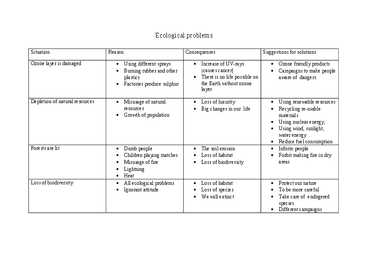
Ecological problems Situation Reason Consequenses Suggestions for solutions Ozone layer is damaged · Using different sprays · Increase of UV-rays · Ozone friendly products · Burning rubber and other (causes cancer) · Campaigns to make people plastics · There is no life possible on aware of dangers · Factories produce sulphur the Earth without ozone layer
NEW ZEALAND Geography: New Zealand is situated midway between the Equator and the South pole in the southern Pacific Ocean. It consists of two large islands, North Island and South Island, plus several smaller ones of which Stewart Island is the largest. North and South Islands are separated by the 32km wide Cook Strait. The total land area is 270,535 sq Km, about the size of Italy, the United Kingdom or the US state of Colorado. North Island is volcanically active with three active volcanoes. South Island has the high snow covered mountain peaks and glaciers of the Southern Alps, a range running almost 500Km along the Island. The longest river is the Waikato on North Island (425 Km), the largest inland stretch of water is Lake Taupo also on North Island (607 sq Km) and the highest point is Mount Cook on South Island (3754 m)
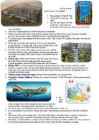
· Energy, food and water sources, transportation systems and basic infrastructure, must all adapt to emerging pressures from climate change, dwindling resources and growing urban populations. · 70 million people a year migrate from the country to cities. That is about 130 a minute, that means very massive globalization. · At this rate, our future cities may turn out to be quasi-temporary, missing the basics of human life, such as water and electricity, still belching out the waste of fuels that warm the globe. · The New City in China: The buildings and all around it work like biological, growing beings, photosynthesising and producing and re- using their own energy. China will be largest solar manufacturer in the world. · Masdar city in United Arab Emirates near Abu Dhabi. First city in the world, that would rely on the renewable energy sources. 6 square kilometers, home for 50,000 people and 1,500 businesses.
1)Main machinery On a ship, the engine room, or ER, is the propulsion machinery spaces of the vessel. To increase the safety and damage survivability of a vessel, the machinery necessary for operations may be segregated into various spaces. The engine room is one of these spaces, and is generally the largest physical compartment of the machinery space. The engine room houses the vessel's prime mover, usually some variations of a heat engine - diesel engine, gas or steam turbine. On some ships, the machinery space may comprise more than one engine room, such as forward and aft, or port or starboard engine rooms, or may be simply numbered. 1.1)Main engine The engine room of a motor vessel typically contains several engines for different purposes.
about 0.8 °C (1.4 °F), with about two-thirds of the increase occurring since 1980.Each of the last three decades has been successively warmer at the Earth's surface than any preceding decade since 1850. More than 90% certain that most of global warming was being caused by increasing concentrations of greenhouse gases produced by human activities.In 2010 that finding was recognized by the national science academies of all major industrialized nations. Affirming these findings in 2013, the IPCC stated that the largest driver of global warming is carbon dioxide (CO2) emissions from fossil fuel combustion, cement production, and land use changes such as deforestation. Its 2013 report states:Human influence has been detected in warming of the atmosphere and the ocean, in changes in the global water cycle, in reductions in snow and ice, in global mean sea level rise, and in changes in some climate extremes.
natural resources by our colonial masters accorded us would be things of history. That is more than forty years ago. Unfortunately, the promise of independence has not been fulfilled. Today, Africa has become more desolate; there is more starvation, diseases and non-provision of essential services than when we got our independence. There are all kinds of wars in Africa than the rest of world put together. The majority of so-called Africans leaders want to stay in power until the day their bodies are put in the grave. Through buffoonery, utter mismanagement and downright stealing of the wealth of the masses, these leaders have so impoverished Africa that we are now nothing but a beggar continent. We beg for everything; we are more dependent on our colonial masters than when we received our independence from them. Africa owes the West more money than we and our generations to come can pay.
Taking up cycling instead of using a car is too dangerous in cities. It could be argued that taking up cycling is very healthy for people. It supports people more to move and it is like doing a sport. Besides it is very good for environment. Thanks to using bicycles cities air will be cleaner and air is not such impure. Thanks to cleaner air people's can breathe better air. This is partly true, but taking up cycling instead of using a car is really more dangerous than use only cars. Thanks to taking up cycling traffic will go busier and messier. There is much different kind of movers in traffic and it makes traffic really dangerous. It is clear that it is not too dangerous. There are many cities where cycling is very popular, for example in Copenhagen
I'd like to present the main issues of our planet and today i'll name 5 of them. These are air pollution, water pollution, endangered animals, deforestation and rubbish. Air pollution Firstly, lets talk about air pollution, which endangeres our life in cities and also the forests near by. Cars and factories blow poisoned gas in the air and it mixes with the oxygen, so the air that we breathe, becomes dangerous to our health. The ozone layer around the Earth, there
Distilled water(doesn't contain CO 2), has pH level 7. Liquids with pH level less than 7 are acidic, liquids with pH level greater than 7 are alkaline. Unpolluted rain has a pH level over 5.7, so it is slightly acidic. Affected areas Places significantly impacted by acid rain around the globe include most of eastern Europe from Poland northward into Scandinavia, the eastern third of the United States and southeastern Canada. Other affected areas include the southeastern coast of China and Taiwan Causes · It is caused when sulfur dioxide and nitrogen oxides are released into the air. In the atmosphere they react with water, oxygen and other chemicals to form more acidic pollutants, known as acid rain. Sulfur dioxide and nitrogen oxides dissolve very easily in water and can be carried very far by wind
Wind power is very old power source, sailing ships have been using wind power for at least 5,500 years. The first practical windmills were built in Afghanistan, from the 7th century to grind corn and draw up water. The first windmill for electricity production was built in Scotland in 1887 to power the lighting in the cottage, thus making it the first house in the world to have its electricity supplied by wind power. During the Second World War, small wind generators were to recharge submarine batteries. In the 1990s, wind power became more important, because fossil fuels pollute the atmosphere and humanity needed alternative fuels. That's because wind power is so necessary. Wind power is also renewable energy and it doesn't cause greenhouse gases. Building windmills is actually quite expensive and they need repairing or replacing about every 12-15 years
Introduction (slide 2) In this presentation I'd like to give a brief overview of clay bricks. I'll speak about 15min to allow time for questions at the end. Firstly clay bricks are known for centuries as one of the most solid and reliable structural elements is set to play a role in reducing global warming. Apart form the many benefits obtained from using clay bricks in construction, such as their durability, insulation properties and aesthetic qualities, recent findings show that they also produce less carbon emissions than any other masonry material. History (slide 3) In more detail the earliest bricks were dried bricks, meaning they were formed from clay- bearing earth or mud and dried usually in the sun until they were strong enough for use. The oldest discovered bricks, originally made from shaped mud and dating before 10000 BC, were
polluted, leaving less than 1% of the world's freshwater, or about 0.003% of all water on Earth, readily accessible for direct human use. • According to the Global Outlook for Water Resources to the Year 2025, it is estimated that by 2025, more than half of the world population will be facing water-based vulnerability and human demand for water will account for 70% of all available freshwater. • Freshwater is the most fundamental finite resource with no substitutes for most uses, yet we are consuming fresh water at least 10 times faster than it is being replenished in regions of northern Africa, the Middle East, India, Pakistan, China, and the U.S.. Species Extinction • Human beings are currently causing the greatest mass extinction of species since the extinction of the dinosaurs 65 million years ago at rates 1000 to 10,000 times faster than normal. • The 2012 update of the IUCN Red List of Threatened Species
Enamlevinumad polümeeride lähtematerjalid · Kõik plastid on polümeerid aga kõik polümeerid pole plastid. Mõned tuntud polümeerid, mis pole plastid on tärklis (ingl k starch), valgud (aminohappe polümeerid), DNA. · The simplified diagram below shows the relationship between monomers and polymers. Identical monomers can combine with each other to form homopolymers, which can be straight or branched chains. Different monomers may combine together to form copolymers, which also may be branched or straight. · plastid on polümeerid- see tähendab, et nad koosnevad tuhandetest samadest polüetüleen, millest on tehtud aatomidest. Näiteks materjal kilekotid koosneb etüleenist valemiga c2h4. · Tselluloos atsetaat, mis on kasutusel kilede tegemisel saadakse puuvillast.
However, nowadays hunting endangered species will make humans be just killers, because it is not necessary to kill something just to have a trophy on the wall at home. People can be proud of what they have done, but decreasing the population of a species largely will cause the specific animal breed to go extinct faster than it would happen via natural causes. Therefore, humans should stop hunting endangered species to slow down their extinction, as these species offer balance in the wildlife, are used without purpose in medicine, and may even reduce poverty. Species on the brink of extinction affect us more than we realize. Sure, pandas are cute, and rhinos are fun to look at, but is there anything more to that? All animals and plants form a very important part of our ecosystem that also includes our lands and waters. Remove one part from the environment and damage will be done. For example, after the last wolves were killed in
 annaabi.ee