The narrator, an airplane pilot, crashes in the Sahara desert. The crash badly damages his airplane and leaves the narrator with very little food or water. As he is worrying over his predicament, he is approached by the little prince, a very serious little blond boy who asks the narrator to draw him a sheep. The narrator obliges, and the two become friends. The pilot learns that the little prince comes from a small planet that the little prince calls Asteroid 325 but that people on Earth call Asteroid B-612. The little prince took great care of this planet, preventing any bad seeds from growing and making sure it was never overrun by baobab trees. One day, a mysterious rose sprouted on the planet and the little prince fell in love with it
Fight Club Chuck Palahniuk Fight Club o Author Chuck Palahniuk o Year 1996 o Genre Satirical novel o Country United States Characters o The Narrator Main character, name never mentioned throughout the novel, founder of Fight Club o Tyler Durden founder of Fight Club o Marla Singer A woman whom the narrator met at a support group, Tyler's lover, extremely grungy, uncaring and suicidal Characters o Angel Face joined Fight Club, very loyal, very beautiful (hence his name), suffers a brutal beating by the narrator because he "wanted to destroy something beautiful" o Robert "Bob" Paulson main character meets him at a support group, later meets him again in Fight Club, former bodybuilder, increased estrogen
disturb the publisher even more for rejecting him. After initially publishing it as a short story in the 1995 compilation, Pursuit of Happiness, Palahniuk expanded it into a full novel, which --contrary to his expectations--the publisher was willing to publish. Some other well-known novels: Rant, Choke, Diary. Analysis of the book 1. Setting The story takes place in somewhere between 1980s and 1990s in the United States. 2. Characters · Main character/narrator His name is never mentioned in the novel. He works as a product recall specialist for a car manufacturing company, traveling from city to city, assessing the damages of car crashes. He describes his job in such a way that makes it sound complex when it actually is not. "If a new car built by my company leaves Chicago traveling west at 60 miles per hour, and
stated to be satirical novel. The novel tells a story about an miserable specialist of a car company. From day to day, he traveled from city to city, inspecting car crashes and deciding whether it was the car producers fault or not. He spent all his free time in cheap motels with insomnia and on daily basis watching corps, blood and human flesh mixed with oil and scrap metal has its own effect on his mind. Since there really isn't a support group for people with similar faith, the narrator starts going to random meetings of suffering people. Soon, the ultimate redemption arrives meeting Mr. Tyler Durden, the exact opposite of the narrator himself. I think for Mr. Palahniuk, the book is a way of telling the World how twisted the consumerist world is. The way of telling, is of course a bit extreme, depending on the readers taste, but I truly like it. Characters, like Mr. Durden himself, are to somewhat insane and perverse, as a
) The late fourteenth century, after 1381, in the T abard Inn and on the road to Canterbury. Why do the pilgrims go on the pilgrimage? Whose grave do they visit? People see a pilgrimage as a cure for sick relatives or friends and you of all your sins. People go on pilgrimages to seek inspiration and to show that they are willing to devote themselves to god and to prove that they believe in him and that they love him. How many pilgrims did the narrator meet at the Tabard Inn in Southwark? 29 How does the narrator describe his role? Chaucer's pilgrim narrators represent a wide spectrum of ranks and occupations. The great variety of tales is matched by the diversity of their tellers; tales are assigned to appropriate narrators and juxtaposed to bring out contrasts in genre, style, tone and values The Knight (est . RÜÜTEL) : What kind of a person is he? Which values does he represent? Describe his looks and skills
§ Cultural impact Author American novelist and freelance journalist 51 year old Pasco, Washington When he was 14, his parents separated University of Oregan School of Journalism Volunteering Cacophony Society "I'm not straight, and I'm not gay. I'm not bisexual. I want out of the labels. I don't want my whole life crammed into a single word. A story. I want to find something else, unknowable, some place to be that's not on the map. A real adventure." Characters THE NARRATOR anonymous works for an unnamed car company Perhaps ,,Joe" - I am Joe's Broken Heart. Tired of life and trapped in his own world Extremely stressed Suffers from insomnia Starts visiting cancer support groups Tyler Durden Not a real person A representation of everything the main character wants to be Works at night
-controlled the north Jack Churchill -WW2 -mad Jack -bagpipes, longbow and a broadsword -fought in Dunkirk and Vågsøy -died 1996 Sean Connery -discharged from the navy -bodybuilder -keen footballer -James Bond -sexy -bored of Bond -narrator Welsh Heroes! Gareth Bale - Plays for real madrid - 2011,12,14,15,16 player - 28, Cardif - In January 2016, 100 mil - New rules for bales Anthony Hopkins -82, born Magram wales - 1 oscar, 1 aw, 1 gb and 2 emmys -doesn't like Roald Dahl -1916-1990, Llandaff wales -army, germany, pilot
audience feel that the room is like cage/prison. The lightning is surrealistic in many ways, it is used to create mood, not to represent life. It fuses expressionism. Developments in Noir include the fact that ``The Black Dahlia`` is set in colour, but usually, many Film Noirs were black and white. The closing scene (and this film in general) is narrated by Bucky and there is used much flashbacks like in the opening scene of ``LA Confidential``, in ``LA Confidential`` the narrator is a news reporter Sid Hudgens (played by Danny DeVito). The use of narrator, as an narrative device, is used in previous Film Noir-s like ``Double Indemnity``, too. The narrator is there to help audience to understand, what is going on and also to sympathise with the anti-hero, to be able to see his point of view and even be on his side. There is more than one similarity between the film I analysed and ``LA Confidential``
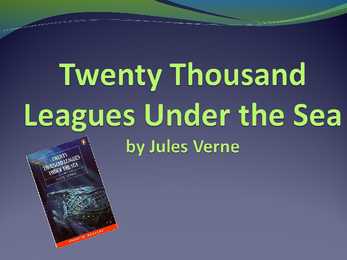
o Jules Verne was a French novelist o He was born on February 8, 1828 at Nantes, France o Studied Law in Paris o Took up writing in his early twenties o His first major success was in 1864 Voyage to the Centre of the Earth o Died on March 24, 1905 at Amiens o Considered to be the `father' of science fiction o Professor Pierre Aronnax the main character, narrator, a professor in the museum in Paris of Natural History; gruff, unrefined and a classic pedant. o Conseil Aronnax's domestic servant, 30 years old, knowledgeable of science, never complains o Ned Land - a Canadian and the king of harpooners, a large and quiet man, easily angered when contradicted. o Captain Nemo- the antagonist of the novel, creator of the Nautilus. o takes place in 1866. o rumors spreading about a large sea monster that inhabiting
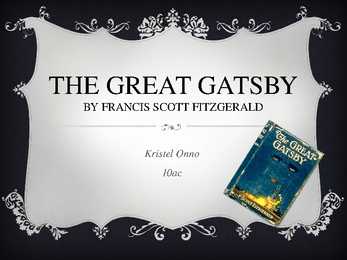
financially. The Fitzgeralds became part of the wealthy, extravagant society of this time. FITZGERALD'S DECLINE he decline of Fitzgerald's personal and rtistic life ended in the 1920s. cott was forced to write "hack work" o support their lifestyle. is addiction to alcohol increased. elda died in a fire e died of a heart attack at age 44. BOOK CHARACTERS ick Carraway is the sory narrator. He is 29yearsold Daisy's cousin, who has just returned from WWI, moves from the Midwest to the East to get into the bond market and lives next door to Jay Gatsby. ay Gatsby is a young, mysterious millionaire from North Dakota, with shady business connections and an obsessive love for Daisy Buchanan, whom he had met when he was a young officer in World War I. D
The most obvious symbol is, of course, the raven itself. When Poe had decided to use a refrain that repeated the word "nevermore," he found that it would be most effective if he used a non-reasoning creature to utter the word. It would make little sense to use a human, since the human could reason to answer the questions (Poe, 1850). In "The Raven" it is important that the answers to the questions are already known, to illustrate the self-torture to which the narrator exposes himself. This way of interpreting signs that do not bear a real meaning, is "one of the most profound impulses of human nature" (Quinn, 1998:441). Another obvious symbol is the bust of Pallas. Why did the raven decide to perch on the goddess of wisdom? One reason could be, because it would lead the narrator to believe that the raven spoke from wisdom, and was not just repeating its only "stock and store," and to signify the scholarship of the narrator
It is studied as a faithful reflection of 14th century life in England. GC was amused by his own characters and rarely criticises them sharply; shows a very deep understanding of human motivation. His comments reveal his profound understanding of the social problem of his day. o The Prologue paints the setting of the story. Introduces each character (30). GC himself functions as the narrator. He tries to be objective and tries to keep a distance from the characters. The descriptions are very vivid and economic. He pays attention to the pilgrims' clothes. E.g. the Knight has come back from some war, is high-minded, gentle-humoured and tries to live according to the ideals of courtly love, although he doesn't understand that this code of behaviour is slowly disappearing
Character Sketch – Daisy The Great Gatsby by F. Scott Fitzgerald Daisy Buchanan is a beautiful young woman from Louisville. She is the cousin of the novel’s narrator Nick Carrayway and the love interest of Jay Gatsby. She is married to an extremely rich and arrogant man called Tom Buchanan. Tom and Nick are acquaintances from college. Daisy-s appearance and the long-lasting impression she left on men is described through her voice by her cousin Nick. I looked back at my cousin, who began to ask me questions in her low, thrilling voice. It was the kind of voice that the ear follows up and down, as if each speech is an arrangement of notes that will
The Cement Garden - Ian McEwan Character Sketch - Tom Tom is the brother of the narrator of the story. He is the youngest child in the family. Tom was a 6-year-old little boy with pale skin. He had a bit big ears, black hair and his smile seemed idiotic. Tom was tender but mettlesome. Since he was the youngest child in the family he was mostly left out due to his age. Other siblings had their own activities together and Tom was too young to understand or take part. I.g. the game of scientists examining a specimen from outer space. His
Character sketch Sal Paradise On the Road Jack Kerouac Sal Paradise is the narrator of the novel. He is an Italian American living in New Jersey with his aunt. Sal is a college student and writer who has for a long time wished to travel around America in order to get inspiration for his novels and finally gets around to it. It is also mentioned that Sal recently split up with his first wife and recovered from a serious illness. Sal and Dean. Before Sal met Dean he was quite reserved and shy, but later Sal becomes almost as outgoing as his new friend
The epic was most probably created by scop(s) who composed it for entertainment and in praise of their master. Over the three centuries the epic was being changed and adapted by them, as it was inherited by word of mouth. The events occurring in the poem are set in Southern Scandinavia, Geatland and Denmark, in the fifth and sixth centuries. It should be observed that the narrative is written in the third person point of view and the narrator is omniscient. The subject matters in this poem are restricted to war and death. This was their present and therefore interesting to them as they could identify with the characters. The restricted variety of themes, flat characters and confrontation are peculiarities of epics. The characters are either the embodiment of utmost goodness or the complete contrary. Beowulf is described as a wise, hardy, noble hero who is fighting universal
-Imagination was very important Like William Blake an English poet has said "I know that this world is a World of Imagination and Vision" -Belief and appreciating nature -Independency Writers placed the individual, rather than society, at the center of their vision. The assertion of nationalism became a central theme of Romantic age. Literature Emergence of new ideas and positive voices. Emphasis was women and children, the heroic isolation of the artist or narrator, and respect for nature. Some writings were also based on the supernatural. Belief in the possibility of progress. Writers tended to be optimists and espoused democratic values. Importance of feeling and imagination. Inspiration for the romantic writers came from two French philosopher Jean Jacques Rousseau and German writer Johann Wolfgang von Goethe. Greatest writers William Wordsworth (1770-1850) : was a major English Romantic poet who, helped to
Oranges Are Not The Only Fruit - Jeanette Winterson Character Sketch – Louie Louie is a mother of Jeanette, the narrator of the novel. She plays an important role in the life of the main character. She was plump and pretty. Drunkards, she used to urge to join her at the church, called her the Jesus Belle. She was loved by men and attracted attention, many of drunkards stopped in the street when Jeanette’s mother walked past and raised their hats to her. She was very religious person. Louie considered church as her family more than her own family.
Character sketch Tom Buchanan The Great Gatsby F. Scott Fizgerald Thomas ,,Tom" Buchanan is a wealthy husband of Daisy Buchanan. They live on East Egg and are both connected to Nick Carraway, the novel's narrator. Daisy is Nick's cousin and Tom was once a member of his social club at Yale. Tom was a football player, enjoys polo and is a racist. Nick describes Tom's appearance quite well: ,,He was a sturdy straw-haired man of thirty with a rather hard mouth and a supercilious manner. Two shining arrogant eyes had established dominance over his face and gave him the appearance of always leaning aggressively forward. Not even the effeminate swank of his riding clothes
Simile - a figure of speech involving the comparison of one thing with another thing of a different kind, used to make a description more emphatic or vivid (e.g. as brave as a lion ). Metaphor - a figure of speech in which a word or phrase is applied to an object or action to which it is not literally applicable. Graphon - Intentional violation of the graphical shape of a word (or word combination) used to reflect its pronunciation point of view - the narrator's position in relation to a story being told. Narrator - a person who narrates something, especially a character who recounts the events of a novel or narrative poem. Mood - is a literary element that evokes certain feelings or vibes in readers through words and descriptions. Usually, mood is referred to as the atmosphere of a literary piece, as it creates an emotional situation that surrounds the readers.
Character Sketch – Julie The Cement Garden by Ian McEvan Julie is the eldest child in her family. She also has a younger sister Sue and two younger brothers-little Tom and the narrator, Jack. Readers get to know Julie’s world through Jack’s eyes only. We get to know Jack’s thoughts of Julie. Jack can be described as an emotionally closed or distant person. As their parents passed away, Julie became the head of the family, which means that she had to take care of her younger siblings to keep the family together. They live in isolation and only have each other. The children were discouraged to bring over friends.
Each category represented a different intention. He developed mastered, perfected stories. The short story of psychological effect. Tales of the grotesque and arabesque contains some of his most famous stories "The Fall of the House of Usher". Typical of a gothic story gloomy, dark, murky. The feeling of intolerable loneliness. One such story is "The Man of the Crowd" the secret of a man who seems to be strangely alienated from human fellowship, the narrator chases the man, still the man remains a mystery. The narrator's feverish in the man's identity symbolises human desire for selfdiscovery. Poe adored the idea of the Doppelganger, uses this motif to stress the complexity of human nature. Another Poe's favourite topic is the impossibility for the artist to escape from the practical world "William Wilson", something haunts the narrator to chase him from country to country, he's been haunted by himself. The theme of Death fascinated Poe
By a slow process, the "irresistible raising" of the ground level has swallowed up the cathedral's once-visible foundation. But the various traces of destruction that still scar its facade were mostly the work of men. During the French Revolution, a large part of the cathedral was ransacked by opponents of the monarchy. Consequently, by the time of the novel, the facade had lost an innumerable amount of statues and even a flight of eleven steps leading to the front entrance. As the narrator remarks: "Time is blind, man stupid." As a result, Notre Dame does not belong to a particular architectural class. It is neither Roman nor Gothic. Its ancient doorway and the round pillars are separated by six centuries, meaning that all the churches of France, both new and ancient, are blended and amalgamated in the mother-church of Notre Dame. After presenting Notre Dame in its social, cultural, and historical context, the narrator situates the cathedral against the backdrop of medieval Paris
Zooey. The Catcher in the Rye is by far the most famous and most critiqued book of his, selling over 250,000 copies every year. In total the book has sold over 65 million copies worldwide. The success of The Catcher in the Rye led to public attention: Salinger became reclusive, publishing new work less frequently. Analysis of the book 1. Setting The story starts in the year 1950 when the novel's protagonist and narrator Holden starts telling a story from a hospital about the events of last year's winter. Most of the story takes place in winter of 1949 just over a couple of days in Pennsylvania and New York. 2. Characters · Holden Caulfield The main character of the book. He has been expelled from many schools due to his failure in fixing his grades and is expelled from his current school, Pencey Prep, right in the beginning of the story
For the Danish king he is the only a mysterious creature, for he doesn't know the Bibel. Again, when aged B. is killed by the dragon, the poet observes that his soul departs from the body. Yet the hero's people, the Geats, in the pagan manner burn his body and bury his ashes with much treasure. This is what commanded in a dying speech of a pagan who cannot hope for anything more than earthly remembrance after death. Important thing about is that both the characters and the narrator continually look before and after and this can sometimes seem difficult to the reader to make clear what in the narrative present is actually happening. For example, after his defeat of Grendel, young receives from grateful Danish host the gift of a rich collar. Instead of describing what the collar looked like, the poet first compares it to a collar in ancient legend, and then, looking forward, says that it was later carried by lord and lost by him on his disastrous raid
What is the mode of narration in these stories? Are the narrators always reliable? The first chapter setting is in convent, 2 the second is outside near the convent (road), and the third one is reservation and the island, in every chapters there is a 1st pr.narration. Reliable. `Saint Marie' 4. Introduce the narrator of `Saint Marie'. Why does she consider herself ignorant? What is the purpose of her wanting to join the convent? Interpret the quotation: `I had the mail- order Catholic soul . . .' (44). Marie, 14-year-old girl. Maybe since she isn't pure blood Indian. She want to enter the white community (to belong there). Her wish is not to 5. go to church but to come in to town where the shops and people are. 6. Describe the Sacred Heart Convent
CHARACTERS Christie's characters are usually well-to-do people. Often the comfortable lifestyle of his characters is undermined by financial problems, which lead to murder. Although her villains use very complicated plans, they are not impossible. Although Christie's writing career spanned over six decades, she was conscious of social change without fixating on the period between the two World Wars. Characters: · Lieutenant Hastings, the narrator, on sick leave from the Western Front. · Hercule Poirot, a famous Belgian detective displaced by the war to England; Hastings' old friend · Inspector Japp of Scotland Yard · Emily Inglethorp, mistress of Styles, a wealthy old woman, John Cavendish's stepmother, forceful person, an energetic, autoratic personality. · Alfred Inglethorp, her much younger new husband. · John Cavendish, her elder stepson and remainderman to Styles. · Mary Cavendish, John's wife
All Quiet on the Western Front Erich Maria Remarque Character List Paul Bäumer - A young German soldier fighting in the trenches during World War I. Paul is the protagonist and narrator of the novel. He is, at heart, a kind, compas-sionate, and sensitive young man, but the brutal expe-rience of warfare teaches him to detach himself from his feelings. His account of the war is a bitter invective against sentimental, romantic ideals of warfare. Read an in-depth analysis of Paul Bäumer. Stanislaus Katczinsky - A soldier belonging to Paul's company and Paul's best friend in the army. Kat, as he is known, is forty years old at the beginning of the novel and has a family at home
his activity, and throughout his prose works championed the essentially verbal condition of literature, in the face of which any recourse to the writer’s inferiority seemed to him pure superstition. It is clear that Proust himself, despite the apparent psychological cha- racter of what is called his analyses, undertook the responsibility of inexorably blurring, by an extreme subtilization, the relation of the writer and his characters: by making the narrator not the person who has seen or felt, nor even the person who writes, but the person who will write (the young man of the novel — but, in fact, how old is he, and who is he? — wants to write but cannot, and the novel ends when at last the writing becomes possible), Proust has given modern writing its epic: by a radical reversal, ins- tead of putting his life into his novel, as we say so often, he makes his very life into a
Every time the voices of his children doing their homework reached him in his study in the stillness of the evening, every time he heard a popular song or some music in a restaurant, every time the wind howled in the chimney -it all came back to him: their walks on the pier, early morning with the mist on the mountains, the Theodosia boat, and the kisses. (p. 273) The story is written in the form of a third-person narration, which allows Chekhov to move from the point of view of the narrator to that of the protagonist. This movement is established as carly as the first paragraph of the story: The appearance The techniques that Chekhov employs (associative thinking, displacement, and projection) are all processes which govern the unconscious. In other words, the unconscious processes taking place in Gurov are communicated to the reader's unconscious by means of their common language Petersbourgh in QOS I'm also doing queen of spades, thought that was a hard question
H. J. Makiewicz. Story of the media magnate Charles Foster Kane. Fragmentation of the story. Overlapping narrative from multiple zanras. The anti-hollywood approach Citizen Kane and its innovations Narration technique an deep focus/sequence shot style imitated by countless directors. Sophisticated deep focus photography and sequence shot: attemptm to technically reporduce the human vision, give the audience the decision where to watch, more ,,realistic" reproducction of real time (of the narrator). Welles rebelled against the Hollywood Studio system: technical experimentation, the production mode, the story-telling, the absence of stars. 1958 Touch of evil Inspector Vargas has to solve a case in the Mexican-American borderland. His counterpart is the corrupt American inspector Quilan. In times when the classical film noir was considered to be over Orson Welles produced the swan song to the genre. Tale about the corruption of human nature. The film was initially recut by the studio. 12
Romanian revolution, a young woman returns home because: `We make bad exiles, we're always homesick [. . .]' (Murphy, 1992, p. 55). Another character in Hoffman's book, who spent a year in New York, confirms the narrator's representation of Easterners as deeply attached to their origins: `This is what cannot be fathomed from the outside: the million tendrils that attach us to home ground, even when the ground is harsh; sometimes, perhaps, especially because it is harsh' (1999, p. 259).
Tasakaalu taastamine Roland Barthes "Sissejuhatus narratiivi strukturaalanalüüsi" (1966) Peafunktsioonid (tuumfunktsioonid)- määravad tegevused Katalüsaatorid- saatvad tegevused, teisejärgulise täh-ga Indeksid (indeksaalsed ehk integratiivsed funktsioonid)- tõkestavad aja ja ruumi tunnuseid,tegelaste seisundit, üldist atmosfääri Wayne Booth. The Rhetoric of Fiction Implitsiitne(varjatud) autor, mitteusaldusväärne jutustaja (unreliable narrator)- reaalse autori alter ego, teksti põhjal tuletatud autori kuju Boriss Uspenski "Kompositsiooni poeetika" (1970): vaatepunktide liigid Hinnanguline (ideoloogiline) Fraseoloogiline Psühholoogiline (pertseptiivne, tajumehhanisimidega seotud) Ajalis-ruumiline G.Genette. Narrative Discourse. Oxford, 1980: jutustajate tüübid Heterodiegeetiline/ homodiegeetiline jutustaja Ekstradiegeetiline/ intradiegeetiline/ metadiegeetiline jutustaja
Tähendus on hajuv, mitte mõisteliselt fikseeritav. Poeetilises tekstis on kõik metafooriline, seal pole enam tegu metafoorilise kõrvutuse v vastandusega. D kriitikat, mis seob Richardi käsitluse Platoni ja Hegeli arusaamadega, võib nimetada ka logotsentrismi kriitikaks. 8. Narratoloogia. Jutustamise situatsiooni võimalikud kirjeldused S.Chatman “Story and Discourse: Narrative Structure in Fiction” Implitsiitne autor organiseerib kõik jutustamise vahendid, kaasa arvatud jutustaja narrator – tekstis ära tuntav jutustaja, jutustav instants, võib olla ka üks tegelastest narratator – see, kellele jutustatakse, kes informatsiooni vastu võtab. Ta ei ole kergesti välja toodav. Samas aga iga passaaž eeldab nii kõnelejat kui seda, kellele kõneldakse. Narratator on täielikult jutustajast tingitud. reaalne autor (Joyce, kes sööb ja magab) implitsiitne narrator narratator implitsiitne
validity of an antiquated code of conduct. His flight from Pamplona is symbolic of the failure of traditional values in the postwar world. Summary: Chapter I [Cohn] learned [boxing] painfully and thoroughly to counteract the feeling of inferiority and shyness he had felt on being treated as a Jew at Princeton. (See Important Quotations Explained) The novel begins with Jake Barnes, the novel's narrator and protagonist, describing Robert Cohn. Cohn was born to a wealthy Jewish family in New York. At Princeton, Cohn faced rampant anti-Semitism. To minimize his feelings of inferiority and to combat his shyness, he threw himself into boxing, becoming the university's middleweight champion. He married very soon after his graduation, on the rebound from his unhappy college experience. He and his wife had three children. Cohn lost most of his fifty-thousand-dollar
The first such use reported by the Oxford English Dictionary dates to 1932. Another early instance is George Orwell's Homage to Catalonia (1938). The term is used by Orwell to describe how, in the Spanish Civil War, political persecutions became a regular occurrence. The term is used when a hunt for wrongdoers becomes abused, and a defendant can be convicted merely on an accusation. For example, in the History Channel documentary America: The Story of Us, narrator Liev Schreiberexplains that "the search for runaway slaves becomes a witch hunt. A black man can be convicted with merely an accusation. Unlike white people, they do not have the right to trial by jury. Judges are paid ten dollars to rule them as slaves, five to set them free." Use of the term was popularized in the United States in the context of the McCarthyist search for communists during the Cold War, which was discredited partly through being compared to the Salem witch trials.
John Steinberg. Like Dos Passos he was critical of american social order but his philosophy was different. He is more optimistic, believes that life goes on and that is indestructable. Although many individual lives were ruined, the life goes on, everything is not material success. Racial minorytis, who do not have all the rights, the have nots, the simple, the poor, the idiots. His method is very interesting. A lot of naturalistic elements, unpleasant details, not pure naturalist. Narrator's point of view, his style is more poetic of the style, rhythm and repetition. Steinberg is fascinated in foreign elements, includeing immigrants. He is a believer of the superiority to the country people to the city people. Because when his characters manage to establish themselves on the land they are usually good hearted and hard working, but when they have to abandon their land the trouble comes. Like a naturalist, great cruelty and passion
present and future as shifting dimensions of a multiple reality. The story is simple. An e-writer called Ali, or Alix (because x marks the spot), will pin up a story for you, cut it to fit. She is a language costumier, writing to order, letting you be the hero of your own life, offering you freedom just for one night. The price? Risk. You risk entering the story as yourself and leaving it as someone else. But if the narrative changes, then so does the narrator, as Ali discovers this is a price she too will have to pay. In The PowerBook Winterson weaves the narrative of an online storyteller named Ali and her/his (we're left guessing) love affair with a married woman into the stories she writes on the email. Ali will concoct a fantastical tale for anyone who wants one in cyberspace. In this book, Winterson has fully embraced the technology of the Internet as a mode of storytelling, and her style of playing with
Their work shows a lot of initiative. Innovative adj. something newly introduced; creative n. innovator Syn. creative n. innovation This innovative project is worthy of support. There have been many innovations in the field of genetic engineering. narrate v. to tell a story; relate adj. narrative Syn. relate n. narrative n. narration n. narrator Walter Cronkite narrated the documentary film. Her fabricated narrative generated a lot of excitement. nevertheless conj. in spite of that Syn. nonetheless She was quite sick; nevertheless, she attended all of her classes. His project was flawed; nevertheless it won second prize. occasionally adv. now and then; once in a while adj. occasional Syn. sometimes n. occasion
two extremes of society and very different ways of viewing the world. Shakespeare often employs Allies like Lear's Fool or Prince Hal's riotous companion Falstaff to explore his heroes more deeply, providing the heroes with comic foils or challeng ing them to look more deeply into their own souls. Sherlock Holmes and Doctor Watson are another example, where the amazing intellect of Holmes is unfolded for the reader through the admiring eyes of his Ally, Watson, narrator of the tales. I N T R O D U C T I O N T O THE SPECIAL W O R L D Dr. Watson illustrates a useful function for Allies of introducing us to an unfamiliar world. Like Watson, they can ask the questions we would be asking. W h e n the hero is t i g h t - l i p p e d or where it would be awkward and unrealistic for him or her to explain things that are second nature to the hero but very exotic to us, an Ally can do the work of explaining everything as needed
 annaabi.ee