Leidsid 33 sarnast õppematerjali, mis on seotud failiga "Mozart and his father Leopold Mozart". Need materjalid aitavad sul teemat sügavamalt mõista.
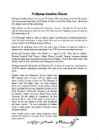
mozart, wolfgang, vienna, father, letter, teacher, letters, move, return, survive, salzburg, 1785, visit, german, best, known, today, amadeus, lucky, experienced, potentialedicated, talent, perhapsifferent, charactersependent, other, working, living, wife, considerable, periodialogue, moving, left, good, 1781, almost, certainly, aided, musicalWolfgang Amadeus Mozart Wolfgang Amadeus Mozart was born on 27 January 1756, in Salzburg, in Austria. His parents were Leopold and Anna Maria Pertl Mozart. He had a sister Kalled Maria Anna. Mozart had five siblings more, but they died young. When Mozart was five, he composed his first piece of music. He made his first concert tour with his father and sister when she was 6. He wrote her first Symphony at age of 9 and his first opera at age of 10. In 1769 Mozart started to work in outdoor chapel concertmaster in Salzburg archbishop's court. His father worked there as chapel master. He passed successfully the exam and after that he became a member of the Bologna Academy of Music. Mozart left the archbishop court in 1781 and went to live in Vienna. In Vienna he worked as a freelance music teacher, pianist and organ player. Since 1787 he was the court chamber musician. Mozart and Contanze Weber were Maried in 4. august in 1782. They had six children:
lifetime, although he was not widely recognised as a great composer until a revival of interest and performances of his music in the first half of the 19th century. He is now regarded as the supreme composer of the Baroque, and as one of the greatest of all time. Johann Sebastian Bach was born in Eisenach, Saxe-Eisenach. He was the youngest child of Johann Ambrosius Bach, the director of the Stadtpfeifer or town musicians, and Maria Elisabeth Lämmerhirt. His father taught him to play violin and harpsichord. His uncles were all professional musicians, whose posts ranged from church organists and court chamber musicians to composers. One uncle, Johann Christoph Bach (164593), was especially famous and introduced him to the art of organ playing. Bach was proud of his family's musical achievements, and around 1735 he drafted a genealogy, "Origin of the musical Bach family". Bach's mother died in 1694, and his father eight months later
Arthur Conan Doyle Life Arthur Conan Doyle was born on 22 May 1859, in Edinburgh, Scotland, to an English father, Charles Altamont Doyle, and an Irish mother, Mary Foley, who had married in 1855.] Although he is now referred to as "Conan Doyle", the origin of this compound surname is uncertain. Conan Doyle's father was an artist, as were his paternal uncles (one of whom was Richard Doyle), and his paternal grandfather John Doyle. Conan Doyle was sent to the Roman Catholic Jesuit preparatory school St. Mary's Hall, Stonyhurst, at the age of eight. He then went on to Stonyhurst College, but by the time he left the school in 1875, he had rejected Christianity to become an agnostic. From 1876 to 1881 he studied medicine at the University of Edinburgh, including a
Seems to be against all forms of governments, comes to conclusion that the republicans way is the best. He finds communism helpful. The question is wheter bloodshed is justified and humane. Unlike earlier hemingway heroes Jordan is an intellectual. Jordan is against suicide, which is major theme in the novel, because Jordan's father commited suicide. Falls in love with Maria, daughter of republican mayor. Three days of love bring him back to life. Maria was raped by facists and her father was killed by facists, disturbed girl. Secondary characters are rememorable. Men and women act differently to war. Men are carried away by war propaganda, women are shown to be wised and appreciate life more than political parties. Men think on taking sides but women value life more. Jordan is an idealist. He is willing to give his life for this cause. But Maria's first loyalty is to her lover, jordan. She places love above war, politics. Pablo is another type, he is a moral coward, he is
artists and Elton John reached #3, preceded by Madonna and The Beatles. John was born and raised in Pinner, Middlesex in a council house of his maternal grandparents, with whom his newlywed parents (Sheila Eileen (Harris) and Stanley Dwight) were living. Then they moved to a nearby semi-detached house. He was educated at Pinner Country Grammar School until the age of 15, before pursuing a career in the music industry. When John began to seriously consider a career in music, his father tried to steer him toward a more conventional career such as banking. He has stated that his wild stage costumes and performances were his way of letting go after such a restrictive childhood. Both of John's parents were musically inclined, his father having been a trumpet player with a semi-professional big band that played military dances. The Dwights were avid record buyers, exposing John to all the popular singers and musicians of the day
In its deepest layers it maintains inseparable connections with the past and makes its way into the future. The requirement for the novel appears as an assertion towards the external search, but is it not evident that the start of the search should be internal, towards the 1 Arnold Schönberg, Ausgewählte Briefe, ed. Erwin Stein (Mainz: B. Schott's Söhne, 1958), 179. English translation: Schoenberg, Arnold, Arnold Schoenberg Letters, ed. Leonard Stein, trans. Eithne Wilkins and Ernst Kaiser (London: Faber and Faber, 1964). 2 See his article “Eesti muusika iseloomlik ilmend” (The characterising expression of Estonian music), in Eesti Kultura II (Tartu: Postimees, 1913). Primary Source. What I mean here is not so much a certain style but the essence of the music we would like to adopt. This is neither old nor new, because it is born from the Absolute. This cannot be put into words but recognised only
for The Pioneer that too were collected in From Sea to Sea and Other Sketches, Letters of Travel. Starting his American travels in San Francisco, Kipling journeyed north to Portland, Oregon; on to Seattle, Washington; up into Canada, to Victoria and Vancouver, British Columbia; back into the U.S. to Yellowstone National Park; down to Salt Lake City; then east to Omaha, Nebraska and on to Chicago, Illinois; then to Beaver, Pennsylvania on the Ohio River to visit the Hill family; from there he went to Chautauqua with Professor Hill, and later to Niagara Falls, Toronto, Washington, D.C., New York and Boston. In the course of this journey he met Mark Twain in Elmira, New York, and felt much awed in his presence. Kipling then crossed the Atlantic, and reached Liverpool in October 1889. Soon thereafter, he made his début in the London literary world to great acclaim. Career as a writer
birth. The idea of the American Dream is rooted in the United States Declaration of Independence which proclaims that "all men are created equal" and that they are "endowed by their Creator with certain inalienable Rights" including "Life, Liberty and the pursuit of Happiness." (Mark Twain's The Adventures of Huckleberry Finn) De Crevecoeur, Hector St. John (17351813): FrancoAmerican Writer. With the publication of his Letters from an American Farmer (1782), Hector St. John de Crevecoeur became one of the eighteenthcentury's most influential commentators on American life and manners. While not born in America, Crevecoeur traded his French citizenship for an American one in 1765, taking up residence in New York. He had traveled throughout New England and its coastal region before claiming his new identity, however, and before seriously embarking upon his life as a farmer in Orange
songs (and others) with their band DVDA. Character Stan Marsh Stan is often skeptical of popular trends Stan is modeled after his voice actor, co-creator Trey Parker, also sharing his birthday of October 19. In many episodes, Stan often reflects on the moral lessons he's attained in a speech that often begins with, "You know, I learned something today...". He suffers from asthma and is often subject to the harsh bullying of his older sister, Shelley. His father Randy is a geologist, and his mother Sharon, works as a secretary at Tom's Rhinoplasty. Stan has indicated a fondness for animals Stan is usually seen in a brown jacket, blue denim jeans, red gloves/mittens, and a red- brimmed blue knit cap adorned with a decorative red pom-pon. Kyle is Stan's best friend, and their relationship is a common topic throughout the series Stan is usually seen solely with Kenny when Kyle is not around.
continues to pursue her affair with Vronsky. Part 4 Anna continues to pursue her affair with Vronsky. Karenin begins to find the situation intolerable. He talks with a lawyer about obtaining a divorce. In Russia at that time, divorce could only be requested by the innocent party in an affair, and required either that the guilty party confessed (which would ruin Anna's position in society) or that the guilty party was discovered in the act. Karenin forces Anna to give him some letters written to her by Vronsky as proof of the affair. However, Anna's brother Stiva argues against it and persuades Karenin to speak with Dolly first. Dolly broaches the subject with Karenin and asks him to reconsider his plans to divorce Anna. She seems to be unsuccessful, but Karenin changes his plans after hearing that Anna is dying after a difficult childbirth. At her bedside, Karenin forgives Vronsky. Vronsky, embarrassed by Karenin's magnanimity, attempts suicide by shooting himself. He fails
His modest background and upbringing are crucial to his development as a writer. Chekhov always felt that he missed out on childhood. It was a very hard lifeand it may have contributed to his poor health: he succumbed later on to the"family disease", tuberculosis, which led to his early death at the age of 44.His mother was a quiet, gentle soul who was full of stories of her early life. In later years, Chekhov would say that "we inherited our talent from our father,but mother gave us soul". The other great passion of his formative years was nature, the Russiancountryside. As a port, Taganrog was surrounded on all sides by the landscapes of the Steppe and Chekhov's earliest stories reveal how intensely aware he was of his bond with the Don Steppe. Chekhov had always claimed that medicine was his wife and literature his mistress. Chekhov had lived for much of his career as a writer under the shadow of the great literary colossus of the age, Lev Tolstoy.
capitalization and punctuation. Many of her poems deal with themes of death and immortality, two subjects which infused her letters to friends. Walter Whitman Walter Whitman (May 31, 1819 March 26, 1892) was an American poet, essayist, journalist, and humanist. He was a part of the transition between Transcendentalism and realism, incorporating both views in his works. Whitman is among the most influential poets in the American canon, often called the father of free verse. His work was very controversial in its time, particularly his poetry collection Leaves of Grass, which was described as obscene for its overt sexuality. Born on Long Island, Whitman worked as a journalist, a teacher, a government clerk, and a volunteer nurse during the American Civil War in addition to publishing his poetry. Early in his career, he also produced a temperance novel, Franklin Evans (1842). Whitman's major
fell and the establishment of a small Anglo-Norman colony, known as The Pale, marks the start point of foreign rule over Ireland. Without too much of a fight all Irish kings gave in to Henry II. The Anglo-Norman authority outside the protected colony, The pale, was non- existent. Henry II reached an agreement with the Irish and they signed the Treaty of Windsor. By this Treaty Rory O'Connor became the monarch of all the unconquered areas of Ireland and in return he recognised King Henry II as his overlord and was due to pay him an annual tribute. A period of eight centuries of foreign oppression had began for the Irish. *Richard I and Minstrel Blondel There is a legend that when King Richard the Lionheart disappeared his favourite trobadure Blondel the Minstrel went to search for him. As a wandering minstrel Blondel travelled for months over central Europe, seeking for news of his friend
The other team didn't know and ran after them. Later first team took the ball and won. 3) JAMES WATT He was born in the small port of Greenock on the river Clyde in Scotland in 1736. His father was a mathematical-instrument maker and also kept a shop to supply ships with goods for their voyages. James was a delicate boy and often suffered from headaches. That is why he could not go to school at the age when other children did. His mother taught him to read and his father taught him writing and arithmetic. He had very good memory and a natural love of work. He liked mathematics and was also fond of designing and making things. James was an observant and thoughtful boy. When James was able to go to school, he was sent to a private school. He learnt many subjects there. In his spare time James began to make experiments. He built a small electrical apparatus with which he gave his friends shocks that made them jump
Bennet, impossible, when I am not acquainted with him myself; how can you be so teasing?" "I honour your circumspection. A fortnight's acquaintance is certainly very little. One cannot know what a man really is by the end of a fortnight. But if we do not venture somebody else will; and after all, Mrs. Long and her daughters must stand their chance; and, therefore, as she will think it an act of kindness, if you decline the office, I will take it on myself." The girls stared at their father. Mrs. Bennet said only, "Nonsense, nonsense!" "What can be the meaning of that emphatic exclamation?" cried he. "Do you consider the forms of introduction, and the stress that is laid on them, as nonsense? I cannot quite agree with you there. What say you, Mary? For you are a young lady of deep reflection, I know, and read great books and make extracts." Mary wished to say something sensible, but knew not how. "While Mary is adjusting her ideas," he continued, "let us return to Mr
first ever Christmas Broadcast. The story began in 1862. Prince Albert, husband of Queen Victoria, was looking for a country home for his eldest son, Albert Edward, Prince of Wales, before his twentieth birthday. The idea was to find a healthy retreat for his young son, away from the distractions of the city. Before a decision had been reached, the Prince Consort died suddenly of typhoid in December 1861. It was left up to his eldest son to conclude the house-hunt. After paying a visit to Sandringham on 3 February 1862, the Prince of Wales was impressed enough to have decided by the end of the day that he wanted to buy the house. For the house and furnishings, the Prince paid £220,000. Sandringham's first role was as a home for newly-weds. Prince Albert Edward married Princess Alexandra of Denmark on 10 March 1863, and they travelled to Norfolk 18 days later. The young couple made many extensions and improvements to the house and estate,
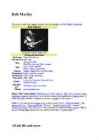
[1] Marley is best known for his reggae songs, which include the hits "I Shot the Sheriff", "No Woman, No Cry", "Three Little Birds", "Exodus", "Could You Be Loved", "Jammin'", "Redemption Song", and "One Love".[2] His posthumous compilation album Legend (1984) is the best-selling reggae album ever, with sales of more than 12 million copies.[2] Early life and career Marley was born in the small village of Nine Mile in Saint Ann Parish, Jamaica. His father, Norval Sinclair Marley, (born in 1895), was a Jamaican of English descent, with parents from Sussex. Norval was a Marine officer and captain, as well as a plantation overseer, when he married Cedella Booker, a black Jamaican then eighteen years old. Norval provided financial support for his wife and child, but seldom saw them, as he was often away on trips. Marley was ten years old when his father died of a heart attack in 1955 at age 60.
informal and ostensive. Exceptions are ignored and the host of minor terms are not defined—the text covers these when they come up. The plaintext is the message that will be put into secret form. Usually the plaintext is in the native tongue of the communicators. The message may be hidden in two basic ways. The methods of steganography conceal the very existence of the message. Among them are invisible inks and microdots and arrangements in which, for example, the first letter of each word in an apparently innocuous text spells out the real message. (When steganography is applied to electrical communications, such as a method that transmits a long radio message in a single short spurt, it is called transmission security.) The methods of cryptography, on the other hand, do not conceal the presence of a secret message but render it unintelligible to outsiders by various transformations of the plaintext. Two basic transformations exist
poems and verse and also wrote literature. Another tale tells of William Tell, who shot an arrow through an apple while standing on his son's head. The Renaissance was an age in which more individuals felt the value of their human being. Martin Luther was nailed to the church door at Wittenberg for selling papal indulgences. He died a horrible death, being excommunicated by a bull. It was the painter Donatello's interest in the female nude that made him the father of the Renaissance. It was an age of great inventions and discoveries. Gutenberg invented the Bible. Sir Walter Raleigh is a historical figure because he invented cigarettes. Another important invention was the circulation of blood. Sir Francis Drake circumcised the world with a 100-foot clipper. The government of England was a limited mockery. Henry VIII found walking difficult because he had an abbess on his knee. Queen Elizabeth was the "Virgin Queen." As a queen she was a success
Norma Jeane Baker by Aimee Semple McPherson.[1] Although she took a stagename of Marilyn Monroe in 1946, she did not legally change her name until February 23, 1956.[11] Her mother was Gladys Pearl (Monroe) Baker.[12] Her family is believed to have been Anglo-Spanish originally; and possibly related to the Sepulvedas. [13] For many years it was believed Gladys' second husband Martin Edward Mortenson (18971981) was Monroe's father. His name was listed on her birth certificate. [14] Foster homes Mentally unstable and unable to care for Monroe, Gladys placed her with foster parents Albert and Ida Bolender of Hawthorne, California, where she lived until she was seven.[15] In her autobiography My Story, Monroe states she believed Albert was a woman. One day, Gladys announced she bought a house. A few months after they had moved in, Gladys suffered a breakdown
Russian absurdist Daniil Kharms, Konstantin Vaginov, Alexander Vvedensky and Nikolay Zabolotsky. Other famous authors experimenting with language were novelists Yuri Olesha and Andrei Platonov and short story writers Isaak Babel and Mikhail Zoshchenko. The OPOJAZ group of literary critics, also known as Russian formalism, was created in close connection with Russian Futurism. Two of its members also produced influential literary works, namely Viktor Shklovsky, whose numerous books (e.g., Zoo, or Letters Not About Love, 1923) defy genre in that they present a novel mix of narration, autobiography, and aesthetic as well as social commentary, and Yury Tynyanov, who used his knowledge of Russia's literary history to produce a set of historical novels mainly set in the Pushkin era (e.g., Young Pushkin: A Novel). Writers like those of the Serapion Brothers group, who insisted on the right of an author to
His memories of the time before the war show that he was once a very different man from the despairing soldier who now narrates the novel. Paul is a compassionate and sensitive young man; before the war, he loved his family and wrote poetry. Because of the horror of the war and the anxiety it induces, Paul, like other soldiers, learns to disconnect his mind from his feelings, keeping his emotions at bay in order to preserve his sanity and survive. As a result, the compassionate young man becomes unable to mourn his dead comrades, unable to feel at home among his family, unable to express his feelings about the war or even talk about his experiences, unable to remember the past fully, and unable to conceive of a future without war. He also becomes a "human animal," capable of relying on animal instinct to kill and survive in battle. But because Paul is extremely sensitive, he is somewhat less able
Telemachus). Joyce fans worldwide now celebrate 16 June as Bloomsday. Life as a whole with its fundamental laws. Depictioning (kirjeldama piltides) ,,the here and now", LIFE. Cf Virginia Woolf, broad panorama of Irish reality, fundamental questions of life and death , does it through individual consciousness, all history in the happenings of one day. Structure, composition, language and style of Ulysses. Structure: depends on myth. 3 parts, Telemachus, the adventures of Odysseus, the return, Penelope (last chapter) The use of myth. Structure: the myth of odysseus->ulysses. Philosophical level, structural level, action level, Giovanni Battista Vico. History of the world, the age of gods, the age of heroes, the age of me, the cycle begins again. A complete man, a modern hero. The characters: Stephen, Bloom, Molly an d their mythological counterparts. Stephen-young, refined (peen), sensitive, cultivated, arrogant. Disappointed, a hamlet figure,
commander Jan Zizka successfully defended Prague against the first anti-Hussite crusade, launched by Sigismund, the Holy Roman emperor, during the Battle of Vítkov Hill. In the 1420s a split developed in the Hussite ranks between radical Taborites, who advocated total war on Catholics, and moderate Utraquists, who consisted mainly of nobles who were more concerned with transforming the Church. In 1434 the Utraquists agreed to accept Sigismund's rule in return for religious tolerance; the Taborites kept fighting, only to be defeated in the same year at the Battle of Lipany. Following Sigismund's death, George of Podbrady (Jií z Podbrad) ruled as Bohemia's one and only Hussite king, from 1452 to 1471, with the backing of Utraquist forces. He was centuries ahead of his time in suggesting a European council to solve international problems by diplomacy rather than war, but he couldn't convince the major European rulers or the pope.
Montoya sees bullfighting as something sacred, and he respects and admires Jake for his genuine enthusiasm about it. Montoya takes a paternal interest in the gifted young bullfighter Pedro Romero and seeks to protect him from the corrupting influences of tourists and fame. Frances Clyne - Cohn's girlfriend at the beginning of the novel. A manipulative status-seeker, Frances was highly domineering early in their relationship and persuaded Cohn to move to Paris. As her looks begin to fade, she becomes increasingly possessive and jealous. Count Mippipopolous - A wealthy Greek count and a veteran of seven wars and four revolutions. Count Mippipopolous becomes infatuated with Brett, but, unlike most of Brett's lovers, he does not subject her to jealous, controlling behavior. Amid the careless, amoral pleasure-seeking crowd that constitutes Jake's social circle, the count stands out as a stable, sane person
Beowulf is a wise king of Jutland when a fire dragon comes to exact revenge for the theft of its precious cup. B. summons his men to battle the dragon, but only one man shows up. Despite that Beowulf manages to defeat the dragon. However he is badly injured and dies. He is buried. THE END. William SHAKESPEARE (April 23, 1564 April 23, 1616) He was baptized on the 29th of April. His father, John, was a merchant, bailiff and leading citizen; his mother, Mary Arden, was a rich farmer's daughter. He attended the local grammar school. He wed his older wife, Anne Hathaway at the age of 18 and they had 3 children - Susanna, and twins Judith/Hamnet. Susanna later became William's caretaker after the death of his wife and the twins. Shakespeare was forced toleave Stratford for London after a quarrel with the local squire.
Oliver went to have a meeting and talk to Mr. Brownlow about his future. They talked about books and how someday Oliver could read and write them if he wanted to. Oliver is afraid that he is going to be sent away and begs to stay. Mr. Brownlow says that he can, and Mr. Grimwig comes for a visit. Mr. Brownlow invites Oliver to stay and talk with them. Mr. Grimwig is a cynic and expounds on the bad qualities of Oliver that he expects are there. Oliver decides that he wants to help and offers to return the books that Mr. Brownlow borrowed. Mr. Brownlow agrees and Mr. Grimwig, keeping with his personality, made a prediction that the boy would never come back once set free. Mr. Brownlow and Mr. Grimwig sat for a long time waiting for Oliver by the tick of the watch that sat on the table. Chapter 15: Nancy reports that where Oliver had been taken and tells them of his illness. They go out to search for him, and as he is returning the books, he runs into Nancy. She made a loud ruckus and
The Rise and Demise of the New Public Management Wolfgang Drechsler (University of Tartu and Tallinn University of Technology, Estonia) © Copyright: Wolfgang Drechsler 2005 Within the public sphere, the most important reform movement of the last quarter of a century has been the New Public Management (NPM). It is of particular interest in the post-autistic economics (pae) context because NPM largely rests on the same ideology and epistemology as standard textbook economics (STE) is based (for my take on this, see Drechsler 2000), and it has had, and still has, similar results.
is a multi-BRIT Award-winning English singer, songwriter, actor, and musician. His career started in 1990, at the age of 16, as a dancer and singer with the pop band Take That. After many disagreements with the management and certain group members, Williams left the group in 1995 to launch his solo career. Williams was born to Peter and Janet Williams in Stoke-on-Trent on 13 February 1974. He and his older sister, Sally, were raised by his mother, Janet, as she and his father, attempted stand-up comedian Peter "Parp" Conway, separated when Williams was three days old and since divorced. Williams attended Mill Hill Primary School and St Margaret Ward's Roman Catholic School where he was "touched" by music, and also attended dance school UKDDF in Tunstall, Staffordshire. He participated in several school plays, and his biggest role was that of the Artful Dodger in a production of Oliver.
officers or Church of England clergymen. His greatgrandfather, also Charles Dodgson, had risen through the ranks of the church to become a bishop. His grandfather, another Charles, had been an army captain, killed in action in Ireland in 1803, when his two sons were hardly more than babies. His mother's name was Frances Jane Lutwidge. The elder of these sons yet another Charles was Carroll's father. He reverted to the other family business and took holy orders. He went to Rugby School, and thence to Christ Church, Oxford. He was mathematically gifted and won a double first degree, which could have been the prelude to a brilliant academic career. Instead he married his first cousin in 1827 and became a country parson. Young Charles' father was an active and highly conservative clergyman of the
of which The Raven (1845) and Annabel Lee (1849) are good examples (Also The Bells). Somewhat overlooked by his contemporary fellow countrymen, Poe's work was particularly influential in France, where it was (discovered and) translated by Charles Baudelaire. The mid-19th cent was a period of astonishing literary creativity in Am lit. In the short space of 6 years, four monumental lit works were published: Nathaniel Hawthorne's (1804-64) The Scarlet Letter (1850), Herman Melville's (1819-91) Moby Dick (1851), Henry David Thoreau's (1817-62) Walden (1854) and Walt Whitman's Leaves of Grass (1855). This period witnessed the highest lit expression of the Puritan tradition and the emergence of a new cultural and philosophical movement, Transcendentalism. Although the Am frontier was being pushed westward, Massachusetts and Virginia, the Puritan strongholds in the east, remained the centre of cultural activity.
Was prepared to come a clergyman got good education: languages, music, literature. Brother jumped off horse into a river, died in bed. Elder brother was already married. Henry Vlll married with his brothers widow.Catherine of Aragon, she came from Spain, she was arden(innukas) Catholic. At first they had good relations. Soon there were big problems. Had daughter Mary, couldn't get a son. Needed a new king. Henry decided to get a divorce. Henry wrote a long letter to Pope for a divorce. Pope said no. Then Henry decleared himself the head of English church to get divorce. Catherine was sent to live in countryside and brought up Mary, who was also a Catholic. Next wife was Anne Bolyn, daughter of a knight. They had daughter called Elizabeth l. Time went by and Henry had to get rid of Anne, she was sent to tower accused of treason (riigi reetmine) and executed. Henry was free, needed another wife. Had six wives together
illustrations by John Leech. The story was an instant success, selling over six thousand copies in one week, and the tale has become one of the most popular and enduring Christmas stories of all time. William Makepeace Thackeray William Makepeace Thackeray was an English novelist of the 19th century. He was famous for his satirical works, particularly Vanity Fair, a panoramic portrait of English society. Thackeray, an only child, was born in Calcutta, India, where his father, Richmond Thackeray (1 September 1781 13 September 1815), held the high rank of secretary to the board of revenue in the British East India Company. William had been sent to England earlier, at the age of five, with a short stopover at St. Helena where the imprisoned Napoleon was pointed out to him. He was educated at schools in Southampton and Chiswick and then at Charterhouse School, where he was a close friend of John Leech
 annaabi.ee