Leidsid 33 sarnast õppematerjali, mis on seotud failiga "Microcontroller homework Week 05". Need materjalid aitavad sul teemat sügavamalt mõista.
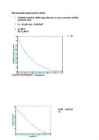
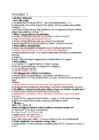
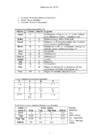
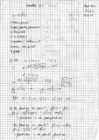
steps, homework, sensitivity, accuracy, precisionMicrocontroller homework for week 05 1. Treshold, sensitivity, (full) range, linearity, accuracy, precision, stability, hysteresis, noise 2. VO = RH/(RT+RH) = 0.381356 V 3. A) 100 B) 212,464 4. A) B) R1 = 16,67 k C) D) E) RF = 10k, RL = 28k2, RH = 107k F) Before scaling: 2.35 steps/°C. After scaling: 3.42 steps/°C 5
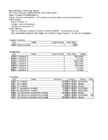
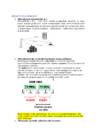
Question 1 Name 9 characteristic parameters of sensors. Treshold, noise, range, stability, linearity, accuracy, precision, sensitivity, hysteresis Question 2 Given the circuit below (using a SYH-2R humidity sensor) determine the output voltage for a relative humidity of 70 % at 30 °C if R T = 50 kΩ and VDD= 2.5 V. R70 30 c =R H =9,2 kV RH 9,2 k V O= ∙ V DD= ∙ 2,5 = 0,388 V (R T + R H ) ( 50 k +9,2 k ) Hint: Check specification for Humidity Sensor of SYH-2R.pdf at http://www.rhopointcomponents.com/images/SYH-2R.pdf
Question 1 Name 9 characteristic parameters of sensors. Solution: 1. Thershold. 2. Sensitivity. 3. Full Range. 4. Linearity. 5. Accuracy. 6. Precision. 7. Stability. 8. Hysteresis. 9. Noise. Question 2 Given the circuit below (using a SYH-2R humidity sensor) determine the output voltage for a relative humidity of 70 % at 30 °C if RT = 50 kΩ and VDD= 2.5 V. Solution: Check specification for Humidity Sensor of SYH-2R.pdf at: http://www.rhopointcomponents.com/images/SYH-2R.pdf 2 Week 04 Homework - Solutions Check Thermistor - Wikipedia.pdf at http://en.wikipedia.org/wiki/Thermistor
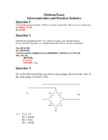
1 R R 2 R3 R4 100 100 0,5V 5V 100 50 100 R4 R4 RS 76,46 Question 4 Figure below shows the thermistor circuit (R25 = 2kΩ). The data sheet and the specifications are provided: Midterm Exam - Solutions 3 D.C. Dissipation Constant: 2 mW/°C Required accuracy: 1.5 °C Sensor circuit VREF = 4 V Application temperature: 0°C to 40 °C a. Calculate the resistance of the thermistor, RTH , at 0°C and 40°C respectively? From the given information, the thermistor resistance at 25°C or R25= 2 kΩ, and RTH at 00C is 2.8533 R25 Then RTH(00C) =2.8533*2 kΩ=5.707 kΩ RTH at 400C is 0.5746 R25 Then RTH(400C) =0.5746*2 kΩ=1.149 kΩ 4 Midterm Exam - Solutions b
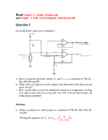
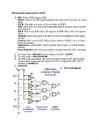
Read Chapter_6_Analog_Outputs.pdf and Chapter_8_EMI_ElectroMagnetic_Interference.pdf Question 1 Given the below open sensor detection: a. Derive equations for both outputs VO and Vsense as a function of VR, R1, Rth, RH, RL and RF. b. What value will appear on each output if the thermistor fails (becomes an open circuit)? c. How can the above schem be modified to implement temperature reading with open sensor detection using only one ADC and one digital input pin of the microcontroller? Solution: a. Derive equations for both outputs as a function of VR, R1, Rth, RH, RL and RF. Rth Writing the equation for V1 : V1 VSense VR th R R1 V0 V2 VR V2 V2 Writing the equation for V2 : RF RH
input to produce some kind of output, and one or both of these is usually analog. The digital portions of an analog system, such as the microprocessor- to-memory interface, are outside the scope of this book. However, there are some system considerations in any design that must interface to the real world, and these will be considered here. Dynamic Range Before a system can be designed, the dynamic range of the inputs and outputs must be known. The dynamic range defines the precision that must be applied to measuring the inputs or generating the outputs. This in turn drives other parts of the design, such as allowable noise and the precision that is required of the components. A simple microprocessor-based system might read an analog input voltage and convert it to a digital value (how this happens will be examined in Chapter 2, “Digital-to-Analog Converters”). Dynamic range is usually expressed in db because it is usually a measurement of relative power or voltage
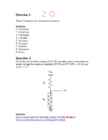
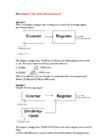
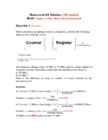
Read Chapter_4_Time_Based_Measurements.pdf Question 1 When converting an analogue value to a frequency, consider the following diagram describing the system. The frequency changes from 20 MHz to 18 MHz and the system samples at an interval of 2ms. How many counts does the microprocessor detect at, 2ms a) 20 MHz? =40000 counts 50 ns 2ms b) 18 MHz? =36 000 counts 55,55 ns What is the difference in terms of number of counts detected by the microprocessor? Between 20MHz and 18MHz are 4000 counts. Question 2 Consider the following diagram The frequency changes from 20 MHz to 18 MHz and the system samples at an interval of 100ns. a) What is the difference in terms of number of counts detected by the microprocessor? 10 MHz 10 MHz =5000 =5555,555 2000 Hz 1800 Hz Between 20MHz and 18MHz are 555,555 counts. b)
Homework-04 Solution (100 marks) Read Chapter_4_Time_Based_Measurements.pdf Question 1 (10 marks) When converting an analogue value to a frequency, consider the following diagram describing the system. The frequency changes from 20 MHz to 18 MHz and the system samples at an interval of 2ms. How many counts does the microprocessor detect at, a) 20 MHz? b) 18 MHz? What is the difference in terms of number of counts detected by the microprocessor? Solution: 1 1 a) Converse 20 MHz to time length: T 0.00005ms f 20,000,000 2ms Number of counts in 2ms: N 40,000 0.00005ms 1 1 b) Converse 18 MHz to time length: T 0.000055556ms f 20,000,000
ADC is operational. Question 2 Output Code = 001111012 Voltage LSB = 0.0195 V Question 3 1010111011011002 Question 4 VE = 0.01484375 V Question 5 13 Bit ADC Question 6 Question 7 A) tU = 400 µs B) td = 1000 µs (1 ms) Question 8 A) -85 dB B) -82 dB C) -84 dB Question 9 A) Sparkle codes / metastability, high power consumption, large size, expensive. B) Speed limited to ~5Msps. May require anti-aliasing filter. C) Slow Conversion rate. High precision external components required to achieve accuracy. D) Higher order (4th order or higher) - multibit ADC and multibit feedback DAC. Question 10 A) SAR B) ± 0.4 LSB C) 1.4 ms D) 8.4 us Question 11 VO = 3,925 V Question 12 VO = 5,67 V Question 13 Resolution = 65536 bits (64K) Question 14 1. Resolution 2. Offset Error 3. Gain Error 4. Monotonicity 5. Relative Accuracy Question 15 A) 5/4 = 1.25 B) 25/8 = 3.125 C) 15/8 = 1.875
1,4 ms d) Minimum conversion time 8,4 us Question 11. A 10 bit DAC has a reference voltage of 5.12V. What is the output voltage for a binary input code of 11000100012? 3,925V Question 12 A 12 bit DAC has a reference voltage of 10V. What is the output voltage for a binary input code of 1001001001002? 5,67V Question 13 What is the resolution of a 16-Bit DAC? 65536 bits Question 14 Name 5 characteristics of DAC’s. Gain error, offset error, resolution, monotonicity, accuracy Question 15 For the following 3-Bit DAC, analyse the circuit to verify its operation for the following input combinations. (Assume VR=5V). a) S2S1S0=0102 1,25 b) S2S1S0=1012 3,125 c) S2S1S0=0112 1,875 Question 16 1. Draw the motor current and the motor voltage characteristic during the operation with a constant PWM signal of 50% duty cycle. 2. Recommend the suitable range of frequency for this PWM applied in microcontrollers. Analyze the advantages and disadvantages of PWM systems.
== 7. You have two Boolean variables A and B. Write down a logic expression using only the operators AND, OR and NOT that will evaluate to true if A and B are equal and to false otherwise. == 7. (A and B) or ((not A) and (not B)) == 8. You have two strings stored in variables S1 and S2. Both strings are stored in ASCII format and contain 8 bits per character and 20 characters per string. Write pseudocode that will compare the strings without case sensitivity and return a Boolean result in variable Y indicating whether the strings match or not. == 8. Y = true for i from 1 to 20 for j from 1 to 8, excluding 3 // first bit is spared (omitted) and the second (third) bit for upper bitindex = j + (i-1)*8 if S1[bitindex] ≠ S2[bitindex] Y = false Exit loop end end end == CPU architecture 9. Suppose a microprocessor adds the numbers shown below respectively. In each instance
7. You have two Boolean variables A and B. Write down a logic expression using only the operators AND, OR and NOT that will evaluate to true if A and B are equal and to false otherwise. (A AND B) OR ((NOT A) AND (NOT B)) 8. You have two strings stored in variables S1 and S2. Both strings are stored in ASCII format and contain 8 bits per character and 20 characters per string. Write pseudocode that will compare the strings without case sensitivity and return a Boolean result in variable Y indicating whether the strings match or not. Y = true; for i from 1 to 20; for j from 1 to 8, excluding 3; //first bit is spared (omitted) and the second (third) bit for upper bitindex = j + (i-1) ∗8; if S1[bitindex] =! S2[bitindex]; Y = false; Exit loop; end; end; end; CPU architecture 9. Suppose a microprocessor adds the numbers shown below respectively. In each instance
Microcontroller homework for week 04 1. SNR - Ratio of RMS signal to RMS SINAD - Ratio of the RMS signal amplitude to the mean value of the root-sum-square (RSS) ENOB - The effective number-of-bits and relates to SINAD THD - Ratio of the rms value of the fundamental signal to the mean value of the RSS of its harmonics. SFDR - Ratio of the RMS value of the signal to the RMS value of the worst spurious signal. Channels related to the inputs of the ADC can either be multiplexed or individually selected. Linearity relates to how a ADC follows a linear function. All ADCs are to a certain extend non-linearity. Temperature is measurement, which in optimal state for ADC-s, lets them function correctly. Power dissipation refers to the amount power dissipated when the ADC is operating. 2. The output code is 001111012 and the voltage of the LSB is 0,0195V 3. The output code is 101011101101100 4. The
Microsoft Excel 16.0 Answer Report Worksheet: [Kodutöö OPERATSIOON 3 SOLVER.xlsx]ül 1 Report Created: 21.5.2018 20:36:19 Result: Solver found a solution. All Constraints and optimality conditions are satisfied. Solver Engine Engine: Simplex LP Solution Time: 0,078 Seconds. Iterations: 8 Subproblems: 0 Solver Options Max Time Unlimited, Iterations Unlimited, Precision 0,000001, Use Automatic Scaling Max Subproblems Unlimited, Max Integer Sols Unlimited, Integer Tolerance 1%, Assume NonNegative Objective Cell (Max) Cell Name Original Value Final Value $J$28 Kasum arvutuslik 0 30050 Variable Cells Cell Name Original Value Final Value Integer
CX-Programmer Ver. 7.2 Operation Manual: Function Blocks/Structured Text (W447) provide details of operations for the WS02-CXPC1-E CX-Programmer. The CompoBus/S Operation Manual (W266) pro- vides CompoBus/S communications specifications and describes CompoBus/S application methods. Please read this manual carefully and be sure you understand the information provide before attempting to install and operate the CPM1A. Section 1 gives a brief overview of the steps involved in developing of a CPM1A System, describes the possible system configurations, and describes the CPM1A’s special features and functions. Section 2 provides the technical specifications of the Units that go together to create a CPM1A PC and describes the main components of the Units. Section 3 describes how to install and wire a CPM1A PC. Section 4 describes SSS capabilities, how to connect the Programming Console, and how to perform the
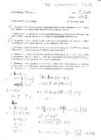
T I l/ Pe*.r (jk'r A !-*c-isvG{',(-ttr,l*-,Vr'*o **a-Llrik J.,'l,'Tq*ij ,{udo L!,a_ i*.fu nr!-^*,5 T R1 Rr Pb Rn,, i- => ---- !._ a . Ju k*, UA ue uh @ '-**'** E Kitr{,"f,f:Ts{
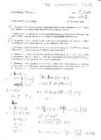
T I l/ Pe*.r (jk'r A !-*c-isvG{',(-ttr,l*-,Vr'*o **a-Llrik J.,'l,'Tq*ij ,{udo L!,a_ i*.fu nr!-^*,5 T R1 Rr Pb Rn,, i- => ---- !._ a . Ju k*, UA ue uh @ '-**'** E Kitr{,"f,f:Ts{
The students greeted their teacher cheerfully. 5 Ma õppisin selle luuletuse pähe. I learned this poem by heart. 6 Lapsed olid enne pidu ootusärevil. The children were excited before the party. 7 osasid vahetama swap the role 8 kahe nädala pärast in two time a week 2 Complete the sentences with the correct verb form 1 Did you meet Ann at the party last night? (meet) 2 Do you think our team will win the football match tomorrow? (win) 3 I can´t go out because I haven´t done my homework yet. (not do) 4 Somebody has broken the lock. I can´t get in. (break) 5 Next year Mary will spend two weeks in Liverpool. (spend) 6 I usually have a cup of tea and sandwich before I go to school. (have; go) 7 Jane is American. (be) She comes from Huston. (come) She has lived there all her life. (live) 8 I have known my next-door neighbour for a year but I haven´t talked to his wife yet. (know; not talk) 3 Make up questions and answer them.
……. a guess. A) topic B) class C) theme D) subject f) You all look tired. Let's……. a break. f) It's time for a break. The bell has……. g) This is a good composition, but you A) gone off B) struck C) rung D) sounded have ……. a lot of errors. g) Our English teacher ……. us some difficult exercises for homework. h) I think you should……. yourself A) set B) put C) obliged D) made more seriously. h) Before you begin the exam paper, always read the……. carefully. i) The teacher gave a lecture, and the A) orders B) instructions C) rules D) answers class ……. notes. i) If you want to pass the examination, you must study ……
Seminar 2 Tarbijate käitumine 1. Kas väide on õige: a) kui piirkasulikkus väheneb (MU>0) , väheneb ka kogukasulikkus; - vale b) ratsionaalselt käituv tarbija lõpetab kauba ostmise, kui kauba piirkasulikkus hakkab vähenema; - vale c) kui tarbija maksimeerib oma kogukasulikkuse, siis on kõigi ostetud kaupade viimaste ühikute piirkasulikkused võrdsed. - vale 2. Üldise e. kogukasulikkuse all mõistetakse: a) viimase tarbitud ühiku piirkasulikkuse ja tarbitud ühiku arvu korrutist; b) kõigi tarbitud ühikute piirkasulikkuse summat; c) viimase tarbitud ühiku piirkasulikkuse ja kauba hinna korrutist; d) esimesena tarbitud ühiku piirkasulikkuse ja tarbitud ühikute arvu korrutist. 3. Piirkasulikkuse all mõistetakse: a) tarbija reageerimistundlikkust kaupade ostmisel, kui kauba hind muutub; b) muutust kogukasulikkuses, kui tarbija tarbib täiendava kaubaühiku; c) muutust kogukasulikkuses, mis on jagatud kauba hinna muutustega, kui tarbija tarbib täiendava kaubaühiku; d) kaub
retested. Some people say "it's as simple as . . . " and then name their pet peeve or passion. My view is not of an education specialist, but of one who loves sharing what I learn, and owes much to educators. Since I don't have an educational theory neatly worked-out, nor an outline of my perceptions, my intent is to address each educational ingredient that comes to my mind. After I've said what I think about each topic, readers may have a fair comprehension of my philosophy. First comes sensitivity. If a person be insensitive, be it from numbing cold, exhaustion, drugs, genetic makeup, or upbringing, then the process of education is bogged down, and results come only after great efforts. Sensitivity in my integrated meaning is broad, covering literally the senses, so that deaf and blind people are less sensitive, as well as people whose senses work perfectly, but whose receptivity or thought processes are blunted for whatever reason
c ' ,t-r,(r l t,{ -' i == 9,tt KONTROL LTO{) nr. b N;,";, ...T."..S-cg.ff x,,,"ur, .....F.t].-n... VONKUMISFi ja LAINED 05. detsernber2005 / . .. l.1. Harmoonj ,eit ionk va punkti v6nke[lnplitrrud orr 8 cm, nurksagedu,s 4 s-1, alffaas
c ' ,t-r,(r l t,{ -' i == 9,tt KONTROL LTO{) nr. b N;,";, ...T."..S-cg.ff x,,,"ur, .....F.t].-n... VONKUMISFi ja LAINED 05. detsernber2005 / . .. l.1. Harmoonj ,eit ionk va punkti v6nke[lnplitrrud orr 8 cm, nurksagedu,s 4 s-1, alffaas
of people, animals or things. a brood of chickens a band of musicians Word File a school of fish Here are some more collective nouns: a bunch of keys a class of pupils a collection of books a deck of cards a fleet of ships a flock of sheep a gaggle of geese a gang of robbers a team of players a herd of cattle a litter of cubs a pod of whales a pack of wolves a pride of lions a flight of steps a set of stamps a swarm of bees a troupe of actors 35 Exercise Farmer John had several different kinds of animals on his farm. Write the correct collective noun for each group of his animals. Farmer John had: a of geese a of sheep a of cattle a of horses
g., the environment and human headache; eye, nose, or throat irritation; dry cough; dry or itchy skin; dizziness and nausea; difficulty in concentrating; fatigue; and sensitivity to odors. Fatigue, dizziness, Sick Building Syndrome (2) nausea Sick building syndrome is strongly suspected when the following
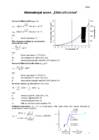
2018 Abimaterjal aines „Ehitusfüüsika“ Veeauru küllastusrõhk, psat, Pa 25 3300 Veeaurusisaldus õhus, g/m3 17 ,269t psat 610,5 e 237,3 t , Pa, kui t 0 o C , 20 2640 Veeaururõhk, Pa 21,875t 15
Skeemitehnika. SS-98. 1. M.Tooley “Everyday electronics data book” 2. Hessin “Impulsstehnika” 3. Horowits “The art of electronics” Skeemitehnika põhilised mõõtühikud Nimetus Tähistus Sümbol Kirjeldus Amper A I Voolutugevus juhtmes on 1A, kui juhtme ristlõiget läbib elektrilaeng 1 kulon 1. sekundi jooksul Kulon C Q Elektrilise laengu ühik e. Elektrihulk Farad F C Mahtuvus on 1F, kui potensiaalide vahe 1V tekitab mahtuvuse elektroodidel laengu. Henry H L Induktiivsus on 1H, kui voolumuutus kiirusega 1A sekundis tekitab induktiivsusel pinge 1V. Jaul J E Energiaühik. Oom R Takistuseühik. Siemens S G Juhtivuseühik. Sekund s t Ajaühik.
Eksami küsimused: 1. Mida tähendab mitmekiireline levi Mitmekiireline levi – info levib mööda peegeldusi, otselevi on väga harva. Kohale jõuab mitu lainet samaaegselt. Halb, sest lained liituvad (võivad tasakaalustada ennast ning signaal kustub ära, nõrgeneb). Kuna inimene liigub, muutub sagedus – lainepikkus – tuleb kogu aeg kanalit järgi kruttida. 2. Mida tähendab alla- ja üleslüli ning dupleks kaugus mobiilsides Pertaining to computer networks, a downlink is a connection from data communications equipment towards data terminal equipment. This is also known as a downstream connection. The uplink port is used to connect a device or smaller local network to a larger network, or connect to the next "higher" device in the topology. For example, the edge switch connects "up" to the distribution layer managed switch. Lühidalt - The communication going from a satellite to ground is called downlink, and when it is
Pilet 1. 1. Valgusdioodid 2. Võimendi põhiparameetid 3. RC-generaator (Wien i sild + OV) 4. TTL-Schottky loogika elemendid 5. RS-triger 1.Valgusdiood on päripingestatud pn-siirdega pooljuhtseadis, milles siire kiirgab valgus laengukandjate rekombinatsiooni tõttu. Vooluläbimisel pn- siiret, osa elektrone muudavad energiat, vahetavad orbiite, vabaneb energiat ning vabanev energia kiiratakse valgusena. n: infrapunane. Algul vaid peen valgus praegu olemas kollane, sinine, roheline. Pinge umbes 2V. valmistatakse (gallium arseeniid fosfiid). Kasutatakse optronites (valgusallik+valguse vastuvõtja). Dioodoptron kiireim 10 -8s. Inertsivaba ja saab ise valida spektri. 2. Võimendus astme põhiparameetrid: Ku=Uvalj/Usis, Ki=Ivalj/Isis, KP=Pvalj/Psis=Ku*Ki. Võimendi puhul KP alati >>1 OV: *Võimendustegur: KUD, K. Sõltub differentspinge sagedused, toiteping, temp. Antakse nullsagedusel ja nimiting-stel K=500..500k *Ühissignaali nõrgendustegur. Reegline ÜSNT=20logK/Ksf (-70..1
9% to 10.2% bodyfat, a 14% reduction of the total fat on my body, in 14 days. How? Timed doses of garlic, sugar cane, and tea extracts, among other things. The process wasn't punishing. It wasn't hard. Tiny changes were all it took. Tiny changes that, while small in isolation, produced enormous changes when used in combination. Want to extend the fat-burning half-life of ca eine? Naringenin, a useful little molecule in grapefruit juice, does just the trick. Need to increase insulin sensitivity before bingeing once per week? Just add some cinnamon to your pastries on Saturday morning, and you can get the job done. Want to blunt your blood glucose for 60 minutes while you eat a high-carb meal guilt-free? There are a half-dozen options. But 2% bodyfat in two weeks? How can that be possible if many general practitioners claim that it's impossible to lose more than two pounds of fat per week? Here's the sad truth: most of
Teema 5. Mõned elektrotehnika ja süsteemitehnika põhimõisted Märkus: teemade numbrid ja pealkirjad on vastavuses M. Pikkovi konspekti teemadega. Teemade alajaotuste pealkirjad üldjuhul vastavuses ei ole. 5.1. Passiivsed resistiivsed vooluahelad Vaatleme passiivseid resistiivseid ("oomilisi") vooluahelaid; samas on mõnikord kasulik tuua paralleelseid näiteid mahtuvusi ja induktiivsusi sisaldavate ahelate kohta, aga ka aktiivahelate kohta, kui need näited aitavad erinevaid seoseid ja reegleid selgitada ja meelde jätta. Elektroonikalülituste puhul eeldatakse reeglina aktiivkomponentide olemasolu nendes. Aktiivkomponendid vajavad oma tööks mitmesuguseid toitepingeid, eelpingeid ja voolusid ning komponendi tunnusjoontel sobiva tööpunkti fikseerimist. See eeldab passiivsete ahelate tundmist ja oskust neid kasutada. Samuti vajatakse passiivahelaid signaalide ülekandel ühelt aktiivkomponent
r-* tTnqt '-qilg._ ,?r, ' qr"7:'#l E4 j -.1 J^*{t(o0r d b,9-, 0T.oY.oP ,)l & 1,3 /,t/" { [ 6r 0x ' l " Jtr ** tC "/ )r ,qrrdx 0 ,1 =,,. c r d,,( J,f *.
.. (13 ask) me to write a book about her way to the top. That's why I ... (14 start) taking notes of her and my other classmates' results. 3. Complete the exercise with the verbs in the past simple, the past continuous, or the past perfect tense. Do you remember? I went I was / we were going I had gone I couldn't wait for the first day of school to show off the new bike which I ... (1 get) as a birthday present. As I ... --- 5 (2 want) to look cool riding up to the front steps, I ... (3 put) on my new skirt. When I ... (4 reach) the school, I ... (5 make) a big mistake and ... (6 smile) at my friends instead of watching where I was going. While I ... (7 wave) at my best friend, I couldn't brake, and I ... (8 hit) the steps. I ... (9 fail) off my bike and ... (10 tear) my skirt. What a great start to the new year! 4. Write the sentences. 1 fifteen the off in I'm minutes to cinema I'm off to the cinema in fifteen minutes.
 annaabi.ee