Leidsid 33 sarnast õppematerjali, mis on seotud failiga "Michael Morpurgo". Need materjalid aitavad sul teemat sügavamalt mõista.
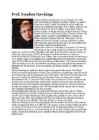
morpurgo, children, horse, books, there, known, british, author, canterbury, went, university, english, french, working, primary, teacher, discovered, talent, four, among, butterfly, lion, novel, britain, tells, experiences, first, years, married, wifeTallinna Rahumäe põhikool Report Michael Morpurgo Lizett Käos 8A Tallinn, 2014 Michael Morpurgo His biographical data Michael Murporgo´s full name is Michael Andrew Bridge Morpurgo. He was born 5 October 1943 in St Albans, Hertfordshire, he attended schools in London, Sussex and Canterbury. He went on to London University to study English and French, followed by a step into the teaching profession and a job in a primary school in Kent. It was there that he discovered what he wanted to do. Morpurgo's biological father was actor Tony Van Bridge. His mother, Kippe Cammaerts (otherwise Catherine Noel Kippe, daughter of Emile Cammaerts), who had been an actress, met (and in 1946 married) Jack Morpurgo (subsequently Professor of American Literature at the University of Leeds from 1969 to 1982)
Michael Morpurgo 1. Introducton. This project is about Michael Morpurgo. He is a well-known British author. He writes the sort of stories he likes to tell his own children. 2. Biographical data. Michael Murporgo´s full name is Michael Andrew Bridge Morpurgo. He was born 5 October 1943 in St Albans, Hertfordshire. He was the son of Tony bridge who was an actor. He attended schools in London, Sussex and Canterbury. 3. Biogrphies. There has been released three biogrphies about Michael Morpurgo. First on was released in 1999 called "Interview with Michael Morpurgo", written by Joanna Carey. In 2004 was released "Dear mr Morpingo: Inside the world of Michael Morpurgo", written by Geoff Fox. In 2005 was released "Michael Morpurgo", written by Shaun McCarthy. 4. Favorites among his own books. Favorites among his own books are The Butterfly Lion, Kensuke´s Kingdom, War Horse and Private Peaceful. 5
Michael Morpurgo Michael Morpurgo was born in 5 October 1943, his full name is Michael Andrew Bridge Morpurgo . He is a well-known British author, who has written over a hundred books for children. There has been released three biogrphies about Michael Morpurgo. First on wasreleased in 1999 called “Interview with Michael Morpurgo”, written by JoannaCarey. In 2004 there was released “Dear mr Morpingo: Inside the world of Michael Morpurgo”, written by Geoff Fox. In 2005 was released “Michael Morpurgo”,written by Shaun McCarthy. Favorites among his own books are The Butterfly Lion, Kensuke´s Kingdom, WarHorse and Private Peaceful. The book talks about a horse who lives on a farm and moves into the battles of World War I. It is a story of friendship lasting through the toughest tests. Michael Morpurgo tells the story trough the eyes of a horse
Charles Dickens Charles John Huffam Dickens was the foremost English novelist of the Victorian era, as well as a vigorous social campaigner. Considered one of the English language's greatest writers, he was acclaimed for his rich storytelling and memorable characters, and achieved massive worldwide popularity in his lifetime. Charles Dickens was born in Landport, Portsmouth in Hampshire, the second of eight children to John Dickens n 7 February 1812. The 12-year-old Dickens began working ten hour days in a Warren's boot-blacking factory. In May 1827, Dickens began work in the office of Ellis and Blackmore as a law clerk. At the age of seventeen, he became a court stenographer and, in 1830, met his first love, Maria Beadnell. Maria's parents disapproved of the courtship and effectively ended the relationship when they sent her to school in Paris.
vivacious woman about whom a future Viceroy of India would say, "Dullness and Mrs. Kipling cannot exist in the same room."[3] Father - John Lockwood Kipling. Lockwood Kipling, a sculptor, an illustrator, museum curator and pottery designer, was the principal and professor of architectural sculpture at the newly- founded Sir Jamsetjee Jeejeebhoy School of Art and Industry in Bombay. Later in life Kipling illustrated many of Rudyard Kipling's books, and other works. Kipling also remained editor of the Journal of Indian Art and Industry, which carried drawing works from the students of the Mayo School. COUPLE named their son after the place they had first met Rudyard Lake. Alice Kipling Fleming - Sister of British author Rudyard Kipling who became a well-known psychic, producing automatic writing under the name "Mrs. Holland." Born June 11, 1868, Alice Kipling was privately educated
The literary history of this nation when the first humanbeing living in what has since become the U.S used language creatively. · Mid to late 18 century put down · Words are powerful, magical · Words must be remembered · Native Americans stories creation of the world · Attidude thought their land/language · Similar stories Dates and names · America was discovered in 1492 by Columbus · 1497 John Cabot went to Canada · 1579 San Fransisco/St. Fransis · 1607 Jamestown collony/John Smith · 1620 a boat called MayFlower · 1630 Boston was established · 1636 Harvard University · 1773 Boston Teaparty · 1775 War of Independence · 1776 4 July Declaration of Independence · First President George Washington Christopher Columbus
ravages of nature only to fall victim to wanton destruction by ,,civilized" man. Like the huge stone statues of Easter Island and prehistoric cave paintings of Altamira and Lascaux, North American Indian rock art is surrounded by an atmosphere of mystery. Although examples of rock art exist at some 15000 sites in canyons, deserts, caves and river gorges. Nowadays, however, primitive rock art in the United States has become a new field of scientific study. Klaus F Wellmann wrote two books about rock art. He is a professor of medicine. Rock art represents the history of aboriginal Americans. In the most cases the art is an expression of ideas and way of life, ritual ceremonies, hunting, fighting. The pictures of people and animals are often strikingly lifelike and artistic. Many of these ancient relics have been destroyed by the ravages of nature and of man. Wind and water have worn away and continue to wear away, unprotected sites.
He died in 1955 at home because of a heart attack. He had 1 child. Liis: "The Phantom of the Opera" A.L. Webber is knighted, started writing musicals in 1965, owns 7 theatres and has written 13 musicals. The story is based on a book. The musical was first staged at Sydmonton, at the home of A.L Webber. The main actors were Sarah Brightman and Michael Crawford. There have been 65 000 performances and over 80 million people have seen it. There was a film made in 2004. The play consists of 2 acts. The main characters are The Phantom and Christine, then Raoul, Carlotta, Madame Giry. It has won over 50 awards. The opera house has 17 floors, is above an underground lake, was built in 1861-1875 in a neo-baroque style, golden ornamental decorations, statues, columns and bronze busts of composers Siret: "Prince Albert" Born in 1819 in Germany. He had unhappy childhood (parents divorced when he was
father, Charles Altamont Doyle, and an Irish mother, Mary Foley, who had married in 1855.] Although he is now referred to as "Conan Doyle", the origin of this compound surname is uncertain. Conan Doyle's father was an artist, as were his paternal uncles (one of whom was Richard Doyle), and his paternal grandfather John Doyle. Conan Doyle was sent to the Roman Catholic Jesuit preparatory school St. Mary's Hall, Stonyhurst, at the age of eight. He then went on to Stonyhurst College, but by the time he left the school in 1875, he had rejected Christianity to become an agnostic. From 1876 to 1881 he studied medicine at the University of Edinburgh, including a period working in the town of Aston (now a district of Birmingham). While studying, he also began writing short stories; his first published story appeared in Chambers's Edinburgh Journal before he was 20. Following his term at university, he served as a
Outstanding figures in British literature Eva Martina Põder 11.b British literature Refers to all literature produced by British authors from the United Kingdom, which includes England, Scotland, Northern Ireland, Wales, the Channel Islands, and Isle of Man Includes early works written in Gaelic, Welsh, and Latin, works in Old, Middle, and Modern English, each of which represents a different period Full of great works British works in Latin Venerable Bede He lived between 673 and 735 AD The greatest of all the AngloSaxon scholars
It was written in 1916 and was first published by John Lane in the USA in October 1920 and in the UK by The Bodley Head (John Lane's UK company) on January 21 1921. In her first novel, The Mysterious Affair at Styles(1920), she created the now-famous Belgian detective Hercule Poirot, the most popular sleuth in fiction since Sherlock Holmes. Poirot and Marple have also been portrayed in the many films, radio programmes and stage plays based on her books.It is Christie's first published novel, and introduces Hercule Poirot, Inspector Japp and Lieutenant Hastings (later, Captain) The story is told in first person by Hastings, and features many of the elements that, thanks to Christie, have become icons of the Golden Age of Detective Fiction. It is set in a large, isolated country manor. There are a half-dozen suspects, most of whom are hiding facts about themselves.
1. Ancient Britain: the Celtic tribes. 2000 years ago there was an Iron Age Celtic culture throughout the Br Isles. It seems that the Celts, who had been arriving from Europe from the 8th cent BC onward, intermingled with the peoples who were already there. The Celts were extremely talented people, creative and artistic. More than 1 Celtic tribe invaded Br. The descendants of ancient Celts live in Wales, Scotland, Cornwall and Ireland. They lived in primitive society. Druids priests, more powerful than chiefs. Acted like prophets. 2. Stonehenge From prehistoric period. Was built on Salisbury plain between 2500 and 1500 bc. One of the most famous and mysterious archaeological sites in the world
He is born on 19. June 1947. He is the only son of Anis Ahmed Rushdie and Negin Bhatt, a teacher. Rushdie was born in Bombay, India, into a Muslim family of Kashmiri descent.[10][11][12] He was educated at Cathedral and John Connon School in Mumbai, Rugby School, and King's College, University of Cambridge, where he studied history. Rushdie's first career was as a copywriter, working for the advertising agency Ogilvy & Mather. It was while he was at Ogilvy that he wrote Midnight's Children, before becoming a full-time writer. His first novel, Grimus, a part-science fiction tale, was generally ignored by the public and literary critics. His next novel, Midnight's Children, catapulted him to literary notability. It is regarded by many as one of the great books of the last 100 years. This work won the 1981 Booker Prize and, in 1993 and 2008, was awarded the Best of the Bookers as the best novel to have received the prize during its first 25 and 40 years
ENGLISH LITERATURE Ancient Britain Lived on the British Isles in the 1st millenium. They most probably came from Eastern Europe and belonged to the Celtic race and also spoke Celtic. They were primitive hunters- gatherers, farmers. Some Celtic words are still used in modern English, however they are used mostly in place names. For example: · avon river · cumb valley · ford shallow place in the river Ancient Britons had their own religion and priests or druids and temples.
J.F.Cooper(1789-1851): he was born in Burlington, New Jersey in 1789. When he expelled from Yale bacause of prank, he joined the navy as a midshipman. In 1810 he took a furlough and never returned to active duty. He married with Susan De Lancy and got 5 children. They lived Europe, but returned to America because he was unpopular in Europe. In 1920 je published his first fiction "Precaution", in 1821 the second one "The Spy". His third book "The Pioneers" was the first of five novels. He died at Cooperstown in 1851. He was immensely popular writer and he considered to be the first major American novelist. R.L.Stevenson(1850-1894): he was born in Edinburgh, Scotland in 1850. He was a sick little boy who spent much of his time in bed. He was very
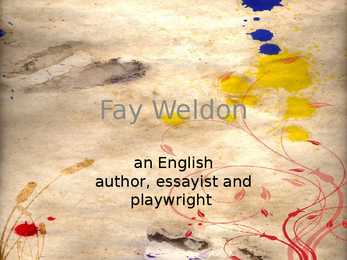
§ In 1967, she published her first novel "The Fat Woman's Joke". § For the next 30 years she built a very successful career, publishing over twenty novels, collections of short stories, films for television, newspaper and magazine articles and becoming a well-known face and voice on the BBC. § In 1971 Weldon wrote the first episode of the landmark television series Upstairs, Downstairs, for which she won a Writers Guild award for Best British TV Series Script. § In 1980 Weldon wrote the screenplay for director/producer John Goldschmidt's television movie "Life for Christine" which told the true story of a 15 year old girl's life imprisonment. The film was shown in prime-time on the ITV Network by Granada Television. § She also wrote the screenplay for the 1980 BBC miniseries adaptation of Jane Austen's Pride and Prejudice starring Elizabeth Garvie and David Rintoul. §
island situated to the northwest of Continental Europe. It is the ninth largest island in the world, the largest European island, and the largest of the British Isles. With a population of about 60.0 million people in mid-2009, it is the third most populous island in the world, after Java and Honsh. Great Britain is surrounded by over 1,000 smaller islands and islets. The island of Ireland lies to its west. Politically, Great Britain may also refer to the island itself together with a number of
During his studies as a theatre major, he began "doctoring" scripts, adapting fiction for theatre production, and finally writing his own one-act and full-length plays. Later he has worked both as a freelancer and a contracted writer. He first wrote the short story "Ender's Game" while working at the BYU press. Ender's Game and its sequel Speaker for the Dead were both awarded the Hugo Award and the Nebula Award, making Card the only author (as of 2008) to win both of science fiction's top prizes in consecutive years. Card continued the series with seven books, which divide into "Shadow" and "Speaker" series. He has also announced his plan to write two more novels: Shadows in Flight, a book that connects the "Shadow" series and "Speaker" series together, and Ender in Exile, a book that takes place after Ender's game and before Speaker for the Dead.
The main activity happens in 1930.-1940. Egipt and during the last days of World War II in one Italy nunnery which was changed after the war to sickbay. · Almásy is not English. He is Hungarian by birth. Almásy's manner is knowledgeable and reflective. Almásy is not a highly dynamic character, he is intriguing and mysterious figure. He is portrayed in a sympathetic light. He was part of a British archaeological group and also as afterwards reveals a spy. · Hana was a twenty-year-old Canadian Army nurse. She put all of her energy into caring for the English Patient. When the hospital was abandoned, Hana refused to leave and instead stayed with her patient. She sees Almásy as saint like and with the "hipbones of Christ". She falls in love with the English Patient in a purely non-sexual way. She also cut off her hair and she didn't look anymore to mirrors.
He was born into a well off family and this is a paradox about him. Upper middle class family, yet his political views were very radical, he was extremely well educated. He was hostile against the social order in the usa. The central theme in his writings is the criticism of basic institutions of american society. Interestingly, he wasnt just a social critic but one of the best experimentalists. Anti war novel called ,,Three soldiers". Dos Passos went to Europe, served for a while. Three main characters, three young soldiers. One is Dan Fuselli, he is an optical worker from San Francisco, naively thinks that war is fun, Chris Field, farmboy, hates the army, was forced to join it. John Andrews, he is the intellectual of the three. He is also very sensitive young man and wants to be a musician. He and Chris Field desert the army. Andrews hides with a French girl and starts writing a symphony and is arrested later. War is hostile to the artist
came to England in 43 AD . The Romans built houses , a port and a bridge over the river and named the place Londinium. In September 1666 , when the Great Fire destroyed four fifts of the wooden buildings . The fire began in the kitchen of the King ´s baker in Pudding Lane and lasted for five days . London . London is an exiting city . The population of London is about seven million people and it is made up of the people of very many nationalities . There are nine piers where you can get a boat and enjoy numerous sights like .... The Tower of London Click to edit Master text styles Second level Third level Fourth level Fifth level St Paul ´s Cathedral Click to edit Master text styles Second level
France, Spain - greatest enemies.So he could save much money and thus laid a good economic basis for his state. Besides that he built a merchant fleet (kaubalaevastik) England begun to dominate in international trade. Unfortunately the king got old and died. Next king was Henry Vlll, second son of the family, wasn't prepared to become a king. Had to take the role as his elder brother died. Was prepared to come a clergyman got good education: languages, music, literature. Brother jumped off horse into a river, died in bed. Elder brother was already married. Henry Vlll married with his brothers widow.Catherine of Aragon, she came from Spain, she was arden(innukas) Catholic. At first they had good relations. Soon there were big problems. Had daughter Mary, couldn't get a son. Needed a new king. Henry decided to get a divorce. Henry wrote a long letter to Pope for a divorce. Pope said no. Then Henry decleared himself the head of English church to get divorce. Catherine was sent to
REVISION QUESTIONS 1. The Contradictory, diverse, chaotic 20th century. New developments in science and philosophy. The essence and influence of Freudian theory. Contradictory, diverse, chaotic 20th c- simultaneous rejection and invocation of the past. While modernists apotheosized the creative geniuses of the past, they also rejected old poetic forms. Challenge old and established beliefs and more and more people had access to books and education more people went to universities. profound change in morals: · No universal value and perspective on things · Multiple truths, multiple perspectives · Nothing has inherent (kaasasündinud, sisemist) importance · Life lacks purpose Science: Albert Einstein-general theory of relativity had a huge impact on culture as well. Everything is relative. Philosophy: Henri Bergson (French) came to challenge the immediate experience ad intuition are
Joseph Rudyard Kipling was a British author and poet. He was born on 30 December 1865 in Bombay, in India which was part of the British Empire then. he is best known for his works of fiction The Jungle Book (1894) (a collection of stories which includes Rikki-Tikki-Tavi), Kim (1901) (a tale of adventure), many short stories, including The Man Who Would Be King (1888); and his poems, including Mandalay (1890), Gunga Din (1890), and If-- (1910).He is regarded as a major "innovator in the art of the short story"; his children's books are enduring classics of children's literature; and his best works speak to a versatile and luminous narrative gift
The Beatles have had more number one albums on the UK charts, and held down the top spot longer, than any other musical act. According to RIAA certifications, they have sold more albums in the US than any other artist. In 2008, Billboard magazine released a list of the all-time top-selling Hot 100 artists to celebrate the US singles chart's fiftieth anniversary, with The Beatles at number one. They have been honoured with 7 Grammy Awards, and they have received 15 Ivor Novello Awards from the British Academy of Songwriters, Composers and Authors. The Beatles were collectively included in Time magazine's compilation of the 20th century's 100 most important and influential people. The Who are an English rock band which was formed in 1964: vocalist Roger Daltrey, guitarist Pete Townshend, bassist John Entwistle, and drummer Keith Moon. They became known for energetic live performances which often included instrument destruction. The Who
English writers Maria maasing Edwin Abbott Abbott · Edwin Abbott Abbott(1838-1926)was an English clergyman and writer.He was born in London. He wrote several theological works and a biography (1885) of Francis Bacon, but he is best known for his Shakespearian Grammar (1870) and religious allegory the Flatland. William Blake · William Blake (17571827) was an English poet, philosopher and artist.He was one of the most extraordinary personalities to emerge during the period of Romanticism. He believed that spiritual reality lies hidden behind the visible world of the senses and he attempted to create a symbolic language to represent his spiritual visions. He began
logic, mathematical theory of grammar) and linguistics (the theory of language structure, comparative linguistics, language typology, psycholinguistics, sociolinguistics; applied linguistics including speech and text processing, quantitative linguistics, modern applied linguistics). History of the Department Russian philology was not studied as an independent academic discipline until 1945, yet from the very beginning of the faculty's existence there were courses in Russian studies on offer for students of Slavic studies. In the 1922/1923 academic year, an independent Section of Russian Language and Literature was founded within the School of Slavic Studies. The section was, from its foundation until 1945, headed by Valerij Alexandrovic Pogorielov. In 1945 another member of the post-revolutionary wave of Russian emigrants, Prof. Alexander Vasilievic Isacenko, was appointed Professor in Russian Philology. In 1946 Prof. A. V. Isacenko became
); world dominion (British empire); Economy: Industrialization; urbanization (people moved to towns no agriculture & food); laissez- faire economy new type, where government has no control over economy; booming economy- needed new markets and endless supply of raw materials; 1845- potato famine in Ireland, 1846- Corn Laws (import of cheap corn to feed hungry people); Social life: religious doubts (Darwin's The Origin of Species 1859)- question raised: is there a God at all?; sexual liberation- changed people thoughts about sex (before men & women had different bedrooms); problems: alcoholism, prostitution, child workforce, primitive technology. · How did the class structure change? Highest class was aristocracy (the Church and the nobility); the middle class/the bourgeoisie (shopkeepers, merchants, lawyers, businessmen etc.) was the biggest class; and the lowest class "the working class" and
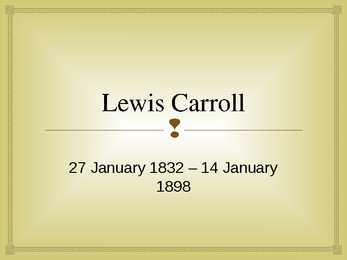
Lewis Carroll 27 January 1832 14 January 1898 Charles L. Dodgson Charles Lutwidge Dodgson (27 January 1832 14 January 1898), better known by the pseudonym Lewis Carroll, was an English author, mathematician, logician, Anglican deacon and photographer. His most famous writings are Alice's Adventures in Wonderland and its sequel Through the LookingGlass, as well as the poems "The Hunting of the Snark" and "Jabberwocky", all examples of the genre of literary nonsense. He is noted for his facility at word play, logic, and fantasy, and there are societies dedicated to the enjoyment and promotion of his
English literature is one of the oldest literatures in Europe; dates back to the 6th century AD. Oral literature, i.e. not written down, spread from person to person. In 449 AD Anglo-‐Saxon tribes invaded England – beginning of the Anglo-‐Saxon period in English literature. The first form of literature was folklore, carried by scops and gleemen, who sang in alliterative verse (a kind of simple poetry). Prose developed much later. The first form of recorded English literature was the epic Beowulf, which was produced sometime near the end of the 7th and beginning �
church and his real name is Carl Gustaf Folke Hubertus. He is also the Duke of Jämtland. Carl became Sweden's King on September 19, 1973 at the age of 27, succeeding his grandfather, King Gustaf VI Adolf. He is son of the Crown Prince Gustaf Adolf, who died in a plane crash in Copenhagen in 1947, and Princess Sibylla of Sachsen-Coburg-Gotha, who died in Stockholm in 1972. King Carl Gustaf married Miss Silvia Renate Sommerlath on June 19, 1976 in the Stockholm Cathedral. Their children are Victoria, Carl Philip and Madeleine. The King has also four older sisters: Margaretha, Birgitta, Désirée and Christina. Carl Gustaf became the Crown Prince at the age of four, when Gustaf V died. Hewent to the preschool and he was taught privately at the Royal Palace of Stockholm. He went to the military service, where he was two and a half years. He trained in the Army, Navy and Air Force. He also took part in a long voyage on the mine-laying vessel
years after the death of Galileo) in Oxford, England. His parents' house was in north London, but during the second world war, Oxford was considered a safer place to have babies. When he was eight, his family moved to St. Albans, a town about 20 miles north of London. At the age of eleven, Stephen went to St. Albans School and then on to University College, Oxford; his father's old college. Stephen wanted to study Mathematics, although his father would have preferred medicine. Mathematics was not available at University College, so he pursued Physics instead. After three years and not very much work, he was awarded a first
relates to American Revolution on the one hand and the European Enlightenment on the other. Influenced by the scientific revolution of the 17th century and the humanist period during the Renaissance, the Enlightenment took scientific reasoning and applied it to human nature, society, and religion. American Enlightenment a gradual but powerful awakening that established the ideals of democracy, liberty, and religious tolerance in the people of America. If there were just one development that directly caused the American Revolution and uplifted the intellectual culture of the continent while it was only a British colony, it would be the American Enlightenment. Broadly, the Enlightenment was an intellectual movement that changed the fundamental perspective of the masses, urging them to foster skepticism and apply scientific principles in matters of religion and morality. Its chief values were: Liberty, Democracy, Republicanism, Religious Tolerance
 annaabi.ee