Leidsid 33 sarnast õppematerjali, mis on seotud failiga "Matsalu rahvuspark inglisekeelne esitlus". Need materjalid aitavad sul teemat sügavamalt mõista.
fourth, matsalupecies, bird, protect, birds, protected, nature, landscapes, hectares, europe, than, areas, here, observation, western, part, reed, local, autumn, through, pink, lady, towers, betweenituated, goals, unique, coastal, islets, current, there, fish, mammals, plants, 6500, traditional, millions, arctic, regions, tailed, duckstay, duringSeal: Great Seal of the United States Motto: In God We Trust 9.83 million km2 and with over 308 million people, the United States is third largest country both by land area and population It is one of the world's most ethnically diverse and multicultural nations The U.S. economy is the world's largest national economy Click to edit Master text styles Second level Third level Fourth level Fifth level Nature America consists of 50 states. 48 of them are on North American continent and 2 of them (Alaska and Hawaii) are separated. Alaska is separated by Canada and Hawaii lies in the Pacific Ocean. America shares borders with Canada, Mexico and Russia. America is surrounded by three oceans Pacific Ocean, Atlantic Ocean and Arctic Ocean.
ENGLAND General overview England is part of the United Kingdom Land borders with Scotland to the north and Wales on to the west The English Channel on south separates it form continental Europe The country includes over 100 smaller islands Capital and largest city is London Its has consitutional monarchy Monarch is Elizabeth II Total area is 130,395 km2 Population is 51,446,000 million, around 84% of the population of the UK Currency is Pound stearling(GBP) Has left-hand traffic Patron saint is ST. George Geography England comprises the central and southern two-thirds of the island of Great
"Melbourne" is the common name. Brisbane Brisbane is the capital and most populous city in the Australian state of Queensland and the third most populous city in Australia. Brisbane's metropolitan area has an approximate population of 2 million.A resident of Brisbane is commonly known as a "Brisbanite". Perth Perth is the capital and largest city of the Australian state of Western Australia and the fourth most populous city in Australia. The Perth metropolitan area has an estimated population of 1,659,000. Adelaide. Adelaide is the capital and most populous city of the Australian state of South Australia, and is the fifthlargest city in Australia. Adelaide has an estimated population of more than 1.28 million. The adjective form of Adelaide used to describe residents or other qualities of the city is "Adelaidean" Abor igines
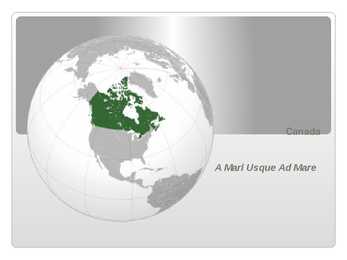
Confederation, Canada was formed as a federal dominion of four provinces this began an accretion of provinces and territories and a process of increasing autonomy from the United Kingdom widening autonomy was highlighted by the Statute of Westminster 1931 culminated in the Canada Act 1982, which severed the vestiges of legal dependence on the British parliament Click to edit Master text styles Second level Third level Fourth level Fifth level Ottawa Capital 45°24N 75°40W / 45.4°N 75.667°W / 45 Largest city Toronto Capital, Largest City Since the end of the last glacial period, Canada has consisted of eight distinct forest regions, including extensive boreal forest on the Canadian Shield Canada has more lakes than any other country, containing much of the world's fresh water Geography
Võnnu Keskkool ESTONIA Referaat Autor: Klass : 9 Juhendaja: Võnnu 2013 Estonia officially the Republic of Estonia, is a state in the Baltic region of Northern Europe It is bordered to the north by the Gulf of Finland, to the west by the Baltic Sea, to the south by Latvia and to the east by Lake Peipus and Russia.Across the Baltic Sealies Sweden in the west and Finland in the north. The territory of Estonia covers 45,227km2 The Estonian climate resembles that of other countries on the Baltic littoral. On account of the country's proximity to the sea, the skies are often cloudy, and rain often falls in the spring and
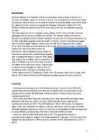
The capital of Estonia is Tallinn. The currency used in Estonia is Eesti kroon. The Estonian national flag is blue-black-white. It was originally the flag of the Estonian Students' Society. The flag was first consecrated in Otepää Church in 1884. For a while, during the Soviet occupation, the flag was banned but it was again seen in public in Tartu in May 1988. The national flower is cornflower, the national bird is barn swallow and the national stone is limestone. The Estonian national anthem called "My Native Land, My Pride and Joy" was composed in 1848 by Friedrich Pacius. The Estonian language words were written by J. V. Jannsen. It was officially adopted after the War of Independence in 1920.The same melody with different words is also Finland's national anthem. The current coat of arms of Estonia is a golden shield which includes three slim, blue leopards
Tallinna Inglise Kolledz Estonia Topic Alice Tärk, 9b Tallinn 2007 FACTFILE Area: 45 228 sq km Poplulation: under 1.4 million Capital: Tallinn Language: Estonian Currency: Eesti kroon (EEK) Main religion: Lutheran National holiday: 24 February (anniversary of the republic) National flower: Cornflower National bird: Barn Swallow National stone: Limestone LOCATION The Republic of Estonia is the northernmost and smallest of the three Baltic States. It is located on the eastern shores of the Baltic Sea in the north east of Europe. To the east the country borders Russia. Latvia is the countries neighbour to the south. From the west the coast of Estonia is washed by the Baltic Sea and from the north by the Gulf of Finland. The length of the coastline is approximately 3 800 km
633 km. The coast varies from limestone cliff in the north to sandy beaches in the west. Most of Estonia's many islands belong to the West Estonian archipelago. The largest islands are Saaremaa with 2671 sq km, Hiiumaa with 989 sq km and Muhu with 200 sq km. The sea between these islands and the Mainland Väinameri is very shallow (less than five metres deep on average) and rich in shoals. The water of the Baltic Sea is brackish. Its average saltinity is only one fourth of that of the sea in general. Thus, most Estonian freshwater fish (about 30 species) also inhabit the sea. There are some 1450 lakes in Estonia (6.1% of its territory). The two largest of them are Lake Peipsi (the fifth largest in Europe) at 3555 sq km and Võrtsjärv with its 270 sq km area. About 1440 vascular plant species grow in Estonia, while ¾ of the total number of species are found in the coastal lowlands and islands.
democracy. The head of state is the Queen of the United Kingdom. Governor-General Michael Jeffery, performs her functions in Queen's absence. The parliament consists the Senate and the House of the Reprentativer. The head of the government is the prime minister. The Prime Minister is elected by the House of Representatives and the Cabinet. The Prime Minister is John Howard. Currency- Australian dollar. Relief Australia has a variety of landscapes. The Great Australian Bight lies in the south of Australia. The Gulf of Carpentaria is between the Arafura Sea and Cape York. The Bass Strait separates the island of Tasmania from the mainland of Australia. The Great Barrier Reef is in the north-east of Australia, between the Coral Sea and the mainland. The western part of Australia is covered with deserts. Most of the rocks have turned into sand. The biggest of them is the Great Sandy Desert, which lies in the north of Western Australia.
is on the 26th of January. In 1788 on the 26th of January the first fleet arrived at Botany Bay and established a penal colony near modern-day Sydney. Geographical Position Australia is located in the Southern Hemisphere. It’s the only continent except for Antarctica that is all south of equator. Sometimes Australia is called the island continent. There is a great reason why. It really is an island. It is 2880 km from the mainland of Asia and is almost half way round the world from Europe. More than 9 600 km separates it from America. Australia lies between the Pacific and Indian oceans. The Timor Sea and the Arafura Sea separate Australia from Indonesia. In the north the coast is washed by Great Australian Bight and the Indian Ocean. In the northeast the Coral Sea washes the coasts and in the southeast there is the Tasman Sea which also separates Australia from New Zealand. The biggest island is Tasmania which is located to the south of the country.
From the east by the Coral Sea and the Tasman Sea. Australia's coastline is about 37,000 km long. The Great Australian Bight washes the southern coast. The Gulf of Carpenteria and the Cape York Peninsula surround it in the south. 3. Relief Australia is the smallest continent in the world It is often called the island continent because is too big for an island but rather small for a continent. Australia is 1,800 miles from the mainland of Asia and almost half way round the world from Europe. More than 6,000 miles of ocean separate in from the America. Australia is the only continent except for Antarctica that lies all south of the equator. The natural zones of Australia are very various. There are deserts, semi deserts, grasslands, savannas, bushlands and rainforests. The wet forests occupy the narrow region in the east. Most of the animals, birds and insects live in that region, because there is enough food. The savannas which are grasslands with some trees are mostly in
Topic Estonia Tallinn 2008 1. Introduction Estonia is a small country about the size of Switzerland, or New Hampshire and Massachussetts combined. Estonia is named after the people called "Ests" who lived in the region in the 1 st century AD. The Republic of Estonia is one of the three countries commonly known as the "Baltic States". The other Baltic States are Latvia and Lithuania. 2. Geographical position Estonia is situated in northeastern Europe. Estonia is bounded on the north by the Gulf of Finland, on the east by Russia, on the south by Latvia and on the west by the Baltic Sea. In the north it borders on Finland. The coastline of the Baltic Sea in Estonia is characterized by numerous gulfs and bays, the biggest of them being the Gulf of Finland, the Gulf of Riga and the Gulf of Pärnu. Bays include the Narva Bay, Matsalu Bay, Kolga Bay, Kunda Bay, Tallinn Bay etc. Estonia has over
Introduction Estonia, officially the Republic of Estonia (Estonian: Eesti or Eesti Vabariik) is a country in the Baltic region of Northern Europe. It is bordered to the north by Finland across the Gulf of Finland, to the west by Sweden across the Baltic Sea, to the south by Latvia (343 km), and to the east by the Russian Federation (338,6 km). The territory of Estonia covers 45,227 km² and is influenced by a temperate seasonal climate. The Estonians are a Finnic people closely related to the Finns, with the Estonian language sharing many similarities to Finnish. The modern name of Estonia is
The maritime climate is temperate, summers are warm and winters mildly cold, the average annual temperature is 5 degrees Celsius and the average annual precipitation is 550 millimetres. The most important assets of the soil are oil shale, phosphorite and peat. The designation “Aestii” was first mentioned by the Roman historian Tacitus in “Germania” (98 AD). By the end of the first millennium the people of Western Europe referred to the land of our ancestors with the name Estonia (derived from Germanic languages and means East). The Estonians, our Finno-Ugric forefathers settled here in approximately 5,000 BC from northern Russia and the Urals, as fishermen and hunters. They called themselves “rural people”, the term “Estonians” started to spread three centuries ago, taking firm root in the middle of the 19th century. From the 13th century onwards the ancient Estonians had to continually fight
Their nearest relatives are koalas. The possum is a furry animal that lives in the trees. This good climber moves about at night. They live in groups and come out to look for food in the night. Some of them are called gliders as they have skin between their legs which they use like wings for gliding from three to another. The egg-laying mammals are the strangest of all the Australia's animals. They lay eggs like birds and feed their young with milk as mammals do. The platypus lives mostly in the rivers of East Australia. The female lays two eggs in a nest of leaves and grass at the end of a burrow in a river bank. When the young come out of eggs, they start licking up the milk that comes from the mother's stomach skin. Platypus gets its food mainly from the river. It has pouches in its cheeks where it can store food to eat later. It has a strong flat tail. It is a good swimmer
I. Portugal ABOUT Photo Location of Portugal (dark green) Portugal (Portuguese: Portugal, IPA: [putua]; officially the Portuguese Republic, Portuguese: República Portuguesa) is a country located in Southwestern Europe, on the Iberian Peninsula. It is the westernmost country of mainland Europe, and is bordered by the Atlantic Ocean to the west and south and by Spain to the north and east. The Atlantic archipelagos of the Azores and Madeira are Portuguese territory as well. The country is named
The Minnesota Twin Study is a longitudinal study that has been going on since 1979. In this study they compare identical twins that have been raised together and twins who have been raised separately. Bouchard determined a heritability estimate of 70% (that is, that 70% of intelligence can be attributed to genetic inheritance). Much research has supported this study, and it one of the most impressive studies among correlational studies because of its size and nature of the sample, but there are still some limitations like ethical concerns and no adequate control to establish the frequency of contact between the twins or the assumption that the twins raised together experienced the same environment. Examine one evolutionary explanation of behavior. The environment presents challenges to each individual and those who adapt best will have a greater chance of surviving and passing on their genes. This is the principle of Charles Darwin's theory of evolution
climate contributed (in part) to the country's rise as a world power, with infrequent severe drought in the major agricultural regions, a general lack of widespread flooding, and a mainly temperate climate that receives adequate precipitation. 6. Animals, plants, agriculture Animals The moose ranges throughout the northern US. In the eastern forests live elks, black bears, deer, foxes, raccoons, skunks and squirrels. Along the coast of the Gulf of Mexico live large and more colorful birds such as pelicans and flamingos. Alligators can also be found there. Bison (buffalo) exists now only in protected areas. In the western areas live elk, deer, bighorn sheep, mountain goats and a small number of brown bears. The Kodiak bear, the largest carnivore found in North America, is found in Alaska. Plants The vegetation of Northern Alaska consists of lichens, mosses, low shrubs and flowering plants.
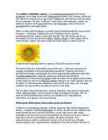
However, the leaves typically exhibit some heliotropism. Cultivation and uses A sunflower farm near Mysore, India. Sunflower heads solds as snacks in China. Sunflowers are native(pärit) to the Americas. The earliest known examples of a fully domesticated sunflower were found at the Olmec site of San Andrés dating some time before 2500 B.C.[1] The Incas used the sunflower as an image of their sun god. Gold images of the flower, as well as seeds, were taken back to Europe early in the 16th century. The Giant sunflower (Hlianthus giganteus) is native to Connecticut. They can grow to be between 3 and 12 feet tall. Their flower heads can be between 2 to 3 inches wide. They are most commonly found in valleys with wet meadows or swamps. The Giant sunflower grows between July and October. To grow well, sunflowers need full sun. They grow best in fertile, moist, well-drained soil with a lot of mulch. In commercial planting, seeds are planted 45 cm (1.5') apart and 2
It has a total area of 9.9 million square kilometers. This includes 755,170 square kilometers of water. Toronto is the largest city in Canada with a population of 4.3 million. Other major cities include Montreal (3.3 million people), Vancouver (1.8 million people). Located in the southeast corner of the nation, Ottawa is the nation's capital. Relief Canada is a vast country comprised of a multitude of very different landscapes: Atlantic provinces, the Appalachians, St. Lawrence and Great Lakes lowlands, Canadian Shield, The Prairies, mountain ranges and high plateaus of the Canadian Cordillera, and northern Canada. Climate Canada's climate varies wildly based on geography, from perma-frost in the north to four distinct seasons towards the equator. In this region the temperature can climb up to 35 degrees Celsius in the summer and descend to a chilly -25 degrees Celsius during winter.
Johan Mähar Tartu 2008 Contents p. 1. Introduction....................................................................................................1 2. Nature and geography.....................................................................................2 3. Position and size.............................................................................................2 4. Climate............................................................................................................3 5. Flora and fauna...............................................................................................4 6. Main fields of economy and industry............
heinous (jälk ) actions. Civilization vs barbarism: which is which? The treatment of the natives at the Company's station increases the barbarity of the "civilized" whites. First Marlowe sees a chain gang of several natives who seem starved and nearly worked to death. As they pass by, they seem to have the blank stare of death, unconscious to Marlowe's presence even though they pass within six inches of him. Again in the grove of death, Marlowe sees the effect of the civilizing light of Europe upon the natives. "They were dying slowly . . . nothing but black shadows of disease and starvation . . . lost in uncongenial surroundings, fed on unfamiliar food, they sickened, became inefficient, and were then allowed to crawl away and rest" (82). Marlowe implies in this passage that the natives were abused, used relentlessly for labor until they were spent, at which point they were "allowed" by the civilized whites to crawl into the grove of death to die
Estonia Estonia is a small country in Northern Europe with an area of about 45 000 sq km. As a part of the East-European Plain, the country has a rather flat surface. The highest and most diverse region in Estonia is in the south-eastern part of the country. At 318 metres, Suur Munamägi is not only the highest point in Estonia, but of all the Baltic countries. There are about 1500 islands in Estonia, the biggest of which being Saaremaa and Hiiumaa. Sixty-four species of mammals have been recorded in Estonia, three of them have been
COFF Common Object File Format [Unix] COGO Coordinate Geometry (Programming Language) COL Collision + Computer Oriented Language COLD Computer Output to Laser Disk COLL Collision COM Component Object Model [Microsoft] + Computer Output Microfilm .COM Command (file name extension) + Commercial Business (Domain Name) [Internet] COM1 First serial Port (asynchronous port) COM2 Second serial Port COM3 Third serial Port COM4 Fourth serial Port COMDEX Computer Dealers Exposition COMET Cornell Macintosh Terminal Emulator COMM Communications COMMAT In Morse Code (.--.-.)(dot dash dash dot dash dot), name of the sign to denote the Commercial At symbol "@". (Adopted by the ITU in December 2003) COMP Compare COMP. Computers [USENET Newsgroup Category] COMSAT Communications Satellite Corporation CON Console (includes Keyboard and Screen) COND Condition CONFIG Configuration
1. Ancient Britain: the Celtic tribes. 2000 years ago there was an Iron Age Celtic culture throughout the Br Isles. It seems that the Celts, who had been arriving from Europe from the 8th cent BC onward, intermingled with the peoples who were already there. The Celts were extremely talented people, creative and artistic. More than 1 Celtic tribe invaded Br. The descendants of ancient Celts live in Wales, Scotland, Cornwall and Ireland. They lived in primitive society. Druids priests, more powerful than chiefs. Acted like prophets. 2. Stonehenge From prehistoric period. Was built on Salisbury plain between 2500 and 1500 bc. One of the most
and cold-water fish. Alaskan coastal waters are the habitat of a number of large mammals including walrus and seals. Caribous spend summers in the tundra but migrate into the conifer forest for winter. The moose ranges throughout the northern United States. In the eastern forests live elks, black bears, deer, foxes, raccoons, skunks and squirrels. Along the coast of the Gulf of Mexico live large and more colourful birds such as pelicans and flamingos. Alligators can also be found there. Bison (buffalo) are popularly associated with the grasslands, although they once ranged over most of eastern North America before becoming nearly extinct because of hunting. Now they exist only in protected areas. In the western areas live elk, deer, bighorn sheep, mountain goats and a small number of brown bears. The Kodiak bear, the largest carnivore in North America, is found in Alaska.
The lower class mainly consisted of Estonians. While an special status secured the supremacy of the Baltic knighthood and the German upper classes in towns, it considerably aggravated the legal and social situation of Estonians. It can be said that the pre-nationhood Landesstaat, with its strict social structure, effectively prevented Estonians from becoming Germans. Considering their relatively small number, the beneficiaries of the Landesstaat were additionally protected by their disproportionally large representation amongst the Russian elite during the following two centuries. Many noblemen of the Baltic provinces had remarkable military careers, the most brilliant being Michael Barclay de Tolly who excelled in the war against Napoleon. Highly-educated and with good language skills, the share of Baltic Germans in the Russian diplomatic corps was considerable; several became ministers and governors general.
Given that the construction industry does not have a particularly good reputation among the public, the first part of this thesis focuses mainly on this problem and its sources. It is the reason why we need new and better business models, like LC and BIM, or even an integration of the two models. Both LC and BIM have been shown to have a profound impact on improving construction processes and therefore, project outcomes, as discussed in the third and the fourth chapters. Different studies and practical experience show that a combination of these originally independent approaches can ensure even better processes. Integrated Project Delivery (IPD), which is discussed in the fifth chapter, is an example of this. In conclusion, a recommendation supported by research is made for improving the Estonian construction industrys performance. Key words: Lean Construction (LC), Building Information Modelling (BIM), Integrated Project
max 3 marks for planting strategy: 4 trees not planted too closely together; 5 support young trees to prevent damage e.g. from grazing animals; 6 species planted that are suitable for prevailing conditions / native spp; 7 softwood sp. / conifers / named conifer / fast growing sp. planted; 8 deciduous broadleaved species around edges for aesthetic reasons; 9 creates different habitats / named habitat / protected habitats/ some fallen trees left to rot; max 3 marks for felling/cropping strategy: 10 ref. to clear felling having negative effects e.g. soil erosion; 11 only mature trees removed / selective felling / individual trees; 12 some clearings / rides / glades in woodland / strip felling; 13 control of, pests / diseases / fire prevention; 14 ref to coppicing / pollarding; 15 (deciduous trees) regrow from base/ idea of rotation/ cycle;
latitude 60 (includes all ice shelves, doesn't prohibit using rights under IL concerning high seas). So Antarctic was an international territory. So it is a common heritage of mankind. It was prohibited to make any new claims on it or enlarge existing claims on it (these were proclaimed as frozen ones). Antarctic is a peaceful zone, any military activities are prohibited, inter alia, any measures of military nature, establishment of military bases, tests of equipment and weapons, fortification. It was permitted to use military equipment for scientific research/purposes. Prohibited to do nuclear explosion and to dispose any nuclear waste. Member states can compose expeditions (under the organizing state's jurisdiction) and polar stations (under the state's jurisdiction) and they are under the jurisdiction of the state, but not the territory.
· Unable to determine his own faith · Hereditary · Naturalists tried to apply in fiction the processes of natural sciences · Writers task is to record facts, systems of behaviour, living conditions, never revealing any natural unbiased (completely natural) · Point of view: amoral-outside the category of morality, neither good or bad · Naturalist find it absurd to blame the wicked. These criminals are doing what nature, environment, their unconscious tells them to do. Naturalists do not judge their characters, they simply report. Try to describe facts like they are. Naturalists depict the lower, coarser forms of life. · Drab, squallid set of scene. Revolting, disgusting · Characters are people with strong animal desires · Neurotic characters unable to understand the forces that control them
recognition as respected individuals with rights of their own. 8 The UNCRC states that all children regardless of their `race, colour, sex, language, religion, political or other opinion, national, ethnic or social origin (Article 2) are entitled to the set of `economic, social, cultural, civil and political rights (Article 4)`.9 The Convention provides a framework stating that children not only have the right to be cared for, provided for and protected but also have the right to participate in the matters that affect their daily lives (Article 12). 10 The Article 12 states that; 8 Howe Brian and Covell Katherine, 2007, p.20. 9 Unicef, The United Nations Convention on The Rights of The Child (2014). http://www.unicef.org.uk/Documents/Publication- pdfs/UNCRC_PRESS200910web.pdf [accessed 5 April 2014] 10 Unicef, UNCRC (Articles 2 & 12) 6
listed at the end. Some, like the Pont du Gard (France) and the Iron Bridge (UK), are already inscribed on the World Heritage List. Others may be candidates for listing given adequate study, comparison, and evaluation. Not every potential World Heritage bridge candidate is cited. It is the job of TICCIH and its member countries to identify and make a case for outstanding bridges so they can be appreciated and protected like the great architectural and natural monuments already designated. Introduction The first bridges were natural, such as the huge rock arch that spans the Ardèche in France, or Natural Bridge in Virginia (USA). The first man-made bridges were tree trunks laid across streams in girder fashion, flat stones, such as the clapper bridges of Dartmoor in Devon (UK), or festoons of vegetation, twisted or braided and hung in suspension
 annaabi.ee