Leidsid 33 sarnast õppematerjali, mis on seotud failiga "Marilyn Monroe". Need materjalid aitavad sul teemat sügavamalt mõista.
monroe, marilyn, star, film, ward, photo, even, year, other, award, actress, death, claim, late, miller, turn, hollywood, best, work, claimed, york, years, later, first, photograph, came, gold, picture, norma, jeane, golden, during, married, call, both, production, comedy, shoot, globe, early, mother, return, contract, part, musical, success, criticsShe replaced two of the lazier secretaries and it is said she will hire an extra person for Saturdays. 4 We regret to inform you that your luggage has been misplaced. It appears to have been put on a plane to Italy. You will be contacted as soon as its exact whereabouts has been discovered. EX 31 1 with, by 2 with 3 in 4 from 5 with 6 from 7 in EX 32 1 I resent my efforts being laughed at. 2 The editor's advice should be listened to. 3 In the `50s, interactive TV hadn't even been dreamt of. 4 The details must be taken care of. 5 Is the radio going to be paid for? EX 33 (your sentences may be different in content, but please make sure that you use the causative form in them; for details see Grammar Reference page 263) 2 He'll have to have it looked at/treated by a specialist. 3 Why don't you have it done by an accountant? 4 So who did he have his work checked by? 5 No wonder you had it stolen. 6 He has to have his ironing done for him.
apartment writing their story on his typewriter which he describes as the tale of a ,,love that will live forever". Directed, produced, and co-written by Baz Luhrmann. Mark Anthony "Baz" Luhrmann was born 17 September 1962. He is an Australian film director, screenwriter and producer. After theatrical successes, including the original stage version of Strictly Ballroom, Luhrmann moved into film, and has directed four so far: · Strictly Ballroom (1992), starring Tara Morice and Paul Mercurio · Romeo + Juliet (1996), starring Leonardo DiCaprio and Claire Danes · Moulin Rouge! (2001), starring Nicole Kidman and Ewan McGregor · Australia (2008), starring Nicole Kidman and Hugh Jackman His first three films are formally marketed as "The Red Curtain Trilogy". Luhrmann's next project is an adaptation of The Great Gatsby, with principal photography slated
Review Kate Winslet Sigrid Pihel From 6.b Tallinn 2010 Kate Elizabeth Winslet is one of the most eminent British female actors who became famous on Hollywood movies. She won Academy Award nominations for five times. She was also nominated for the prestigious Emmy Award. The awards won by Kate Winslet the include BAFTA, Grammy and Screen Actor's guild award. The English actress is famous for diverse range of characters she played in her entire film career. She is thus a beautiful female actor with the capability to play a diverse range of roles. Early life of Kate Winslet Kate Winslet was born on October 5, 1975 in Reading, Berkshire, England to Roger John Winslet and Sally Ann Bridges. Her father was swimming-pool contractor and her mother was a barmaid, though both of them shared a common interest of acting. She had
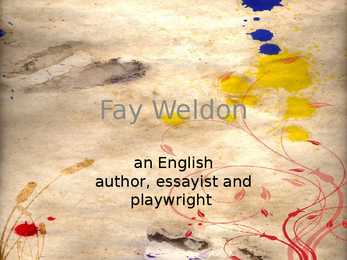
Work § In 1967, she published her first novel "The Fat Woman's Joke". § For the next 30 years she built a very successful career, publishing over twenty novels, collections of short stories, films for television, newspaper and magazine articles and becoming a well-known face and voice on the BBC. § In 1971 Weldon wrote the first episode of the landmark television series Upstairs, Downstairs, for which she won a Writers Guild award for Best British TV Series Script. § In 1980 Weldon wrote the screenplay for director/producer John Goldschmidt's television movie "Life for Christine" which told the true story of a 15 year old girl's life imprisonment. The film was shown in prime-time on the ITV Network by Granada Television. § She also wrote the screenplay for the 1980 BBC miniseries adaptation of Jane Austen's Pride and Prejudice starring Elizabeth Garvie and David Rintoul. §
The making of a new nation. The Enlightenment in America. The emergence of the notion of the American Dream. The great Enlighteners: Crèvecoeur, Jefferson, Paine, Franklin. The American Enlightenment is the intellectual thriving period in the United States in the midtolate 18th century (17151789), especially as it relates to American Revolution on the one hand and the European Enlightenment on the other. Influenced by the scientific revolution of the 17th century and the humanist period during the Renaissance, the Enlightenment took scientific reasoning and applied it to human nature, society, and religion. American Enlightenment a gradual but powerful awakening that established the ideals of democracy, liberty, and religious tolerance in the people of America.
[4] Prince Albert replaced Melbourne as the dominant male influence in Victoria's life. She was thoroughly devoted to him, and completely submitted to his will. [5] Victoria did nothing without her husband's approval. His interests in art, science and industry spurred him to organize the Crystal Palace Exhibition in 1851, a highly profitable industrial convention. [6] Her marriage to Prince Albert brought nine children between 1840 and 1857. Most of her children married into other Royal families of Europe. [7] On December 14th 1861 Albert died from typhoid fever at Windsor Castle. Victoria remained in self-imposed seclusion for ten years. This genuine, but obsessive mourning kept her occupied for the rest of her life and played an important role in the evolution of what would become the Victorian mentality. [6] She had lost a devoted husband and her principal trusted adviser in affairs of state. For the rest of her reign she wore black. Widowhood
principal about Elizabeth's embezzlement scheme, but he dismisses her claims as groundless. Elizabeth later learns that the teacher of the class with the highest state test scores will receive a $5,700 bonus. With this knowledge, Elizabeth decides to change her style of teaching, forcing the class to study intensely for the upcoming test. However, the change is not enough and the students have low scores on their quizzes, frustrating her even more. Meanwhile, she befriends Russell the gym teacher as Amy and Scott start dating. Elizabeth steals the state test answers by impersonating a journalist and seducing Carl Halabi (Thomas Lennon), who is in charge of the exam. Elizabeth drugs Carl in his office, and steals the test. A month later, Elizabeth wins the bonus and pays for the appointment to get her breasts enlarged. When Elizabeth learns that Amy and Scott are chaperoning an upcoming field trip, she taints
Chapter 21 Chapter 42 Chapter 1 It is a truth universally acknowledged, that a single man in possession of a good fortune, must be in want of a wife. However little known the feelings or views of such a man may be on his first entering a neighbourhood, this truth is so well fixed in the minds of the surrounding families, that he is considered the rightful property of some one or other of their daughters. "My dear Mr. Bennet," said his lady to him one day, "have you heard that Netherfield Park is let at last?" Mr. Bennet replied that he had not. "But it is," returned she; "for Mrs. Long has just been here, and she told me all about it." Mr. Bennet made no answer. "Do you not want to know who has taken it?" cried his wife impatiently. "You want to tell me, and I have no objection to hearing it." This was invitation enough. "Why, my dear, you must know, Mrs
The couple leave for Europe - leaving behind Anna's son Seryozha - without obtaining a divorce. Much more straightforward is Stiva's matchmaking with Levin: a meeting he arranges between Levin and Kitty results in their reconciliation and betrothal. Part 5 Levin and Kitty marry and immediately go to start their new life together on Levin's country estate. The couple are happy but do not have a very smooth start to their married life and take some time to get used to each other. Levin feels some dissatisfaction at the amount of time Kitty wants to spend with him and is slightly scornful of her preoccupation with domestic matters, which he feels are too prosaic and not compatible with his romantic ideas of love. A few months later, Levin learns that his brother Nikolai is dying of consumption. Levin wants to go to him, and is initially angry and put out that Kitty wishes to accompany him
His modest background and upbringing are crucial to his development as a writer. Chekhov always felt that he missed out on childhood. It was a very hard lifeand it may have contributed to his poor health: he succumbed later on to the"family disease", tuberculosis, which led to his early death at the age of 44.His mother was a quiet, gentle soul who was full of stories of her early life. In later years, Chekhov would say that "we inherited our talent from our father,but mother gave us soul". The other great passion of his formative years was nature, the Russiancountryside. As a port, Taganrog was surrounded on all sides by the landscapes of the Steppe and Chekhov's earliest stories reveal how intensely aware he was of his bond with the Don Steppe. Chekhov had always claimed that medicine was his wife and literature his mistress. Chekhov had lived for much of his career as a writer under the shadow of the great literary colossus of the age, Lev Tolstoy.
The Moving Finger Agatha Christie Plot summary: Brother and sister Jerry and Joanna Burton bought a country house in an idyllic English town called Lymstock so that Jerry could recover from injuries received in a wartime plane crash. They had been living in London their whole life and thus were excited but intimidated to go. Lymstock was much like any other English village, no more than 300 people. Those that live there enjoy the peace of rural life and form a union to where it can be difficult for strangers to blend in. Fortunately, it wasn't much of a problem for Jerry and Joanna. They were just getting to know the town's strange members and their characters when an anonymous letter arrived, accusing the two of not being brother and sister, but lovers. The letter
that the Church of England was beyond reform. Escaping persecution from church leadership and the King, they came to America. Of Plymouth Plantation Of Plymouth Plantation is the single most complete authority for the story of the Pilgrims and the early years of the Colony they founded. Written between 1620 and 1647, the journal describes the story of the Pilgrims from 1608, when they settled in the Netherlands, through the 1620 Mayflower voyage, until the year 1647. The book ends with a list, written in 1650, of Mayflower passengers and what happened to them. The Age of Reason The Age of Reason: Being an Investigation of True and Fabulous Theology , a deistic treatise written by eighteenth-century British radical and American revolutionary Thomas Paine, critiques institutionalized religion and challenges the inerrancy of the Bible. Published in
Yes, so it is, but, I do have a certain reason. Do you remember Sir Thom of the Minquettes'? That fine young man with fascinating blue eyes... Oh, my sweet Mary, you will never guess what happened yesterday! It was about seven o'clock in the evening when Lillian called me out for a walk you know I can't say `no' to my little sis. Anyway we went to the forest near the Swan Lake and, believe it or not, got lost! Awful! I was so scared... We walked and walked, not even knowing the direction we were heading to, until we reached a huge mansion. And the garden around it was so extraordinary... That is something you just must see! But neither the trees nor flowers could be as wonderful as the owner himself! Sir Thom treated us tea and sandwiches, not forgetting to show us way back to the village. He was so kind, don't you think? In the end, when we had nearly reached our home, he suddenly stopped and called us to a ball! Can you imagine?! A ball with Sir Thom
we today call book printing. The first book was printed between 1444 and 1446, so these years can be considered as the beginning years of book printing. His most important preserved printings are the 40 copies of the Bible. By the end of the 15 th century there were about 1000 print-shops in Europe already. The oldest Estonian book dates back to 1535. Libraries form a vital part of education. They make available-through books, films, recordings and other media- knowledge that has been accumulated through the ages. People in all walks of life use libraries to get information for their work. Libraries also play an important role in preserving people's cultural heritage. For example, some libraries have rare books, authors' and composers' manuscripts or works by artists. Today's libraries differ very much from the ones from the past - not only in the contents and services, but also in physical layout and atmosphere. Library derives
_____________________________________ 2 What time do you go/are you going to bed at weekends? _____________________________________ 3 This Girlzone CD is belonging/belongs to Alan. _____________________________________ 4 I understand/am understanding English, but not Spanish. _____________________________________ 5 Why does she run/is she running? Because she's late for work. __________________________________ 6 She doesn't enjoy/is not enjoying the film. _____________________________________ 7 This milk is tasting/tastes horrible. _____________________________________ 8 The Spice Girls are making/make a new CD at the moment. _____________________________________ 9 I am thinking/think it's a good idea for you to study biology. _____________________________________ 10 We want to go for a walk but it's raining/it rains outside. _____________________________________
Taken at the Flood "There is a Tide" redirects here. "There is a Tide" is also the name of a short story by Larry Niven, set in the Known Space universe. Taken at the Flood is a work of detective fiction by British writer Agatha Christie, first published in the US by Dodd, Mead and Company in March 1948 under the title of There is a Tide...[1] and in the UK by the Collins Crime Club in the November of the same year under Christie's original title.[2] The US edition retailed at $2.50[1] and the UK edition at eight shillings and sixpence (8/6).[2] It features her famous Belgian detective, Hercule Poirot, and is set in 1946. 1 Plot summary In a flashback from late Spring to early Spring, Lynn Marchmont, newly demobilised from the Women's Royal Naval Service, finds difficulty settling into the village life of Warmsley Vale. She is engaged to Rowley, one of several members of the Cloade family living nearby
perceptions and intuitions. Many contemporary readers were shocked by his celebration of the body and the theme of love between man and man which led to rumours about his homosexuality. Whitman was a highly experimental poet who believed that poetry should not be bound by rules and restrictions. He tended to avoid the use of metaphors or similes and his poetry is often strongly declarative and non-figurative. The poetry of Whitman's contemporary, Emily Dickinson (1830-1886), was even more strikingly original. Born in New England, Dickinson spent most of her life in quiet isolation detached from events of her time. Her poems are extremely personal and intimate. Recurring themes include nature and death and, although she had rejected orthodox religion, much of her work contains a strong sense of spirituality. Many of her poems, however, are ironic and witty suggesting that their creator was a woman of great humour
It was believed that a witch often joined a pact with the devil to gain powers to deal with infertility, immense fear for her children's well-being, or revenge against a lover. The long-term result of amalgamation of distinct types of magic-worker into one is the considerable present-day confusion as to what witches actually did, whether they harmed or healed, what role they had in the community, whether they can be identified with the "witches" of other cultures and even whether they existed as anything other than a projection. Present-day beliefs about the witches of history attribute to them elements of the folklore witch, the charmer, the cunning man or wise woman, the diviner and the astrologer. Powers typically attributed to European witches include turning food poisonous or inedible, flying on broomsticks or pitchforks, casting spells, cursing people, making livestock ill and crops fail, and creating fear and local chaos.
extramarital relations recently. But, it's really hard to find something that good, and really easy to lose it. Just consider pro and con, and then keep what you really love. However, distance makes everything clearer; you can only see the whole when you are far enough. Take Alex for an example, as she had travelled ever further outwards, she found the answer. The Nature of Truth: Annie was a successful author and she met an old friend, Jane, on the train. Things change a lot, even if you had settled down. Jane had the boyfriend in collage and they soon got married after graduated. At first, they had a happy life, but one year later, Jane's husband had extramarital relations and divorced with Jane. In a summary, what will life be in the future? Future is not to see. Just the facts: Reporter was Lisa's first job and now she was going to write an article about Gary who killed a judgment in town and Gary was sentenced to death. However, Gary said he didn't kill that man
Because of that he died.( 9 June1870) Oliver Twist (1837-39), Nicholas Nickleby (1838-39), The Old Curiosity Shop and, Barnaby Rudge: A Tale of the Riots of 'Eighty as part of the Master Humphrey's Clock series (1840- 41), A Christmas Carol written in 1843. Hard Times- For These Times. is a novel by Charles Dickens, first published in 1854. The book is a state-of-the-nation novel, which aimed to highlight the social and economic pressures that some people were experiencing. Unlike other such writings at the time, the novel is unusual in that it is not set in London. A Christmas Carol in Prose, Being a Ghost Story of Christmas (commonly known as A Christmas Carol) is a novella by Charles Dickens first published on December 19, 1843 with illustrations by John Leech. The story was an instant success, selling over six thousand copies in one week, and the tale has become one of the most popular and enduring Christmas stories of all time.
brother Prince Harry and, two years later, earned his wings by completing pilot training at Royal Air Force College Cranwell. In 2009, the Prince transferred to the Royal Air Force and was promoted to flight lieutenant. PRINCE HARRY Diana's second son, Prince Harry is third in the line of succession to the thrones of 16 independent Commonwealth realms. After an education at various schools around the United Kingdom and spending parts of his gap year in Australia and Lesotho, Harry avoided a university education to join the military. He was commissioned as a second lieutenant and completed his training as a tank commander. He served for 77 days on the front line in the Afghan War, although he was pulled out after an American website revealed his presence there. CHARITY WORK Diana became increasingly associated with numerous charities. As Princess of Wales she was expected to visit hospitals, schools, etc.
"You Belong To Me" by Mary Higgins Clark This book was written by Mary Higgins Clark in the year 1998. In the Asian Age was written about this book "Clark keeps you reading...very engaging" and the Daily Mirror wrote "Clark plays out her story like a pro that she is...flawless". About Mary Higgins Clark Mary Theresa Eleanor Higgins Clark Conheeney is born in December 24th in the year 1927 in the Bronx, New York. She has wrote twenty-four books and each and every one of them has been a bestseller in the United States and various European countries
Anne. of England to survive infancy born in King Henry VIII had desperately wanted a wedlock; her mother was Henry's second legitimate son, to ensure the Tudor wife, Anne Boleyn. succession. Anne had been crowned with St. Edward's crown, unlike any other queen consort, while carrying Elizabeth. Historian Alice Hunt has suggested that this was done because Anne's pregnancy was visible at the moment of coronation and she was carrying an heir who was presumed to be male. Elizabeth was baptised on 10 September in a ceremony held at Greenwich On 2 May 1536, she was arrested and Palace. Archbishop Thomas Cranmer, imprisoned. Hastily convicted on charges
Ameerika Kirjandus 30.01.13 Naturalism · France, Emile Zola · Put down his theory in 1879: Le Roman Experimental, attempt to explain the development of human society throuch biological laws · Outlook is deterministic, pessimistic, fatalistic (fate or biology) · Man as an animal-clever than other beasts, still explainable within the framework · Man is not a free agent, is govern by something · Unable to determine his own faith · Hereditary · Naturalists tried to apply in fiction the processes of natural sciences · Writers task is to record facts, systems of behaviour, living conditions, never revealing any natural unbiased (completely natural) · Point of view: amoral-outside the category of morality, neither good or bad
During this period a new class called bourgeoeisie came into being. This is the period when monarchies based on nationality were estabilished. The Renaessance started in Italy In the 14th century. Then it spread all over Europe, reached England in 16th century. The struggle for power culminated in a war called The War of Roses. It was a civil war between two dynasties, families. They had different emblems on one side the Yorks (white rose) other Lancasters (red). They couldn't decide who gets the throne. War ended 1485. A new dynasty came to throne, Tudor, the first king in this dynasty was Henry Vll. When he came to throne a period of stability followed because he built a nation based state. He was good at diplomacy.He could avoid quarrels and wars with neigbouring countries. France, Spain - greatest enemies.So he could save much money and thus laid a good economic basis for his state. Besides that he built a
She just had to enjoy it. In the sixth letter he tells her to go to the lighthouse. Near the lighthouse swim dolphins and Holly liked them very much. In the seventh letter he tells her to find a job that she really enjoys. Holly hated her previous jobs. The eight letter says that she should plant sunflowers, to brighten the dark October days. Also there was an extra letter for his friend John. It was a birthday wish. The ninth letter says that she should go to the ball that they attend every year. The last letter tells her not to be afraid of falling in love again. Every letter ended with the same sentence: "P.S. I love you..." Even if she didn't like all the plans he had for her, she followed through and did them all. During the experience she meets up with Daniel. Daniels girlfriend had been unfaithful and he was alone. Together they became close and Daniel fell in love with Holly. But because Holly wasn't ready for it she started ignoring Daniel
5 (possible answers) she was my age and apart from the 1 1 go ahead 5 come to eighties hairstyle we're the spitting 1 Well, you will go to bed late every night. 2 fall through 6 bring about image of each other! Some people 2 Well, you will refuse to wear a 3 tip off 7 go down with say that they can see a strong family coat. 4 mistake for 8 come up with resemblance between my dad and me.
Jennifer Lopez Jennifer Lynn Lopez (born July 24, 1969) is an American actress, dancer, entrepreneur and recording artist. Widely recognized as being the definition of America's sweetheart, Lopez has been cited as being the most influential Hispanic performer in the United States. She is one of the highest paid actresses in Hollywood and is the highest paid actor of Latin descent, making up to US$15 million per film role. Lopez has sold over 11.8 million albums in the United States and over 70 million records worldwide.[1][2] She became interested in pursuing a career in the entertainment industry following her small role in the 1986 film My Little Girl, to the dismay of her Puerto Rican parents, who believed that it was an unrealistic career route for a Latino. Following her move from The Bronx to Manhattan, Lopez performed in regional stage productions, before touring with musicals in Europe and Japan
She never attended school. Dame Agatha Christie was an English crime writer of novels, short stories and plays. She also wrote romances under the name Mary Westmacott, but is best remembered for her 80 detective novels and her successful West End theatre plays. On the Christmas Eve in 1914, Agatha married an aviator, Archibald Christie. their daughter, Rosalind, was born in 1919. On discovering extramarital affair, she divorced him in 1928. In the same year Christie's beloved mother died. During World War I she worked in a Red Cross Hospital in Torquayas a hospital dispenser, which gave her a knowledge of poisons. It was to be useful when she started writing mysteries. Christie's first detective novel, The Mysterious Affair at Styles, introduced Hercule Poirot, the Belgian detective, who appeared in more than 40 books, the last of which was CURTAIN (1975). The Christies bought a house and named it 'Styles' after the first novel
Card's writing career began primarily as a poet, studying at Brigham Young University. During his studies as a theatre major, he began "doctoring" scripts, adapting fiction for theatre production, and finally writing his own one-act and full-length plays. Later he has worked both as a freelancer and a contracted writer. He first wrote the short story "Ender's Game" while working at the BYU press. Ender's Game and its sequel Speaker for the Dead were both awarded the Hugo Award and the Nebula Award, making Card the only author (as of 2008) to win both of science fiction's top prizes in consecutive years. Card continued the series with seven books, which divide into "Shadow" and "Speaker" series. He has also announced his plan to write two more novels: Shadows in Flight, a book that connects the "Shadow" series and "Speaker" series together, and Ender in Exile, a book that takes place after Ender's game and before Speaker for the Dead.
The woman, without a word of who she was, died and left her new born boy, Oliver, to the drunken nurse that stood by. Chapter2: The State gave Oliver to Mrs. Mann who housed a number of orphaned children. Mrs. Mann took a large portion of the money given to her by the authorities for each child's food so Oliver grew up small and malnourished. On his ninth birthday, the town beadle, Mr. Bumble, came to collect Oliver and take him to the board for an interview. They told him he was to live with other wards of the state to become educated and learn a trade. Oliver did not mind this, but soon after he arrived, the state decided to implement a plan that would save money by feeding the people very little. After a time on this diet, the boys at the table chose Oliver to go ask the head cook for more gruel. Oliver did this, and was taken away. A flyer was then posted that said the state would give five pounds for someone to take young Oliver off their hands.
vivacious woman about whom a future Viceroy of India would say, "Dullness and Mrs. Kipling cannot exist in the same room."[3] Father - John Lockwood Kipling. Lockwood Kipling, a sculptor, an illustrator, museum curator and pottery designer, was the principal and professor of architectural sculpture at the newly- founded Sir Jamsetjee Jeejeebhoy School of Art and Industry in Bombay. Later in life Kipling illustrated many of Rudyard Kipling's books, and other works. Kipling also remained editor of the Journal of Indian Art and Industry, which carried drawing works from the students of the Mayo School. COUPLE named their son after the place they had first met Rudyard Lake. Alice Kipling Fleming - Sister of British author Rudyard Kipling who became a well-known psychic, producing automatic writing under the name "Mrs. Holland." Born June 11, 1868, Alice Kipling was privately educated
(NOT The majority of these people is very poor.) 23. Use too much/many before (adjective +) noun; use too before an adjective with no noun. There's too much noise. I bought too much red paint. Those shoes are too expensive. (NOT Those shoes are too much expensive.) 24. Use that, not what, after all. I've told you all that I know. (NOT I've told you all what I know.) He gave her all that he had. 25. Don't say according to me to give your opinion. I think it's a good film. (NOT According to me, it's a good film.) In my opinion, you're making a serious mistake. (NOT According to me, you're making a serious mistake.) 26. Don't ask about possibilities with May you ...? etc. Do you think you'll go camping this summer? (NOT May you go camping this summer?) Is Joan likely to be here tomorrow? (NOT May Joan be here tomorrow?) or more details, see Practical English Usage 3rd Edition page 339. 27. Use who, not which, for people in relative structures.
 annaabi.ee