Leidsid 33 sarnast õppematerjali, mis on seotud failiga "Kuuba". Need materjalid aitavad sul teemat sügavamalt mõista.
cuba, power, year, republic, government, assembly, years, supreme, court, introduction, party, leading, force, first, secretary, president, raul, castro, february, duties, five, parliament, body, council, recent, january, highest, judicial, branch, courtsRUNNING HEAD: RUSSIA Russia Throughout the History U.S Government Table of Contents 1. Introduction 2. History of Russia 3. Russia nowadays 4. Important people in Russia throughout the history 5. Conclusion 6. References Introduction- Russia Throughout the History Russia is a one of the biggest countries is the world. The first clues about Russian history are from as early as the 9th century. Russia has suffered through rough times in war, mad leaders and tough life amongst the locals
1. UN as a world organization The United Nations officially came into existence on 24 October 1945, when the UN Charter had been ratified by a majority of the original 51 Member States. The day is now celebrated each year around the world as United Nations Day. The purpose of the United Nations is to bring all nations of the world together to work for peace and development, based on the principles of justice, human dignity and the well-being of all people. It affords the opportunity for countries to balance global interdependence and national interests when addressing international problems. There are currently 192 Members of the United Nations. The Aims of the United Nations:
Kerli Uue 10.r The Republic of Estonia Estonia is a democratic parliamentary republic divided into 15 counties. The capital and largest city is Tallinn. Estonia's neighbours are Latvia, Russia and Finland. The parliment is named ,,The Riigikogu." The Estonian parliament has 101 members and influences the governing of the state primarily by determining the income and the expenses of the state. The Riigikogu elects and appoints several high officials of the state, including the President of the Republic. The Parliament of Estonia is elected by people for a four year term
Community (ECSC). 1957 Treaties of Rome establish the European Economic Community (EEC) and the European Atomic Energy Community (Euratom). 1959 July, seven countries of the Organisation for European Economic Co- operation (OEEC) – Austria, Denmark, Norway, Portugal, Sweden, Switzerland and the UK – decide to establish a European Free Trade Association (EFTA). 1960 Creation of European Free Trade Association 1961 UK applies to join the Community. 1962 The Parliamentary Assembly changes its name to the European Parliament. 1965 The Treaty merging the executives of the three Communities (ECSC, EEC, Euratom) is signed in Brussels; enters into force on July 1, 1967. Empty chair crisis 1966 Luxembourg compromise – solution for the empty chair crisis: weaker commission, veto power, common argiculture policy, qualified majority voting 1967 UK re-applies to join the Community. 1968 Agreement of EEC’s common external tarif 1972
Estonian state system The Resolution of the National Independence of Estonia was adopted on August 20, 1991. The Constitution of Estonia is the fundamental law of the Republic of Estonia and it was adopted in June 1992. Estonia is a Democratic Parliamentary Republic where the supreme power is vested in the people. The head of State of Estonia is the President of the Republic who can be elected for two five-year terms. The Legislature. The Parliament of Estonia is called Riigikogu and it is elected by people for a four year term. The election is universal, uniform and direct. Voting is secret. The Riigikogu is comprised of one hundred and one members. The Riigikogu has three main functions: legislation, reviewing the activities of the executive power, representation. The members of the Riigikogu have the rights to form factions. The Executive.
and Northern Ireland and of Her other Realms and Territories Queen, Head of the Commonwealth, Defender of the Faith. 2. The Queen’s working day. Starts after breakfast. Reads the newspapers which are prepared by the Press Secretary, and a report on the previous day’s proceedings in the Parliament and the letters she receives. Also phone calls. Once a month she attends the Privy Council in order to give Royal Assent to various items of government legislation. Discusses domestic matters with the Master of the Household. Towards the end of the day, there is always another pile of official papers and reports waiting to be read or acted upon. The business on constitutional monarchy never ends. 3. Who is the present heir to the throne? Speak about his education. Who are the 2nd and 3rd in line? Present heir is Prince Charles, The Prince of Wales. Has been an exchange student in Australia
11.02.09 INGLISE KEEL Palju aega läheb. 10 nädalat aint. One of the ESP courses. What we are going to do, what is needed: · What we do - 1 test, on words. · 2 Essays, that means that we have to look into academic writing · Homereading we read a case from European Court of Justice thingy. · Oral thing. · 90% you have to attend · Have to prepare for class and take part of it etc What we learn: Terms Expressions / collocations (nt obey/abide by the law) Explaining AWOL absence without a leave Legal English can be divided into 3 levels. We learn the first one, which is needed for the other two! You have to know the vocabulary etc. Second level has to do with legal contracts..
United States of America Table of Contents 1. Facts 2. Geography 3. Nature 4. History 5. Population 6. Government 7. Industry, economy 8. America's pop culture Facts Official Name: United States of America Capital City: Washington, D.C. Largest city: New York City Official languages: None at federal level National language: English Government: Federal constitutional republic President: Barack Obama ( Barack Hussein Obama II) Vice President: Joe Biden (Joseph Robinette "Joe" Biden, Jr) Population: 2009 estimate 306,108,000 people
I Native Americans · Origin of Native Americans Origin is debatable Siberia->Alaska Crossed the land bridge around 14,000 years ago "ice-free corridor" Hunters, searching for fresh grounds · Different tribes and their way of life In tents, dark skin, hair is long, black and straight, women-agriculture, men- hunting. bands(chief. Travelled together) and tribes land was owned by the tribe that occupied it. 200 different tribes Apache- "enemy"- hunted buffalos, oil and natural gas from their land Cherokee- largest tribe Cheyenne- from Minnesota and S & N Dakota. High system of laws Northwest Ordinance of 1787
Tallinn English College Topic Estonia Tallinn 2008 1. Introduction Estonia is a small country about the size of Switzerland, or New Hampshire and Massachussetts combined. Estonia is named after the people called "Ests" who lived in the region in the 1 st century AD. The Republic of Estonia is one of the three countries commonly known as the "Baltic States". The other Baltic States are Latvia and Lithuania. 2. Geographical position Estonia is situated in northeastern Europe. Estonia is bounded on the north by the Gulf of Finland, on the east by Russia, on the south by Latvia and on the west by the Baltic Sea. In the north it borders on Finland. The coastline of the Baltic Sea in Estonia is characterized by numerous gulfs and bays, the biggest of them
The modern name of Estonia is thought to originate from the Roman historian Tacitus, who in his book Germania (ca. AD 98) described a people called the Aestii. Similarly, ancient Scandinavian sagas refer to a land called Eistland, close to the German term Estland for the country. Early Latin and other ancient versions of the name are Estia and Hestia. Until the late 1930s, the name was often written as Esthonia in most English speaking countries. Estonia is a democratic parliamentary republic and is divided into fifteen counties. The capital and largest city is Tallinn. With a population of only 1.4 million, it is one of the least-populous members of the European Union. Estonia was a member of the League of Nations from 22 September 1921, has been a member of the United Nations since 17 September 1991, of the European Union since 1 May 2004 and of NATO since 29 March 2004 Estonia has also signed the Kyoto protocol. Economy
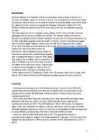
lions were first used as Estonia's heraldic emblem in the 13th century, a similar motif was later used on the coat of arms of the Province of Estonia under Swedish rule. Estonia changed hands but the three lions remained, in 1925 they were adopted officially. The present coat of arms is a golden shield charged with three blue lions with golden oak branch on each side. Ministers: * Andrus Ansip Peaminister represents the government to approve the state budget, represents Estonia in the European Council, directs the activity of the government *Tõnis Lukas - Haridus- ja teadusminister sets aims for the development of vocational education and training in Estonia, guarantees the expedient and effective development and education *Rein Lang Justiitsminister decreases and prevents corruption in private and public sector, plans to carry out a legal and criminal policy of the state
Otto was his third child. Hans was a very good father, because first education got Otto by father. In 1886, he went to the municipal school of Rakvere and in 1888 to Emperor Alexander State High School in Tallinn, later High School in Saint Petersburg. In 1896, he graduated as an extern in the Estonian Governorate High School of Tallinn. In 1907, Otto married to Lydia Hindrikson. Their first two childrens, daughter Hella and son Hans died early. Daughter was 4 and son was 3 years old, but their second daughter Lydia died in 1966 after the war. Lydia Hindrikson died on 29 July 1934. Otto worked as a lawyer in Tallinn and Narva, he got a lot of population and he was therefore elected to a member of Tallinn city council from 1904 to 1905. He was also active in Estonian national organizations and became and activist on self-government reform. In 1905 Revolution, Otto was forced to flee abroad and then he lived in many European countries, like Switzerland
states and where the laws of member states provide for lesser rights European Union law can be enforced by the courts of member states. European Union institutions The European Union is governed by seven(7) institutions. Article 13 of the Treaty on European Union lists them in the following order: 1) the European Parliament 2) the European Council 3) the Council of the European Union (simply called "Council") 4) the European Commission 5) the Court of Justice of the European Union 6) the European Central Bank 7) the Court of Auditors Most EU institutions were created with the establishment of the European Coal and Steel Community (ECSC) in the 1950s. Much change since then has been in the context the shifting of the power balance away from the Council and towards the Parliament. The European Parliament The European Parliament (EU Parliament or the EP) is the directly elected parliamentary institution of the European Union
Estonia. Estonia, officially the Republic of Estonia is a country in Northern Europe. It is the smallest of the three Baltic countries. Estonia has land borders with Latvia (339 km) to the south and Russia (229 km) to the east. It is separated from Finland in the north by the narrow Gulf of Finland and from Sweden in the west by the Baltic Sea. Estonia has been a member of the European Union since May 1, 2004 and of the NATO since March 29, 2004. The area of Estonia is about 45000 square kilometres and the population is
I. Portugal ABOUT Photo Location of Portugal (dark green) Portugal (Portuguese: Portugal, IPA: [putua]; officially the Portuguese Republic, Portuguese: República Portuguesa) is a country located in Southwestern Europe, on the Iberian Peninsula. It is the westernmost country of mainland Europe, and is bordered by the Atlantic Ocean to the west and south and by Spain to the north and east. The Atlantic
Tallinna Inglise Kolledz Estonia Topic Alice Tärk, 9b Tallinn 2007 FACTFILE Area: 45 228 sq km Poplulation: under 1.4 million Capital: Tallinn Language: Estonian Currency: Eesti kroon (EEK) Main religion: Lutheran National holiday: 24 February (anniversary of the republic) National flower: Cornflower National bird: Barn Swallow National stone: Limestone LOCATION The Republic of Estonia is the northernmost and smallest of the three Baltic States. It is located on the eastern shores of the Baltic Sea in the north east of Europe. To the east the country borders Russia. Latvia is the countries neighbour to the south. From the west the coast of Estonia is washed by the Baltic Sea and from the north by the Gulf of Finland. The length of the coastline is approximately 3 800 km. The longest distance from east to west is
Established church The Church of England is the established church, which means that: 1.)the Monarch is the Supreme Governor of the church, 2.)the Church performs a number of official functions, 3.)Church and State are linked. To disestablish Disestablishmentarianism refers to campaigns to sever links between church and state, particularly in relation to the Church of England as an established church. It was initially a movement in the United Kingdom in the 18th century. The established churches in Wales and Ireland could not count on even nominal adherence by a majority of the population
The Great Famine (1845-52) killed roughly a million and prompted another million to emigrate. In 1890, 40 % of Irish people were living abroad "Exodus in reverse" has been used to describe Irish people returning to Ireland, especially from the US. Immigration from many countries, but mostly from Poland, the UK, Lithuania, Latvia, Nigeria and Romania. Is Ireland still an emigration country? No 7. What is the difference between the Irish Free State and the Republic of Ireland? All three names refer to the same country (Northern Ireland was part of the Irish Free State for one day, if you want to be really pedantic). The Irish Free State was established in 1922. It was part of the British Commonwealth, and a dominion of the UK, with which it shared a monarchy. Before this, all of Ireland was a part of the UK. In 1937, Irish voters backed a plebiscite which voided the Anglo-Irish Agreement (which created
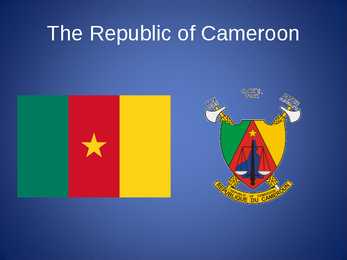
The Republic of Cameroon Cameroon · A unitary republic of central and western Africa · Bordered by Nigeria to the west; Chad to the northeast; the Central African Republic to the east; and Equatorial Guinea, Gabon, and the Republic of the Congo to the south. · Cameroon's coastline lies on the Bight of Bonny, part of the Gulf of Guinea and the Atlantic Ocean. · The country is called "Africa in miniature" for its geological and cultural diversity. History · The territory of present day Cameroon was first settled during the Neolithic · Portuguese sailors reached the coast in 1472 · The German Empire claimed the territory as the colony of Kamerun in 1884 and began a steady push inland.
Gaelic Alba. The use of the words Scots and Scotland to encompass all of what is now Scotland became common in the Late Middle Ages. History Repeated glaciations, which covered the entire land-mass of modern Scotland, have destroyed any traces of human habitation that may have existed before the Mesolithic period. It is believed that the first post-glacial groups of hunter-gatherers arrived in Scotland around 12,800 years ago, as the ice sheet retreated after the last glaciation. Groups of settlers began building the first known permanent houses on Scottish soil around 9,500 years ago, and the first villages around 6,000 years ago. The well-preserved village of Skara Brae on the Mainland of Orkney dates from this period. Neolithic habitation, burial and ritual sites are particularly common and well-preserved in the Northern Isles and Western Isles, where lack of trees led to most structures
established the relationships between Estonia, Livonia and the Russian Empire. The Baltic Landesstaat reached its full development. The freedom of action in the new provinces was naturally granted to one of the most firm ideological pillars of the tsarist empire -- the Russian orthodox church; though as the Landeskirche in the Estonian and Livonian territories, the Lutheran church long maintained a de facto predominance. The most important organ of Baltic German local government was the Diet, consisting of all the noble families who had been `selected' in a list of the eligible. Although jealously guarding their privileges, the knighthoods still never became entirely closed. Between sessions of a Diet, the legislative power of the knighthoods belonged to the Council of the Diet. The towns were governed by the Town Councils, which supplemented their ranks from among the representatives of merchants and lawyers. The citizens and the inhabitants of a
Sõnad/tõlked * U6 1. citizenship kodakondsus 2. state riik 3. lawful relationship- seaduslik suhe 4. determines mutual rights and obligations määrab vastastikused õigused ja kohustused 5. questions of citizenship are first of all regulated by kodakondsuse küsimused on eelkõige reguleeritud ... abil/kaudu/alusel 6. the Constitution of the Republic of Estonia EV PS 7. the Citizenship act kodakondusseadus 8. according to § 8 - § 8 alusel/järgi 9. right to õigus millelegi 10. shall be acquired by birth omandatakse sünniga 11. proceeds from the principle tuleneb ... printsiibist 12. any child found in Estonia iga Eestist leitud laps 13. at the request of the child's legal guardian lapse seadusliku esindaja/hooldaja nõudel/palvel 14
Tallinn English College Topic The United States of America Tallinn 2007 1. Introduction The United States of America's territory is over 3.7 million square miles (over 9.6 million km²) and population more than 300 million people. The capital city is Washington D.C. Although the United States has no official language at the federal level, English is the de facto national language. English is the most common language for daily interaction among both native and non-native speakers. Spanish is the second language. The largest city is the New York City. The
law. Descriptive law – describes the way people or natural phenomena behave, e. g. law of gravity Prescriptive law – prescribe how people ought to behave e.g. speed limits In all societies relations between people are regulated by prescriptive law; customs (informal rules of social and moral behaviour); rules we accept if we belong to a particular institution (religion, organization); laws imposed on people by a government Penalties for breaking the rules are different. For not following the customs there may not be a punishment, or a person may be criticized by the society; rules of a social institution tend to carry precise penalties but they are not enforceable by any political authority; however governments use a system of courts backed by the power of the police to enforce the laws they have made. The relations between people are regulated by a combination of all these rules.
SOCIETY AND CULTURE OF ENGLISH-SPEAKING COUNTRIES Introduction 1. Nowadays, English is so widely spoken that it can hardly be considered "a one nation's" language. The main countries where English is spoken are: the U.K, the U.S, Canada, Australia, the Republic of Ireland, New Zealand, West Indies 2. There are approx. 300-400 million speakers of English in the world. English occupies the 3rd place by its number of speakers; it is right behind Mandarin and Spanish. 3. ESL (English as a Second Language) used in your own country (e.g. India) EFL (English as a Foreign Language) used in a foreign country ESP (English for Specific Purposes) used in business, airlines, hotels etc. 4
The EU institutions Lecturer: Matti Kauppi Student: Viktoria Gratšjova Tallinn, 2014 The institutions of the European Union form a complex and unique polity and, in determining whether or not this structure and the law making powers granted to each respective institution are inherently undemocratic, it is vital to define what is meant by the term ‘democratic’. In his Gettysburg address Abraham Lincoln referred to a government which was ‘of the people, by the people, for the people’and it is by this criterion that democracy is often judged. These principles are reflected in having equal access to power and in being equal before the law. It must be considered not only whether law making powers are granted to elected persons, but also whether the balance of power between institutions within the European Union promotes the ideals of democracy.
February 24: Independence Day The Republic of Estonia was founded on February 24, 1918 when the Salvation Committee, Päästekomitee, declared the independence of the Republic of Estonia. This date was celebrated as the Day of Independence until the Soviet occupation of Estonia in 1940. During the Soviet occupation, the Independence Day was festively celebrated in Estonian communities around the world. Every year, the US Secretary of State sent greetings on the occasion to the Ambassador of the Republic of Estonia to the United States, Ernst Jaakson. On February 24, 1989, the red flag of Soviet Estonia was replaced by the blue-black-white Estonian national flag on Toompea and since that time the Independence Day has been celebrated as a public holiday again. This year Estonia will celebrate the 83rd anniversary of the declaration of the state independence. A Quest for Independence
Location U.S is located in North America, bordering both the North Atlantic Ocean and the North Pacific Ocean. United States neighbour countries are Canada and Mexico. The USA has the 8th longest coastline in the world at ~20 000 km. 62% of the perimeter of the USA is coastline. The USA's coastline is made up of beaches, cliffs, mangroves, and urban and developed areas, which make America very versatile country. Political division United States of America distributes into 50 states. The government power is limited by a dual system of government (federal government and individual state government). The federal government of the United States is the central United States governmental body. The federal government has three branches: the legislative, executive and judicial. Through a system of separation powers, all three branches have some authority over the others and are equal. Federal government was given the powers and responsibilities to deal, that face the problems of a whole
Finland judicial system Roadmap Finnish judicial system General courts Administrative courts Special courts Lay judges in Finland The Finnish judicial system consist of: ● Courts ● Prosecution service ● Enforcement authorities ● Prison and probation service ● Bar Association General courts 1.District Courts 2.Courts of Appeal 3.Supreme Court District court ( Finnish: käräjäoikeus) 27 district courts Criminal cases, civil cases and petitionary matters Chief Judge and District Judges Courts of Appeal 5 courts Chief Justice and Senior Justices Appointed by the president The Supreme Court Helsinki President and 18 justices Function is to rule on important points of law Gives advice to President and Ministry of Justice Administrative courts Regional Administrative Court 8 courts
The largest cities are Tallinn, Tartu, Narva, Pärnu. According to the information from tallinn.ee there are 439 517 people living in Tallinn of the 1th of January. In 2013 there where 621 300 people employed across all industry sectors. 26 500 of them were working in public sector, 187 900 in private sector and 407 000 in tertiary sector. The most important branches of Estonian industry are food, construction and electronic industries. For the last five years the rate of natural increase has been negative for Estonia and has been decreasing. In the last ten years only in 2010 there was a positive rate of natural increase. According to the 2014 statistics the rate of natural increase was -1933. There were 13 551 people born and 15 484 people died in 2014. ERLE MAIDO
prosecution (süüdistus) - the institution and carrying on of legal proceeding against a person injury (vigastus) - an act or event that causes someone/something no longer to be fully healthy claim (nõudeõigus) - to apply for compensation or to inherit something prison (vangla) - residence for incaretaking criminals majority (enamus) - greater amount of the group public opinion (avalik arvamus) - collective opinion of many people on same issue, problem etc. Seperation of Power (võimude lahusus) - division of responsibilites into distinct branches to limit any branch from excersising the core functions of another (legislative, executive, judicial) pressure group (surve gurpp) - an interest group that attempts to influence legislation, for example through propaganda dangerous driving (ohtlik sõitmine) - a way of driving that threats other's safety or life
British Parliament Structure and Functioning of the British Parliament today Britain is a parliamentary monarchy . The British Parliament is a bicameral parliament , that is to say that it is made up of two chambers, or two "Houses"; above the two Houses, but in an essentially formal role , there is the Sovereign - king or queen - also known as "the crown." Role of the Sovereign The British monarch has all authority, but no power. The Sovereign appoints the Prime Minister, and every year opens the sessions of parliament, in a historical and ritual ceremony called the State Opening of Parliament . Historically, this ceremony used to take place in the Autumn; but since 2012, it has been brought forward to May. This is the only regular time when the members of both Houses come together. During the ceremony, the Sovereign reads out the government's intended programme. The "Queen 's Speech" is a summary of the
 annaabi.ee