Leidsid 33 sarnast õppematerjali, mis on seotud failiga "Keskkonnaprobleemid". Need materjalid aitavad sul teemat sügavamalt mõista.
nafta, spill, marine, effect, effects, cause, sand, animal, juurdekasvu, animals, habitat, plant, metsakasutus, components, plants, other, physical, impact, clean, fish, coastal, such, areas, surface, affect, sertifikaat, kasutust, toxic, salt, caused, affected, live, ability, waters, resource, term, products, root, mangrove, protect, üleraie, reostusplastics and pharmaceuticals. Petroleum is used in manufacturing a wide variety of materials, and it is estimated that the world consumes about 88 million barrels each day. The use of fossil fuels such as petroleum can have a negative impact on Earth's biosphere, releasing pollutants and greenhouse gases into the air and damaging ecosystems through events such as oil spills. Concern over the depletion of the earth's finite reserves of oil, and the effect this would have on a society dependent on it, is a field known as peak oil. Etymology The word "petroleum" comes from Greek: πέτρα (petra) for rock and Greek: ἔλαιον (elaion) for oil. The term was found (in the spelling "petraoleum") in 10th-century Old English sources. It was used in the treatise De Natura Fossilium, published in 1546 by the German mineralogist Georg Bauer, also known as Georgius Agricola. In the 19th
Water pollution Attention for water pollution exploded in the 1980s. The oil spill of the Exxon Valdez showed many around the world just how horrible the effects of water pollution could be. However, even the Exxon Valdez spill barely touched the surface of the problem of water pollution. The ship spilt only 5% of the oil spilt that year, and oil is just one of many pollutants that people dump into the water every year. Every year, 14 billions pounds of sewage, sludge, and garbage are dumped into the world's oceans. 19 trillion gallons of waste also enter the water annually. The problem of ocean pollution affects every nation around the world. This is especially true
Learn more about converting energy units in the Units of Measurement section. NONRENEWABLE ENERGY Nonrenewable energy sources come out of the ground as liquids, gases and solids. Right now, crude oil (petroleum) is the only naturally liquid commercial fossil fuel. Natural gas and propane are normally gases, and coal is a solid. Coal, petroleum, natural gas, and propane are all considered fossil fuels because they formed from the buried remains of plants and animals that lived millions of years ago. Uranium ore, a solid, is mined and converted to a fuel. Uranium is not a fossil fuel. These energy sources are considered nonrenewable because they can not be replenished (made again) in a short period of time. Renewable energy sources can be replenished naturally in a short period of time. Picture 4.1. Non-renewable energy SIGNFICANT EVENTS IN THE HISTORY OF ENERGY BY FUEL Pre-1885
Norther Europe’s environment" by Britt Aniansson. Oceans and seas are polluted every day by different substances that reach the waters from different sources on land and at the sea. The author points out four main problems in the marine environment. One of the main problems is the chemical pollution which is caused by natural or man- made halogenated compounds, pesticides, dioxins, chlorinated organic materieals and so on. These compounds are causing deformage in marine animals and are storaged in their fatty tissues. They have also been found in organisms throughout the world oceans because they are dispersed quickly by winds and currents. Another problem that affects the marine life is excess phosphorus and nitrogen flow into the sea from towns, factories and other man-made sources which cause intense algae growth. Algal blooming consumes large amounts of dissolved oxygen and in areas with poorer water
Water pollution Water pollution is the contamination of water bodies such as lakes, rivers, oceans, and groundwater caused by human activities, which can be harmful to organisms and plants and for all of us. First, we have to talk about the causes of water pollution. Domestic households, industrial and agricultural practices produce wastewater that can cause pollution of many lakes and rivers. Industry is a huge source of water pollution, it produces pollutants that are extremely harmful to people and the environment. Dumping of litter in the sea can also cause huge problems. Different items take different lengths of time to degrade in water. Oceans are polluted by oil on a daily basis from oil spills, everyday shipping and dumping. Secondly, it is very significant to know about dangers of water pollution.
environmental problems make us vulnerable to disasters and tragedies, now and in the future. Unless we address the various issues seriously we are surely doomed for disaster. Current environmental problems require urgent attention. 1. Pollution: Pollution of air, water and soil require millions of years to recoup. Industry and motor vehicle exhaust are the number one pollutants. Heavy metals, nitrates and plastic are toxins responsible for pollution. While water pollution is caused by oil spill, acid rain, urban runoff; air pollution is caused by various gases and toxins released by industries and factories and burning of fossil fuels; soil pollution is majorly caused by industrial waste that deprives soil from essential nutrients. FIND OUT 5 WAYS HOW TO STOP POLLUTION. 2. Global Warming: Climate changes like global warming is the result of human practices like emission of Greenhouse gases. Global warming leads to rising temperatures of the oceans and the earth surface
with smaller turbines being used to provide electricity to isolated locations. Utility companies increasingly buy back surplus electricity produced by small domestic turbines. Wind energy as a power source is favoured by many environmentalists as an alternative to fossil fuels, as it is plentiful, renewable, widely distributed, clean, and produces lower greenhouse gas emissions, although the construction of wind farms is not universally welcomed due to their visual impact and other effects on the environment. The intermittency of wind seldom creates problems when using wind power to supply a low proportion of total demand. Where wind is to be used for a moderate fraction of demand, additional costs for compensation of intermittency are considered to be modest. Annual generation Annual Wind Power Generation (TWh) for Top 10 countries and their total electricity consumption(TWh 2005 2006 2007 2008
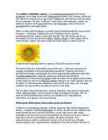
flowers grow in a mesmerizing pattern of two opposite spirals. This is most easily seen either before the disk flowers open up or after the seed has set and all the accessory flower parts have fallen off. This is one of the more interesting patterns in nature. The rough-hairy quality of the Common Sunflower is characteristic of many members of its family. These little bristles probably serve two functions: to discourage plant- eating animals and to conserve water in the plant by limiting evaporation. Members of the sunflower family are popular with butterflies because the wide flower head makes a good "landing platform" and the numerous individual flowers make for a high probability of finding nectar. Monarch butterflies are commonly seen nectaring on sunflowers during their fall migration. Whether as a source of food for people and wildlife or an eye-catching splash of color on
During the summer the sun shines almost 24 hours a day. Summer are usually warm. Average summer temperatures range from 3° to 16°C. TaigaTaiga is the Russian word for forest and is the largest biome in the world. It stretches over Eurasia and North America. The taiga is located near the top of the world, just below the tundra biome. The winters in the taiga are very cold with only snowfall. The summers are warm, rainy, and humid. Some of the animals in the taiga hibernate in the winter, some fly south if they can, while some just cooperate with the environment. GrasslandsGrassland biomes can be found in the middle latitudes. They can have either moist continental climates or dry subtropical climates. There are two different types of grasslands; tall-grass, which are humid and very wet, and short-grass, which are dry, with hotter summers and colder winters than the tall-grass prairie
emission of pollutants gasses such as sulfuric dioxide, when goal is burned in electric power stations, sulfur impurities form sulfur dioxide S + O2 SO2 · The gas is also produced when fuels obtained crude oil are burned. When sulfur dioxide is released into the air it reacts with water and oxygen to form sulfuric acid, which is strong it ionizes completely to hydrogen ions. H2SO4 2H + SO4-2 Effects pH range Effect 6.59 No effect 6.06.4 Unlikely to be harmful except when carbon dioxide levels are very high (1000 mg I 1) 5.05.9 Not especially harmful except when carbon dioxide levels are high (20 mg I 1) or ferric ions are present 4.54.9 Harmful to the eggs of salmon and trout species (salmonids) and to adult fish when levels of Ca 2, Na and Cl are low 4.04.4 Harmful to adult fish of many types which have not been progressively acclimated to low pH 3.53
The impact of water pollution on wildlife and their natural habitat can be immense. While it may seem like preventing water pollution can be an overwhelming subject to tackle, there are also a number of things that the average person can do to help stop water pollution. Tips on Preventing Water Pollution The best solution for water pollution is prevention. While pollution that has already occurred is a current threat to all life on Earth, attempts to clean it up may cause even more harm.There are several steps that can be taken to help prevent water pollution from getting worse. Keep Machinery in Good Working Order The oil used to lubricate engines in all types of machines needs to be changed regularly. When the oil is changed, it presents a number of environmental hazards if not disposed of properly. As oil moves throughout the crank case of an engine, it breaks down into many different types of carcinogenic and even mutagenic compounds
Maanteetransport 1 Teised liikuvad saasteallikad 0 Haiglajäätmete põlemine 0,5 Tööstusjäätmete põletamine 8 Why are dioxins a problem? Dioxins are widely encountered toxic substances. They are found in all environmental compartments, are persistent and, being fat soluble, they tend to accumulate in higher animals including humans. Their resistance to degradation and semivolatility means that they may be transported over long distances and give rise to transnational exchanges of pollutants. In addition, dioxins which were released into the environment many years ago are still contributing to current exposure. Even very small dioxin concentrations can cause negative effects on the environment and on human health, in particular on the most vulnerable groups like children
spills). ⦿ Ground Water Pollution – This becomes more relevant as it affects our drinking water. It become infected by toxic chemicals. ⦿ Microbial Pollution – Found in the countries who don’t have the facilities to cure the water so the bacteria and viruses grow in the water. The people have no other way of getting water so they are forced to drink it. WHAT CAUSES WATER POLLUTION? ⦿ Wastewater ⦿ Marine dumping ⦿ Industrian waste ⦿ Radioactive waste ⦿ Oli pollution ⦿ Underground storage ⦿ Global warming WHY IS IT A PROBLEM? ⦿ It causes worldwide disasters and deaths. ⦿ It may not damage our health immediately but can be harmful after long time. ⦿ Industrial waste often contains many toxic compounds that damage the health of animals who live in a water and those who eat them. ⦿ Microbial water pollution is a major problem in the developing
grown on the African oil palm tree. Oil palms are originally from Western Africa, but can flourish wherever heat and rainfall are abundant. Today, palm oil is grown throughout Africa, Asia, North America, and South America, with 85% of all palm oil globally produced and exported from Indonesia and Malaysia; but most of the time not using sustainable measures. The industry is linked to major issues such as deforestation, habitat degradation, climate change, animal cruelty and indigenous rights abuses in the countries where it is produced, as the land and forests must be cleared for the development of the oil palm plantations. According to the World Wildlife Fund, an area the equivalent size of 300 football fields of rainforest is cleared each hour to make way for palm oil production. This large-scale deforestation is pushing many species to extinction, and findings show that if nothing hanges, species like the
The ability to turn waste products into something which can be utilized is also rather convenient, especially in developing countries, where available resources may be limited. Furthermore, by turning biomass into biogas, people can address issues like sewage treatment, ensuring that raw sewage is not released into the natural environment. Producing process Biogas is normally produced by using the excreta of animals as the source material. In most of the countries where biogas is produced, the excreta of the cattle and other farm animals are used. In India gobar or cow dung is used for the purpose of making biogas. 20% of the excreta of animals are made up of dust particles that are inorganic in nature. The percentage of the inorganic dust particles is brought down by combining water with the excreta in a 1:1 ratio. The rate of feeding of any biogas
151,480 miles of coastline. Most of Canada's human population lives along its southern border. 3. Relief Canada's geography is very diverse. It has huge lakes, evergreen forests, prairies, meadows and beautiful mountains. There are thousands of miles of coastline with beaches, fjords and wild rivers flowing to the oceans. Canada is a country of wide open spaces and beautiful landscape where traveling visitors can unexpectedly bump into wild animals like bears or be struck by unusual sight like the scarecrows on the Cabot Trail. Canada is rich in natural wonders, one of them, the Niagara Falls between lakes Erie and Ontario, which is the second biggest waterfall in the world is one of the greatest attractions in the world. About twelve million tourists come to see the beauty of the falling waters on the border between the United States of America and Canada
I'd like to present the main issues of our planet and today i'll name 5 of them. These are air pollution, water pollution, endangered animals, deforestation and rubbish. Air pollution Firstly, lets talk about air pollution, which endangeres our life in cities and also the forests near by. Cars and factories blow poisoned gas in the air and it mixes with the oxygen, so the air that we breathe, becomes dangerous to our health. The ozone layer around the Earth, there is a special type of oxygen called ,,ozone"
Irene Allais Susan Brewer Cemagref, UMR Genial, Equipe Automat Food Science and Human Nutrition, & Qualite Alimentaire, 24 Av Landais, University of Illinois, USA. F-63172 Aubiere 1, France. E-mail: [email protected] E-mail: [email protected] Janice A. Callahan Keizo Arihara Food Technology and Safety Laboratory, Department of Animal Science, Kitasato Bldg 201, BARC-East, Beltsville, Maryland University, Towada-shi, Aomori 034-8628, 20705, USA. Japan. E-mail: [email protected] E-mail: [email protected] Marta Castro-Giráldez M. Concepción Aristoy Institute of Food Engineering for Department of Food Science, Instituto de Development, Universidad Politécnica de
Most of Canada's human population lives along its southern border. Geographical facts. Canada's geography is very diverse. It has huge lakes, evergreen forests, prairies, meadows and beautiful mountains. There are thousands of miles of coastline with beaches, fjords and wild rivers flowing to the oceans. Canada is a country of wide open spaces and beautiful landscape where traveling visitors can unexpectedly bump into wild animals like bears or be struck by unusual sight like the scarecrows on the Cabot Trail. Canada is rich in natural wonders, one of them, the Niagara Falls between lakes Erie and Ontario, which is the second biggest waterfall in the world is one of the greatest attractions in the world. About twelve million tourists come to see the beauty of the falling waters on the border between the United States of America and Canada.
Margit Tepner k0848752 policy incentives. So far, policy incentives have been key drivers of biofuels' production in Europe and the USA. Figure 4. Global bioethanol production projection (USDA, 2012). Bioethanol is mainly produced in Brazil and the USA. Biofuels production and its increase in the future is closely linked to the oil prices. A study (Timilsina, 2011) has found that 25% increase in oil price (from 2009 baseline figures) in 2020 would cause a 20,4% increase in global biofuel production. In turn, increasing oil prices would shift land away from food production as it becomes less profitable. Secondly, increasing oil prices would especially increase the food prices in countries, where its production is energy intensive. According to the International Energy Forum Report, the targets set by the European and US government won't be achieved, but biofuels production will still increase significantly. It is
service. 1973, American utilities buy 41 nuclear power plants. January, 1983 President Reagan signs the Nuclear Waste Policy Act. Hydro power was surpassed by nuclear power in total electrical generation in 1984. In the unit 4 reactor of the Chernobyl Nuclear plant were two explosions on April 26, 1986. This disaster exposed millions of people to radioactive isotopes. It has been linked many forms of cancer in natives of eastern Europe and Russia, as well as destroying animals and plants. December 1993, the total number of nuclear power plants in the United States is 109, collectively producing 610 billion kWhs of electricity. Nuclear power today Nuclear power is the world's largest source of emission-free energy. Nuclear power plants produce no controlled air pollutants, such as sulphur and particulates, or greenhouse gases. The use of nuclear power in place of other energy sources helps to keep the air clean, preserve the Earth's
Global Warming One of the biggest issues our planet and its inhabitants are facing nowadays is global warming. Global warming, also often referred to as the greenhouse effect, has not always been a problem. However, over the last centuries, since the Industrial Revolution things have changed. Polar regions are melting, species are dying, climate zones are shifting, migration patterns for animals such as polar bears and birds are being disrupted our world as we know it is changing. Some scientists believe that the climate will reach a tipping point, a point at which even a tiny additional increase would throw the system into violent change. We started doing harmful things and only now do we realize what we have done and what we are doing. At this current rate by the middle of next century the Earth's temperature may rise a predicted from 2 to 6 degrees Celsius
from the EU. The EU exported 105 billion of goods to Russia in 2008 and Russia exported 173,2 billion to the EU. 68.2% of Russian exports to the EU are accounted for by energy and fuel supplies. In 2010, imports from Russia are mainly energy and mineral fuels products (79.5%), some manufactured goods chemicals and raw materials. EU exports to Russia are diversified, covering nearly all categories of machinery and transport equipment (44.7%), manufactured goods, food and live animals. The biggest EU trade partners for Russia are Germany, Italy and France. Among the EU Member States, Germany (25.2 bn euro or 32% of EU exports) was by far the largest exporter to Russia in the first nine months of 2011, followed by Italy (6.9 bn or 9%), France (5.4 bn or 7%) and the Netherlands (5.1 bn or 6%). Germany (26.9 bn or 18% of EU imports) was also the largest importer, followed by the Netherlands (19.7 bn or 13%), Poland (13.1 bn or 9%), Italy (12.8 bn or 9%) and France (10
Solubility in water: 3.6 g/100 mL at 20°C Solubility in ethanol: perfectly Viscosity: 3.71 cP (3.71 mPa·s at 25 °C) pH: >7 log Pow: 0.90/0.98 Koc: 25,5 3. Kinetics and metabolism The substance can be absorbed into the body by inhalation, through the skin and by ingestion, also as a vapour. The mean lethal dose of aniline may be between 15 and 30 grams. In case of short-term exposure the substance is irritating to the eyes and the skin. The substance may cause effects on the blood, resulting in the formation of methaemoglobin. Exposure at high levels may result in death. Repeated or prolonged contact may cause skin sensitization. The substance may have effects on the blood, resulting in formation of methaemoglobin. Tends to accumulate in the body, especially in bladder. Often leads to bladder cancer. Aniline was tested on animals, but in mice was observed no increase in tumour incidence, in rats, it
in good condition. Clips which are broken or maintenance, but if the reading noted in doing so, and fit a new seal after missing can lead to chafing of the hoses, paragraph 5 is not as given in the adjustment is complete where required by pipes or wiring which could cause more Specifications first remove the tamperproof law. Do not break tamperproof seals on a serious problems in the future. plug, prising it free using a small screwdriver. vehicle which is still under warranty.
The coat of arms features a kangaroo and an emu (the national animals of Australia), golden wattle (the national floral emblem), a shield with the coats of arms of the six states of Australia and a star for all states and territories. Australia's national anthem is "Advance Australia Fair", which replaced "God Save The Queen" in 1984. the unofficial anthem is "Waltzing Matilda". As said before Australias national animals are kangaroos and emus. Often coalas are mentioned too, its floral emblem is the golden wattle and its national colours are the colours of its flag red, white and blue. Head of state Head of state is Queen Elizabeth II, who is queen of United Kingdom and also queen is Australia. In practice, Governor General performs her functions in queen's absence. Since 1989 Bill Hayden has been the Governor General Government
Protecting endangered species will make a difference in humans' life In the nature of humankind it is natural to hunt animals. However, nowadays hunting endangered species will make humans be just killers, because it is not necessary to kill something just to have a trophy on the wall at home. People can be proud of what they have done, but decreasing the population of a species largely will cause the specific animal breed to go extinct faster than it would happen via natural causes. Therefore, humans should stop hunting endangered species to slow down their extinction, as these species offer balance in the wildlife, are used without purpose in medicine, and may even reduce poverty. Species on the brink of extinction affect us more than we realize. Sure, pandas are cute, and rhinos are fun to look at, but is there anything more to that
Formaldehyde Formaldehyde is a colorless, flammable gas at room temperature. It has a pungent, distinct odor and may cause a burning sensation to the eyes, nose, and lungs at high concentrations. Formaldehyde is also known as methanal, methylene oxide, oxymethylene, methylaldehyde, and oxomethane. Formaldehyde can react with many other chemicals, and it will break down into methanol (wood alcohol) and carbon monoxide at very high temperatures. Formaldehyde is naturally produced in very small amounts in our bodies as a part of our normal, everyday metabolism and causes us no harm
The consumption of herbage by introduced grazers in savanna woodlands has led to a reduction in the amount of fuel available for burning and resulted in fewer and cooler fires. The introduction of exotic pasture legumes has also led to a reduction in the need to burn to produce a flush of green growth because legumes retain high nutrient levels throughout the year, and because fires can have a negative impact on legume populations which causes a reluctance to burn. Grazing and browsing animals The closed forests types such as broadleaf forests and rainforests are usually not grazed owing to the closed structure precluding grass growth, and hence offering
winds can blow between 48 to 97 kilometres. The tundra is basically like a desert when it comes to precipitation. Only about 150-250 millimetres of precipitation (mostly snow) fall each year. When water saturates the upper surface, bogs and ponds may form, providing moisture for plants, and breeding thousands of insects that attract many migrating birds. Animals are adapted to handle cold winters and to breed and raise young quickly in the very short and cool summers. Some animals have grown thick fur that turns white in the winter. Others find a place to hibernate during the winter months. Many plants have dark red leaves that allow the plant to absorb more heat from the sun in the cold tundra climate. All of the plants are adapted to sweeping winds and disturbances of the soil. Many plants grow in a low, tight clump - this growth habit helps protect them from the cold and snow. They can carry out photosynthesis at low temperatures and low light intensities
When chipping steel, lubricate the chisel point with light machine oil. Don't use oil on cast iron. Files are used for cutting, smoothing or removing small amount of metal. They are made in various shapes, cuts of teeth and length. Single cut files are used for sharpening tools and finish filing. Double cut files are used for rough work and removal of metal. When filing soft metal, small particles of the metal will remain between the file teeth. This will cause the file to scratch the metal that is being worked on. To clean the teeth a file card brush is used. This is a combination wire brush and a bristle brush; the wire side is run across the file teeth and they are then cleaned off with the bristle side. Steel Wire Brushes are used for removing old paint and rust. Terminal brush is a conical brush with wavy steel bristles for cleaning clamps. Inserted card brush is used for cleaning battery posts.
.............................................................................................5 Relief............................................................................................................................6 Climate ........................................................................................................................7 Plants............................................................................................................................7 Animal life................................................................................................................... 7 Natural Resources........................................................................................................ 8 Economy...................................................................................................................... 8 Population and Ethnicity.............................................................................................
Tartu Kivilinna Gümnaasium Liis Viljak 10b Bodyshop Company The Body Shop International plc is a global manufacturer and retailer of naturally inspired, ethically produced beauty and cosmetics products. Founded in the UK in 1976 by Dame Anita Roddick, we now have over 2,100 stores in 55 countries, with a range of over 1,200 products, all animal cruelty free, and many with fairly traded natural ingredients. We were the first international cosmetics brand to be awarded the Humane Cosmetics Standard for our Against Animal Testing policy. And we have our own fair trade programme called Community Trade, making us the only cosmetics company with such an extensive commitment to trading fairly. Community Trade now works with 31 suppliers in 24 countries, providing over 15,000 people across the globe with essential income to build their futures
 annaabi.ee