Leidsid 33 sarnast õppematerjali, mis on seotud failiga "Kaudkõne inglise keeles". Need materjalid aitavad sul teemat sügavamalt mõista.
kaudkõne, otsekõne, here, before, nihe, asesõna, colin, scotland, minevikku, mary, reading, fantasy, novel, lewis, finished, teacher, year, month, know, friend, tuhala, mother, famous, asesõnad, shakespeare, 1616, wrote, plays, wilson, books, teenage, girls, ajavormid, gave, given, modaalverbid, could, today, these, those, yesterday, there, tomorrowLihttulevik The future simple Tulevikus toimuv tegevus, mis ei sõltu meie tahtest või mille suhtes teeme otsuse kõnelemise momendil. Next week, tomorrow, in two years time, in 2020. will + 1. pv (will not = won't) Maria will be thirteen next year. Maybe I won't go to the party tomorrow, I'm too tired. Will you help me with my homework tonight? Kestev olevik The present continuous Praegu toimuv tegevus. Now, at the present. am / is / are + -ing We are learning English. Is Mark reading or writing? Where is the teacher standing? 3 Kestev minevik The past continuous Minevikus teatud hetkel parajasti kestnud tegevus. Yesterday at 6, when she came, this time on Tuesday. was / were + -ing When the teacher came in, the pupils were talking. What were you doing when she opened the door? I was not talking, I was reading a book. Kestev tulevik The future conrinuous Väljendab tegevust, mis hakkab tulevikus toimuma
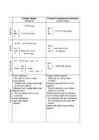
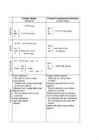
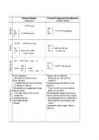
Lihttulevik The future simple Tulevikus toimuv tegevus, mis ei sõltu meie tahtest või mille suhtes teeme otsuse kõnelemise momendil. Next week, tomorrow, in two years time, in 2020. will + 1. pv (will not = won't) Maria will be thirteen next year. Maybe I won't go to the party tomorrow, I'm too tired. Will you help me with my homework tonight? Kestev olevik The present continuous Praegu toimuv tegevus. Now, at the present. am / is / are + -ing We are learning English. Is Mark reading or writing? Where is the teacher standing? 3 4 Kestev minevik The past continuous Minevikus teatud hetkel parajasti kestnud tegevus. Yesterday at 6, when she came, this time on Tuesday. was / were + -ing When the teacher came in, the pupils were talking. What were you doing when she opened the door? I was not talking, I was reading a book. Kestev tulevik The future conrinuous Väljendab tegevust, mis hakkab tulevikus toimuma
Direct speech Reported speech Jo says: Jo said: ,,I like tennis." (that) she liked tennis. ,,John is going to learn it too." (that) John was going to learn it too. ,,Mary has given up her hobby too." (that) Mary had given up her hobby too. ,,I can´t play tennis on Monday" (that) she couldn´t play tennis on Monday. ,,I don´t know when I can play it." (that) she didn´t know when she could play it. (that) ,,I will phone Mary when I can teach she would phone Mary when she could teach her. her." · Mõned ,,lähedust" väljendavad sõnad kaudses kõnes vahetatakse ,,kaugust"
I have asked I have not asked Have I asked? He/she/it has gone He/she/it has not gone Has he/she/it gone? We/you/they have made We/you/they have not made Have we/you/they made? Täismineviku väljendab: · Tegevust, mis toimus enne kõnemomenti, kuid mille tagajärg on kõnelejale tähtis. John has arrived. I have finished writing a letter. Oh God! I have cut my finger. · Tegevust, mis algas enne kõnemomenti, kestab selleni või jätkub edasi. Tegevus võib olla määratletud sõnadega since, for. They have lived here for two years. · Tegevust, mis lõpeb enne mingit tegevust või muutust tulevikus, näiteks ajamääruslausetes, kus kasutatakse sidesõnu when, until, till, before jt.
asesõnadele ka asjavormid, mis nihkuvad mineviku suunas, ja ajamäärussõnad (today, this week, yesterday, last year) ning näitavad asesõnad (this, these). Küsilausetes lisanduvad kõigile neile muutustele ka veel ka sõnajärje muutused. Seega on küsilauseid minevikus kõige raskem kaudkõnesse panna. He said to me,"I was at home yesterday." He told me that he had been at home the previous day/ the day before. He asked me,"Where did you live two years ago?" He asked me where I had lived two years before. 3. Alati pole vaja otsekõnes öeldut kaudkõnes sõna-sõnalt edasi anda. Tähtis on edastada öeldu mõte. Seda saab teha kasutades saatelauses sobivaid tegusõnu: accept, advise, agree, allow, apologize, ask, beg, promise, recommend, refuse, suggest, warn. He asked me," will you come to my birthday on Sunday?" He invited me to his party on Sunday.
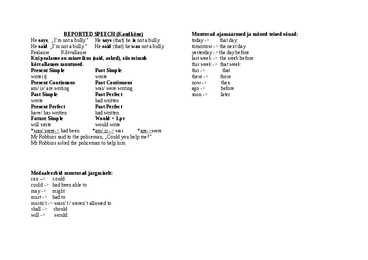
had > had had can > could could > had been able to may > might must > had to mustn't > wasn't/weren't allowed to today > that day yesterday > the day before tomorrow > the next day this year/ month/ week > that year/ month/ week last year/ month/ week > the year/month/week before next year/ month/ week > the next year/ month/ week now > then ago > before soon > later here > there
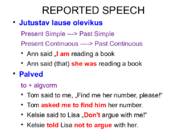
REPORTED SPEECH Jutustav lause olevikus Present Simple ---> Past Simple Present Continuous ----> Past Continuous Ann said ,,I am reading a book Ann said (that) she was reading a book Palved to + algvorm Tom said to me, ,,Find me her number, please!" Tom asked me to find him her number. Kelsie said to Lisa ,,Don't argue with me!" Kelsie told Lisa not to argue with her. Jutustav lause minevikus Past Simple --> Past Perfect (had + 3.pv) Present Perfect --> Past Perfect Past Continuous ---> had + been + ing Lynn said ,,I went to the cinema last night."
1 _____________________________________________________________________________________________ Yes, I have a painting by Picasso on my wall. 2 _____________________________________________________________________________________________ In my free time I watch TV and read. 3 ____________________________________________________________________________________________ I'm reading a book by Charles Dickens. 4 ____________________________________________________________________________________________ She works in a bank. 5 ____________________________________________________________________________________________ No, he isn't learning to play a musical instrument. 6 ____________________________________________________________________________________________ My birthday is on 8 August.
Reporting clause Direct speech He says, ,,I like your car." Kaudne Kõne Indirect speech Pealause Sidesõna Sihitislause Main clause Linking word Object clause He says that he likes my car Väitlaused kaudses kõnes Statements in indirect speech Tom says to me he likes my car Joe is saying that Mary is leaving next week You have told me He kas worked there for two years Ann will tell them our friends will arrive at 7 o'clock Kui saatelause verb on minevikus, toimub otsese kõne kaudseks muutmisel aegade nihe vastavalt aegade järjestuse reeglile , mis nõuab ,et kui pealause verb on minevikus, peab ka sihitislause verb olema ühes mineviku ajavormis. the present indefinite the past indefinite the present continuos the past perfect
using direct speech or direct speech reported speech. speech `I'm tired!', Helen said. Helen said (that) she was tired. The main verb of the sentence is usually past ( Tom said that... / I told her that...) and the rest of the sentence is usually past too. Sequence of tenses if the verb in the main sentence is in the past tense the other verbs are usually in one of the past tense too. Present Simple Past Simple I'm a teacher. He said (that) he was a teacher Present Progressive Past Progressive I'm having lunch with my He said (that) he was having parents. lunch with his parents. Past Simple Past Perfect He said (that) he had bought a I bought a new car. new car. Future Simple FutureinthePast
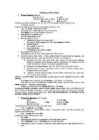
the reported speech: direct speech: "I like ice cream" reported speech: She said she liked ice cream. ......... · When there are Changing tenses: present changes to past:::: am/is --- was are -- were want/like/know/go etc --- wanted/liked/knew/went etc do/does --- did have/has had will --- would can --- could wanted/liked --- had wanted/had liked NT: Jo says "Mary has given up het hobby." - Jo said that Mary had given up her hobby. · Some other words change also, which are more fit?? to reported speech: this that these those here there now then ago before today that day tomorrow the next day yesterday the day before last night the previous night next the following week/year week/year NT: He said: ,,I am coming to the party today
follow me!" 2 The Capital Letter The capital letter is also called a big letter or upper- case letter, or sometimes just a capital. A B C D E F G H I J K L M N O P Q R S T U V W X Y Z When do you use a capital letter? 4Use a capital letter for the first letter in a sentence: The dog is barking. Come here! 4Always use a capital letter for the word I : I am eight years old. Tom and I are good friends. 4Use a capital letter for the names of people: Alice, Tom, James, Kim, Snow White 4Use a capital letter for the names of places: National Museum, Bronx Zoo, London, Sacramento 4Use a capital letter for festivals, holidays, days of the week, months of the year: New Year's Day, Christmas, Labor Day, Mother's Day, Sunday, Monday, Friday, January, May, July, October
Award, making Card the only author (as of 2008) to win both of science fiction's top prizes in consecutive years. Card continued the series with seven books, which divide into "Shadow" and "Speaker" series. He has also announced his plan to write two more novels: Shadows in Flight, a book that connects the "Shadow" series and "Speaker" series together, and Ender in Exile, a book that takes place after Ender's game and before Speaker for the Dead. Furthermore, Card recently announced that Ender's Game will soon be made into a movie. Though Card is best-known for "Ender's Game", he has also written in a variety of other genres, including plays, short stories, books on writing, the Homecoming series, other science fiction books, and nonfiction, such as articles on computer technology. Orson Scott Card in 2008 and when he was younger. The Setting
Present Progressive Past Progressive Present Perfect Past Perfect Present Perfect Progressive Past Perfect Progressive Past Simple Past Perfect Past Progressive Past Perfect Progressive Past Perfect jääb muutmata Past Perfect Progressive jääb muutmata Future Simple Future in the Past 3. Kui saatelause verb on minevikus, asendatakse kaudses kõnes mõned lähedust väljendavad sõnad kaugust väljendavate sõnadega: This that These those Here there Now then Ago before Today that day Tomorrow the next day Yesterday the day before Last night the previous night Next week the following week Aegade nihet ei toimu kui 1. Lause väljendab üldtuntud tõde He said, ´The sun is 92 million miles away.´ He said that the sun is 92 million miles away. Tingimuslausete 2. ja 3. tüübis 2. Kui Past Simple otsese kõnes tähistab tegevust, mis toimus teatud momendil
· action that is still going on now, up to now · action that stopped recently · finished action that has an influence on the present action that has taken place once, never or several times before the moment of speaking Present Perfect A: He has been · putting emphasis on the all day, Continuous speaking. course or duration (not the since 1993, N: He has not been how long?, result) speaking. the whole
toimunud tegevus. Periood pole Tegevus, mis toimus minevikus ja läbi, aga tegevus toimub: mille tulemus oli näha minevikus. We've done five tests this week. He was happy. She had agreed Tegevus, mida on/ei ole kunagi to merry him. tehtud: Laused, milles on järgmisi sõnu: She's never been so happy before, after, already, just, for, before. since, till, until, when, by, by the time, never... Future Simple (lihttulevik) Be going to... will I vorm (play) shall VÕI am is going to I vorm (going to play) are will
got out the taxi. She was talking on her mobile Praeguseks lõppenud mineviku phone while she was driving to harjumused ja olukorrad: work. Kitchens were very different a Kestev tegevus minevikus, kui hundred years ago. teine tegevus tuli sisse: Laused, milles on järgmisi sõnu: He was walking down the street yesterday, then, when, How long when he ran into an old friend. ago ...?, last night/week/month/ /year, Tuesday, three days/years P.S. ago, in 1999. now . P.C. mine (9. klassi seisuga) Present Perfect Past Perfect (täisminevik) (enneminevik)
toimunud tegevus. Periood pole Tegevus, mis toimus minevikus ja läbi, aga tegevus toimub: mille tulemus oli näha minevikus. We've done five tests this week. He was happy. She had agreed Tegevus, mida on/ei ole kunagi to merry him. tehtud: Laused, milles on järgmisi sõnu: She's never been so happy before, after, already, just, for, before. since, till, until, when, by, by the time, never... Future Simple (lihttulevik) Be going to... will I vorm (play) shall VÕI am is going to I vorm (going to play) are will
lõppkonsonant kahekordistub stop stopping, travel-travelling -ie lõpuliste verbide puhul muutub ie->y lie lying 1. Kõnemomendil, käesoleval ajaperioodil või ajutiselt toimuv tegevus. Tom is drinking tea now. I´m looking for a new job these days. 2. Adverbidega always, constantly, continually sageli korduv tegevus, mida kõneleja heaks ei kiida. Mary is always laughing. 3. Lähimas tulevikus toimuv tegevus, mis on ette kavatsetud, kokku lepitud. I´m meeting Jim tonight. 4. Muutuv, arenev tegevus. The weather is getting worse. Ajamäärused now, at the moment, at present, these days, nowadays, today, tonight, always, still etc. 3. Present Perfect (täisminevik) he has worked have (I, you, we, they) III (-ed) he has not worked
make it mean everything. I've managed to pick up some bits and pieces of other languages as well – bit of Spanish, some words of Italian, a tiny bit of Finnish, some German (blaming Rammstein and my Neuss friends for that!) and even some made-up languages. Ten or eight years ago I spoke a quite fluent Quenya – that is high-elvish made up by Tolkien. I've created a few languages as well, for either writing or roleplay purposes. Lastly, I'd like to return to English. Like I said before, once I got into reading books in English, I never stopped. Unless it's Shakespeare or something I would not understand in Estonian, either, I can read everything. Unfamiliar words I either pick up from context or these days use my wonderful e-reader built-in English dictionary-thesaurus. (No Estonian words there, either.) As to written English. Well, that began with me keeping a secret diary for years and years, and since
3. Present Continuous [am/is/are + present participle]. Tegevus toimub/ei toimu praegusel hetkel. You are watching TV. You are learning English now. I am studying to become a doctor. I am meeting some friends after work. Active= Right now, Tom is writing the letter. Passive= Right now, the letter is being written by Tom. 4. Past Simple [VERB+ed] or irregular verbs. Tegevus algas/lõppes minevikus täpsel ajal. . You called Debbie. I saw a movie yesterday. I finished work, walked to the beach, and found a nice place to swim. I lived in Brazil for two years. I studied French when I was a child. Active = Tom repaired the car. Passive= The car was repaired by Tom. 5. Past Continuous [was/were + present participle]. Pikalt kestev tegevus katkestati minevikus. You were studying when she called. I was watching TV when she called. Last night at 6 PM, I was eating dinner. I was studying while he was making dinner. She was always coming to class late
must be in want of a wife. However little known the feelings or views of such a man may be on his first entering a neighbourhood, this truth is so well fixed in the minds of the surrounding families, that he is considered the rightful property of some one or other of their daughters. "My dear Mr. Bennet," said his lady to him one day, "have you heard that Netherfield Park is let at last?" Mr. Bennet replied that he had not. "But it is," returned she; "for Mrs. Long has just been here, and she told me all about it." Mr. Bennet made no answer. "Do you not want to know who has taken it?" cried his wife impatiently. "You want to tell me, and I have no objection to hearing it." This was invitation enough. "Why, my dear, you must know, Mrs. Long says that Netherfield is taken by a young man of large fortune from the north of England; that he came down on Monday in a chaise and four to see the place, and was so much delighted with it, that he agreed with Mr. Morris
Maturita Solutions Upper-Intermediate Workbook Key 1G Magazine article page 10 1 1 Introduction: C 2 Background information: A 3 Main events: D 4 Conclusion: B 2 1 One afternoon, at the time, when I finally reached safety, after that day 2 and fast! The rock was now more than a kilometre out to sea! After that day, I always checked the times of the tides before I went swimming! I'd never been so exhausted in my life! 3 exhausted, fantastic 4 Only when I woke up ... 3 1 Had the distance been twenty metres further, I wouldn't have made it. 2 Never in my life had I been so exhausted. 3 So tired was I that I fell asleep. 45 Students' own answers Photocopiable © Oxford University Press 2 Maturita Solutions Upper-Intermediate Workbook Key Unit 2 4
5 If you don't need the gloves immediately, it's ... to wait until the sales start. 6 It's wise to remember the birthdays of your family and friends. 7 Gina's mum was puzzled to hear about the broken window. 8 I was ... to have a matchbox on me, so we could light a candle. 6. Translate. 1 Ma asun teele. Kohtumiseni homme! I'm off, see you at home! 2 Võta aega ja mõtle see läbi enne, kui vastad. Take your time and thing it through, before you answear. 3 Mis lahti? Kas te kaklesite? What's up? Fighted you? 4 Mul tuli hea mõte. Miks me ei võiks üllatuspidu teha? I hit upon an idea, why couldn't we do the sürpriise party? 5 Eddie ja Lara vahel tekkis pinge. The tention was building up between Eddie and Laura. 6 Et endid lõbustada, hakkasime naljalugusid rääkima. To cheer ourselves up, we tõld the funny stories. 7 Carrie silmad olid täis pisaraid kui ta luges oma venna kirja.
I look forward to seeing you. (NOT I look forward to see you.) We're looking forward to going on holiday. (NOT ... to go on holiday.) 17. Information is an uncountable noun. Can you give me some information? (NOT Can you give me an information?) I got a lot of information from the Internet. (NOT I got a lot of informations from the Internet.) 18. Use ing forms after prepositions. I drove there without stopping. (NOT I drove there without to stop.) Wash your hands before eating. (NOT Wash your hands before to eat.) 19. Use this, not that, for things that are close. Come here and look at this paper. (NOT Come here and look at that paper.) How long have you been in this country? (NOT How long have you been in that country?) 20. Use a plural noun after one and a half. We waited one and a half hours. (NOT We waited one and a half hour.) A mile is about one and a half kilometres. (NOT A mile is about one and a half kilometre.) 21
REPORTED SPEECH (Kaudkõne) Muutuvad ajamäärused ja mõned teised sõnad: He says, ,,I'm not a bully." He says (that) he is not a bully. today -> that day He said ,,I'm not a bully." He said (that) he was not a bully. tomorrow -> the next day Pealause Kõrvallause yesterday -> the day before Kui pealause on minevikus (said, asked), siis toimub last week -> the week before kõrvallauses muutused. this week -> that week Present Simple Past Simple this -> that write(s) wrote these -> those Present Continuous Past Continuous now -> then am/ is/ are writing was/ were writing ago -> before
SIDESÕNAKS TULEB IF 1) " Do you speak English" -> she asked me if I spoke English teasel puhul jääb sidesõnaks küsisõna näiteks-> -> "what are you talking about?" -> she wanted to know what I was talking about (sõnade järjekord muutub nii nagu jaatavas lauses) TEISI MUUTUSI .. oluline Rasmus!!! Õpi päheeee!!! Today -> that day That/These->those Tomorrow-> the next day Here->there Yesterday -> the day before Can->could Ago-> before Will->would This->that Must-> had to Põhimõtteliselt: Ipv -> IIpv IIpv->had+IIIpv Did->had don't see->didn't see does he see? -> it he saw
2) Nicky........to San Francisco when the accident happened. A flies B has flown C was flying D has been flying 3) Why don`t you let her........her story? A finish B to finish C finishing D have finished 4) Tim........in a cafe at present, but he has already applied for a new job A work B have worked C is working D worked 5) My father........already worked for two years before he went to University. A was B had C has D is 3. Change the order of the words to make a correct sentence. ( 5 points ) 1) I wonder / can / you / me / help / if 2) a / my / to / written / I / mother / already / letter / long / have 3) the / watch / often / they / TV / in / evening 4) the / gave / my / for / this / umbrella / is / that / Sally / me / my / birthday
term. We would be grateful if you would allow us to hold the party in the main hall on 30th May from 8pm to 11pm. We plan to have a disco and some refreshments. Melanie Clark is making the arrangements for the food and drink and Vicki Brown is organising the decorations. In accordance with the college rules, we will make sure the hall is cleaned immediately after the party. Also, as the party will be over before midnight I can assure that there will not be a problem about the noice. I hope that this meets with your approval. If you have any questions please do not hestitate to ask. Yours sincerely, allkiri Liis Perekonnanimi Application Dear Sir/Madam, I am writing to apply for the position of information officer which was advertised in ,,The Evening News". I am 19 years old and am studying German at university. I am in my third year and would like the
FUTURE SIMPLE BE GOING TO Will + infinitive (will go) Am/is/are going to + infinitive (is going to rain) 1.A decision at the moment of 1.Future plans made before the speaking: moment of speaking: A: 'I'm cold'. A: 'We've run out of milk.' B: 'I'll close the window'. B: 'I know, I'm going to buy some.' 2.Prediction based on opinion: 2.Prediction based on present I think the Conservatives will win the evidence: next election. Look at those boys playing football! 3
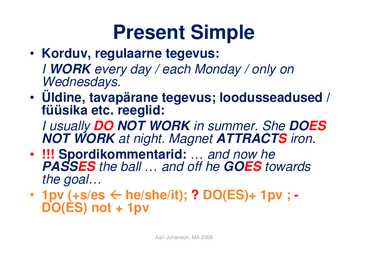
S/he IS TALKing on the phone now. I AM READing an interesting book. · Ajutine, regulaarsele ja tavapärasele vastanduv tegevus (tulevikku viitav): This summer they ARE not GROWing cucumbers as usual. They'RE GROWing tomatoes instead. · !!! Halvakspanu väljendus harjumuspärase tegevuse kohta: He IS always COMPLAINing! · BE (am/is/are) + 1pv-ing Aari Juhanson, MA 2008 Present Perfect ON -NUD · Toimunud tegevus, seos olevikuga: I have WORKed here for 3 years. · Toimunud olevikuga seotud/lõpetamata tegevus (saab muuta): S/he has CALLed them twice already. · !!! Kordne tegevus: It's the umpteenth time you've TOLD me this! Have I ever FORGOTTEN anything? · !!! Tutvuse pikkuse väljendus: I don't know how long I have KNOWN her. · have/has (s/he, it) + -ed/3 pv Aari Juhanson, MA 2008 Present Perfect Progressive · Tegevuse protsessi/kestvuse rõhutamine, lõpetamata:
Agatha Christie was born Agatha May Clarissa Miller in Devon, in England in 1890, the youngest of three children. Her father died, when she was a child. At sixteen she was sent to school in Paris where she studied singing and piano. Christie was an accomplished pianist but her stage fright and shyness prevented her from pursuing a career in music. She never attended school. Dame Agatha Christie was an English crime writer of novels, short stories and plays. She also wrote romances under the name Mary Westmacott, but is best remembered for her 80 detective novels and her successful West End theatre plays. On the Christmas Eve in 1914, Agatha married an aviator, Archibald Christie. their daughter, Rosalind, was born in 1919. On discovering extramarital affair, she divorced him in 1928. In the same year Christie's beloved mother died. During World War I she worked in a Red Cross Hospital in Torquayas a hospital dispenser, which gave her a knowledge of poisons
spend a month every summer until I was fourteen. That was the year I finally put my foot down; these past three summers, my dad, Charlie, vacationed with me in California for two weeks instead. It was to Forks that I now exiled myself-- an action that I took with great horror. I detested Forks. I loved Phoenix. I loved the sun and the blistering heat. I loved the vigorous, sprawling city. "Bella," my mom said to me -- the last of a thousand times -- before I got on the plane. "You don't have to do this." My mom looks like me, except with short hair and laugh lines. I felt a spasm of panic as I stared at her wide, childlike eyes. How could I leave my loving, erratic, harebrained mother to fend for herself? Of course she had Phil now, so the bills would probably get paid, there would be food in the refrigerator, gas in her car, and someone to call when she got lost, but still... "I want to go," I lied
 annaabi.ee