Leidsid 33 sarnast õppematerjali, mis on seotud failiga "IRELAND". Need materjalid aitavad sul teemat sügavamalt mõista.
ireland, republic, petroleum, equipment, january, temperatures, goods, chemicals, products, sources, northern, february, months, year, july, ethnic, groups, peat, copper, lead, limestone, silver, president, mary, currency, before, introduction, notes, coins, irish, export, computers, animal, import, processing, clothing, attention, reference, geography..................................................................... 8 Population and Ethnicity..............................................................................................9 3 Introduction The official name of the country is the United Kingdom. The United Kingdom is an island country. It consists of the island of Great Britain and Northern Ireland. Great Britain can be divided into three parts England, Wales and Scotland. Each of them has their own capital city. Glasgow in Scotland, Cardiff in Wales and London in England. The country is situated in the north-western Europe. The territory of the United Kingdom is about 244,000 square kilometres and about 60 million people live there. The UK contains a number of small islands. The largest islands that belong to the United
In Canada, the variety of landscapes shows the diversity of our climate. In the north, low precipitation and cold temperatures favour permafrost and suppress vegetation growth, resulting in treeless tundra. South of the tundra, on the Canadian Shield, summers are short and warm, and winters are long and cold. Annual precipitation is abundant, allowing coniferous forests to establish and grow. On the Pacific coast, the combination of heavy rainfall and mild temperatures year round supports Canada, Kärt Kalvet 8a temperate rain forests. On the Prairies, the large number of days of sunshine affects the development of the agricultural landscape. In the Maritimes, the Atlantic Ocean moderates the climate such that winters are generally long and mild, and summers are short and cool. These conditions help in the development of forests. Finally, around the Great Lakes and alongside the St
The political system is a federation of six states (Queensland, New South Wales, Tasmania, Western Australia, South Australia and Victoria). The capital city is Canberra in New South Wales. Australia is a parliamentary democracy. Queen Elizabeth II is formally head of state, but she is represented in Australia by a Governor General. There are two houses of Parliament: the Senate and the House of Representatives. Prince Charles has said that Australians should be able to have a Republic if they want one. Animals and plants. Sixty million years ago Australia and its nearby islands were separated from the other world by a great upheaval. They were cut off from Asia by the ocean. Almost no animals visited Australia before English colonists began to settle there. Now a strange thing happened when the ocean blocked off this island continent. The ancestors of cats and tigers, of dogs and wolves, of elephant and sheep just were not there
Cities Muckanaghederdauhaulia - This is probably the longest place name in Ireland. it consists of 22 letters There is also a village in Ireland called '' Inch village'' outside the village there is a sign '' Inch 1 mile'' i couldn't find a picture of it from the internet so i created a sign myself to make it more clear, so that can be quite confusing for a foreigner The capital city , Dublin was founded by the Vikings in 841 Worth to mention The Titanic was built in Harland and Wolff yards in Belfast , which is nowadays part of the Northern Ireland , but back then in 1909 - 1912 (which is the time when Titanic was built ) it was
They had a great respect of the land and a belief in the Dreamtime. As the population grew and new areas were explored, five largely self-governing Crown Colonies were established over the course of the 19th century. On the 1 January 1901, the colonies became states linked by one federal government the Commonwealth of Australia. Settlers came from Britain and Ireland, and the people of Australia are still mainly of British or Irish origin, with a culture and outlook similar to that of the United Kingdom and the United States. After World War II , Australia encouraged mass immigration from Europe. Since the 1970s immigration from Asia and other parts of the world was also encouraged. Culture Australians are making a name for themselves in sports. They are especially well-
Swansea. English is the main language of Great Britain, but Welsh is officially recognized in Wales and Gaelic in Scotland. 2. Geographical position The British Isles is the geographical term for a group of about 5000 islands off the coast of mainland Europe. The largest island is Great Britain, which is also the largest island in Europe. It consists of England, Wales and Scotland. The next largest island is Ireland, which is made up of Northern Ireland and the Irish Republic. Britain and Northern Island together form the United Kingdom. When referring to Britain or Great Britain in everyday life, the names are used to mean the United Kingdom. The English Channel (and best known: the Strait of Dover) separate Britain from mainland Europe and its closest neighboring country France. 3. History Great Britain has a long and interesting history stretching back millennia's. The
It is the eight largest city in Europe. Most Finns speak Finnish. The second language is Swedish. Finland is rated the sixth most peaceful country in the World. In Finland there are more than 60000 lakes. Capital: Helsinki Area: 338145km2 Population: 5200000 Language: Finnish, Swedish Currency: Euro (EUR) Goverment: Parliamentary republic President: Tarja Halonen Prime Minister: Matti Vanhanen 1 Nature and geography Finland is a country of thousands of lakes and islands; 187,888 lakes (larger than 500 m²) and 179,584 islands to be precise. One of these lakes, Saimaa, is the fifth largest in Europe. The Finnish landscape is mostly flat with few hills and its highest point, the Halti at
Ireland Ireland (Irish: Éire, Irish pronunciation:) is a country in north-western Europe. The modern sovereign state occupies about five-sixths of the island of Ireland, which was first partitioned on 3 May 1921. It is bordered by Northern Ireland--part of the United Kingdom--to the north, by the Atlantic Ocean to the west, the Irish Sea to the east and the Celtic Sea and St George's Channel to the South and South-East. The legal name of the state is simply "Ireland", but its legal description the Republic of Ireland is sometimes used to differentiate the state from the island.
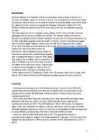
Estonia Topic Tallinn 2007 2 List of Contents page Facts and figures 3 Geography 3 Climate 3 Nature 4 History 5 Economy 6 Culture 6 Biggest towns 7 Language 8 3 Facts and figures The Republic of Estonia is a small country. Covering only 45, 228 sq km it is slightly bigger than Denmark, Belgium or Switzerland. Estonia's population is under 1.4 million. The official language is Estonian but since very many Russians live here Russian is also wide spread. The capital of Estonia is Tallinn. The currency used in Estonia is Eesti kroon. The Estonian national flag is blue-black-white. It was originally the flag of the Estonian Students' Society
Lawrence. The St. Lawrence, with its tributaries, is navigable for over 3,058 km. The largest lake situated entirely in Canada is Great Bear Lake at 31,328 km2 in the Northwest Territories. The largest lake which is at least partly in Canadian territory is Lake Superior Climate Canada's climate is as diverse as its landscape. Generally, Canadians enjoy four very distinct seasons, particularly in the more populated regions along the US border. Daytime summer temperatures can rise to 35°C and higher, while lows of -25°C are not uncommon in winter. More moderate temperatures are the norm in spring and fall. Summers can be hot and dry on the prairies, humid in central Canada, and milder on the coasts. Spring is generally pleasant across the country. Autumns are often crisp and cool, but brightened by rich orange and red leaves on trees. Winters are generally cold with periods of snow, although southern Alberta enjoys the
Introduction Jamaica is an island nation of the Greater Antilles, 234 kilometres (146 mi) in length and as much as 80 kilometres (50 mi) in width situated in the Caribbean Sea. It is about 620 kilometres (385 mi) northeast of the Central American mainland, 145 kilometres (90 mi) south of Cuba, and 190 kilometres (120 mi) west of the island of Hispaniola, on which Haiti and the Dominican Republic are situated. Its indigenous Arawakan-speaking Taíno inhabitants named the island Xaymaca, meaning either the "Land of Springs," or the "Land of Wood and Water". Formerly a Spanish possession known as Santiago, it later became the British West Indies Crown colony of Jamaica. It is the third most populous anglophone country in the Americas, after the United States and Canada. I chosed Jamica because there are many things what I like in this country. Mostly I
The residential and commercial sectors combined use 39 percent of all energy. These two sectors include all 4 types of buildings, such as houses, offices, stores, restaurants, and places of worship. Energy used for transportation accounts for more than a quarter of all energy. Picture 2.1. Share of energy consumed by major selectors of the economy (2007) 2.1 Uses of energy in homes The ability to maintain desired temperatures is one of the most important accomplishments of modern technology. Our ovens, freezers, and homes can be kept at any temperature we choose, a luxury that wasn't possible 100 years ago. Keeping our homes comfortable uses a lot of energy. Over 40 percent of the average home's energy consumption is used for heating. Another 20 percent is used for water heating, 8 percent for cooling rooms, and 5 percent for refrigeration. Almost one-fourth of the energy used in homes is used for
The United Kingdom The United Kingdom consists of England, Scotland, Wales and North Ireland and it is situated in the Atlantic Ocean near the mainland of Europe. The population of the UK is 58.6 million and area is 244,110 sq km. Britain has a temperate humid climate. Its characteristic features are mild winters, warm summer, no temperature extremes, abundant rain all year round and frequent changes of weather. The mild climate is partly due to the warm Gulf Stream and partly to the south westerly winds. Occasional winds from the east in winter may bring cold and dry weather
and in the1990s in the Gulf War and now they are fighting in Iraq. Industry The US is extremely rich in natural resources. The western mountains are especially rich in them. The US is among the leading countries in the value of its mineral production. The US is third, after Russia and Saudi Arabia, in the production of petroleum. Mining has been the key of development of the USA. The US has large deposits of coal, iron ore, natural gas, and petroleum, which are vital to the country's industrial strength. Its many other important minerals include copper, gold, lead, silver and zinc. To meet its needs the US must import additional amounts of iron ore, petroleum, and other minerals.Most American industry is located in the eastern and mid- western parts, around the Great Lakes and also on the Pacific coast.The US engineering products are known all over the world. The US produces planes, rockets, cars, agricultural machinery, ships, etc
Tallinn 2013 Ott Speek Subject: English Geodesy Study group: GI-21b PETROLEUM PRESENTATION Petroleum (L. petroleum, from Greek: Πέτρα (rock) + Latin: oleum (oil) is a naturally occurring flammable liquid consisting of a complex mixture of hydrocarbons of various molecular weights and other liquid organic compounds, that are found in geologic formations beneath the Earth's surface. The name Petroleum covers both naturally occurring unprocessed crude oils and petroleum products that are made up of refined crude oil. A fossil fuel, it is formed when large quantities of dead organisms, usually zooplankton and algae, are buried underneath sedimentary rock and undergo intense heat and pressure. Petroleum is recovered mostly through oil drilling. This comes after the studies of structural geology (at the reservoir scale), sedimentary basin analysis, reservoir characterization (mainly in terms of porosity and permeable structures). It is refined and
Tallinn English College Topic Estonia Tallinn 2008 1. Introduction Estonia is a small country about the size of Switzerland, or New Hampshire and Massachussetts combined. Estonia is named after the people called "Ests" who lived in the region in the 1 st century AD. The Republic of Estonia is one of the three countries commonly known as the "Baltic States". The other Baltic States are Latvia and Lithuania. 2. Geographical position Estonia is situated in northeastern Europe. Estonia is bounded on the north by the Gulf of Finland, on the east by Russia, on the south by Latvia and on the west by the Baltic Sea. In the north it borders on Finland. The coastline of the Baltic Sea in Estonia is characterized by numerous gulfs and bays, the biggest of them
4. Milline on riigi ekspordi ja impordi suhe/väliskaubanduse tasakaal (USD)? Andmed leiad ül 2 aadressilt . Eksport- 464.900.0 US $, per capital on 7.628 US$ , koht mm-s on 9-s Import- 636.000.0 US $, per capital on 10.436 US $, koht mm-s on 6-s 5. Mida Sinu riik peamiselt ekspordib export commodities? Loetle /nimeta ja energiavaradele tõmba joon alla. Ül 2 link. Tubakas, kütused, kemikaalid, karastusjoogid, manufactured goods (ei oska tõlkida) 6. Mida Sinu riik peamiselt impordib import commodities? Loetle /nimeta ja energiavaradele tõmba joon alla. Ül 2 link toiduained, kütused, manufactured goods(ei tea kuidas tõlkida), erinevad masinad 7. Selle ülesande lahendamisel on mõistlik kasutada linki : http://www.citypopulation.de/cities.html . Toimi samamoodi nagu ül 3 i ja j alapunkti puhul .Kaubandus trade.
BARRIERS TO DISTRICT HEATING DEVELOPMENT IN SOME EUROPEAN COUNTRIES Abstract District heating (DH) offers low primary energy demand, high security of supply and small CO 2 emissions. Barriers to DH in the UK, Ireland, France, Romania and the Czech Republic have been compiled through publications and interviews. DH systems require large investments, have negative initial cash flow and long payback time, which obstructs financing. One actor should control DH from source to consumption. If the value chain is fragmented, contracts are required between the links. It increases risks and financing costs, like in the UK and Ireland, where DH is not established. There are few multi-
5 million, Lviv (Lvov) - 1.5 million, Donetsk 1 million, Dnipropetrovsk (Dnepropetrovsk) - 1 million, Odesa (Odessa) 1 million. Zaporizhzhya (Zaporozhye) 0.8 million. 5 GDP growth, %: 1.0 (2013 forecast EBRD downward revision from previously projected 2.5%). Official language: Ukrainian (although Russian is widely used in business communication). Currency: Hryvnya (UAH). Government type: republic. Membership: the United Nations, the International Monetary Fund (IMF), the World Bank, the European Bank for Reconstruction and Development (EBRD), the World Trade Organization (WTO), etc. Ukraine is bordered by Russia in the east, the Black Sea in the south, Moldova, Romania, Hungary, Slovakia and Poland in the west, and Belarus in the north. The country is rich in mineral resources: iron ore, coal, manganese, natural gas (shale costly and dangerous to
The modern name of Estonia is thought to originate from the Roman historian Tacitus, who in his book Germania (ca. AD 98) described a people called the Aestii. Similarly, ancient Scandinavian sagas refer to a land called Eistland, close to the German term Estland for the country. Early Latin and other ancient versions of the name are Estia and Hestia. Until the late 1930s, the name was often written as Esthonia in most English speaking countries. Estonia is a democratic parliamentary republic and is divided into fifteen counties. The capital and largest city is Tallinn. With a population of only 1.4 million, it is one of the least-populous members of the European Union. Estonia was a member of the League of Nations from 22 September 1921, has been a member of the United Nations since 17 September 1991, of the European Union since 1 May 2004 and of NATO since 29 March 2004 Estonia has also signed the Kyoto protocol. Economy
Soviet Union. After that in the 1960s and 1970s the Americans fought in the Korean and in the Vietnam War, and in the1990s in the Gulf War and now they are fighting in Iraq. Industry The US is extremely rich in natural resources. The western mountains are especially rich in them. The US is among the leading countries in the value of its mineral production. The US is third, after Russia and Saudi Arabia, in the production of petroleum. Mining has been the key of development of the USA. The US has large deposits of coal, iron ore, natural gas, and petroleum, which are vital to the country's industrial strength. Its many other important minerals include copper, gold, lead, silver and zinc. To meet its needs the US must import additional amounts of iron ore, petroleum, and other minerals. Most American industry is located in the eastern and mid-western parts, around the Great Lakes and also on the Pacific coast.
North Island has a warm mild climate, almost sub-tropical in the extreme north. Auckland average summer temperature (January) is about 21C and winter is 11C. Annual rainfall in North Island is around 125-150cm, the west receiving slightly more rain than the east. South island is colder. Energy and natural resources: Despite a comparatively small population and abundant natural resources, New Zealand is a net importer of energy. Energy importation is in the form of oil products. About 30% of primary energy is from renewable energy sources. The leading manufacturing sectors are food processing, metal fabrication, wood and paper products. Natural resources: natural gas, iron ore, sand, coal, timber, hydropower, gold, limestone Government & economy: New Zealand is a constitutional monarchy with a parlamentary democracy. The House of Representatives - with 120 members an 5 seats for Maoris. Queen Elizabeth is Queen of New
must take into account national sovereignty as well as global needs. The organization won the 2001 Nobel Peace Prize, and a number of its officers and agencies have also been awarded the prize. Other evaluations of the UN's effectiveness have been mixed. Some commentators believe the organization to be an important force for peace and human development, while others have called the organization ineffective, corrupt, or biased. 2. General knowledge on your delegation COUNTRY: Syrian Arab Republic POPULATION: Over 13 million LANGUAGE: Arabic (official); French; English RELIGION: Islam, Christianity, Druze, Judaism, Baha'i Syrian Arab Republic, more commonly known as Syria. The fertile land of Syria lies at the crossroads of great trade routes between the East and West. It is also the site of many holy places in Judaism, Christianity, and Islam. Because of these advantages, it has been invaded, conquered, and occupied by many different peoples over its long history
Estonia. Estonia, officially the Republic of Estonia is a country in Northern Europe. It is the smallest of the three Baltic countries. Estonia has land borders with Latvia (339 km) to the south and Russia (229 km) to the east. It is separated from Finland in the north by the narrow Gulf of Finland and from Sweden in the west by the Baltic Sea. Estonia has been a member of the European Union since May 1, 2004 and of the NATO since March 29, 2004. The area of Estonia is about 45000 square kilometres and the population is
Euratom) is signed in Brussels; enters into force on July 1, 1967. Empty chair crisis 1966 Luxembourg compromise – solution for the empty chair crisis: weaker commission, veto power, common argiculture policy, qualified majority voting 1967 UK re-applies to join the Community. 1968 Agreement of EEC’s common external tarif 1972 Referendum in Norway on joining; majority votes against. Launch of „snake in the tunnel“ 1973 January: Denmark, Ireland and the UK join the European Communities. 1974 April: foreign secretary James Callaghan makes statement to the Council on the new Labour government’s policy on the Community. Calls for major changes in the Common Agricultural Policy (CAP), "fairer methods of financing the Community budget" and solutions to monetary problems. December: the Community’s heads of state or government decide to hold meetings three times a year as the European Council, agree direct
the largest of the British Isles. With a population of about 60.0 million people in mid-2009, it is the third most populous island in the world, after Java and Honsh. Great Britain is surrounded by over 1,000 smaller islands and islets. The island of Ireland lies to its west. Politically, Great Britain may also refer to the island itself together with a number of surrounding islands which comprise the territory of England, Scotland and Wales. All of the island is territory of the sovereign state of the United Kingdom of Great Britain and Northern Ireland, and most of the United Kingdom's territory is in Great Britain. Most of England, Scotland, and Wales are on the island of Great Britain, as are their respective capital
The region has many small coastal communities, although there are also major industrial centers such as Halifax and Sydney in Nova Scotia. There are the Appalachian Mountains in this region but they are not at all like the grand, rugged mountains of the Pacific Region. The Appalachians are old, rounded mountains. Valleys in the region, such as the Annapolis Valley are important farming areas producing fruit, vegetables and dairy products. The Atlantic Provinces are also called the "Orchard" of Canada. Canada's North includes the Yukon Territory and the Northwest Territories, along with all Canada's Arctic Islands. This region is quite remote since most of Canada's population lives in the south. However, the North is home to over 85 000 people, many of them indigenous people and to a great variety of wildlife including caribou and polar bears. The North covers a
a second language. 5. Which British colonies became dominions? What was their status? Is the name dominion used for these countries nowadays? The first dominions were Canada (1867), Australia (1901), and New Zealand (1907) The name "dominion" is not used anymore. 6. Which organisation unites Britain and most of its former colonies nowadays? The Commonwealth unites Britain with its former colonies. Ireland 1. Who were the early inhabitants of Ireland? Seafarers, fisheremen and hunter-gatherers from mainland Europe arrived around 8000 BC 2. When was Christianity established in Ireland? 432 AD Saint Patrick arrived in Ireland and began converting the Irish to Christianity. Who is Ireland's patron saint? Saint Patrick is Ireland's patron saint. When is his feast day? His feast day is on 17 March 3. When did the English conquest of Ireland begin? Henry II, with permission from tha Pope, sought to conquer Ireland
regular-season wins in the 1995-96 NBA season. Jordan retired for a second time in 1999, but returned for two more NBA seasons in 2001 as a member of the Washington Wizards. Michael Jordan 11 Economy The economy of the United States is really well-developed. Also there is really good infrastructure and USA has capitalist mixed economy. The United States is the biggest importer of goods and third goods exporter in the world. Top trading partners are Canada, China, Japan and Germany. The economy is postindustrial, with the service sector contributing 67.8% of GDP, though the United States remains an industrial power. The leading business field by gross business receipts is wholesale and retail trade; by net income it is manufacturing. Chemical products are the leading manufacturing field. The United States is the third largest producer of oil in the world, as well as its largest importer
SOCIETY AND CULTURE OF ENGLISH-SPEAKING COUNTRIES Introduction 1. Nowadays, English is so widely spoken that it can hardly be considered "a one nation's" language. The main countries where English is spoken are: the U.K, the U.S, Canada, Australia, the Republic of Ireland, New Zealand, West Indies 2. There are approx. 300-400 million speakers of English in the world. English occupies the 3rd place by its number of speakers; it is right behind Mandarin and Spanish. 3. ESL (English as a Second Language) used in your own country (e.g. India) EFL (English as a Foreign Language) used in a foreign country ESP (English for Specific Purposes) used in business, airlines, hotels etc. 4
capital. The population is about 19 million people and growing. New South Wales is the most populated state and Victoria is the most densely populated state. The national language is English. It is English because British settlers came to live in Australia in the past and they brought convicts with them who were also British. Symbols. The Australian Flag came into being after the federation of the Australian States into the Commonwealth of Australian on the first January, 1901. The Commonwealth Blue Ensign was selected as a result of a public competition (over 30 000 designs were submitted). In the upper left corner there is the Union Jack that is the national flag of England. It denotes Australia's historical links with Great Britain. Under the flag there is the Commonwealth star which has seven tips. Six of them represent the states and the last one is for the Commonwealth of Australia. The Southern Cross is in the right. It consists of five stars
...................................11 3.5 Investments........................................................................ 12 3.6 Current Account.................................................................. 13 3.7 Government Budget Deficit/Surplus............................................14 4. Summary.....................................................................................15 5. Sources....................................................................................... 16 1 Introduction The goal of this paper is to compare the economic performance of Finland, Estonia and Hungary. Comparison of different counties in a constantly changing economic environment is interesting, especially after the economic crisis. The results of the analysis will provide us information which of the countries has done the best in recovering
natural resources such as gold, nickel, aluminium, and lead; many, if not most, towns in the northern part of the country, where agriculture is difficult, exist because of a nearby mine or source of timber. 7. Climate Because of its great latitudinal extent, Canada has a wide variety of climates. Ocean currents play an important role, with both the warm waters of the Gulf Stream in the Atlantic and the Alaska Current in the Pacific affecting climate. Average winter and summer high temperatures across Canada range depending on the location. Winters can be harsh in many regions of the country, particularly in the Prairie provinces, where daily average temperatures are near -15 °, but can drop below -40 °C with severe wind chills. Coastal British Columbia is an exception and enjoys a temperate climate with a mild and rainy winter. Average summer high temperatures across Canada range depending on the location.
 annaabi.ee