Leidsid 33 sarnast õppematerjali, mis on seotud failiga "Inglise keele ajavormid". Need materjalid aitavad sul teemat sügavamalt mõista.
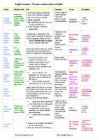
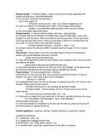
põhivorm, minevik, lausetes, present, simple, olevik, continuous, clock, today, perfect, already, yesterday, lihtolevik, korduvat, sometimes, often, usually, once, täisminevik, year, never, lately, lihtminevik, eitavas, came, while, enneminevik, olevikku, before, until, till, lihttulevik, ennustamine, tomorrowressive Yesterday at 6 infinitive + I was going This time on certain time (in the past) kestev ing he was going Friday · you don't know whether it was minevik finished or not Today,Never · you say that sth. has *äsja lõppenud have/has + Present this week. *täna/sel nädalal past happened or is finished in the I've worked Yet, ever . toimunud participle
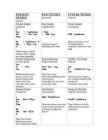
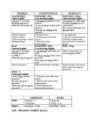
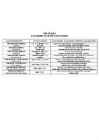
PRESENT PAST TENSES FUTURE TENSES TENSES minevik tulevik olevik Present Simple Past Simple Future Simple lihtolevik Lihtminevik Lihttulevik I You + I põhivorm + II pv We ? , - Do + I pv. ?, - Did + I pv Will + I põhivorm They He + I põhivorm + S Tegevus tulevikus, mis ei She ?,- Does + I pv Lõpetatud tegevus ole ettekavatsetud It (yesterday, last week) (tomorrow, next week, next year) Korduv tegevus, faktid (always, often, usually, every day, normally) Present Continuous Past Continuous GOING-TO Future
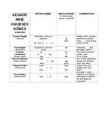
MOODUSTAMINE ABITEGUSÕNAD AJAMÄÄRUSED AEGADE Et moodustada eitavat, küsilauset NIHE KAUDSES KÕNES AJAVORM Present Simple Tegusõna I põhivorm Always, often, usually, Lihtolevik (algvorm) do sometimes, seldom, does every .... , once a year, he / she / it +s twice a month ...... Past Simple Tegusõna II põhivorm did Yesterday, ..... ago, Lihtminevik (+ ed) last night / week / .....
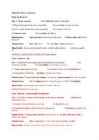
INGLISE KEEL Sisukord Sisukord 2 Ajavormid Tense vorms 3 Lihtolevik The present simple 3 Lihtminevik The past simple 3 Lihttulevik The future simple 3 Kestev olevik The present continuous 3 Kestev minevik The past continuous 4 Kestev tulevik The future conrinuous 4 Täisminevik The present perfect 4 Enneminevik The past perfect 4 Ennetulevik Future perfect 5 Üldminevik Past tense 5 Üldtulevik Future indefinite 5 Artiklid ja eessõnad 7 Eessõnad 7 Kesksõnad 8
INGLISE KEEL Sisukord Sisukord.................................................................................................................................. 2 Ajavormid Tense vorms.......................................................................................................3 Lihtolevik The present simple..................................................................................... 3 Lihtminevik The past simple....................................................................................... 3 Lihttulevik The future simple...................................................................................... 3 Kestev olevik The present continuous......................................................................... 3 Kestev minevik The past continuous
They are building a new bridge in our town. 2. Changes happening around now. The population of the world is increasing fast. 3. Arrangements for the future. I am flying to Toronto next Friday. Negative form: We aren't (are not) working at the moment. I am not enjoying this show very much. Question form: Are they playing football in the park right now?Why is she laughing? Signal words: at the moment, now, right now, Listen!, Look! etc. PRESENT PERFECT (täisminevik) Form: have/has + past participle (3. põhivorm) Use: 1. An action in the past, where the fact, not the time, is important. I have been to England four times. 2. An action in the past that has a result now. She has lost her keys. 3. Something that began in the past and still continues now. He has been in hospital since Monday. Negative form: We haven't (have not) done our homework yet. He hasn't (has not) visited his granny since August.
SIMPLE CONTINUOUS PERFECT I (-s) DO/DOES AM/IS/ARE + ING HAVE/HAS + III pv. I learn English I am learning English I have learned English. I get up at 7 every day. I'm reading a good book at the I've learned 10 words today. He doesn't get up at 7. moment. He hasn't learned any new What time do you get up? He isn't reading anything at the words today. moment. How many words have you What are you reading at the learned today? moment? 1 Korduv tegevus. 1 Praegu toimuv. 1 Äsja lõppenud 2 Püsiv olukord
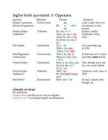
Inglise keele ajavormid: 5. Õppeaasta Ajavorm Tähendus Vormid Abisõnad Present Continuous Kestev olevik am Look! Listen! Now! At (Present Progressive) BE is +ING the moment. At the are present. Present Simple Üldolevik He, she, it + S Always, usually (Indefinite) They, we, you, I (s) Sometimes, every ?does (he, she, it) (s) often Do (they, we, you, I) (s) Past Simple Lihtminevik II pv/ -ed Last, yesterday, ago
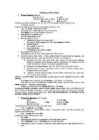
TENSES. ACTIVE VOICE. 1. Present Simple (üldolevik) I (he, she, it s) he works Eitav,küsiv do (I, you, we, they) he does not work does (he, she, it) does he work? Verbidele, mis lõpevad infinitiivis ss, -sh, -ch, -x või o, lisatakse ainsuse 3. pöördes es he touches, she goes Verbidel, mis lõpevad y-ga, mille ees on konsonant, muutub y->ies
Ing Present Simple Present Progressive/Continuous (lihtolevik) (kestev olevik) I vorm (play) am JAATAV he is I vorm+ing (playing) she I vorm+s (plays) are it do not I vorm (don't play) am
Ing Present Simple Present Progressive/Continuous (lihtolevik) (kestev olevik) I vorm (play) am JAATAV he is I vorm+ing (playing) she I vorm+s (plays) are it do not I vorm (don't play) am
Ing Present Simple Present Progressive/Continuous (lihtolevik) (kestev olevik) I vorm (play) am JAATAV he is I vorm+ing (playing) she I vorm+s (plays) are it do not I vorm (don't play) am
Affirmative tense Use Signal Words /Negative/Question · always · action in the present taking place Simple Present A: He speaks. · every ... once, never or several times N: He does not speak. tegevus, mis toimub ühe korra, mitte · never Lihtolevik Q: Does he speak? · normally kunagi või mitu korda
PRESENT SIMPLE [s] lihtolevik · kestvad tegevused. Tom works in the market. · rutiinid. He works every day. · loodusseadused. The sun sets in the west. · ajatabelid ja programmid. The buss leaves at 7 am. · (spordi) kommentaarid. Ben passes ball to Tom. väljendid, mida kasutatakse: usually, often, always, every day/week etc, in the morning/afternoon/evening, at night/the weekend, on Friday etc. He works He don't work Does he work PRESENT CONTINUOUS [ is + ing] kestev olevik · tegevused, mis praegu leiavad aset. Karl is doing his homework at the moment. · plaanitud tegevus lähitulevikus. I am going to school tomorrow. · kui midagi toimub/muutub praegu. The number of burglaries is increasing. · alati sama korduv tegevus. You are always eating, when i wake up. väljendid, mida kasutatakse: now, at the moment, at present, these days, nowdays, still, today, tonight etc. He is working He isn't working Is he working
Jaatav lause - reeglipärased tegusõnad 74 Jaatav lause - ebareeglipärased tegusõnad 75 Eitav ja küsiv lause 77 USED TO 78 LISTEN & REPEAT REPEAT 59 Lk. Üldtulevik 78 Kestev olevik 80 Kestev minevik 82 Täisminevik 83 Käskiv kõneviis 85 Tingimuslaused 85 CAN / COULD 86 MAY 88 MUST 89 SHOULD 90
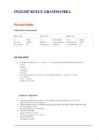
THE TENSES AJAVORMID JA NENDE KASUTAMINE AJAVORMI NIMETUS MOODUSTAMINE KASUTAMINE; SAGEDAMINI ESINEVAD AJAMÄÄRUSED THE PRESENT SIMPLE I pv. (+ s); do/does + I pv. Tegevus toimub korduvalt, on harjumuspärane. püsiv olukord, ajagraafikutega seotud tulevik Lihtolevik live, goes every day, usually, often, sometimes, always THE PAST SIMPLE II pv.; did + I pv. Tegevus toimub minevikus. Lihtminevik lived, went yesterday, last week two years ago, in 1998
Get/ Have something TENSE ACTIVE PASSIVE WHEN? done Present Simple Am/is/are + Every day, year, often, I pv + do/does Have/ get + sth+ III pv Lihtolevik III pv usually, always Past Simple Yesterday, last year,
AJAD Simple Present: (olevik. Kui midagi toimub iga päev. every day.) EXAMPLES: I play tennis. She does not play tennis. The train leaves every morning at 8 am. The train does not leave at 9am. She always forgets her purse. (Ta alati unustab oma koti) He never forgets his wallet. Every twelve months, the Earth circles the sun. The sun does not circle the Earth. Past Simple: (midagi on tehtud. Tegusõna tuleb panna minevikku ehk II põhivormi. Seda aega tuleb kasutada siis, kui lause väljendab tegevust, mis minevikus tehti ja ka ära lõpetati!) EXAMPLES: I saw a movie yesterday. (Ma nägin eile filmi. Nägin filmi lõpuni.) I didn't see a movie yesterday. Last year, I traveled to Japan. (Sõitsin Jaapanini välja, mitte ei jäänud reisi peal kuhugi toppama) Last year, I didn't travel to Japan. She washed her car. (Ta pesi auto ära
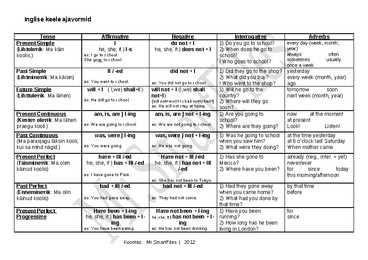
Inglise keele ajavormid Tense Affirmative Negative Interrogative Adverbs Present Simple I do not + I 1) Do you go to school? every day (week, month, (Lihtolevik: Ma käin he, she, it } I-s he, she, it } does not + I 2) When does he go to year) koolis.) ex: I go to school. school? always often She goes to school
Past tenses /mineviku ajad/ 1. Past Simple /lihtminevik/ Formation/moodustamine: -- Kõikides pööretes/isikutes tegusõna II põhivorm, mis reeglina lõpeb mineviku tunnusega ed (like liked (hääldub [laikt]); hate hated [heitid]). Ebareeglipäraste sõnade puhul tuleb kasutada II põhivormi (vt. irregular verbs; ebareeglipäraste verbide tabel; näit. write wrote; run ran; buy bought jne.) - Küsimuste ja eitava vormi moodustamisel tuleb tegusõna panna algvormi; aga lisatakse mineviku abisõna did (Did you like the film? She did not (didn't) read the newspaper. When did you come home?)
Olevik: PS He/she/it + -s /Does I/you/we sama /Do PC am/is/are + -ing PP ... + Have/has + III PPC ... + Have/has been + -ing Minevik: PS -ed/III PC Was/were + -ing PP I/she/it/you/they + Had + -ed/III PPC - ... + had + been + -ing PPS - ... + have/has + III Olevik: Present Simple Lihtolevik: Tegijale harjumuspärane, tihti korduv tegevus, loodusseadused, sõiduplaanid, püsiv olukord. Eevery day/month/ year/once twice a week /often/ usually/ always/seldom/never. Tulevikku väljendades pärast: when, after, as soon as, until. Olekut väljendavate tegusõnadega: Like, love, hate, enjoy, prefer, adore; See, hear, smell, taste, feel, look, sound; Know, believe, understand, realise, remember, forget, notice, recognise, think,
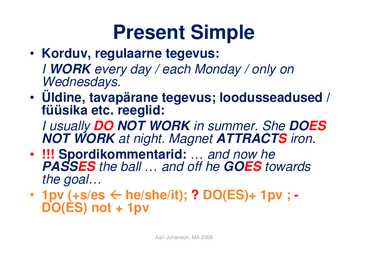
Present Simple · Korduv, regulaarne tegevus: I WORK every day / each Monday / only on Wednesdays. · Üldine, tavapärane tegevus; loodusseadused / füüsika etc. reeglid: I usually DO NOT WORK in summer. She DOES NOT WORK at night. Magnet ATTRACTS iron. · !!! Spordikommentarid: ... and now he PASSES the ball ... and off he GOES towards the goal... · 1pv (+s/es Å he/she/it); ? DO(ES)+ 1pv ; - DO(ES) not + 1pv Aari Juhanson, MA 2008 Present Progressive · Hetkel toimuv, pooleliolev tegevus: S/he IS TALKing on the phone now. I AM READing an interesting book. · Ajutine, regulaarsele ja tavapärasele vastanduv tegevus (tulevikku viitav): This summer they ARE not GROWing cucumbers as usual. They'RE GROWing tomatoes instead. · !!! Halvakspanu väljendus harjumuspärase tegevuse kohta: He IS always COMPLAINing! · BE (am/is/are) + 1pv-ing Aari Juhanson, MA 2008 Present Perfect ON -NUD
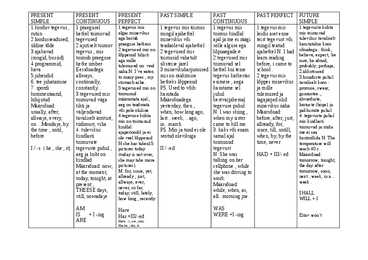
PRESENT PRESENT PRESENT PRESENT PAST SIMPLE PAST PAST PERFECT PAST PERFECT SIMPLE CONTINIOUS PERFECT PERFECT CONTINUOUS SIMPLE CONTINUOUS SIMPLE CONTINUOUS Lihtolevik Kestev olevik Täisminevik Kestev Lihtminevik Kestev minevik Enneminevik Kestev täisminevik enneminevik I pv Am/is/are, I pv, Has/have, III Has/have, II pv, -ed Was/were, -ing Had, III pv Had, been, -ing -ing pv/-ed been, -ing
Present tenses : 1) Present simple regular actions and routines especially with frequency(kordumine ) adverbs(määrsõna) N: Do you go to school by car every day ? I don't often watch TV. 2)Present continuousbe + verb + ing. Actions happening now N; Look! It's snowing. I'm meeting Jane tonight. You're always losing things. 3)keep + ingto describe habitual actions which may be irritating. N: my uncle keeps making silly jokes. Present perfect: 1) Present perfect simple: have/has + past participle. N: I've been here for ten minutes .The phone has rung ten times today. Look at this cheque,'I've won first prize. They have made a new star wars film. I've just got home. How long have you been here ? Have you ever been to Paris? It's the best book I've ever read. It's the first time I have ever been abroad. 2)Present perfect continious : have/has + been + ing. N:I've been living in this flat since 2000
I see that man who you are pointing at. · Üldist, kogu aeg toimuvat või korduvat tegevust, pole oluline, kas tegevus toimub rääkimise hetkel. Teachers teach in schools. He usually goes to gym on Monday. · Tegevust mingil ajal. I go to school at 8 o´clock. You have to pay taxes once a month. · Kõigile tuntud fakte. Life passes by quickly. Present Continuous Kestva oleviku moodustamine Jaatav vorm Eitav vorm Küsiv vorm I am speaking I am not speaking Am I speaking? He/she/it is going He/she/it is not going Is he/she/it going? We/you/they are making We/you/they are not making Are we/you/they making? NB! ERANDID!
AJAVORMI NIMETUS MOODUSTAMINE KASUTAMINE ; SAGEDAMINI ESINEVAD AJAMÄÄRUSED THE PRESENT I pv ( +s ); do/does Tegevus toimub korduvalt, on harjumuspärane. ev SMPLE live, goes every day, usually, often, somtimes, always,never Lihtolevik THE PAST SIMPLE II pv; did ,lived, Tegevus toimus minevikus. Lihtminevik went yesterday, last week, two years ago, in 1998 THE FUTURE SMPLE ( shall ) / will +I pv. Tegevus toimub tulevikus. Lihttulevik will go tomorrow, next week, soon, later, In 2050 THE FUTURE IN THE ( should ) / would +I Kaudses kõnes tuleviku asemel, kui pealause on
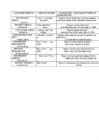
Inglise keeles Eesti keeles + -/? Usage Näited 1. Present Simple Lihtolevik I ajavorm Do, don't, does, doesn't A permanent state, a generally Every day, always, often, (He, she, it + -s) known fact, usual or repeated usually, sometimes, rarely,
AJAVORMID JA NENDE MOODUSTAMINE AJAVORMI NIMETUS MOODUSTAMINE KASUTAMINE, SAGEDAMINI ESINEVAD AJAMÄÄRUSED THE PRESENT I pv; do/does + I Tegevus toimub korduvalt, on harjumuspärane SIMPLE live, goes twice a week, every day, usually, often, sometimes, always THE PAST (+) II pv; did + I Tegevus toimub minevikus SIMPLE lived, went yesterday, last week, two years ago, in 1996 THE FUTURE (shall)/will + I Tegevus toimub tulevikus, on üksteisele järgnev
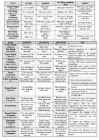
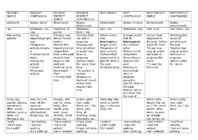
PRESENT PRESENT PRESENT PAST SIMPLE PAST PAST PERFECT FUTURE SIMPLE CONTINUOUS PERFECT CONTINUOUS SIMPLE 1.korduv tegevus , 1.praegusel 1.tegevus mis 1.tegevus mis toimus 1.tegevus mis 1.tegevus mis 1.tegevuste kohta rutiin hetkel toimuvad algas minevikus mingil ajahetkel toimus kindlal leidis aset enne mis toimuvad 2.loodusseadused, tegevused aga kestab minevikus või ajal ja me ei räägi teist tegevust või tulevikus tavaliselt
Present simple Work/works, do/does Every, often,usually,always,sometimes,once,twice, at weekends Püsiv ja korduv tegevus Tulevikus toimub tegevus, mis on seotud graafikute, sõiduplaanidega, tunniplanid Üleüldised tõed ja loodusseadused Kui midagi kommenteeritakse - tv Present continius am, is, are working be vormi abil tehakse now, at the moment, look, listen, hurry up just praegu toimub tegevus praegusel perioodil toimuv tegevus kõige kindlam tulevik ettekavatsetud tulevik Present perfect Have, has worked 3pv Eitavaid, küs have / has Ever, never, for, since, already, yet, today, this week / month / yrear Äsja lõppenud tegevus, millele visatakse pilk peale Tükk aega varem toimunud tegevus (eesti keeles nud) Elavate inimeste puhul kui tahame öelda, mida on oma elus teinud Present Prefect continius have has been working for, all, since, lately, recently tegevus algas minevikus, aga rõhutatakse, et parajasti nüüd kestab ta ikka edasi she has been working all morning
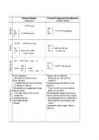
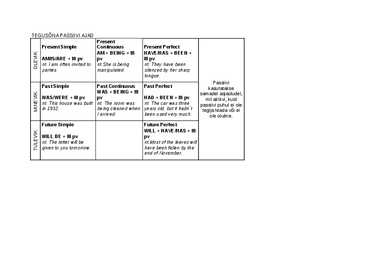
TEGUSÕNA PASSIIVI AJAD Present Present Simple Continuous Present Perfect AM + BEING + III HAVE/HAS + BEEN + OLEVIK AM/IS/ARE + III pv pv III pv nt. I am often invited to nt.She is being nt. They have been parties. manipulated. silenced by her sharp tongue. Passiivi
garden. Kui me tahame teada, kes või mis oli tegija, saame moodustada passiivi küsimuse Who/ What ... by?: Who was the book written by? Passiivi moodustatakse be (is/ was jne) + mineviku kesksõna (past participle) ehk III põhivorm (done/ cleaned/ seen jne). Aktiivilause sihitisest saab passiivilause alus. Aktiivilause tegusõna jääb samasse ajavormi, kuid muutub passiivseks. Aktiivilause alus ehk tegija jäetakse ära või pannakse lause lõppu prepositsiooni by järele: Present simple passive am/ is/ are + III pv (cleaned/ seen jne) Many accidents are caused by careless driving. Present simple active: Somebody cleans this room every day. passive: This room is cleaned every day. Past simple passive was/ were + III pv (cleaned/ seen jne) We were woken up by a loud noise during the night. Past simple active: Somebody cleaned this room yesterday. passive: This room was cleaned yesterday. These rooms were cleaned yesterday.
TENSES (Table) Past Simple Present Simple Future Simple Tegusõna 2. pv Tegusõna 1. pv Tegusõna on esitatud kujul [NB! He/She/It _____(e)s] Küsimuse/eituse will + 1. pv moodustamiseks kasut. Küsimuse/eituse did + 1. pv moodustamiseks kasut. Eituste moodustamisel do / does + 1. pv will not = won't Tunnused lauses: Lihtminevik
 annaabi.ee