Leidsid 33 sarnast õppematerjali, mis on seotud failiga "Imperial War Museum". Need materjalid aitavad sul teemat sügavamalt mõista.
museum, imperial, branch, first, mission, south, other, nation, north, collection, organisation, england, during, record, finally, royal, southwark, expand, period, building, referred, trust, admission, department, aire, british, five, founded, effort, britain, empire, today, gives, enable, understanding, impact, originally, housed, crystal, palace, hillArt Museum of Estonia Art Museum of Estonia was founded on November 17th, 1919, but it was not until 1921 that it got its first permanent building the Kadriorg Palace, built in the 18th century. In 1929 the palace was expropriated from the Art Museum in order to rebuild it as the residence of the President of Estonia. The Art Museum of Estonia was housed in several different temporary spaces, until it moved back to the palace in 1946. In September, 1991 the Kadriorg Palace was closed, because it had totally deteriorated by then. At the end of the year the Supreme Council of the Republic of Estonia decided to guarantee the construction of a new building for the Art Museum of Estonia in Kadriorg. Untill then the Knighthood House at Toompea Hill served as the temporary main building of the Art Museum of Estonia
London History The Romans AD 43- AD 410 The Romans finally invaded Britain in AD 43 from Kent. The Romans lead by Julius Caesar attempted to invade Britain twice before that in 55 and 54 BC but the invasions were unsuccessful. They made their way to the river Thames and sailed up it. The Romans knew it was important to control a crossing point at the river Thames, so they decided to build a settlement on the north bank. Although small settlements had been built on the banks of the Thames, the Romans were the ones who built the first city. They called their city Londinium. The Roman engineers noticed that the point where the swampy river narrowed would make an ideal crossing point, they built London Bridge. Less than 20 years later the native Iceni tribe, led by Queen Boudicca, rose up against the Romans in revenge for mistreatment and burnt Londinium to the ground
.............................3 2. History.........................................................................................................4 3. Early History...............................................................................................4 4. The Post-War Years....................................................................................5 5. Recent History.............................................................................................6 6. Estonian Maritime Museum and the Seaplane Harbour.............................6 7. Comments on the Seaplane Hangars...........................................................7 8. Restoration..................................................................................................7 9. Interesting Facts..........................................................................................8 10. Summary...................................................................................................9 11
London important sights guide Roman period 20th century · Big Ben is the nickname for the great bell of the clock at the north end of the Palace of Westminster in London and is often extended to refer to the clock or the clock tower as well. It is the largest four-faced chiming clock and the third-tallest free-standing clock tower in the world. The clock first ticked on 31 May 1859. The pendulum is installed within an enclosed windproof box sunk beneath the clockroom. It is 3.9m long, weighs 300 kg and beats every 2 seconds. The clockwork mechanism in a room below weighs 5 tons. · Buckingham Palace is the official London residence of the British monarch. Originally known as, the building which forms the core of today's palace was a large townhouse built for the Duke of
politics, education, entertainment and even fashion contribute to its status as a major global city. London is a major tourist attraction with four world heritage sites, several royal parks and numerous iconic landmarks such as the Houses of Parliament, Towe Bridge, the Tower of London, Westminster Abbey and the London Eye. 2. History Although there is some evidence of a permanent settlement before the Romans came in 43 A.D., it is more accepted by historians that the Romans were the first. The settlement was called Londinium. The first London lasted for just seventeen years, for around AD 61, a tribe of Celts led by Queen Boudica stormed London, burning it to the ground. The next heavily-planned London prospered and surpassed Colchester (another major city at the time) as the capital of the Roman province of Britannia. At its height in the 2nd century, Roman London had a population of about 60,000. However, by the 3 rd century, the city fell into a decline due to trouble in the
· Write to: The Ceremony of the Keys, Waterloo Block, HM Tower of London, London, England, EC3N 4AB, stating the names of the attendees and enclosing a self- addressed envelope, together with the requisite British Postage Stamps, or a minimum of two International Reply Coupons. Ham House · This suggestion comes from one of our New Zealand readers. · With such passion and vigor he has described this one. · The first Earl of Dysart was granted a peerage and the estate of Ham for enduring Charles I`s punishments when misbehaving. · It was his daughter, Elizabeth, very ambitious lady who had with help of her second husband, the Earl of Lauderdale built it even bigger and more grandeur. · Unfortunately, her lifestyle was too expensive so the family was left heavily in debt. · It was Horace Walpole who described Ham House as a `Sleeping Beauty`.
The UK & London The United Kingdom (or the UK) is a short way of saying the United Kingdom of Great Britain and Norther Ireland. The UK is situated north-west of the European continent between the Atlantic Ocean and the North Sea. The UK consists of England, Wales, Scotland and Northern Ireland. Its highest point is Ben Nevis in Scotland followed by Snowdon in Wales. The Severn is the longest river in the United Kingdom. Other important rivers are the Trent, the Mersey, the Tyne, etc. Lough Neagh which lies in the centre of Northern Ireland is thr UK's largest freshwater lake. The climate in the UK is variable. The weather changes so frequently that it is difficult to forecast. It is not unusual for people to complain that the weathermen were wrong. Fortunately there is no extreme weather conditions, it is never very cold or very hot.
The City of London History The City of London occupies one square mile in the middle of the capital. It once made up the entire town of London, surrounded by the wall first built by the Romans. The Roman Londinium grew up on the northern side of the "London Bridge" in the past. Products such as olive oil, wines and fruit were brought by ships from different parts of the Roman Empire and unloaded onto wooden quays along the river. In AD 61 the native Celtic Iceni tribe, led by Queen Boudicca, rose up against The Romans. They burnt Londinium to the ground but Roman armies eventually defeated Boudicca. The city was rebuilt and was gradually surrounded with a wall
It is unique for its well-preserved architecture from the 13-15 centuries. In contrast to the ancient town-walls and towers, Tallinn of today offers modern hotels, restaurants, sport and cultural centres. Every five years national song and folk dance festivals take place in Tallinn. The yachting regatta of the 1980 Moscow Olympic Games was held at Pirita. History Tallinn means in English "Danish town". The place is believed to have been settled by Finno-Ugric people about 2500 BC. It was first marked on a map of the world by the Arab geographer al-Idrisi in 1154. The Estonians were the first to build a stronghold on the spot of the Toompea Hill, but the real Tallinn was built by the Danes who conquered the north of Estonia in 1219. Legend has it that one day, when the Danes were about to lose a bloody battle, the sky suddenly opened and a red flag with a white cross on it dropped down upon them from the heaven. This is how the Danes obtained their national flag.
9A TALLINN Report Supervisor: Inge Välja Tallinn 2006 Order of contents: 1.Introduction 2.Toompea 3.Lower Town 4.Kadriorg and Pirita 5.Museums 1. Introduction Tallinn, the capital of Estonia, lies on the Baltic Sea. It is on almost the same latitude east St. Petersburg in Russia, Stockholm in Sweden and Stavanger in Norway, and covers 158 sq km. Tallinn was first marked on a map of the world by the Arab geographer al-Idrisi in 1154, its name then being Kolyvan (probably derived from the name Kalev). In the 13th-century Chronicle of Henricus de Lettis the town was called Lyndanise. Later came Reval (presumably after the old county of Rävala), the name used by the Germans who ruled the country for seven centuries. Russians then modified Reval to Revel. For Estonians, the town came to be called Tallinn from Taanilinn (Danish
London London is the capital of Great Britain. It is situated on the river Thames. The Thames is a river flowing through southern England and connecting London with the sea. The Thames has a length of 346 kilometres (215 miles). The first bridge was the tower bridge, built in the 12th century. The second bridge was built in the year 1750. .The river Thames divides London into the northern and the southern part. The port of London is one of the greatest trade centres in the world. The river Thames is certainly the most famous water body in London. London is also the seat of the government of Great Britain. It is one of the largest cities in the world with its population of about seven million
Rudyard Kipling - One of the most memorable English writers of all time Family of Joseph Rudyard Kipling Mother- Alice MacDonald Kipling. Alice Kipling (one of four remarkable Victorian sisters) was a vivacious woman about whom a future Viceroy of India would say, "Dullness and Mrs. Kipling cannot exist in the same room."[3] Father - John Lockwood Kipling. Lockwood Kipling, a sculptor, an illustrator, museum curator and pottery designer, was the principal and professor of architectural sculpture at the newly- founded Sir Jamsetjee Jeejeebhoy School of Art and Industry in Bombay. Later in life Kipling illustrated many of Rudyard Kipling's books, and other works. Kipling also remained editor of the Journal of Indian Art and Industry, which carried drawing works from the students of the Mayo School. COUPLE named their son after the place they had first met Rudyard Lake.
tribes. The Celts built a number of hill forts throughout the region. The society was divided into warrior aristocracy, agricultural commons and the priests, the druids. *Caesar in Britain - Britain was very rich in minerals but that wasn't the main reason Caesar wanted to defeat it. He could clearly see that Britain was a threat to his latest and greatest conquest - France. He invaded Britain twice, in 55 and 54 BC. The first invasion was unsuccessful - it gained a beachhead on the coast of Kent but achieved little else. The second was more successful, the Celts asked for truce. However it wasn't a victory he had imagined and Julius Caesar never returned to Britain after that. The island was left undisturbed for nearly a century. *The Roman occupation of Britain 43-410 and its legacy Britain was conquered by Emperor Claudius, the Roman rule in England lasted up to 410. The Romans left behind a
Delaunay continued to work in a mostly abstract style. During the 1937 World Fair in Paris, Delaunay participated in the design of the railway and air travel pavilions. When World War II erupted, the Delaunays moved to the Auvergne, in an effort to avoid the invading German forces. Suffering from cancer, Delaunay was unable to endure being moved around, and his health deteriorated. He died from cancer on 25 October 1941 in Montpellier. The Aichi Prefectural Museum of Art (Japan), the Albright-Knox Art Gallery (Buffalo, New York), the Art Institute of Chicago, the Berkeley Art Museum, the Bilbao Fine Arts Museum (Spain), National Museum of Serbia in Belgrade, the Fine Arts Museums of San Francisco, the Guggenheim Museum (New York City), the Honolulu Academy of Arts, Kunstmuseum Basel (Switzerland), the Museum of Modern Art (New York City), the National Gallery of Victoria (Australia), the National Galleries of Scotland, the New Art Gallery (Walsall,
eventual destruction fighting in the East, likely during the Bar Kochba Revolt. The invasion was delayed by a mutiny of the troops, who were eventually persuaded by an imperial freedman to overcome their fear of crossing the Ocean and campaigning beyond the limits of the known world. They sailed in three divisions, and probably landed at Richborough in Kent, although some suggest that at least part of the invasion force landed on the south coast, in the Fishbourne area of West Sussex. The Romans defeated the Catuvellauni and their allies in two battles: the first, assuming a Richborough landing, on the river Medway, the second on the Thames. One of the Catuvellaunian leaders, Togodumnus, was killed, but his brother Caratacus survived to continue resistance elsewhere. Plautius halted at the Thames and sent for Claudius, who arrived with reinforcements, including artillery and elephants, for the final march to the
1. What is known about the earliest settlers from Estonia to the territory of the present-day US? *The first immigrants from Estonia in the US = 1627 no trace of the "Estonians and Livonians" who left their homeland to settle at the mouth of the Delaware River (a Swedish colony) · 1654 at least one Estonian in the settlement of New Sweden on the Delaware River Johan Schalbrick, a drummer from Tallinn (Reval) · New Sweden Swedish colony on the Delaware River from 16381655 · 1657 Martinus Hoffman, born in Tallinn (Reval), came to New York (New
Estonia. Estonia, officially the Republic of Estonia is a country in Northern Europe. It is the smallest of the three Baltic countries. Estonia has land borders with Latvia (339 km) to the south and Russia (229 km) to the east. It is separated from Finland in the north by the narrow Gulf of Finland and from Sweden in the west by the Baltic Sea. Estonia has been a member of the European Union since May 1, 2004 and of the NATO since March 29, 2004. The area of Estonia is about 45000 square kilometres and the population is about 1.4 million people. The capital of Estonia is Tallinn and the official language is Estonian. The currency is Eesti kroon. The main religion is Lutheran. Anniversary of the republic is celebrated on February 20
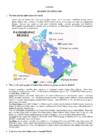
Physiographic regionalization is defined here as the process by which regions with relatively homogeneous physical geography are determined 2. Who are the native people of Canada? Into which three groups can they be divided? Canada's constitution specifies three categories of aboriginal peoples: Indian (First Nations), Métis, Inuit. According to Canadian census 2011, 1.4 mln people of Aboriginal origin (4.3%): 852,000 First Nations persons, 452,000 Métis, 59,000 Inuit. Indian (First Nations) - No written history before the contact with Europeans. Chief historical sources European priests, travellers and traders not interested in the preservation of "pagan"myths. Different estimates about their number in Canada when Europeans reached North America from 300,000 to 1 mln. Saw themselves as part of nature, not as its masters.
1. The Queen’s official title. Elizabeth the Second, by the Grace of God, of the United Kingdom of Great Britain and Northern Ireland and of Her other Realms and Territories Queen, Head of the Commonwealth, Defender of the Faith. 2. The Queen’s working day. Starts after breakfast. Reads the newspapers which are prepared by the Press Secretary, and a report on the previous day’s proceedings in the Parliament and the letters she receives. Also phone calls. Once a month she attends the Privy Council in order to give Royal Assent to various items of government legislation.
THE CITY OF LONDON History The City of London occupies one square mile in the middle of the capital. It once made up entire town of London, surrounded by the wall first built by Romans. The Romans also built a bridge over the Thames and there has been one in the same area ever since. The Roman Londinium grew up on the northern side of the bridge. In AD 61 the native Celtic tribe, led by Queen Boudicca, rose up against the Romans. They burnt down Londinium to the ground and killed most of its inhabitants. Roman armies eventually defeated Boudicca and Londinium was rebuilt.
History of Football Forerunners of football The creation of football as we understand it today is geographically confined to British shores, but there is extensive evidence of ancient games with the same basic principles as the modern day incarnation. The first of these was identified as part of Shang Dynasty China in the 5th century BC, the game's objective being to kick a leather ball through a hole in a piece of cloth which between two 30 foot poles. The Tsu'Chu military exercise in 3rd century China was also an interesting elaboration on this theme; the premise once again being to kick a leather ball through a 30-40 centimetre opening. As the Tsu'Chu exercise lacked the central team element of today's football, attention
Tallinn English College Topic Estonia Tallinn 2008 1. Introduction Estonia is a small country about the size of Switzerland, or New Hampshire and Massachussetts combined. Estonia is named after the people called "Ests" who lived in the region in the 1 st century AD. The Republic of Estonia is one of the three countries commonly known as the "Baltic States". The other Baltic States are Latvia and Lithuania. 2. Geographical position Estonia is situated in northeastern Europe. Estonia is bounded on the north by the Gulf of Finland, on the east by Russia, on the south by Latvia and on the west by the Baltic Sea. In the north it borders on Finland. The coastline of the Baltic Sea in Estonia is characterized by numerous gulfs and bays, the biggest of them being the Gulf of Finland, the Gulf of Riga and the Gulf of Pärnu. Bays include the
One of the mysteries is how it was built at all with the technology of the time. Another is its purpose. It appears to function as a kind on astronomical clock and we know it was used by the Druids for ceremonies marking the passing of the seasons. It appears in number of novels. These days it is not only the interest of tourists but is also a gathering point of certain minority groups. It is now fenced off to protect it from damage. 3. The Roman conquest Julius Caesar's first raid was in 55 BC but the romans left. Ad 43- the Romans came to stay. The army established Roman rule in the south and SW of the country. The Romans started to introduce their laws to a new province of the Roman Empire and started to build good roads. Officials were appointed (governors, procurators to collect taxes, look after the estates and mines and se that the gold, silver, iron and lead were exported back to Rome). Introduced schools,a new language Latin, large farms (villas), baths.
buildings, roads Christianity in Roman Britain Until 4th C christians were persecuted 313 AD Emperor Constantine legalised christianity 380 AD Emperor Theodosius I made it the official religion of the empire Paganism had been eclipsed but continued to pose a political, religious challenge Boudicca Queen of Iceni people of Eastern England, led an uprising against Roman forces Prasutagus(ruler) was first allowed to rule when romans conquered England, after his death, romans decided to rule Iceni and flogged Boudicca and raped her daughters 60-62 AD Iceni rebelled, Boudicca´s warriors defeated Roman Ninth Legion, destroied capital-Colchester Finally Boudicca was defetated, she poisoned herself to avoid capture Hadrian´s wall A defensive barrier builtin 122 AD by Roman emperor Hadrian to guard the northern part of
Romans were highly developed and had their own language latin, which has also greatly influenced English. The military occupation of the Isles ended in 410 AD. The Romans eventually brought Christianity to Britain. Hadrian's wall on the border of Scotland and England. It began construction in 122 AD. An Anglo-Saxon attack on Rome forced the Romans to leave The British Isles. They were replaced by Germanic tribes Angles, Jutes and Saxons, who drove the Celts to the north (Scotland) and west (Wales). They came from the North and Baltic Seas. Along with them came their dialects, which constitute the basis for Old English. Around 4500 words are still used today. They also had their own religion and Germanic gods. Their names are still used today: Freya Friday, Thor Thursday, Angle-land England. The Anglo-Saxons divided the cuntry into small warring kingdoms Northumbria, Mercia, Wessex, Sussex, Essex, Kent, East Anglia
In 1784 an amateur theatre began playing in a house situated in the same place and soon became a professional German City Theatre. The famous German writer August von Kotzebue (1761-1819), the life and soul of the theatre, lived in Tallinn for several long periods. (Otto von Kotzebue, the son of August von Kotzebue, accompanied explorer Adam Johann von Krusenstern on his Journey around the World of 18031806.) Estonian was heard from a theatre stage for the first time. Early in the 19th century city architect Carl Ludwig Engel (helped rebuild Helsinki and also built the palace at 8 Kohtu Street on Toompea) designed a sumptuous hall for the theatre, but it was destroyed in a fire. Another fire devastated the theatre in 1902, after which it moved out from Old Town. The premises came into the possession of the Puppet Theatre in 1955. In 1991, the whole building was given to the theatre. Renovation works took place in 2001-03. 5 17 Lai Street
The capital city is Washington D.C. Although the United States has no official language at the federal level, English is the de facto national language. English is the most common language for daily interaction among both native and non-native speakers. Spanish is the second language. The largest city is the New York City. The Government is Federal constitutional republic and the president is George W. Bush. 2. Geographical position The United States of America is located on the continent of North America. It has borders with two countries Mexico and Canada. There are also the Atlantic Ocean, the Pacific Ocean and the Gulf of Mexico surrounding the big country. There are 50 states in America. Most of the people live in towns. The biggest state is Alaska; next by size are California, Alaska and Montana. Six states - Maine, Vermont, New Hampshire, Connecticut, Rhode Island and Massachusetts are called New England. They are all small states in the USA that lie in the north- east
Department of Russian Literature and Modern Language Studies in 1948. Prof. Isacenko was still holding the leading post in 1950 when the Department of Russian Language and Literature came into being. In 1955, when Prof. A. V. Isacenko left Bratislava for Olomouc, the department already had ten full-time teachers. Russian studies continued developing in the second half of the 1950s and in the 1960s when Prof. A. V. Isacenko was replaced first by Assoc. Prof. . urovic (1955-1959) and then by Assoc. Prof. J. Kopanicák (1959-1970). The political turnaround in 1989, of course, also had impact on the evolution of Russian studies as an academic discipline. The department found itself in a peculiar situation. On the one hand, it represented one of the most developed philological disciplines with a large personnel and material base; on the other hand, the factors that had made Russian studies one
Some of the things you will learn in THE CODEBREAKERS • How secret Japanese messages were decoded in Washington hours before Pearl Harbor. • How German codebreakers helped usher in the Russian Revolution. • How John F. Kennedy escaped capture in the Pacific because the Japanese failed to solve a simple cipher. • How codebreaking determined a presidential election, convicted an underworld syndicate head, won the battle of Midway, led to cruel Allied defeats in North Africa, and broke up a vast Nazi spy ring. • How one American became the world's most famous codebreaker, and another became the world's greatest. • How codes and codebreakers operate today within the secret agencies of the U.S. and Russia. • And incredibly much more. "For many evenings of gripping reading, no better choice can be made than this book." —Christian Science Monitor THE
following criteria and pass the test of authenticity: Represent a masterpiece of human creative genius; Have exerted great influence, over a span of time or within a cultural area of the world, on developments in engineering theory, technology, construction, transportation, and communication; Be an outstanding example of a type which illustrates a significant stage in bridge engineering or technological developments. A World Heritage bridge, like other properties, must meet the test of authenticity in design, materials, workmanship, or setting (the Committee has stressed that reconstruction is only acceptable if carried out on the basis of complete and detailed documentation of the original artefact and to no extent on conjecture). The criteria of authenticity may apply to Japanese bridges like the Kintaikyo spanning the Nishiki River in Iwakuni or Palladio's bridge over the River Brenta at Bassano a Grappa near Venice (Italy)
Britain History Pre-Norman Britain The Iberians brought their metal-working skills and the first real civilization to Britain in the third millennium B.C and were overrun by various Celtic invasions that began in the 8th century. The Celts introduced their tribal organization and an early form of agriculture before they were forced westward by the Roman invasion. Forms of Celtic language are still spoken in Britain. Romans (with Julius Caesar in the head of them) first tried to occupy Britain in 55 B.C., but there was a rebellion in Gaul so they had to leave to fight against it
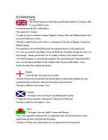
* it covers 243,610 sq km * everybody from the UK is called British * the capital city is London * is made up of four constituent countries: England, Scotland, Wales and Northern Ireland which in turn are divided into counties * the flag is called the Union Jack which is a combination of the flags of England, Scotland and Northern Ireland * the population is about 60,000,000 people, the population density is 242 people/sq km * its coasts are washed by the Atlantic Ocean, the North Sea, the English Channel, the Celtic Sea, Saint George's Channel, and the Irish Sea. It is linked to France by the Channel Tunnel * the United Kingdom is a constitutional monarchy. The current monarch is Queen Elizabeth II, who is also the Queen and Head of State of fifteen other Commonwealth Realms, such as Canada, Australia, New Zealand and Jamaica. England: * it has 50 cities, the capital city is London
Northern Ireland. The relatively limited variety of fauna and flora on the island is due to its size and the fact that wildlife has had little time to develop since the last glacial period. The high level of urbanisation on the island has contributed to a species extinction rate that is about 100 times greater than the background species extinction rate. 2 The History of the Great Britain The island was first inhabited by people who crossed over the land bridge from the European mainland. Traces of early humans have been found (at Boxgrove Quarry, Sussex) from some 500,000 years ago and modern humans from about 30,000 years ago. Until about 10,000 years ago, Great Britain was joined to Ireland, and as recently as 8,000 years ago it was joined to the continent by a strip of low marsh to what is now Denmark and the Netherlands. Britain in the reign of Elizabeth
 annaabi.ee