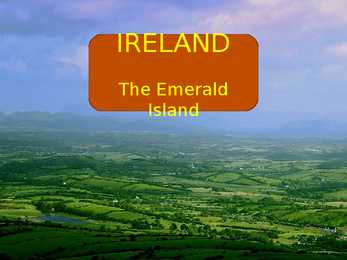
IRELAND The Emerald Island Ireland has two nicknames e ra l d Em Th e Isl e The Is l a nd of S aints a nd Scho l a rs 9000 years ago... ice more ice Click to edit Master text styles Second level Click to edit Master text stylesThird level Fourth level Second level Fifth level Third level Fourth level Fifth level Gaelic Ireland Lordship of Ireland Kingdom of Ireland United Kingdom of Great Britain and Ireland The Republic of Ireland Once humans ...
ICE AGE The earth is very old. During its long history there have been many changes in climate. Between one and two million years ago one of these changes took place the great Ice Age began. It grew colder in the Far North. More snow fell in the winter than could melt away in the summer. The snow grew deeper and deeper. It changed to solid ice. As more snow fell, the ice grew thicker. It began to move. Great sheets of moving ice, or glaciers, were formed. The edges of the sheets were pushed outward. At last the ice covered most of what is now Canada. And it spread southward into what is now the United States. The ice was probably a mile deep in places. It moved over hills and valleys, rivers and forests. It moved slowly perhaps only a foot a day. Millions of plants were buried by the ice. Many animals moved south. Among the animals able to stand the cold near th...
Ireland Position Ireland is the third largest island in Europe, and the twentieth largest island in the world. It lies to the northwest of Continental Europe and is surrounded by hundreds of islands. To the east of Ireland, separated by the Irish Sea, is the island of Great Britain. Politically, the Republic of Ireland (also known simply as Ireland) covers five sixths of the island, with Northern Ireland, part of the United Kingdom, covering the remainder in the northeast. Climate Overall, Ireland has a mild, but changeable, Oceanic climate with few extremes. The warmest recorded air temperature was 33.3 °C at Kilkenny Castle, County Kilkenny on 26 June 1887, where as the lowest recorded temperature was 19.1 °C at Markree Castle, County Sligo on 16 January 1881. Inland areas are warmer in summer, and colder in winter there are usually around 40 days of below freezing temperatur...
Wayne Gretzky Presentation Who? Wayne Douglas Gretzky He was born January 26, 1961 Canadian professional ice hockey player Early years... First goals at age two First team at age six First coach Dick Martin Over 1000 goals by age 13 NHL Carieer 20 years in NHL 1979 1988 Edmonton Oilers 1988 1996 Los Angeles Kings 1996 St. Louis Blues 1996-1999 New York Rangers 61 records Thank you for your attention!
concluded otherwise. The haplogroup R1b is found to dominate throughout Ireland, contradicting the idea that Celtic culture was established in Ireland via the mass migration of Celtic people from Central Europe. [27] A study conducted by Trinity College Dublin, and part-funded by the National Millennium Committee, concluded that the Irish are primarily descended from people who migrated north from Iberia after the Ice-Age ended some 12,000 years ago. The geneticists who conducted this research, produced a map of Europe with contours linking places that corresponded in terms of genetic ancestry. One contour goes around the edge of the Atlantic, around Wales, Scotland, Ireland and includes Galicia and the Basque Country.[28] Over the last 1,000 years, there have been influences by the Vikings, who founded several ports, including Dublin, and Normans, with some admixture to the gene pool
POPSICLE AND LOLLIPOP About popsicle ● a water-based frozen snack ● ice lolly, ice poles, freeze pops, popsicle ● made by freezing flavored liquid around a stick (fruit juice) History ● Frank Epperson at the age of 11 ● 1905 ● he left a glass of powdered soda and water with a mixing stick in it outside during a cold night How to make ● https://www.youtube.com/watch?v=lgmBhhvTJqQ ● take the popsicle containers ● put whatever you like in it-juice, yoghurt, fruits, or everything together) ● place a stick in it and put it in a freezer ● after a few hours take it out and enjoy About lollipop ● a type of sweet candy consisting mainly of hardened, flavored sucrose with corn syrup on a stick ● intended for licking History ● George Smith is claimed to be the first to invent the modern lollipop in 1908 ● related to the Rome tradition of selling toffee apples on a stick ● the invention is still something of a mysery Types ●...
The Weather and Climate 'Funny weather we are having' is a statement of the obvious we have used for generations as a greeting. When the deep cold lasts long and heavy snow and blizzards give us the shivers we replace "funny" with something stronger, such as "terrible", "ghastly". At times like these people ask what is happening to the weather. So we go to the experts, who tell us in language appropriate to the subject, what happened yesterday, what is happening today, and what might happen in the next few years. Weather and climate specialists all over the world have collected a vast quantity of information. They can describe what is happening around us. With satellites they can forecast more accurately what might happen in the immediate future. Their research has produced evidence of why past climatic changes took place. There have been many climate fluctua...
The history of Scotland begins around 10,000 years ago, when humans first began to inhabit what is now Scotland after the end of the Devensian glaciation, the last ice age. Of the Stone Age, Bronze Age, and Iron Age civilization that existed in the territory, many artifacts remain, but few written records were left behind. The recorded history of Scotland begins with the arrival of the Roman Empire in Britain, when the Romans occupied what is now broadly England, Wales and the Scottish Lowlands, administering it as a Roman province called Britannia. To the north was territory not governed by the Romans -- Caledonia, by name. Its people were the Picts. From a classical historical viewpoint Scotland seemed a peripheral country, slow to gain advances filtering out from the Mediterranean fount of civilisation, but as knowledge of the past increases it has become apparent that some developments were earlier and more advanced than previously ...
Test 18 1 Translate. 1 Haruldased loomad on kaitse all. Rare animals are under protection. 2 Jääaeg on populaarne film. Ice age is a popular movie. 3 Rebasejaht on kõrgklassi ajaviide. Fox Hunting is an upper-class pastime. 4 Ma pean iga päev klaverimängu harjutama. I have to practise playing the piano every day. 5 Mitu sportlast sellel võistlusel osales? How many athletes participated in this competition? 6 Vanemad on vastutatavad oma laste eest. Parents are responsible for their children. 7 Me asusime teele varahommikul. We set-off early in the morning. 8 Kas sa saad paar minutit oodata? Can you wait a couple of minutes? 2 Write sentences using the information in the table. 1 Mary likes singing, travelling and ice cream. 2 Tom likes ice cream, stories about animals and travelling. 3 Mary doesn´t like stories about animals or watching cartoons. 4 Tom doesn´t like watching cart...
Roald Dahl “The Landlady” Worksheet 1 1. Find information about the setting: town, time of day, weather. TOWN: Bath TIME OF DAY: nine o’clock in the evening WEATHER: air was deadly cold and the wind was like a flat blade of ice 2. At the beginning, we find out that the story is about: a) a young man who is looking for a pub in London b) a young man who is looking for a place to stay in Bath + c) a young man who is cold and tired because of a long train journey. Bill has come there: a) to make new friends b) to take on a new job + c) to find loggings The houses along the street: a) are in good condition b) are no longer lived in c) are in need of repair + 3. Find information about the first character: full name, age, job, travelling from..via..by FULL NAME: Billy Weaver AGE: 17 JOB: he came...
Topic Canada History The first people to live in what is now Canada arrive from Asia at least 20 000 years ago. They arrived by a way of a land bridge that once connected Asia and North America at what is now Alaska. In 1497, John Capot, an Italian navigator in the service of England found rich fishing grounds off Canada's southeast coast. France took the lead in exploring the country and set up a colony in eastern Canada in the early 1600's. Great Britain gained control of the country in 1763 and thousands of British immigrants began to join the French who remained in Canada. Canada gained its independence from Britain in 1931. Position/area Canada is the second largest country in the world. Canada extends across the continent of North America, from Newfoundland to British Columbia. Over 5000 km of border separate Canada and the United States...
Sports I like to do sport. I have done sport for whole life. That may-be because my parents do sport, actually our whole family do sport. My dad is good at duatlon (that realm consist of bike riding and running). He is good cross county skier. He attends many others field sports too example orientation, cross country riding, ice-skating, roller-skating and many others. My mum is PE teacher. Older sister Karmen plays basketball in Pärnu sports school. Smaller sister Karolin is a skier. She also dance and go to gymnastic training. I go to volleyball trainings in Pärnu five times a week. I have played volley- ball about two years. I like play volleyball, because it is fun and nice game. I am (with Falck Pärnu volleyball team) winner of u-16 volleyball championship. I have always liked ballgames. When I was younger I played basketball, football and table-tennis. When I went to grade school I played ch...
The Day After Tomorrow The Day After Tomorrow is a disaster film dealing with global warming starring with Dennis Quaid in the role of government climatologist Jack Hall, Jake Gyllenhaal in the role of Jack's son, Ian Holm in the role of Jack's colleague and Sela Ward in the role of Sam's best friend . Film is directed by Roland Emmerich who has also directed the film Independence Day. This film talks about global catastrophe, where second ice age is coming with a huge storm before it. A climatologist Jack Hall's researches show that his fears are coming true. He must go to the White House to warn everybody, but in addition he must reach to New York to save his son who is draped in a library by storm. On the plus side the movie is visually stunning. Special effects are great and there is plenty of action to keep you in front of the screen. On the other hand some people may not like how far all this climate changing has taken and f...
Global warming means that the temperature keeps going higher. The world is now warmer than at any time since the last Ice Age. The problem of desertification increases every year. More and more fertile areas become useless. Seas, lakes and other bodies of water dry out. One reason why the global warming is happening is that the population is growing and we need to do more work so everyone can feel themselves comfortable. They have enough to eat, new clothes, warm house and so on. Some areas become uninhabitable so people have to move around and maybe even fight for something. For example for clean water. People so far have acted careless and not thinking ahead too far in the future. There have been few who have tried to stand out and make others understand what they should do. They have showed what has happened so far and what will happen if no action is taken under consideration. Global warming and our part in it is a serious problem...
Canada. Canada is a very large country. It is over 600,000 sq kilometers larger than the United States. Over 5,000 km of border separate Canada and the United States. Canada does not have nearly as many people as the United States, it has only a tenth as many. Its climate helps to explain why there are so few people in so big land. The northern part of Canada is called Eskimo land and there are very cold winters. Only in the southern part and the west coast is the climate as mild as in the western part of the United States. During the Ice Age almost all of Canada was covered time after time whit great sheets of ice. These sheets carried away much of Canada's soil to the United States. Parts of Canada were first settled by the French, part of it by the English. Picturesque Quebec is the most French, of Canada's big cities. Canada's largest city, Montrea...
The foundation stones The Island Britain has a mild climate due to the Gulf Stream which brings warm waters from the Gulf of Mexico. The northern part of the island in average 5'C cooler and it's mountainous or hilly and that's why the south has been more populated.. Britain became an island only 5000 years BC after the Ice Age ended. Britain's prehistory The first evidence of human life on the island are dated back to 250 000 BC. 50 000 BC in a milder Ice Age period Britain became habitable again. People from that time were the ancestors of the modern British. 10 000 BC ige age ended and Britain became inhabited by small groups of hunters who probably followed herds of deer. 5000BC Britain became an island and deer died out. 3000BC the Neolithic people came (probably from Spanish peninsula or even North African ...
Scotlan History The history of Scotland begins around 10,000 years ago, when humans first began to inhabit Scotland after the end of the Devensian glaciation, the last ice age. Of the Stone Age, Bronze Age, and Iron Age civilization that existed in the country, many artifacts remain, but few written records were left behind.People lived in Scotland for at least 8,500 years before recorded history dealt with Britain. The written history of Scotland largely begins with the arrival of the Roman Empire in Britain, when the Romans occupied what is now England and Wales, administering it as a Roman province called Britannia. To the north was territory not governed by the Romans -- Caledonia, by name. Its people were the Picts. From a classical historical viewpoint Scotland seemed a peripheral country, slow to gain advances filtering out from the Mediterranean fount of civilisation, but as knowledge of the past incr...
Brazil, officially the Federative Republic of Brazil, is a country in South America. It is the fifth largest country by geographical area, occupying nearly half of South America. Bounded by the Atlantic Ocean on the east, Brazil has a coastline of over 7,491 kilometers. It is bordered on the north by Venezuela, Suriname, Guyana and the overseas department of French Guiana; on the northwest by Colombia; on the west by Bolivia and Peru; on the southwest by Argentina and Paraguay and on the south by Uruguay. Population of Brazil is made up of many racial and ethnic groups. The last National Research for Sample of Domiciles (PNAD) census revealed the following: 49.4% of the population are White, about 93 million; 42.3% are Pardo (brown), about 80 million; 7.4% are Black, about 13 million; 0.5% are Asian, about 1 million; and 0.4% are Amerindian, about 519,000. Most native peoples who live and lived within Brazil's cu...
Artikkel Artikkel puudub Määrav artikkel Isikunimed: Perekonnanimed mitmuses: Veiko the Tamms Tom Smith the Talvistes Riiginimed, kontinendid: Riigi või piirkonna nimed, mis on mitmuses Estonia või kus on täiendina pärisnimi, kingdom, France state või republic: Asia the United Kingdom = the UK Europe the United States of America = the USA = the US the Republic of Estonia the Estonian Republic the United Arab Emirates ...
Canada Geography The geography of Canada is vast and diverse. Occupying most of the northern portion of North America, Canada is the world's second largest country in total area. The highest point in Canada is Mount Logan 6,050 m, which is in the Yukon. The two principal river systems are the Mackenzie and the St. Lawrence. The St. Lawrence, with its tributaries, is navigable for over 3,058 km. The largest lake situated entirely in Canada is Great Bear Lake at 31,328 km2 in the Northwest Territories. The largest lake which is at least partly in Canadian territory is Lake Superior Climate Canada's climate is as diverse as its landscape. Generally, Canadians enjoy four very distinct seasons, particularly in the more populated regions along the US border. Daytime summer temperatures can rise to 35°C and higher, while lows of -25°C are not uncommon in winter. More moderat...
Prehistoric Britain · They built forts on hilltops and · When the English Channel was pro-tected them with ditches and formed by meltic ice(around 6000 BC), ramparts. Britain was part of the European land mass. · The earliest inhabitants lived in limestone caves. · About 3000 BC the British Isles were inhabited by a people as known as the Iberians. · Celts and Iberians both lived under · They used stone axes and made the primitive system: there was no antlers and bones into leather-working private property, no classes and tools. exploitation. · Inhabitants put up buildings of · They caught fish, grew wheat and stone and wood, built the fi...
olar bear communication P Polar bear v The polar bear or the sea/ice bear are the world's largest land predators. They can be found in the Artic, Canada, Russia, Denmark (Greenland), and Norway. v In the wild polar bears live up to age 25. v Polar bears have been known to swim 100 miles at a stretch. v Polar bears primarily eat seals. Communication v When a Polar bear wants to play, he communicates this to another bear by wagging his head from side to side. Such play sessions involve ritualised fighting or mock battles. v A mother Polar bear can comfort, protect, or punish her cubs by using her body, muzzle, or paws and scold her cubs with a low growl or a soft cuff. Communication v Among Polar bears, hissing, snorting and a lowered head signifies aggression. An attacking Polar bear will charge forward with head down and ears laid back. Submissive Polar bears always move downwi...
Retelling the Aboriginal people 1. The formation of the continent Australia, a continent of geographic and biological diversity (mitmekesisus), has an amazing range of animal and plant life, as well as one of the world's oldest ethnic groups. After the last Ice age, when sea rose considerably (märkimisväärselt kasvanud), Australia and its largest island Tasmania, became isolated form the rest of Asia. 2. The earliest inhabitants The earliest humans living in Australia are called Aborigines and they are descended (pärinevad) from among the earliest humans in the world. For thousands of years Aborigines lived as hunter-gatherers along the coast and in the inland desert areas, following the same lifestyle as their ancestors. 3. Finding food and water Aboriginal tribes obtained water from trees and roots and even squeezed water out of the bodies of frogs. Women collected anything that grew or moved,...
Territory and landscape Canada is one of the largest countries in the world. It covers nearly 4 million square miles. It is dividend into ten provinces( British Columbia, Manitoba, New Brunswick, Alberta, Nova Scotia, Ontario, Prince Edward Island, Quebec, Saskatchewan, Newfoundland ) along with two territories( the Yukon, the Northwest territories ). The capital city is Ottawa. Canada is a country rich in forests. It borders in the south with The United States and it's surrounded in the west by the Pacific Ocean, in the east by the Atlantic Ocean and above by many smaller bays, but is also borderedd with Alaska in the north-west. To the north of Canada is the broad Canadian Shield, an area of rock scoured clean by the last ice age, thinly soiled, rich in minerals, and dotted with lakes and rivers. Canada by far has more lakes than any other country and has ...
Report Title: ,,Frankenstein'' Author: Mary Shelley Genre: Novel Setting (time): 19th century Setting (place): North Pole, Europe (Switzerland, Scotland, England) Tone: magical, dark, mysterious, ghostly Themes: love, loneliness, science, human tendency Introduction Frankenstein was first published in March, 1818. This book is also known as The Modern Prometheus. Frankenstein is one of the most popular works of gothic horror and science fiction literature and it is considered to be one of the best known novels of English Romanticism. Characters Robert Walton: Walton is a well-educated sea captain who wants to explore the North Pole. He meets Victor there and then he writes Victor's story to his sister. Victor Frankenstein: A young man who is interested in science, chemistry and nature and he is the creator of the monster. Elizabeth Frankenstein: The wife of Victor and who is later ki...
Topic Canada Canada is the second largest country in the world, only Russia has a greater land area. It covers nearly 4 million square kilometers. Canada is a country that is occupying most of northern America and it shares land borders with the United States to the south and northwest. Canada has the longest coast line and has about one fourth of all the fresh water available in the world. Canada has six time zones and it consists of ten provinces and three territories. Canada's birthday is on the first of July and its motto is: "From sea to sea". The first inhabitants were the ancestors of the Aborigines. Today Canada is the home of over a million Aboriginal people. They came to Canada about 25 000 years ago. First Europeans came to Canada about 1000 years ago. The first Europeans in Canada were the Vikings. The population of Canada is about...
12. Articles zero, a/an, the Zero · Zero article is used, when article the or a/an is not used. · Articles are not used with the names of languages. Example: He was learning Chinese. · Is not used with the names of sports. Example: She plays badminton and basketball. · Is not used before academic subjects. Example: She's taking economics and math. · Is not used with seasons. Example: In spring, we like to clean the house. · Is not used with institutions. Example: He's in church/college/jail/class. · Is not used with meals. Example: Breakfast was delicious. · Is not used with diseases. Example: She has cancer. · Is not used with time of day. Example: We'll be there around midnight. · Is not used when you are speaking about transport. Example: He comes to work by taxi. A/an Using a or an depends on the sound that begins the next word. · a is used before ...
Tallinn is a small port town in which the population is 371 000 people, and the area is only 159,2 km².( square kilometers). Tallinn, the capital of Estonia, is named after taani linnus, which means Danish castle. The Castle in question was built by King Waldemar of Denmark in the 13th century. The settlement quickly developed itself into a busy port. -The Old Town In medieval age Tallinn was called Reval and it was as big as the Tallinns Old Town is now. Uniqueness of Tallinn is that it is one of very few European cities, where the historical lay-out is kept in it's original form , and has a lot of monuments of that time. Thanks to that in 1997 Old Tallinn has been included in the list of a world heritage of UNESCO. -The Raekoja Square The Raekoja Square is used for senturies like market and fair square, here took place many festivals, and criminals were executed. In summer on Raekoja Square many open air conserts ...
American literature The literary history of this nation when the first humanbeing living in what has since become the U.S used language creatively. · Mid to late 18 century put down · Words are powerful, magical · Words must be remembered · Native Americans stories creation of the world · Attidude thought their land/language · Similar stories Dates and names · America was discovered in 1492 by Columbus · 1497 John Cabot went to Canada · 1579 San Fransisco/St. Fransis · 1607 Jamestown collony/John Smith · 1620 a boat called MayFlower · 1630 Boston was established · 1636 Harvard University · 1773 Boston Teaparty · 1775 War of Independence · 1776 4 July Declaration of Independence · First President George Washington Christopher Columbus Chris...
LONG BEFORE the white man set foot on American soil, the American Indians, or rather the Native Americans, had been living in America. When the Europeans came here, there were probably about 10 million Indians populating America north of present-day Mexico. And they had been living in America for quite some time. It is believed that the first Native Americans arrived during the last ice-age, approximately 20,000 - 30,000 years ago through a land-bridge across the Bering Sound, from northeastern Siberia into Alaska. The oldest documented Indian cultures in North America are Sandia (15000 BC), Clovis (12000 BC) and Folsom (8000 BC) Although it is believed that the Indians originated in Asia, few if any of them came from India. The name "Indian" was first applied to them by Christopher Columbus, who believed that the mainland and islands of America were part of the Indies, in Asia.
The United Kingdom The United Kingdom consists of England, Scotland, Wales and North Ireland and it is situated in the Atlantic Ocean near the mainland of Europe. The population of the UK is 58.6 million and area is 244,110 sq km. Britain has a temperate humid climate. Its characteristic features are mild winters, warm summer, no temperature extremes, abundant rain all year round and frequent changes of weather. The mild climate is partly due to the warm Gulf Stream and partly to the south westerly winds. Occasional winds from the east in winter may bring cold and dry weather. The distribution of rainfall is influenced by the Atlantic Stream. The mountainous areas of the north and west have more rain than the lowlands of the south and east. Wales is located on a peninsula in central-west Britain. The entire area of Wales is about 20,779 km². Wales borders by England to the e...
Project ESTONIA MAP OF ESTONIA Southern Viljandimaa The southern part of Viljandi county catches the eye with its sublime scenery. The area today lies in the very heart of the historical Mulgimaa the home of hills, deep valleys and lakes brought together by a beauty spot Halliste primeval valley. According to several folk tales, it is also in these valleys, woods and bogs that Old Nick found refuge.The great variety displayed in the nature is also reflected in the local cultural heritage. At the beginning of the 19th century growing linen spread and became the basis of the legendary wealth of Mulgi farms. The ancient barn-dwellings and decaying manor houses are the mute witnesses of those times. The riches and cultural heritage of Mulgimaa owe to the diligence and tenacity of the local people. Village handicraftsmen and masters have always been honoured. Mulgikapsad (stewed sauerkraut with barley gro...
Estonia. Estonia, officially the Republic of Estonia is a country in Northern Europe. It is the smallest of the three Baltic countries. Estonia has land borders with Latvia (339 km) to the south and Russia (229 km) to the east. It is separated from Finland in the north by the narrow Gulf of Finland and from Sweden in the west by the Baltic Sea. Estonia has been a member of the European Union since May 1, 2004 and of the NATO since March 29, 2004. The area of Estonia is about 45000 square kilometres and the population is about 1.4 million people. The capital of Estonia is Tallinn and the official language is Estonian. The currency is Eesti kroon. The main religion is Lutheran. Anniversary of the republic is celebrated on February 20. The national flower is cornflower, national bird is barn swallow and national stone is limestone. It is a land of great natural beaut...
TartuWaldorf School FINLAND Report Johan Mähar Tartu 2008 Contents p. 1. Introduction....................................................................................................1 2. Nature and geography.....................................................................................2 3. Position and size.............................................................................................2 4. Climate..............................................................................................
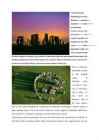
STONEHENGE Stonehenge is surely Britain's greatest national icon, symbolizing mystery, power and endurance. Its original purpose is unclear to us, but some ...
Tallinn English College Topic Estonia Tallinn 2008 1. Introduction Estonia is a small country about the size of Switzerland, or New Hampshire and Massachussetts combined. Estonia is named after the people called "Ests" who lived in the region in the 1 st century AD. The Republic of Estonia is one of the three countries commonly known as the "Baltic States". The other Baltic States are Latvia and Lithuania. 2. Geographical position Estonia is situated in northeastern Europe. Estonia is bounded on the north by the Gulf of Finland, on the east by Russia, on the south by Latvia and on the west by the Baltic Sea. In the north it borders on Finland. The coastline of the Baltic Sea in Estonia is characterized by numerous gulfs and bays, the biggest of them being the Gulf of Finland, the Gulf of Riga and the Gulf of Pärnu. Bays include the Narva Bay, Matsalu Bay, Kolga Bay, Kunda Bay, Tallinn Bay etc....
Cities Muckanaghederdauhaulia - This is probably the longest place name in Ireland. it consists of 22 letters There is also a village in Ireland called '' Inch village'' outside the village there is a sign '' Inch 1 mile'' i couldn't find a picture of it from the internet so i created a sign myself to make it more clear, so that can be quite confusing for a foreigner The capital city , Dublin was founded by the Vikings in 841 Worth to mention The Titanic was built in Harland and Wolff yards in Belfast , which is nowadays part of the Northern Ireland , but back then in 1909 - 1912 (which is the time when Titanic was built ) it was still part of the Ireland. So the worlds most famous ship was built in Ireland. Also Guinness beer originated in Arthur Guinness' brewery at St. James's Gate in Dublin. Nowadays it is one of the most successful beer brands in the world, being exported worldwide. sports : First I'm going...
Introduction to Literature N.Raud Lecture 1 Some Theories of Literature Sources: Sylvan Barnet. Morton Berman. William Burto. 2000. An Introduction to Literature. Fiction. Poetry. Drama. Boston. Toronto: Little, Brown and Company. Guy De Maupassant, Hautot and His Son, pp.325333 James Joyce, Araby,pp.345349 William Faulkner, The Bear, ÕIS, SMFolder WHAT IS LITERATURE? Literature is a "performance in words". It has an element of entertaining display, we expect literature to be in some sense entertaining, or, to afford pleasure. WHAT IS IT THAT MAKES LITERATURE PLEASANT? A literary work seizes our interest and more or less at least for a moment makes the rest of the world fade and vanish. A work of art has this power to catch us up momentarily and to delight us. TRUTH IN LITERATURE Art offers truth as well as pleasure. What ki...
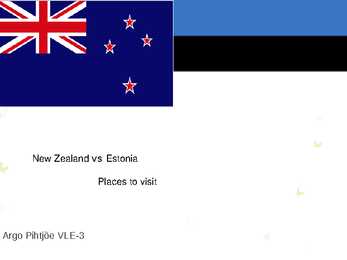
New Zealand vs Estonia Places to visit Argo Pihtjõe VLE-3 Some facts: Full name: Republic of Estonia Full name: New Zealand Population: 1.3 million (UN, 2010) Population: 4.3 million (UN, 2010) Capital: Tallinn Capital: Wellington Area: 45,227 sq km (17,462 sq miles) Area: 270,534 sq km (104,454 sq miles) Major languages: Estonian Major languages: English, Maori Major religion: Christianity Major religion: Christianity Life expectancy: 69 years (men), 79 Life expectancy: 79 years (men), 83 years (women) (UN) years (women) (UN) Monetary unit: euro Monetary unit: 1 New Zealand dollar Main exports: Machinery, textiles, wood ($NZ) = 100 cents products Main exports: Wool, food and dairy GNI per capita: US $14,060 (World...
FORMATION OF MEDIEVAL kARELIA · WHAT WAS BEFORE MIDDLE AGES · WHAT CHANGES OCCURRED WITH IT HOW KARELIA LOOKED LIKE WHEN NEW · ERA DAWNED IN 16th CENTURY GEOGRAPHY OF KARELIA AND ITS RELEVANCE Click to edit Master text styles Major changes in prehistoric times in Second level Karelia Third level Transgression of Ladoga Birth of Vuoksi 3700 BCE Fourth level Birth of Neva 1300 BCE Fifth level Land rise during entire period from Ice Age till today, leading most notably to changes in Vuoksi river's flow Crossroads of trading routes White Sea/Arctic Ocean Upper Volga / Caspian basin Baltic Sea basin Dnepr / Black Sea basin Daugava Waterways: Gulf of Finland, Ladoga, Onega, White Sea, Neva, Vuoksi, Svir, Volkhov, Vyt...
Semiootika essee Reklaamklipi analüüs Antud essees analüüsin Maakera ühte reklaami võttes aluseks Umberto Eco visuaalsete kujutiste kodeerimise mitmetasandilise struktuur. Valik selle konkreetse firma telereklaami kasuks oli tingitud hiljuti kirjutatud põhjalikust uuringust AS Nordic Foods´i kommunikatsioonist ning brändingust ning seetõttu tundus loomuliku jätkuna, et ma ka selles töös analüüsin sama kaubamärki. Maakera kaubamärk loodi 2004. aasta mais ning tegemist on täiesti Eestimaise asutusega, nimelt loodi antud firma (AS Nordic Foods) Eestimaist kapitali kasutades. Müügiartikliteks on valimistoidud, supid ja kapsad. Poodides paistavad Maakera tooted välja oma nö eriliste pakendite poolest st need näevad õige lihtsad välja: pakendis oleva toidu pilt, Maakera logo, toidu nimetus (need on küll kohe väga erilised) ning kena valge taust, mis vaheldub kohati rohelisega (seda põhjendas Maakera turundusjuht Katre Kõvask sellega, ...
Japanese festivals Japanese festivals are traditional festive occasions. Some festivals have their roots in Chinese festivals but have undergone dramatic changes as they mixed with local customs. Some are so different that they do not even remotely resemble the original festival despite sharing the same name and date. There are also various local festivals (e.g. Tobata Gion) that are mostly unknown outside a given prefecture. It is commonly said that you will always find a festival somewhere in Japan. Matsuri is the Japanese word for a festival or holiday. In Japan, festivals are usually sponsored by a local shrine or temple, though they can be secular. There is no specific matsuri days for all of Japan; dates vary from area to area, and even within a specific area, but festival days do tend to cluster around traditional holidays such as Setsubun or Obon. Almost every locale has at least one mat...
The Life of Dante, the Inferno of Dante Dante Alighieri, one of the greatest poets of the Middle Ages, was born in Florence, Italy on June 5, 1265. He was born to a middle-class Florentine family. At an early age he began to write poetry and became fascinated with lyrics. During his adolescence, Dante fell in love with a beautiful girl named Beatrice Portinari. He saw her only twice but she provided much inspiration for his literary masterpieces. Her death at a young age left him grief-stricken. His first book, La Vita Nuova, was written about her. Sometime before 1294, Dante married Gemma Donati. They had four children. Dante was active in the political and military life of Florence. He entered the army as a youth and held several important positions in the Florence government during the 1290's. During his life, Florence was divided politically between Guelphs and Ghibellines. The Guelphs supported the church and liked to keep thi...
Scotland ! Scotland (Gaelic: Alba) is a country in northwest Europe that occupies the northern third of the island of Great Britain. It is part of the United Kingdom, and shares a land border to the south with England. It is bounded by the North Sea to the east, the Atlantic Ocean to the north and west, and the North Channel and Irish Sea to the southwest. In addition to the mainland, Scotland consists of over 790 islands including the Northern Isles and the Hebrides. Edinburgh, the country's capital and second largest city, is one of Europe's largest financial centres. It was the hub of the Scottish Enlightenment of the 18th century, which saw Scotland become one of the commercial, intellectual and industrial powerhouses of Europe. Scotland's largest city is Glasgow, which was once one of the world's leading industrial metropolises, and now lies at the centre of the Greater Glasgow conurbation which dominates the Scottish Low...
Topic Australia Introduction Many people know Australia as the land down under because it is the only continent except for Antarctica that is all on the southern hemisphere. Its name means ,,Southland". The official name of the country is the Commonwealth of Australia. It's capital is Canberra. Australia is the sixth largest country in the world but the smallest continent. Australia has 6 states and 2 territories (New South Wales, Victoria, Tasmania, Queensland, Western Australia , South Australia, The Australian Capital Territory and the Northern Territory). The Australian people are culturally the same as the Anglo Americans. There also live aborigines. Aborigines are the ancestors of the people. Like the US and Canada, Australia was an English speaking colony of Great Britain. Today Australia is a modern developed country with a diversified economy. Australia is an island continent of 7.7 million square kilometres, which ma...
INGLISE KEELE PÕHITÕED C.K 2017 A – AN – SOME Singular: a or an Use some for things you can't count ◦ *a banana *a car *a monkey *a football ◦ *some milk *some water *some coffee ◦ *an egg*an accident *an umbrella *an *some sugar eagle ◦ *some tea *some juice*some money *some butter Plural: some Exercises: 1. http://www.english-4u.de/a_an_some_ex1.htm ◦ *some bananas *some cats *some monkeys *some 2. http://www.english-4u.de/a_an_some_ex3.htm balls ◦ *some eggs*some oranges *some umbrellas *some 3. http://www.english-4u.de/a_an_some_ex6.htm eagles We us the ...
1) General facts The UK: * the United Kingdom of Great Britain and Northern Ireland was formed in 1801 * it covers 243,610 sq km * everybody from the UK is called British * the capital city is London * is made up of four constituent countries: England, Scotland, Wales and Northern Ireland which in turn are divided into counties * the flag is called the Union Jack which is a combination of the flags of England, Scotland and Northern Ireland * the population is about 60,000,000 people, the population density is 242 people/sq km * its coasts are washed by the Atlantic Ocean, the North Sea, the English Channel, the Celtic Sea, Saint George's Channel, and the Irish Sea. It is linked to France by the Channel Tunnel * the United Kingdom is a constitutional monarchy. The current monarch is Queen Elizabeth II, who is also the Queen and Head of State of fifteen other Commonwealth Realms, such as Can...
Country study test # 3 1. Why was it often said that ,,the sun never sets on the British Empire"? ... is used to describe an empire of such a large extent that, at any one time, at least part of its territory is in daylight. This was a saying refering to the fact that Britian had colonies all around the world. 2. What is the Commonwealth? The Commonwealth is an association of sovereign nations that support each other and work together towards international goals. 3. When was it founded? 1931 4. Who were the founder members? Great Britain, the Irish Free State (now the Republic of Ireland), Canada, Newfoundland (since 1949 part of Canada), Australia, New Zealand, and South Africa. 5. Are they still members? Why? Irish Free State left in 1949 with the republic of ireland acts, Newfoundland (since 1949 part of Canada), 6. What was the difference between the British Empire an...
Canada is the second largest country in the world. Situated to the north of the United States, in North America, it has both English and French as its official languages. Even though its area is bigger than that of the United States, its population is only about 11% of that of the USA some 35 million. Because of that, Canada has one of the lowest population densities in the world. The capital of Canada is Ottawa the name of whose comes from the old Algonquin language, with the original word meaning `to trade'. Due to the country's huge size and position, it is very diverse. It is bordered by the Pacific Ocean to the west, the Atlantic to the east, and the Arctic to the north. The landscapes differ greatly from rolling plains and mountains to the cold tundra in the northern part of the country. Geographically, the country's split into 5 major regions the Pacific, the Prairie Provinces, Central Canada, the Atlantic Provinces and...
Tallinn English College Topic Great Britain 2007 1. Introduction The official name of Great Britain is `the United Kingdom of Great Britain and Northern Ireland (or short United Kingdom)' The population is about 60.4 million. The capital is London. Other biggest cities include Birmingham, Bristol, Portsmouth, Glasgow and Swansea. English is the main language of Great Britain, but Welsh is officially recognized in Wales and Gaelic in Scotland. 2. Geographical position The British Isles is the geographical term for a group of about 5000 islands off the coast of mainland Europe. The largest island is Great Britain, which is also the largest island in Europe. It consists of England, Wales and Scotland. The next largest island is Ireland, which is made up of Northern Ireland and the Irish Republic. Britain and Northern Island together form the United Kingdom. When referring to Britain ...
 annaabi.ee