Leidsid 33 sarnast õppematerjali, mis on seotud failiga "H. G. Wells". Need materjalid aitavad sul teemat sügavamalt mõista.
wells, fiction, work, science, novel, machine, teach, brief, father, place, however, assistant, teacher, study, verne, wrote, early, novels, these, herbert, biography, sometimes, kent, england, cricket, player, mother, former, lady, raised, idea, find, different, thirteen, left, expected, proper, station, worked, briefly, stint, finally, found, grammarJ.F.Cooper(1789-1851): he was born in Burlington, New Jersey in 1789. When he expelled from Yale bacause of prank, he joined the navy as a midshipman. In 1810 he took a furlough and never returned to active duty. He married with Susan De Lancy and got 5 children. They lived Europe, but returned to America because he was unpopular in Europe. In 1920 je published his first fiction "Precaution", in 1821 the second one "The Spy". His third book "The Pioneers" was the first of five novels. He died at Cooperstown in 1851. He was immensely popular writer and he considered to be the first major American novelist. R.L.Stevenson(1850-1894): he was born in Edinburgh, Scotland in 1850. He was a sick little boy who spent much of his time in bed. He was very lonely only child. When he grew older and seemed stronger, his father took him on trips to he wildest coasts of Sotland
Curriculum within in philological faculty includes courses of Russian and European languages and literature, courses of Linguistics and Theory of Literature for students to familiarize themselves with various schools and trends of Russian and foreign philology. The core curriculum also includes a number of Liberal Arts courses (Philosophy, History, Psychology, Pedagogy), as well as courses of basic mathematics and computer studies, and optional courses of science and the Humanities. The Department of Theory of Literature and the Department of General and Comparative Linguistics teach a vast number of core courses to junior students, both offering major courses to senior students in all the divisions of the faculty. The Department of Theory of Literature teaches literature as a type of art, focusing on the genesis, structure, classification, and functioning of literary works, on stylistics and
Published in three parts in 1794, 1795, and 1807, it was a bestseller in America, where it caused a short- lived deistic revival. British audiences, however, fearing increased political radicalism as a result of the French revolution, received it with more hostility. The Age of Reason presents common deistic arguments; for example, it highlights the corruption of the Christian Church and criticizes its efforts to acquire political power. Paine advocates reason in the place of revelation, leading him to reject miracles and to view the Bible as an ordinary piece of literature rather than as a divinely inspired text. The Age of Reason is not atheistic, but deistic: it promotes natural religion and argues for a creator-God. Benjamin Franklin Benjamin Franklin (January 17, 1706 April 17, 1790) was one of the Founding Fathers of the United States of America. A noted polymath, Franklin was a leading author and printer,
documents may have been the American Declaration of Independence and United States Constitution. To feel the full impact of the Enlightenment on America one needs only to look at the first inaugural address of Thomas Jefferson, who, along with Benjamin Franklin, is considered to be the American most touched by the ideas of the Enlightenment. Attempts to reconcile science and religion resulted in a widespread rejection of prophecy, miracle and revealed religion in preference for Deism especially by Thomas Paine in "The Age of Reason" and by Thomas Jefferson in his short Jefferson Bible from which all supernatural aspects were removed. Benjamin Franklin was influential in America, England, Scotland, and France, for his political activism and for his advances in physics.
education. National wealth accumulated: markets all over the world, many factories; social contradictions i.e. double standard: rich/poor, empire/colonies, wealth/exploitation, family/law, personal expression/social criteria, great expectations/failure. Conflict between religious beliefs and science, e.g. Darwin’s theory of evolution, discoveries in geology and biology disprove the Bible. Early Victorians – boundless optimism, mid-‐Victorians – confident but conservative, late Victorians – anti-‐Victorian.
01.13 Naturalism · France, Emile Zola · Put down his theory in 1879: Le Roman Experimental, attempt to explain the development of human society throuch biological laws · Outlook is deterministic, pessimistic, fatalistic (fate or biology) · Man as an animal-clever than other beasts, still explainable within the framework · Man is not a free agent, is govern by something · Unable to determine his own faith · Hereditary · Naturalists tried to apply in fiction the processes of natural sciences · Writers task is to record facts, systems of behaviour, living conditions, never revealing any natural unbiased (completely natural) · Point of view: amoral-outside the category of morality, neither good or bad · Naturalist find it absurd to blame the wicked. These criminals are doing what nature, environment, their unconscious tells them to do. Naturalists do not judge their characters, they simply report
well as a vigorous social campaigner. Considered one of the English language's greatest writers, he was acclaimed for his rich storytelling and memorable characters, and achieved massive worldwide popularity in his lifetime. Charles Dickens was born in Landport, Portsmouth in Hampshire, the second of eight children to John Dickens n 7 February 1812. The 12-year-old Dickens began working ten hour days in a Warren's boot-blacking factory. In May 1827, Dickens began work in the office of Ellis and Blackmore as a law clerk. At the age of seventeen, he became a court stenographer and, in 1830, met his first love, Maria Beadnell. Maria's parents disapproved of the courtship and effectively ended the relationship when they sent her to school in Paris. In 1834, Dickens became a political journalist, reporting on parliamentary debate and traveling across Britain by stagecoach to cover election campaigns for the Morning Chronice.
colonisation to Englishmen back in the homeland. An example of this form of writing is John Smith's A True Relation of Virginia, which is widely recognized to be the first example of Am lit. The early years of colonisation produced a mass of utilitarian writings including biographies, accounts of voyages, diaries, sermons, pamphlets. Much of the material addressed the problems of Church and State. There were few examples of fiction, poetry or drama. Anne Bradstreet of Massachusetts published some lyrical poems of high literary quality (1650) and Edward Taylor, who was born in England but lived in Boston, wrote some poetry in the style of John Donne and the metaphysical poets. All 17 th cent Am writings were, both in content and form, similar to English lit of the same period. The great literary figures of the 18th cent were Benjamin Franklin (1706-1790), Thomas Paine (1737-1809) and Thomas Jefferson (1743-1826).
Lockwood Kipling, a sculptor, an illustrator, museum curator and pottery designer, was the principal and professor of architectural sculpture at the newly- founded Sir Jamsetjee Jeejeebhoy School of Art and Industry in Bombay. Later in life Kipling illustrated many of Rudyard Kipling's books, and other works. Kipling also remained editor of the Journal of Indian Art and Industry, which carried drawing works from the students of the Mayo School. COUPLE named their son after the place they had first met Rudyard Lake. Alice Kipling Fleming - Sister of British author Rudyard Kipling who became a well-known psychic, producing automatic writing under the name "Mrs. Holland." Born June 11, 1868, Alice Kipling was privately educated. She went to India at age 16 and married British army officer John Fleming. While in India she wrote a number of poems, and in 1893 initially experimented with automatic writing. After a
British Literature in the 20th-21st Century REVISION QUESTIONS 1. The Contradictory, diverse, chaotic 20th century. New developments in science and philosophy. The essence and influence of Freudian theory. Contradictory, diverse, chaotic 20th c- simultaneous rejection and invocation of the past. While modernists apotheosized the creative geniuses of the past, they also rejected old poetic forms. Challenge old and established beliefs and more and more people had access to books and education more people went to universities. profound change in morals: · No universal value and perspective on things
ENGLISH LITERATURE Ancient Britain Lived on the British Isles in the 1st millenium. They most probably came from Eastern Europe and belonged to the Celtic race and also spoke Celtic. They were primitive hunters- gatherers, farmers. Some Celtic words are still used in modern English, however they are used mostly in place names. For example: · avon river · cumb valley · ford shallow place in the river Ancient Britons had their own religion and priests or druids and temples. In the year 55 BC Britain became a Roman province. Romans were highly developed and had their own language latin, which has also greatly influenced English. The military occupation of the Isles ended in 410 AD. The Romans eventually brought Christianity to Britain. Hadrian's wall on the border of Scotland and England. It began construction in 122 AD.
other European countries. English boys play it at school, and in public parks. When they grow up, they play as members of important amateur teams or as a professional in teams competing in football ,,leagues". Professional football is as much a business as a sport. Rugby football was first played in 1823. In rugby every player is allowed to carry the ball. The ball is oval, not round. Each team contains 15 players. The oldest game of football in England is probably the football match which takes place at Ashburn on Shrove Tuesday every year. The game starts in the centre of the town, and the distance between two goals is two miles. The only rule is not to use motorcycles, cars and lorries in the game. In 1958 one team buried the ball. The other team didn't know and ran after them. Later first team took the ball and won. 3) JAMES WATT He was born in the small port of Greenock on the river Clyde in Scotland in 1736. His
Estuary English 1. The geographical dimension: Is `Estuary' English estuary? Estuary English is a dialect of English widely spoken in South East England, especially along the River Thames and its estuary. Phonetician John C. Wells defines Estuary English as "Standard English spoken with the accent of the southeast of England".[1] The name comes from the area around the Thames, particularly London, Kent, north Surrey and south Essex. The variety first came to public prominence in an article by DavidRosewarne in the Times Educational Supplement in October 1984. [2] Rosewarne argued that it may eventually replace RP (Received Pronunciation) in the south-east
Arthur Conan Doyle Life Arthur Conan Doyle was born on 22 May 1859, in Edinburgh, Scotland, to an English father, Charles Altamont Doyle, and an Irish mother, Mary Foley, who had married in 1855.] Although he is now referred to as "Conan Doyle", the origin of this compound surname is uncertain. Conan Doyle's father was an artist, as were his paternal uncles (one of whom was Richard Doyle), and his paternal grandfather John Doyle. Conan Doyle was sent to the Roman Catholic Jesuit preparatory school St. Mary's Hall, Stonyhurst, at the age of eight. He then went on to Stonyhurst College, but by the time he left the school in 1875, he had rejected Christianity to become an agnostic. From 1876 to 1881 he studied medicine at the University of Edinburgh, including a
British authors from the United Kingdom, which includes England, Scotland, Northern Ireland, Wales, the Channel Islands, and Isle of Man Includes early works written in Gaelic, Welsh, and Latin, works in Old, Middle, and Modern English, each of which represents a different period Full of great works British works in Latin Venerable Bede He lived between 673 and 735 AD The greatest of all the AngloSaxon scholars He's the earliest English historian, whose work has shed light on a period of English history that would have otherwise been unknown ,,The Father of English History" Wrote / translated about 40 books on almost every area of knowledge, i.e. nature, astronomy, and poetry His best known work is "The Ecclesiastical History of the English People" Starting with the Roman invasion in the 5th century, he recorded the history of the English up to his own day Old English Cædmon ,,The Father of English Hymn"
His most important preserved printings are the 40 copies of the Bible. By the end of the 15 th century there were about 1000 print-shops in Europe already. The oldest Estonian book dates back to 1535. Libraries form a vital part of education. They make available-through books, films, recordings and other media- knowledge that has been accumulated through the ages. People in all walks of life use libraries to get information for their work. Libraries also play an important role in preserving people's cultural heritage. For example, some libraries have rare books, authors' and composers' manuscripts or works by artists. Today's libraries differ very much from the ones from the past - not only in the contents and services, but also in physical layout and atmosphere. Library derives from the Latin word "liber" which means book. It shows that libraries were
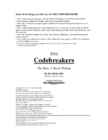
head, won the battle of Midway, led to cruel Allied defeats in North Africa, and broke up a vast Nazi spy ring. • How one American became the world's most famous codebreaker, and another became the world's greatest. • How codes and codebreakers operate today within the secret agencies of the U.S. and Russia. • And incredibly much more. "For many evenings of gripping reading, no better choice can be made than this book." —Christian Science Monitor THE Codebreakers The Story of Secret Writing By DAVID KAHN (abridged by the author) A SIGNET BOOK from
overturned the authority of the Middle Ages and the classical world. And by authority I am not referring specifically to that of the Church the demise of its authority was already well under way even before the Lutheran Reformation had begun. The authority I am speaking of is intellectual in nature and consisted of the triad of Aristotle(384322) and Ptolemy (c.90168). The revolutionaries of the new science had to escape their intellectual heritage [ pärandus ]. With this in mind, the revolution in science which emerged [ kerkis esile ] in the 16th and 17th centuries has appeared as a watershed in world history. The long term effects of both the Scientific Revolution and the modern acceptance and dependence upon science can be felt today in our daily lives. And not with standing some major calamity science and the scientific spirit will be around for centuries to come.
Why do u need to show people things they see every day? The first ,,cinema": cafe. Le grand cafe, paris. 28th of december 1895. Watched the lumiere brothers film. ,,Arrival of the train at le ciotat" the first horror film ever made? People were scared that the train will hit them. That category didnt exist in their brains. Whats wrong? The fact that noone minds the camera. Noone bothers to look into the camera, why didnt nobody looked in the camera. The machine maded noise, but people didnt mind that. The film was staged. It wasn't documentary, like they said. The idea of fake, manipulation. People were manipuating. Cinema is a manipulation. Even documentary is manipulation. First comedy: auguste ad louis lumiere ,,l'arouseur arrose" the waterer who is being watered Purpose was pure entertainment. Gradually those projectors were becomeing populars. Were many fun fairs. Werent no distripution. Pathe-inventor of film industry
He spent his entire life advocating the brotherhood of all humankind. One of his favorite quotations was: "I would unite with anybody to do right and with nobody to do wrong." Life as a slave Frederick Augustus Washington Bailey, who later became known as Frederick Douglass, was born a slave in Talbot County, Maryland near Hillsboro. He was separated from his mother, Harriet Bailey, when he was still an infant. She died when Douglass was about 7. The identity of Douglass' father is obscure; Douglass originally stated that his father was a white man, perhaps his master, Captain Aaron Anthony, but later said he knew nothing of his father's identity. When Anthony died, Douglass was given to Mrs. Lucretia Auld, wife of Captain Thomas Auld. Mrs. Auld then sent Douglass to Baltimore to serve the Captain's brother, Hugh Auld. Early education When Douglass was 12 years old, Hugh Auld's wife, Sophia, broke the law by teaching him some letters of the alphabet
Philip Larkin’s Poetry: Themes, Form, Style, Imagery and Symbolism Author: Sandra Olivares González Tutor: Jesús Marín Calvarro Degree in English Studies, English Department, Faculty of Philosophy and Letters, University of Extremadura Cáceres, 29th January 2016 Philip Larkin’s Poetry: Themes, Form, Style, Imagery and Symbolism The aim of this work is to obtain some characteristics of the poetry of Philip Larkin, such us the origin of his themes, the way in which he writes his poems and the symbolism he uses (which is a very controversial topic because some assume that he does use it, while some others say that he uses it in an ironic way). In this work we tried to make a revision on the vision of Larkin through the studies that had been made on him, and on the basis of it we can say, that the voice of Larkin still clearly contemporary
......................................................................... ...... 6 · Language and style.................................................................................................................. 7 · More about the novel.............................................................................................................. 8 · Sources.............................................................................................................................. ....... 9 Page 2 About the author Douglas Noël Adams was and English writer (11 March 1952 11 May 2001). He borned in Cambridge
Very costy. Closed court, believed in masques. 3. 17th century „metaphysical” poetry (Donne, Quarles, Herbert, Crashaw, Vaughan, Marvell) Religious poetry, books of emblems (allegorical pictures, verses explaining their moral), unconventional or „unpotic” figures like compass or mosquito to reach surprise effects, paradox and oxymoron. About the profound areas of experience: love (romantic and sexual), man’s relationship with God. Brief but intense meditations, striking use of wit, irony and wordplay. John Donne: passionate feeling and logical argument are mixed, play of intellect, conceits (extended metaphors), wit, huge range of ideas with startling connections between them, analyses love with different moods (cynicism and profound dedication) The First Anniversary. An Anatomy of the World; The Flea; Love’s Alchemy; Elegy XIX To His Mistress Going To Bed; Holy Sonnets (9, X, XIV); Hymn To God My God, in My Sickness.
BOOK REPORT Title of the book: Fight Club Author (name and some general information): Chuck Palahniuk is an American novelist born February 21, 1962 in Washington, USA. He is best known as the author for the novel Fight Club (1996), which was made into a movie in 1999. Palahniuk began writing fiction in his mid-thirties. When he attempted to publish his novel, Invisible Monsters, publishers rejected it for its disturbing content. This led him to work on Fight Club which he wrote as an attempt to disturb the publisher even more for rejecting him. After initially publishing it as a short story in the 1995 compilation, Pursuit of Happiness, Palahniuk expanded it into a full novel, which --contrary to his expectations--the publisher was willing to publish. Some other well-known novels: Rant, Choke, Diary. Analysis of the book 1. Setting The story takes place in somewhere between 1980s and 1990s in the United States. 2
Next wife was Anne Bolyn, daughter of a knight. They had daughter called Elizabeth l. Time went by and Henry had to get rid of Anne, she was sent to tower accused of treason (riigi reetmine) and executed. Henry was free, needed another wife. Had six wives together. 1 died, 1 survived, 2 divorced, 2 killed. Henry had a son, was a king Edward Vl, died very young. Henry was a talented musican and scholar, spent much money on it. Soon he had spent all savings his father had collected, he needed money. He understood that monasteries had become useless. So he closed them, took away the riches dissolution of monasteries. When henry quarreled with the Pope, made England independent of Rome. Beginning of the Anglican church. Henry died 1547, only son came to throne Edward Vll, was too young to rule alone. There was acouncil of nobles who did it for him. Unfortunately he died at the age of 16 There was a great problem with finding new king. His
................................................................................................................ My Opinion............................................................................................................................... Orson Scott Card He was born on the 24th of August, 1951 in Richland, Washington. Card's writing career began primarily as a poet, studying at Brigham Young University. During his studies as a theatre major, he began "doctoring" scripts, adapting fiction for theatre production, and finally writing his own one-act and full-length plays. Later he has worked both as a freelancer and a contracted writer. He first wrote the short story "Ender's Game" while working at the BYU press. Ender's Game and its sequel Speaker for the Dead were both awarded the Hugo Award and the Nebula Award, making Card the only author (as of 2008) to win both of science fiction's top prizes in consecutive years
Of OE poetry and prose. The distinction between verse and prose is by no mean always clear in that period of time. Anglo-Saxon verse is the product of a tradition which reached far back into pre-literate times and which was challenged and eventually replaced after the Conquest by a quite different tradition, so to say Eng poetry began with an end. But by contrast, the earliest monuments of English prose represent the true beginning of a tradition of written prose. But indeed the only work of prose which can claim a foothold of English literature is `Mandeville's Travels' and it's translated from the French. With the religious works bulk much larger and important writers are Thomas More, Jeremy Taylor, etc. The main tradition of vernacular prose began in England in late 800s with the Anglo-Saxon chronicle and with the group of translations made or inspired by the king himself. However, the best of
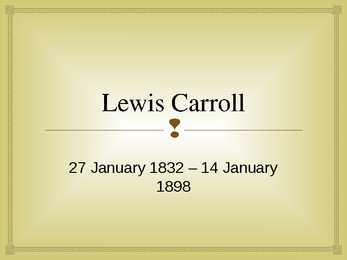
officers or Church of England clergymen. His greatgrandfather, also Charles Dodgson, had risen through the ranks of the church to become a bishop. His grandfather, another Charles, had been an army captain, killed in action in Ireland in 1803, when his two sons were hardly more than babies. His mother's name was Frances Jane Lutwidge. The elder of these sons yet another Charles was Carroll's father. He reverted to the other family business and took holy orders. He went to Rugby School, and thence to Christ Church, Oxford. He was mathematically gifted and won a double first degree, which could have been the prelude to a brilliant academic career. Instead he married his first cousin in 1827 and became a country parson. Young Charles' father was an active and highly conservative clergyman of the
the medium is the message. This is merely to say that the personal and social consequences of any medium-that is, of any extension of ourselves-result from the new scale that is introduced into our affairs by each extension of ourselves, or by any new technology. Thus, with automation, for example, the new patterns of human association tend to eliminate jobs, it is true. That is the negative result. Positively, automation creates roles for people, which is to say depth of involvement in their work and human association that our preceding mechanical technology had destroyed. Many people would be disposed to say that it was not the machine, but what one did with the machine, that was its meaning or message. In terms of the ways in which the machine altered our relations to one another and to ourselves, it mattered not in the least whether it turned out cornflakes or Cadillacs. The restructuring of human work and
artists and Elton John reached #3, preceded by Madonna and The Beatles. John was born and raised in Pinner, Middlesex in a council house of his maternal grandparents, with whom his newlywed parents (Sheila Eileen (Harris) and Stanley Dwight) were living. Then they moved to a nearby semi-detached house. He was educated at Pinner Country Grammar School until the age of 15, before pursuing a career in the music industry. When John began to seriously consider a career in music, his father tried to steer him toward a more conventional career such as banking. He has stated that his wild stage costumes and performances were his way of letting go after such a restrictive childhood. Both of John's parents were musically inclined, his father having been a trumpet player with a semi-professional big band that played military dances. The Dwights were avid record buyers, exposing John to all the popular singers and musicians of the day
Fay Weldon an English author, essayist and playwright Early life § Fay Weldon was supposed to be born in New Zealand, but instead was born in England in 1931. At 5 weeks old she and her mother returned to New Zealand. § Her father was a doctor and her mother was a writer of commercial fiction under the pen name "Pearl Bellairs", among others. Her parents divorced when she was five. She lived with her mother, sister and grandmother until she started college and, as a result, grew up believing "the world was peopled by females". This problably influenced her works too. § She returned to England with her mother and studied economics and psychology at the University of St Andrews in Scotland.
is a multi-BRIT Award-winning English singer, songwriter, actor, and musician. His career started in 1990, at the age of 16, as a dancer and singer with the pop band Take That. After many disagreements with the management and certain group members, Williams left the group in 1995 to launch his solo career. Williams was born to Peter and Janet Williams in Stoke-on-Trent on 13 February 1974. He and his older sister, Sally, were raised by his mother, Janet, as she and his father, attempted stand-up comedian Peter "Parp" Conway, separated when Williams was three days old and since divorced. Williams attended Mill Hill Primary School and St Margaret Ward's Roman Catholic School where he was "touched" by music, and also attended dance school UKDDF in Tunstall, Staffordshire. He participated in several school plays, and his biggest role was that of the Artful Dodger in a production of Oliver.
BOOKS (From Wikipedia, the free encyclopedia) A book is a set or collection of written, printed, illustrated, or blank sheets, made of paper, parchment, or other various material, usually fastened together to hinge at one side. A single sheet within a book is called a leaf, and each side of a leaf is called a page. A book produced in electronic format is known as an electronic book (e-book). Books may also refer to works of literature, or a main division of such a work. In library and information science, a book is called a monograph, to distinguish it from serial periodicals such as magazines, journals or newspaper. The body of all written works including books is literature. In novels and sometimes other types of books (e.g. biographies), a book may be divided into several large sections, also called books (Book 1, Book 2, Book 3, etc.). A lover of books is usually referred to as a bibliophile, or, more informally, a bookworm.
 annaabi.ee