Leidsid 33 sarnast õppematerjali, mis on seotud failiga "Easter in England". Need materjalid aitavad sul teemat sügavamalt mõista.
east, easter, eggs, jesus, traditional, chocolate, christ, dance, christian, times, days, came, back, gift, special, color, england, holidays, festival, death, sunday, year, before, first, birds, these, painted, size, cake, sometimes, children, traditions, morris, church, kaia, teder, susanne, festivals, giving, means, oldest, important, celebration1. How many public holidays or Red-Letter Days are there in Britain? Name them. 8 public holidays in Britain: two at Christmas, one for the New Year(which was only introduced in the late 1970s) two at Easter and three Bank Holidays. 2. What is the same and what is different about the way Christmas is celebrated in England and Estonia? In England, there's common to sing Carol's and for children, Christmas means pantomimes plays based on fairy tales which combine comedy, dance and song. A traditional Christmas dinner includes roast turkey with roast potatoes, a range of vegetables, cranberry sauce etc., followed by Christmas pudding and Christmas cake. The pulling of crackers(and the wearing of paper hats) before the meal is quite popular. Afterwards many watch the Queen's traditional Christmas address on TV at 3 pm. Christmas actually contains of 3 days: Christmas Eve, Christmas Day and Boxing Day
order to sneak into the castle. But, alas, the lord of the manor's son discovers the deception. He is overcome by jealous rage and orders his men to seal the girl inside the thick stone walls while still alive. Turned into an incarnation of undying love, the White Lady now appears every August, on the night of the full moon, in the Dome Church chapel window. Haapsalu is seven-and-a- quarter centuries old this year, and the townsfolk intend to make it a celebration to remember. The annual dance and light show dedicated to the Lady alone involves over 100 performers - and you'll have several chances to catch it over the four days of the event. Musical shows, dances and contests of strength and skill will be held all over town. This festival is held in August and it is said that Haapsalu, Estonia's most famous ghost, appears during this festival Black nights film festival http://www.tourism.tallinn.ee/fpage/events/newwinprint/ Beerfestival ( Õllesummer)
That would have enabled people to keep a record of changing of seasons. Although it is still unclear who built it. Hadrian’s Wall is an ancient wall which was built in 2nd century by Hadrian, the emperor of Rome from AD 117 to 138, and it marked the northern border of the Roman Empire in Britain. The wall was 80 Roman miles (117 kilometres) long and it is situated in northern Great Britain and stretched from Solway Firth in the west to the Tyne River near Newcastle in the east. It was built to keep the Caledonians of Scotland out of England. Windsor Castle, which is one of the official residents of British monarch, is located in the English country of Berkshire. It is the largest in habited castle in the world and the oldest in continuous occupation, since it dates back to the time of William the Conqueror. The castle’s area is approximately 484,000 square feet (44, 955 square metres). The castle has been
a nation's assumption of independent statehood, usually after ceasing to be a group or part of another nation or state; more rarely after the end of a military occupation. Most countries observe their respective independence days as a national holiday, and in some cases the observance date is controversial or contested. Good Friday Moveable Friday Good Friday is a religious holiday observed primarily by Christians commemorating the crucifixion of Jesus Christ and his death at Calvary. The holiday is observed during Holy Week as part of the Paschal Triduum on the Friday preceding Easter Sunday, and may coincide with the Jewish observance of Passover. It is also known as Holy Friday, Great Friday, Black Friday, or Easter Friday, though the latter properly refers to the Friday in Easter week. Easter Sunday Moveable Sunday Easter is a Christian festival and holiday celebrating the resurrection of Jesus
Easter traditions in Estonia Easter traditions are rather young in Estonia. Our grandmothers took the eastern habits from BalticGermans without taking over the meanings painted eggs just seemed so beautiful. So for us, their grandchildren, painting eggs has no connection with religion traditions. It is more like a way of expressing one's creativity. We use different colors and techniques: painting with herbs, watercolors, markers, special colors etc. There aren't any certain patterns to use, everyone can do it any way they like. We also give colored eggs as presents to friends and children are cracking the eggs. More than Easter Estonians have traditionally celebrated a spring. There is a day
Name 6 islands, 5 rivers, 3 lakes, 3 mountains in UK. Isle of Man, Isle of Wight, Isle of Lewis, Island of Mull, Island of Arran, Anglesey Island Severn, Thames, Tweed, Avon, Trent, Dove Ben Nevis, Snowdon, Ben Macdui 7. Stonehenge. Stonehenge was produced by a culture that left no written records. Built on Salisbury Plain, in Wiltshire, England some time between 5,000-4,300 years ago. One of the most famous megaliths in the world, dating from prehistoric times. Stonehenge consists of circles of stone arranged in complex patterns, and their origin is still being explored. Some of the stones come from over 200 miles away in Wales. There is little or no direct evidence revealing the construction techniques used by the Stonehenge builders. It was probably associated with sun-worship and other rites of prehistoric people. It appears to function as a kind of astronomical clock.
The veil was held in place with a crown of orange blossoms. The bride carried the same flowers in her bouquet. Later she left the bouquet in the church, put it on a relative's grave, or sent it to the convent where she studied. After the ceremony the members of the family signed the register. The guests then went to the bride's home for the banquet. The bride cut the cake and gave pieces of it to single girls to put under their pillows. When the guests began to dance, the bride and her mother went to the bridal chamber where she took off her wedding clothes and changed into her nightgown. The bride and groom spent their honeymoon in her parents' house. They were expected to stay in the bedroom for five days or more. Creole Customs Creole customs can be divided into two kinds: religious and non-religious. Religious customs focus on holidays: All Saints Day, Mardi gras and Easter, for example. On All
Henry won the throne when he defeated Richard III at the Battle of Bosworth Field. He was the last king of England to win his throne on the field of battle. He was successful in restoring the power and stability of the English monarchy after the political upheavals of the Wars of the Roses. He founded a long-lasting dynasty and was peaceably succeeded by his son, Henry VIII, after a reign of 23 years. Church of England - the officially established Christian church in England and the oldest in the worldwide Anglican Communion. The Church of England understands itself to be both Catholic and Reformed. 19. The Elizabeth Age - was a time associated with Queen Elizabeth I's reign (15581603) and is often considered to be the golden age in English history. It was the height of the English Renaissance and saw the flowering of English poetry, music and literature. This was also the time
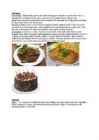
German Sauerbraten: Traditionally made with a beef roasting joint (topside or similar) the meat is marinated for 2-3 days in beer, spices such as cloves, juniper berries, allspice and peppercorns, bay leaves and onions and is braised in the marinade for a long period, resulting in very tender melt-in-the-mouth meat. The Black Forest: cake is one of the most popular German national foods. Cake consists of several layers of chocolate cake, with whipped cream and cherries between each layer. Then the cake is decorated with additional whipped cream and chocolate shavings. A Schnitzel in German is a slice of pork or veal haunch. Dish made with boneless meat thinned with a mallet (escalope-style preparation), coated in bread crumbs and fried. Only if it is made of veal and coated in bread crumbs is it called Wiener Schnitzel; a pork version is called Schnitzel Wiener Art (Viennese type schnitzel)
Longer & Uncut in 1999, and the three-episode Imaginationland story arc was reissued straight-to-DVD in 2008 CHARACTERS Main protagonists: Stan Marsh, Kyle Broflovski, Eric Cartman, and Kenny McCormick There are many recurring characters on the show, including the boys' families, school staff, and other students. These include Leopold "Butters" Stotch, Chef (who no longer appears in the show), Mr. Hankey, Towelie, Jesus, and Satan. Episodes have parodied Michael Jackson ("The Jeffersons"), Paris Hilton ("Stupid Spoiled Whore Video Playset"), and The Passion of the Christ ("The Passion of the Jew"). The show has also addressed serious political issues such as terrorism ("Cartoon Wars"), American immigration policy ("Goobacks"), gay marriage ("Follow That Egg!"), racism ("With Apologies to Jesse Jackson"), and the Terri Schiavo case ("Best Friends Forever").
Estonian National Cuisine re a d a c k B Bl The word ,,bread" came to Estonian from Germanic languages. Traditional black bread spread in Estonia in the second century. In a household people usually baked bread on Saturdays. Depending on the size of the family, they usually made 6-10 loaves of bread. One loaf of bread usually weighed about 2-5 kg. Beliefs and habits If a piece of bread was dropped, it had to be picked up and given a kiss so that hunger would not come to the house. A loaf of bread was never put on a table upside crust down
Traditions Australia doesn't have many traditions. Attempts to get Halloween off the ground have stalled due to one too many homeowners telling little kids to get off their property or they will see a scary sight. Australia celebrates many of the same holidays as do people of the Western world, such as Easter and Christmas. However, Australians also celebrate some holidays unique to their country and culture. Australia Day Australia Day, 26 January, is the anniversary of the arrival of the First Fleet of 11 convict ships from Great Britain, and the raising of the Union Jack at Sydney Cove by its commander Captain Arthur Phillip, in 1788. On Australia Day, over half of the nation's population of 21 million attend either an organised
Mardi Gras Ursula 10. kl Mardi Gras A Christian holiday and popular cultural phenomenon, Mardi Gras dates back thousands of years to pagan spring and fertility rites. Mardi Gras can occur on any Tuesday from February 3 through March 9. It is always scheduled 47 days preceding Easter (the 40 days of Lent, plus seven Sundays). Mardi Gras, also known as "Shrove Tuesday", "Pancake Tuesday" or "Fat Tuesday" is celebrated all over the world with fun, games, and a lot of eating. The official colors of Mardi Gras are purple, green and gold. Purple represents justice, green stands for faith, and gold signifies power. There is no general theme for Mardi Gras, but each individual parade depicts a specific subject. Among the more popular subjects have been history, children's
Valentine's Day is a holiday, which is celebrated on the 14 th February. This holiday is named after a priest Valentine. The holiday is celebrated almost everywhere around the world. It is the traditional day on which lovers express their love for each other, sending cards. On this day people show how much they care about their friends. Usually on this day people gift hand-made cards and roses. Nowadays people can also send e-cards. Modern Valentine symbols include the heart-shaped outline and the figure of the winged Cupid. The traditional Valentine's colours are pink and red. On that day people should were pink and red clothes. In different countries there are different traditions on
two-thirds of Australia, but its population is less than 100,000. In some places, it doesn't rain for years. There are hills and big dry salt lakes, and it is very difficult to grow anything there. Many people live on sheep or cattle stations, a few of which are as large as the country of England. The nearest neighbour can be a hundred kilometres away and the nearest city 1,500 kilometres away. Australia has a population of about 23 million people, most of whom live in the south and east of the country, where the summers are warm and the winters not too cold. The highest mountain in Australia is Mount Kosciuszko, at 2,228 metres. Australia's longest river, the Murray-Darling, is 2,700 kilometres long. The only large permanent lakes in Australia have been artificially created, as most of the natural lakes there are dry for months or years at a time. Lake Eyre is the largest lake in Australia and also the lowest point.
Christmas in Australia Christmas in Australia is often very hot. Whereas the northern hemisphere is in the middle of winter, Australians are baking in summer heat. It is not unusual to have Christmas Day well into the mid 30 degrees Celsius, or near 100 degrees Fahrenheit. A traditional meal includes a turkey dinner, with ham, and pork. A flaming Christmas plum pudding is added for dessert. In the Australian gold rushes, Christmas puddings often contained a gold nugget. Today a small favor is baked inside. Whoever finds this knows s/he will enjoy good luck. Another treat is Mince Pies. Some Australians and particularly tourists often have their Christmas dinner at midday on a local beach, Bondi Beach in Sydney's Eastern Suburbs attracts thousands of people on Christmas Day
So, Australia is both a country and a continent. If you want to make clear that you are speaking about the country, you may call it the Commonwealth of Australia. It’s the official name of the country. Australia is the smallest continent, but one of the largest countries on Earth. It’s 6th largest country. Its area is about 7.6 million sq km. One third of it is occupied by deserts. It’s both the flattest and, except for Antarctica the driest. Neighbouring countries include Indonesia, East Timor and Papua New Guinea in the north, the Solomon Islands, Vanuatu in the northeast, and New Zealand in the southeast. Its capital is Canberra. Other big cities are Melbourne, Sydney, and Brisbane. National language in Australia is English. Monetary unit is Australian dollar. Their national holiday is on the 26th of January. In 1788 on the 26th of January the first fleet arrived at Botany Bay and established a penal colony near modern-day Sydney. Geographical Position
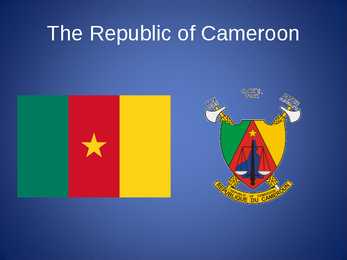
law with common law influences · The judiciary is officially divided into tribunals, the court of appeal, and the supreme court. Politics and Government · Human rights organisations accuse police and military forces of mistreating and even torturing criminal suspects, ethnic minorities, homosexuals, and political activists · The National Assembly makes legislation. The body consists of 180 members who are elected for five-year terms and meet three times per year. Laws are passed on a majority vote. Rarely has the assembly changed or blocked legislation proposed by the president. · President Paul Biya's Cameroon People's Democratic Movement (CPDM) was the only legal political party until December 1990. Numerous ethnic and regional political groups have since formed · The last parliamentary elections were held on 22 July 2007. Education · Most children have access to free, state-run schools or
oriented tourism. Noted clubs include Space, Pacha, Privilege (ex Ku), Amnesia, DC10, Eden, El Divino, Es Paradis, and Café del Mar.It is also home to the 'West End' party district of Sant Antoni, a popular stop for many tourists. History In 654 BC Phoenician settlers founded a port in the Balearic Islands, as Ibossim (from the Phoenician iboshim dedicated to the god of the music and dance Bes).It was later known to Romans as "Ebusus". The Greeks, who came to Ibiza during the time of the Phoenicians, were the first to call the two islands of Ibiza and Formentera the Pityûssai (, "pine-covered islands"; a translation of the Phoenician name).With the decline of Phoenicia after the Assyrian invasions, Ibiza came under the control of Carthage, also a former Phoenician colony. The island produced dye, salt, fish sauce (garum), and wool.
1) INDIAN ROCK ART: A NATIONAL TREASURE IN DANGER Unrecognized, unprotected, this priceless legacy of primitive art has endured the ravages of nature only to fall victim to wanton destruction by ,,civilized" man. Like the huge stone statues of Easter Island and prehistoric cave paintings of Altamira and Lascaux, North American Indian rock art is surrounded by an atmosphere of mystery. Although examples of rock art exist at some 15000 sites in canyons, deserts, caves and river gorges. Nowadays, however, primitive rock art in the United States has become a new field of scientific study. Klaus F Wellmann wrote two books about rock art. He is a professor of medicine. Rock art represents the history of aboriginal Americans
In 1893, New Zealand was the first country in the world to give women the right to vote. New Zealand's economy has traditionally been based on exports from its very efficient agricultural system. With warm temperatures and a lot of rain, New Zealand is a great place for farms of all kinds. For every person living in New Zealand there are twenty sheep and three cows. That is why New Zealand sells more meat from these animals, and more butter, than any other country, and also a lot of wool. Other traditional exports include wood, paper, fruit and vegetables, and fish. In the last few decades wine has also become important. New Zealand has substantial hydroelectric power and fairly large reserves of natural gas. The leading manufacturing sectors are food processing, metal fabrication, and wood and paper products. Its main trading partners are Australia, the US, Japan, and China. New Zealand is one of the top holiday destinations in the world with its clean green natural
(Scotland) and west (Wales). They came from the North and Baltic Seas. Along with them came their dialects, which constitute the basis for Old English. Around 4500 words are still used today. They also had their own religion and Germanic gods. Their names are still used today: Freya Friday, Thor Thursday, Angle-land England. The Anglo-Saxons divided the cuntry into small warring kingdoms Northumbria, Mercia, Wessex, Sussex, Essex, Kent, East Anglia. Due to constant conflict weakened the kingdoms. The political power was in Wessex, which was the most powerful of the kingdoms. The Anglo-Saxons were farmers and fishermen and lived in small communities. They deployed a crop rotation over three fields; used heavy ploughs. In 787 AD came the Vikings from Scandinavia, who set up their own state Danelaw. Had their own religion, however their rituals did not demand sacrifices. Introduced new words (1800).
The journey is difficult and full of revelations, disappointment and questions, but they persevere. The end of their journey leads Dante and Virgil to the bottom of Hell. Lucifer is seen in all his ugliness and they are drawn towards Heaven. They emerge to the surface, rising above the ugliness of sin and journey towards their goal as they catch sight of the stars shining in the heavens. Their journey begins on Good Friday and they emerge from Hell on the day of Resurrection, Easter Sunday on the underside of the world, in the hemisphere of water at the foot of Mount Purgatory. Dante's vision expresses his personal experience, through images to convey his interpretation of the nature of human existence. He writes in the first person so the reader can identify and deeply understand the truths he wished to share about the meaning of life and man's relationship with the Creator. Dante is remembered as a great thinker and one of the most learned writers of all time
................7 Recipe.............................................................................................................................................8 Pasta alla Carbonara (eesti keeles)...................................................................................................9 2 ITALY KITCHEN Italian Cuisine is traditional Italian food. It is often made up of the famous Italian foods such as pasta, pizza, cannoli and red or white wine. Italian cuisine often contains a lot of carbs and sometimes fats. Italian food also has a lot of vegetables and healthy fats, such as olives, broccoli, and lettuces. Italians are also famous for the different kinds of breads they make. Spaghetti is traditional
Even though its area is bigger than that of the United States, its population is only about 11% of that of the USA some 35 million. Because of that, Canada has one of the lowest population densities in the world. The capital of Canada is Ottawa the name of whose comes from the old Algonquin language, with the original word meaning `to trade'. Due to the country's huge size and position, it is very diverse. It is bordered by the Pacific Ocean to the west, the Atlantic to the east, and the Arctic to the north. The landscapes differ greatly from rolling plains and mountains to the cold tundra in the northern part of the country. Geographically, the country's split into 5 major regions the Pacific, the Prairie Provinces, Central Canada, the Atlantic Provinces and the North. The Pacific Region is known for its mild coastal climate, its forests and its spectacular mountains. The three Prairie Provinces are known for their rolling plains and their extreme
only Whigs in his administration; the Emperor's heir is described as having "one of his heels higher than the other", which describes the encouragement by the Prince of Wales (the future George II) of the political opposition during his father's life; once he ascended the throne, however, George II was as staunch a favorer of the Whigs as his father had been. The novel further describes an intraLilliputian quarrel over the practice of breaking eggs. Traditionally, Lilliputians broke boiled eggs on the larger end; a few generations ago, an Emperor of Lilliput had decreed that all eggs be broken on the smaller end. The differences between BigEndians (those who broke their eggs at the larger end) and LittleEndians had given rise to "six rebellions... wherein one Emperor lost his life, and another his crown". The BigEndian/LittleEndian controversy reflects, in a much simplified form, British quarrels over religion
............................................... 8 Prepositions of Time – in, on & at • in is used with centuries, decades, years, seasons and months, parts of the day, periods of time • on is used with dates, special days, days of week, day of week + part of day, day + of ... • at is used with holidays, exact time, meals and with night in on at • the 20th century • the 29th of November • Christmas / Easter • the Middle ages /August the first • six o’clock / 7.30 • the 1980s • Christmas Day / New • midday / noon / • 2006 Year’s Eve / Easter midnight • winter / summer Sunday • the weekend / • May / August / • Wednesday(s) weekends November • Monday morning • breakfast
Põima farm prove that the problem is also huge in Estonia. One possible way to show people how serious the problem is, is to distribute those materials. Often just talking about something serious does not create the image to the people and they need proof to realise the deepness of it. Even more, recently WSPA (World Society for the Protection of Animals) published an international report, where it is said that most of the 61 milliard farm animals who are raised to get milk, meet or eggs, are living in cruel conditions and are suffering from severe maltreatment. The report also exteriorizes the main ways of ill-treatment of the farm animals. One thing is that the calves are taken away from their mothers few days after they are born. Although they should be together 9-12 months. What is more, 75% of 5,6 milliard hens are kept in so small cages that they cannot even stretch their wings. In addition, those chickens that are raised to
present, or future. `Since' refers to a point in past time. A We use adverbials of time to say when something happens. We often use noun groups called time expressions as adverbials of time. yesterday, today, tomorrow last year, next Saturday, next week the day after tomorrow, last night, · the other day · Do not use the prepositions `at', `in', `on'!!! Prepositional phrases as adverbials of time: `at' is used with: clock times: at eight o'clock, at three fifteen religious festivals: at Christmas, at Easter mealtimes: at breakfast, at lunchtimes specific periods: at night, at the weekend, at weekends, at half-term `in' is used with: · seasons: in autumn, in the spring years and centuries: in 1985, in the year 2000, in the nineteenth century months: in July, in December parts of the day: in the morning, in the evenings Note that we also use `in' to say that
of London, famous for its Speakers' Corner. The park is divided in two by the Serpentine Lake. The park was the site of The Great Exhibition of 1851, for which the Crystal Palace was built. Buckingham Palace is the official residence of the king or queen of England. The palace is a setting for state occasions and royal entertaining and a major tourist attraction. It has been a rallying point for the British people at times of national rejoicing and crisis. Originally known as Buckingham House, the building was built for the Duke of Buckingham in the 18 th century and acquired by King George III as a private residence. It was enlarged over the next 75 years, forming three wings around a central courtyard. Chinatown Located in between Leicester Square and Shaftesbury Avenue, it is a self- contained jumble of shops, cafes and restaurants that makes up one of London's most distinct and popular ethnic enclaves
Natural Zones and Flora. There are five distinguishable natural zones in Australia. In the very east there are wet forests (1.) that occupy the space between the Great Dividing Range and the eastern coast. Westward from the Great Dividing Range the wet forests give place to beautiful grasslands with some trees . These grasslands are called the savannas (2.). Farther west the trees disappear and the bushlands (3.) begin. The real desert (4.) occupies the centre of the Western Plateau. In the very southwest there are thin forests of evergreen trees (5.).
BRITISH HISTORY 17TH-19TH CENTURY SEVENTEENTH-CENTURY ☄ When James I became the first English king of the Stuart dynasty, he was already king of Scotland, so the crowns of these two countries were united. ☄ The kind of Middle English spoken in lowland Scotland had developed into a written language known as Scots ☄ The Scottish Protestant church adopted English rather than Scots bibles ☄ Religion and politics are inextricably linked ☄ Some people tried to kill the king because he wasn't Catholic enough and another king had been killed, partly because he seemed too Catholic ☄ Anger grew in the country at the way that the Stuart monarchs raised money ☄ Puritanism- ideological Protestantism ☄ Some of them thought the luxurious lifestyle of the king and his followers was immoral. They were also fiercely anti-Catholic and suspicious of the apparent sympathy towards Catholicism of the Stuart m
Ireland Ireland (Irish: Éire, Irish pronunciation:) is a country in north-western Europe. The modern sovereign state occupies about five-sixths of the island of Ireland, which was first partitioned on 3 May 1921. It is bordered by Northern Ireland--part of the United Kingdom--to the north, by the Atlantic Ocean to the west, the Irish Sea to the east and the Celtic Sea and St George's Channel to the South and South-East. The legal name of the state is simply "Ireland", but its legal description the Republic of Ireland is sometimes used to differentiate the state from the island. On 29 December 1937 Ireland became the successor-state to the Irish Free State, itself established on 6 December 1922. Ireland was one of the poorest countries in Western Europe and had high emigration. The protectionist economy was opened in the late 1950s
 annaabi.ee