 50 punkti
Autor soovib selle materjali allalaadimise eest saada 50 punkti.
50 punkti
Autor soovib selle materjali allalaadimise eest saada 50 punkti.
 ~ 6 lehte
Lehekülgede arv dokumendis
~ 6 lehte
Lehekülgede arv dokumendis
 2013-01-14
Kuupäev, millal dokument üles laeti
2013-01-14
Kuupäev, millal dokument üles laeti
 5 laadimist
Kokku alla laetud
5 laadimist
Kokku alla laetud
 0 arvamust
Teiste kasutajate poolt lisatud kommentaarid
0 arvamust
Teiste kasutajate poolt lisatud kommentaarid
 ursula1607
Õppematerjali autor
ursula1607
Õppematerjali autor
school Addiction and drugs summary name form year Table of contents Smoking...............................................................................................page 3 Narcotics............................................................................................................................page 4 1. Marijuana..............................................................................page 4 2. Ecstasy.................................................................................page 5 3. Heroin.................................................................................p
ALCOHOL Alcohol is a widely used substance for both science and in technology. Its name comes from an Arabic word al-kuhl meaning " a powder for painting the eyes". The term was later applied to all compounds that contain alcoholic spirits. To most people alcohol is considerd a downer that reduces activity in the nervous system. Some of the things alcohol effects you is, the alcohol intoxicated person exhibits lose muscle tone, loss of fine moter coordination,and often has a staggering "drunken" gait. The eyes may appear somewhat "glossy" and pupils may be slow to respond to stimulus. At high doses pupils may become constricted. At intoxing doses, alcohol can decrease heart rate, lower blood pressure and respiration rate, and result in decreased reflex and slower reaction times. Skin may be cool to touch but to the user may feel warm or normal, profuse sweating may accompany alcohol use. Loose muscle tone, lose of fine motor coordination,odor of alcohol on the breath,a
Tundra animals Reindeer Reindeer were first domesticated in Norway and northern Asia. When it was seen how valuable they were, they were brought to Alaska in 1887 and later to parts of Canada. These North American reindeer became known as caribou. Although they are called by different names, they are both considered to be a single species. Unlike deer, both the male and female have antlers. The antlers of the male are long, branched and massive, and they are a little flattened at the ends. The antlers of the female are much shorter, simpler and more slender and irregular. Their large, spreading hooves support the animal in snow in the winter and marshy tundra in the summer. Reindeer are also great swimmers and use their feet as paddles. They can also lower their metabolic rate and go into a semi-hibernation when conditions get very harsh. When it looks like there is nothing to eat on the winter tundra, reindeer will scrape the snow away wit
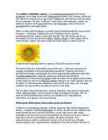
The sunflower (Helianthus annuus) is an annual(iga aastane) plant in the family Asteraceae, with a large flower head (inflorescence(õiekobar, õisik, õitseaeg, õidumine)). The stem(tüvi) of the flower can grow up to 3 metres tall, with the flower head reaching 30 cm in diameter. The term "sunflower" is also used to refer(nimetama, viitama, üle andma) to all plants of the genus(perekond, sugu) Helianthus, many of which are perennial(alaline, aastaringne) plants. What is usually called the flower is actually a head (formally(ametlikult) composite(liit-, komposiit- ; korvõieline, komposiit) flower) of numerous flowers (florets) crowded(täistuubitud, tunglev, rahvarohke) together. The outer flowers are the ray florets(pähik (õisiku osa) and can be yellow, maroon, orange, or other colors, and are sterile(steriilne, viljatu). The florets inside the circular head are called disc florets. Sunflower head displaying florets in spirals of 34 and 55 around the outside The florets wi
Decriminalizing Cannabis in Estonia. Estonia is the leading country in Europe with the highest number of drug fatalities per capita, deaths by fentanyl are raising and current drug policy is not doing its job. According to the most recent data, Estonia's overdose mortality rate is seven times the average in the EU. This is a big concern for a country as little as Estonia, and also a reason why the decriminalizing cannabis topic has grown so popular lately. Cannabis, as a soft drug, is criminalized in Estonia and that fact leads people to go after stronger drugs because by the law they are on the same scale. The popularity of “China white” is growing in Estonia, as it is so easily accessible, but so does the mortality rate because it is very easy to overdose on fentanyl. Estonia should re- form its drug policy because stricter laws and punishments do not change society for the better and current drug policy is not showing any positive effect either.
Topic Australia Introduction Many people know Australia as the land down under because it is the only continent except for Antarctica that is all on the southern hemisphere. Its name means ,,Southland". The official name of the country is the Commonwealth of Australia. It's capital is Canberra. Australia is the sixth largest country in the world but the smallest continent. Australia has 6 states and 2 territories (New South Wales, Victoria, Tasmania, Queensland, Western Australia , South Australia, The Australian Capital Territory and the Northern Territory). The Australian people are culturally the same as the Anglo Americans. There also live aborigines. Aborigines are the ancestors of the people. Like the US and Canada, Australia was an English speaking colony of Great Britain. Today Australia is a modern developed country with a diversified economy. Australia is an island continent of 7.7 million square kilometres, which makes it a little smaller than the USA. Located in
Formaldehyde Formaldehyde is a colorless, flammable gas at room temperature. It has a pungent, distinct odor and may cause a burning sensation to the eyes, nose, and lungs at high concentrations. Formaldehyde is also known as methanal, methylene oxide, oxymethylene, methylaldehyde, and oxomethane. Formaldehyde can react with many other chemicals, and it will break down into methanol (wood alcohol) and carbon monoxide at very high temperatures. Formaldehyde is naturally produced in very small amounts in our bodies as a part of our normal, everyday metabolism and causes us no harm. It can also be found in the air that we breathe at home and at work, in the food we eat, and in some products that we put on our skin. A major source of formaldehyde that we breathe every day is found in smog in the lower atmosphere. Automobile exhaust from cars without catalytic converters or those using oxygenated gasoline also contain formaldehyde. At home, forma
1 Caffeine 2 3 Caffeine (C8H10N4O2) is the common name for trimethylxanthine (systematic name is 1,3,7- 4 trimethylxanthine or 3,7-dihydro-1,3,7-trimethyl-1H-purine-2,6-dione). The chemical is also 5 known as coffeine, theine, mateine, guaranine, or methyltheobromine. Caffeine is naturally 6 produced by several plants, including coffee beans, guarana, yerba maté, cacao beans, and tea. 7 For the plants, caffeine acts as a natural pesticide. It paralyzes and kills insects that attempt to 8 feed on the plants. The molecule was first isolated by the German chemist Friedrich Ferdinand 9 Runge in 1819. 10 When purified, caffeine is an intensely bitter white powder. It is added to colas and other soft 11 drinks to impart a pleasing bitter note. However, caffeine is also an addictive stimulant. In 12 humans, it stimulates the central nervous system, heart rate, and respiration, has psychotropic 13 (mood altering) p
 annaabi.ee







Kõik kommentaarid