Leidsid 33 sarnast õppematerjali, mis on seotud failiga "CONDITIONALS, SUPPOSE/SUPPOSING, PREFER +ING/WOULD PREFER". Need materjalid aitavad sul teemat sügavamalt mõista.
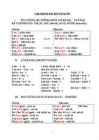
suppose, prefer, marks, simple, clause, night, work, gone, here, conditionals, present, boil, loodusseadus, study, hindeid, õppinud, tõlgi, came, back, late, today, hilja, stood, film, star, classical, party, accept, concert, muusika, perfect, reading, books, watching, television, games, doing, homeworkConditionals Sentences with if are used to express possibilities. 0 Zero conditional If-clause present (past) simple Main clause present (past) simple Sometimes sentences with if express certainty rather than possibility. The zero conditional is used to talk about sth. that is always true (such as a scientific fact), or that was always true in the past. In this type of conditional we can use when instead of if. E.g., If/When you mix blue and red, you get purple. If/When you don't water flowers, they die. (present simple in both parts of the sentence) If/When I asked her to come with us, she always said no.
Future Forms Future Forms · 1) Future Simple will work · 2) Be going to am/is/are going to work · 3) Present Continuous am/is/are working · 4) Present Simple start(s) Future Forms · 5) Future Continuous will be working · 6) Future Perfect will have worked · 7) Future Perfect Continuous will have been working Future Simple · We do our morning exercises and think, "I think we will have a nice day " · Prediction (ennustused kõhutunde põhjal) · verbs think, believe, guess, expect, hope etc · expressions be sure, be afraid etc · adverbs probably, perhaps, certainly Future Simple · You see your little brother carrying a very heavy suitcase and you think, "I will help him carry the suitcase." · on-the-spot decision (hetkeotsused)
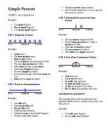
INGLISE KEELE KORDAMINE TIME CLAUSES Present Simple · Permanent states, facts (Tom works..) · Repeated and habitual actions, routines (She usually goes..) · Laws of nature and general truths (The sun sets in the west) · Timetables and programmes · Sporting commentaries, rewiews (Beckham wins the ball, crosses and Owen scores) · Feelings and emotions (I love Tallinn..) TIME EXPRESSIONS USED WITH PRESENT SIMPLE: usually, often, always, every day/week etc, in the morning/evening
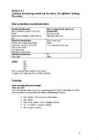
Tests Superstar 1 Luke Prodromou Test 1 Name____________________ Class_______ Use your English 1 Complete these sentences using the correct form (present simple or present continuous) of the verb in brackets. _ 1 She is in a band and she _________________________________ (record) a CD at the moment. _ 2 She is an actress and often _________________________________ (appear) on television. _ 3 At the moment she _________________________________ (have) a rest because she is tired. _ 4 Mike is a doctor and he _________________________________ (live) in Manchester. _ 5 I _________________________________ (start) work at 8.30 every morning.
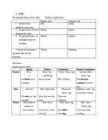
Tense Signal words Use Form affirmative negative interrogative every day something happens repeatedly sometimes how often something happens always I work. I don't work. Do I work? one action follows another often Infinitive He works. He doesn't work. Does he work? Simple Present things in general usually he/she/it + -s I go. I don't go. Do I go? after the following verbs (to love,
frequency(kordumine ) adverbs(määrsõna) N: Do you go to school by car every day ? I don't often watch TV. 2)Present continuousbe + verb + ing. Actions happening now N; Look! It's snowing. I'm meeting Jane tonight. You're always losing things. 3)keep + ingto describe habitual actions which may be irritating. N: my uncle keeps making silly jokes. Present perfect: 1) Present perfect simple: have/has + past participle. N: I've been here for ten minutes .The phone has rung ten times today. Look at this cheque,'I've won first prize. They have made a new star wars film. I've just got home. How long have you been here ? Have you ever been to Paris? It's the best book I've ever read. It's the first time I have ever been abroad. 2)Present perfect continious : have/has + been + ing. N:I've been living in this flat since 2000. I've been waiting for ages. I'm hot,I've been running.
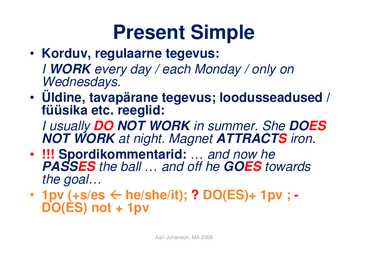
Present Simple · Korduv, regulaarne tegevus: I WORK every day / each Monday / only on Wednesdays. · Üldine, tavapärane tegevus; loodusseadused / füüsika etc. reeglid: I usually DO NOT WORK in summer. She DOES NOT WORK at night. Magnet ATTRACTS iron. · !!! Spordikommentarid: ... and now he PASSES the ball ... and off he GOES towards the goal... · 1pv (+s/es Å he/she/it); ? DO(ES)+ 1pv ; - DO(ES) not + 1pv Aari Juhanson, MA 2008 Present Progressive · Hetkel toimuv, pooleliolev tegevus: S/he IS TALKing on the phone now. I AM READing an interesting book. · Ajutine, regulaarsele ja tavapärasele vastanduv tegevus (tulevikku viitav): This summer they ARE not GROWing
1. the base form Talk Speak üldoleviku tüvivorm 2. the past form/ -ed form Talked Spoke üldmineviku vorm 3. the past participle (-ed Talked Spoken participle) mineviku kesksõna 4. the present participle (- Talking Speaking ing participle) oleviku kesksõna The tenses: Expressing the future: Simple Perfect Continuous Perfect Continuous Present Base Have / has + to be + base+ ing has/ have been +s + pariticiple base+ -ing He drinks tea at I have walked She is talking She has been breakfast. waiting for you all
Here's a breakdown of how you can express how you really are without complaining too much. · Fine, thanks. / On top of the world, thanks. · OK, thanks · Not so bad, thanks. / Can't complain, thanks. · So so, thanks. / So and so, thanks. · Not so good, actually 1 The English alphabet Spelling Work with your partner and spell out first your name and then some names of places. Write down each letter as you hear it, and then say the word. The English alphabet on the phone: You might find the following alphabet (used by international airlines) useful when trying to spell a word on the telephone. A Alpha O Oscar Ä Alpha-Echo Ö Oscar-Echo B Bravo P Papa
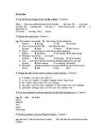
1) Ann is my best friend! We........each other for years A know B knew C knows D have known 2) Nicky........to San Francisco when the accident happened. A flies B has flown C was flying D has been flying 3) Why don`t you let her........her story? A finish B to finish C finishing D have finished 4) Tim........in a cafe at present, but he has already applied for a new job A work B have worked C is working D worked 5) My father........already worked for two years before he went to University. A was B had C has D is 3. Change the order of the words to make a correct sentence. ( 5 points ) 1) I wonder / can / you / me / help / if 2) a / my / to / written / I / mother / already / letter / long / have 3) the / watch / often / they / TV / in / evening
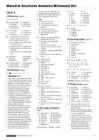
again to keep the noise down. between Paul and Joe. 1D Sporting origins page 67 2 She recognised him at once. 2 Phobias can be genetically 3 He's working at his father's shop inherited. 1 1 staunchly / resolutely for the time being. 3 When it comes to politics, 2 By and large 4 They'll be here any moment now. Edward and his dad have a lot in 3 swiftly 5 Everybody makes mistakes once common. 4 loosely in a while. 4 Luke is the spitting image of Matt 5 categorically 6 My brother was still a baby at the Damon. 6 widely time
· Varsti toimuvat tegevust, mis on enne kokku lepitud, ette kavatsetud. We are meeting tonight. We are going to the theatre. Pane tähele! Kestvat olevikku kasutatakse tegevusverbides (I am dancing, you are eating etc.). Mõned verbid on mitte tegevusverbid, näiteks ei saa öelda I am liking või you are knowing, vaid I like ja you know. Järgmiseid verbe ei kasutata tavaliselt kestvas olevikus. like love hate want need prefer know realise suppose mean understand believe remember belong contain consist depend seem Past Simple Lihtmineviku moodustamine Jaatav vorm Eitav vorm Küsiv vorm I asked I did not ask Did I ask? He/she/it went He/she/it did not go Did he/she/it go?
Conditionals Table of Contents Conditionals ......................................................................... 2 A. Real Conditionals ............................................................. 2 B. Unreal Conditionals ......................................................... 3 Linking words used in Conditionals ...................................... 4 Conditionals Conditions deal with imagined situations: some are possible, some are unlikely, some are impossible. A. Real Conditionals Real Conditionals refer to situations that are true, have happened, generally happen or are likely to happen. The First Conditional expresses a possible condition and a probable result: If I have time, I will help you. In the if-clause we use the Present Simple, in the main clause will + the verb.
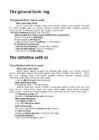
Golden Grammar rules 1. Don't use an with own. Sue needs her own room. (NOT Sue needs an own room.) I'd like a phone line of my own. (NOT ... an own phone line.) 2. Use or rather to correct yourself. She's German or rather, Austrian. (NOT She's German or better, Austrian.) I'll see you on Friday or rather, Saturday. 3. Use the simple present play(s), rain(s) etc to talk about habits and repeated actions. I play tennis every Saturday. (NOT I am playing tennis every Saturday.) It usually rains a lot in November. 4. Use will ..., not the present, for offers and promises. I'll cook you supper this evening. (NOT I cook you supper this evening.) I promise I'll phone you tomorrow. (NOT I promise I phone you tomorrow.) 5. Don't drop prepositions with passive verbs. I don't like to be shouted at
3 1 was getting, arrived Challenge! 2 It's a mixed class of girls and boys. 2 was preparing, cut Students' own answers 3 It's difficult to tell what kind of 3 discovered, were building 1E Past perfect simple and lesson their in. 4 started, was talking 4 It could be that they're in a maths 5 found, was living continuous page 8 lesson. 4 1 has/had just arrived 1 1 had been having hits since 1992
1. Active/Passive Active - the professor teaches the students. Passive - The students are taught by the professor 2. Present Simple [VERB] + s/es in third person. Tegevus on korduv või tavapärane. You speak English. I play tennis. Cats like milk. The train leaves tonight at 6 PM. I am here now. Active= Once a week, Tom cleans the car. Passive= Once a week, the car is cleaned by Tom. 3. Present Continuous [am/is/are + present participle]. Tegevus toimub/ei toimu praegusel hetkel. You are watching TV. You are learning English now. I am studying to become a doctor. I am meeting some friends after work. Active= Right now, Tom is writing the letter. Passive= Right now, the letter is being written by Tom. 4. Past Simple [VERB+ed] or irregular verbs
University of North Carolina. He is the author of over 150 articles as well as seven books. Routledge Contemporary Introductions to Philosophy Series Editor: Paul K. Moser Loyola University of Chicago This innovative, well-structured series is for students who have already done an introductory course in philosophy. Each book introduces a core general subject in contemporary philosophy and offers students an accessible but substantial transition from introductory to higher-level college work in that subject. The series is accessible to non-specialists and each book clearly motivates and expounds the problems and positions introduced. An orientating chapter briefly introduces its topic and reminds readers of any crucial material they need to have retained from a typical introductory course. Considerable attention is given to explaining the central philosophical problems of a subject and the main competing solutions and arguments for those solutions. The primary aim is to
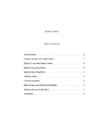
INGLISE KEEL Sisukord Sisukord 2 Ajavormid Tense vorms 3 Lihtolevik The present simple 3 Lihtminevik The past simple 3 Lihttulevik The future simple 3 Kestev olevik The present continuous 3 Kestev minevik The past continuous 4 Kestev tulevik The future conrinuous 4 Täisminevik The present perfect 4 Enneminevik The past perfect 4 Ennetulevik Future perfect 5 Üldminevik Past tense 5 Üldtulevik Future indefinite 5
INGLISE KEEL Sisukord Sisukord.................................................................................................................................. 2 Ajavormid Tense vorms.......................................................................................................3 Lihtolevik The present simple..................................................................................... 3 Lihtminevik The past simple....................................................................................... 3 Lihttulevik The future simple...................................................................................... 3 Kestev olevik The present continuous......................................................................... 3 Kestev minevik The past continuous
must be in want of a wife. However little known the feelings or views of such a man may be on his first entering a neighbourhood, this truth is so well fixed in the minds of the surrounding families, that he is considered the rightful property of some one or other of their daughters. "My dear Mr. Bennet," said his lady to him one day, "have you heard that Netherfield Park is let at last?" Mr. Bennet replied that he had not. "But it is," returned she; "for Mrs. Long has just been here, and she told me all about it." Mr. Bennet made no answer. "Do you not want to know who has taken it?" cried his wife impatiently. "You want to tell me, and I have no objection to hearing it." This was invitation enough. "Why, my dear, you must know, Mrs. Long says that Netherfield is taken by a young man of large fortune from the north of England; that he came down on Monday in a chaise and four to see the place, and was so much delighted with it, that he agreed with Mr. Morris
sentences. All students of English, be they native speakers or those who are studying English as a second language, will profit from the fundamental introduction and review of grammar provided by SADDLEBACK'S BASIC ENGLISH GRAMMAR 1 and 2. Helpful marginal notes throughout the books have been provided to reinforce existing skills and call attention to common problem areas. We wish you every success in your pursuit of English proficiency. 1 What is Grammar? 5 The Simple Past Tense 98 Regular and Irregular Verbs 99 Was and Were 104 2 The Capital Letter 6 The Past Progressive Tense 106 The Future Tense 108 Can and Could 112
e.g. I can swim. Do you think I should go? Characteristics of Modal Verbs • There is no -s in the third person singular: She can ski. He must be tired. It might rain. • They are used to form questions and negatives: Shall we go for a walk? What should I do? He can’t dance. You mustn’t tell lies! • Modal auxiliary verbs don’t usually have past forms. Other expressions are used instead: I had to work hard at school. The prisoner was able to/managed to escape by climbing onto the roof of the prison. (NOT *could escape) (=ability / performance on one occasion) In some cases could can be used with a past meaning: I could swim when I was six. (=general ability) • They have no infinitives and no –ing forms. Other expressions are used instead. I’d love to be able to ski. I hate having to get up early. • They are followed by an infinitive without -to
Cali 2005 Was Born Traveled to Europe Husband 1978 School graduates @ Oxford 1999 Started Got married School 1983 2008 2 The Six English Verb Tenses Three Simple Tenses Simple continuous Present You walk. You are walking I run. I am running. Past You Walked You were walking. I ran. I was running. Future You will walk. You will be walking. I will run. I will be running. Three Perfect Tenses Perfect continuous Present perfect you have walked
thou shalt surely die. Genesis 2:17 PREFACE I'd never given much thought to how I would die -- though I'd had reason enough in the last few months -- but even if I had, I would not have imagined it like this. I stared without breathing across the long room, into the dark eyes of the hunter, and he looked pleasantly back at me. Surely it was a good way to die, in the place of someone else, someone I loved. Noble, even. That ought to count for something. I knew that if I'd never gone to Forks, I wouldn't be facing death now. But, terrified as I was, I couldn't bring myself to regret the decision. When life offers you a dream so far beyond any of your expectations, it's not reasonable to grieve when it comes to an end. The hunter smiled in a friendly way as he sauntered forward to kill me. 1. FIRST SIGHT My mother drove me to the airport with the windows rolled down. It was seventy-five degrees in Phoenix, the sky a perfect, cloudless blue
so much noise. I can't hear myself think! f) Darling, I love you so much! I wish we are / had been / would be / could be together always! g) I'm sorry I missed your birthday party. I really wish I come / came / had come / would come. h) I like my new boss but I wish she gave / would give / could give me some more responsibility. i) Having a lovely time in Brighton. I wish you are / were / had been here. j) This car was a complete waste of money. If only I didn't buy /hadn't bought it. 2.- 3.- 4.- Choose the most suitable verb form in each sentence. a) A cheque is all right, but I'd rather you pay / paid me cash. b) Imagine you live / lived in New York. How would you feel? c) If only I have / had / would have a screwdriver with me. d) If you want to catch the last train, it's time you leave / left. e) I'd rather you don't / didn't tell anyone about our conversation.
......... · When there are Changing tenses: present changes to past:::: am/is --- was are -- were want/like/know/go etc --- wanted/liked/knew/went etc do/does --- did have/has had will --- would can --- could wanted/liked --- had wanted/had liked NT: Jo says "Mary has given up het hobby." - Jo said that Mary had given up her hobby. · Some other words change also, which are more fit?? to reported speech: this that these those here there now then ago before today that day tomorrow the next day yesterday the day before last night the previous night next the following week/year week/year NT: He said: ,,I am coming to the party today." --- He said (that) he was coming to the party that day. · Questions.In direct speech the the questions starts with do, does, did they do not
beautiful (al. 3 silpi) more beautiful the most beautiful tired more tired the most tired boring more boring the most boring Erandid: good/ well better the best Bad/ ill worse the worst many/ much more the most little smaller/ less the smallest/ least VII. CONDITIONALS (TINGIMUSLAUSED) KASUTATAKSE SIIS, KUI SOOVITAKSE RÄÄKIDA VÕIMALIKEST SÜNDMUSTEST JA OLUKORDADEST JA NENDE TAGAJÄRGEDEST. If _________________, ______________. ___________________ if _____________. ! alati ei pruugi IF-i lauses olla! 2 4 conditionals: Zero cond. käibetõed, sagedased sündmused First cond. üsna tõenäolised sündmused Second cond. ebatõenäolised sündm. Third cond. miski, mis oleks võinud minevikus toimuda, aga ei
In some fixed expressions I can not bear listening to people who complain. I can not help feeling that he is cheating us. That book is not worth reading. The infinitive with to The infinitive with to is used: After some main verbs (afford, agree, appear, arrange, ask, attempt, bear, begin, care, choose, consent, decide, determine, expect, fail, forget, happen, hate, help, hesitate, hope, intend, learn, like, love, manage, mean, offer, prefer, prepare, pretend, promise, propose, refuse, remember, seem, start, swear, try, want, wish) I can not afford to eat in that restaurant. After some main verbs Followed by object + infinitive with to (advise, allow, ask, cause, command, encourage, expect, forbid, force, get, hate, help, instruct, intend, invite, leave, like, mean, need, oblige, order, permit, persuade, prefer, press, recommend, remind, request, teach, tell, tempt, trouble, want, warn, wish)
· I play tennis. · She does not play tennis. USE 4 Now (Non-Continuous Verbs) · Does he play tennis? · The train leaves every morning at 8 AM. · The train does not leave at 9 AM. · When does the train usually leave? · She always forgets her purse. · He never forgets his wallet. Examples: · Every twelve months, the Earth circles the Sun. · I am here now. · Does the Sun circle the Earth? · She is not here now. · He needs help right now. USE 2 Facts or Generalizations · He does not need help now. · He has his passport in his hand. · Do you have your passport with you?
Proper count: There are three Evas in the class. Count noncount (mass): After the accident, there was cat all over the road. Mass count: The waitress brought three waters to the table. - dual class membership: some nouns can be seen from the point of view of count or noncount nouns. I want an evening paper. Wrap the parcel up in brown paper - a different lexical item a garment clothing, a laugh laughter, a `permit permission, a job, a task work, a poem - poetry - conversion: nouns may also be shifted from one class to another by means of conversion A: What cheeses have you got today? B: Well, we have Cheddar, Gorgonzola, and Danish blue. Grammatica categories: Each of the main word classes has a typical set of grammatical categories. Number: Number is the only inherent category for which nouns are inflected in all of the GMC languages, and the majority of nouns in all of these languages have plural forms which
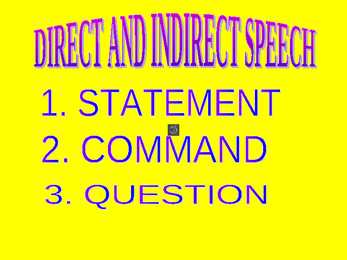
· DIRECT · INDIRECT · Am, is, are · Was/were · Shall/will · Should/would · Can · Could · May · Might · Must · Have/has to · Ought to · Had to CHANGES OF ADVERB OF TIME & PLACE · DIRECT · INDIRECT · NOW · THEN · TOMORROW · THE FOLLOWING DAY · NEXT WEEK · THE FOLLOWING WEEK · TONIGHT · THAT NIGHT · TODAY · THAT DAY · YESTERDAY · THE DAY BEFORE · LAST NIGHT · THE NIGHT BEFORE · LAST WEEK · THE WEEK BEFORE · HERE · THERE · THIS · THAT · THESE · THOSE CHANGES OF TENSES · DIRECT · INDIRECT · SIMPLE PRESENT · SIMPLE PAST · SIMPLE PAST · PAST PERFECT · PRESENT PERFECT · PAST PERFECT · PRESENT · PAST CONTINUOUS CONTINUOUS
results, you have the right road map in your hands.You have before you the DNA of your future. All you need to create a wonderful fu- ture for yourself is to read this book, decide how you are going to apply it to your own life, write out a plan, and then go forth with en- thusiasm and make it happen. I have a confession to make. I am one of Brian’s raving fans. I have studied him, his brilliant work, and the extraordinary results he has achieved. I am also one of his close colleagues and friends. We have worked together on many platforms, and met and talked with each other on numerous occasions. Brian is one of the finest thinkers and writers on inner develop- ment and personal success in the world. I know; I have sold over 82 million books aimed at helping people get the most out of themselves.
kaudses kõnes 4.2b Kestev minevik Kasutame: et rääkida asjades, mis on minevikus kestvad. They were walking along the bank of a river. et rääkida sündmusest, mis oli kestev, kui teine sündmus aset leidis They were driving down the road when a dog ran in front of the car. et rääkida tegevustest, mis leidsid aset samal ajal minevikus While I was cooking lunch, Gina was washing the floor. 4.2c Past perfect simple (Had+past participle) Kasutame et rääkida sündmustest, mis leidsid aset enne, kui teine mineviku vorm When I saw her, I realised I had met her before kaudses kõnes 4.2c Kestev täisminevik Kasutame: et rääkida tegevusest, mis kestsid kuni nimetatud sündmuseni minevikus I had been walking for three hours when I came to a small village. kaudses kõnes UNIT 5 5.1 Time expressions .
 annaabi.ee