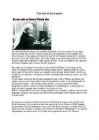
The Fall of the Empire The fall of the British Empire was caused by World War II for two reasons. Firstly, many nations felt that their sacrifice should be rewarded with independence, for example India. Also, the losses to the Japanese destroyed the myth of the European omnipotence. Secondly, heavily in debt to the United States, the United Kingdom was financially exhausted. This left it almost impossible to defend its wider colonies by force. So the vast markets were opened to American companies and to weaken the UK in general. No empire has been larger or more diverse than the British Empire. At its apogee in the 1930s, 42 million Britons governed 500 million foreign subjects. Britannia ruled the waves, and a quarter of the earth's surface was coloured red on the map. Where Britain's writ did not run directly, its influence, sustained by matchless industrial and commercial sinews, was often paramoun...
Old English ( 450-1100 AD) The invading Germanic tribes spoke similar languages, which in Britain developed into what we now call Old English. Old English did not sound or look like English today. Native English speakers now would have great difficulty understanding Old English. Old English was spoken until around 1100. Middle English (1100-1500) In 1066 William the Conqueror, the Duke of Normandy invaded England. The new conquerors brought with them a kind of French and there was a period where the lower classes spoke English and the upper classes spoke French. In the 14th century English became dominant in Britain again, but with many French words added. Modern English Early Modern English (1500-1800) Towards the end of Middle English the change in pronunciation started, with vowels being pronounced shorter and shorter. From the 16th century the British had contact with many peoples from around the world and many new words and phras...
History of English literature Periods: 1. Anglo-saxon or early literature (499 - 1066) 2. Second or Norman or late Medieval period (1066 - 13/14 century) 3. Renaissance or Modern period (13-14 century present) Anglo-Saxon period · All of the literature had its roots in folklore · Texts were orally transmitted, the anglosaxons had no written language · Two types of singers: 1) scop (attached to the royal court, wrote poetry and songs, performed them); 2) gleeman (travelled, mostly sang other peoples' songs, not their own songs; performers of scop songs) · The oldest known song Widsith (The Far Traveller/Wonderer); tells of a gleeman who travels in Europe, of his love of noble deeds, speaks of the shortness of life http://en.wikipedia.org/wiki/Widsith · The other known song Deor's Lament. Can be called the first English lyrics, about 40 lines. Talks about a scop who is not happy w...
English studies British history Eleri Pärna Form 9 2010 About 1.What is Stonehenge? 2. Who were the Celts and the Druids? 3. When did the Romans invade Britain? 4. Why did Julius Ceasar call the land Albion ? 5.Why and who built the Hadrian Wall? 6. When did the Saxons settle in Britain? 7. When did the Vikings first raid Britain? 8. Who were the Normans? 9. When was the Battle of Hastings? 10. Who was William The Conquerer? What is Stonehenge? a prehistoric monument located in the English county of Wiltshire built in several stages from 2800 - 1800 BC. Druids built Stonehenge. Who were the Celts and the Druids? The Celts were a group of peoples that occupied lands stretching from the British Isles to Gallatia. The Druids were the wise ones, the educated class of the Celts. ( lawyers, doctors, teachers, storytellers, ...
THE ANGLO-SAXON PERIOD English literature came when the Angles, the Saxons, the Jutes and the Frisians invaded Britain. During this time English was called Anglo- Saxon or Old English. In the chronicles of Roman history (composed in Latin) is said that Britain makes its first appearance in written language when Romans invade the England. BEOWULF most important poem, surviving in a 10th-cent manuscript. The historical period of the poem's events can be dated in the 6th to 8th century. Much of the material of the poem is legendary and paralleled in other Germanic historical-mythological literature in Norse, Old English, and German. GEOFFREY CHAUCER (1340-1400) Politician and writer, fought in France during the 100 years war. He visited Genoa and Florence where he became acquainted with Italian literature and in particular with the works of Dante, Petrarch and Boccaccio. The French period (up to 1370). early works were ba...
Suppletion Present in languages of different families. Present in Old, Middle and Modern English, though the general tendency is towards more regularity/iconicity so the number of suppletive forms has decreased.In the text: goon to go wenden - to turn Gan was suppletive in Old English, past form: eode.Eode was supplanted by went (past form of wenden) at the end of the Middle English period.To wend has survived in Modern English in phrases such as to wend one's way, we wended homewards (ironic usage). Thus: suppletivity- suppletion different parts of one and the same paradigm come from what were originally different paradigms (different words with close meanings or words in different but close dialects).Suppletion embraces verbs, adjectives, nouns. Be was/were been (Old English beon/wesan) (am, art, is, are); in Old English some suppletive forms were used parallel to one another) Good better best Bad worse worst Much more...
The Importance of English History Essay There is not a single country in the world without a history it can be either long or short, yet still a unique part of the existence. England has had many colourful events throughout the history, but some have dominated over the others and therefore all together formed a country we can see nowadays: the Great Britain. Starting from the beginning, Britain was part of the mainland until about 6000 BC, when it became an island. Ever since then it has been developing slightly different from the other part of the Europe. For example, when two parts separated, some animals had already adopted the life on the island and did not move back to the mainland. They suited their appearance more comfortable for the isolated island and learned how to survive in the wet climate and rather heavy air. The first inhabitants the Iberians also h...
The history of the English Language Kristin Klaus, 10a Short history · Started with the arrival of three Germanic tribes who invaded Britain during the 5th century AD · The tribes: the Angles, the Saxons, the Jutes · At that time the inhabitants spoke a Celtic language · The invadors pushed them west and north Germanic invaders entered Britain on the east and south coasts in the 5th century. Old English · 450-1100 AD · The Germanic tribes spoke similar languages which developed into Old English · Did not sound or look like English today · About half of the most commonly used English words have Old English roots · Be, strong, water Part of Beowulf, a poem written in Old English. Middle English · 1100-1500 · In 1066 William the Conqueror, the Duke of Normandy (part of modern France), invaded and conquered England · The new conquerors (called the Normans) brought with them a kind of French, which became the la...
CHARACTERISTIC FEATURES OF OLD ENGLISH - 15 monophtongs, (7 long, 7 short, 1 central), 4 diphtongs, 17 consonants. Free variaton of R, and it was pronounced everywhere. Very much Germanic in character. Quite some special consonants that no longer exist. About morphology: synthetic with numerous aglutinating tendencies. System of tenses Germanic, but with a reduction of tenses. Paradigmatic leveling; Stress shift; Word order; Loan words (Old Norse, Old French). Dual pronouns. Determiners - no separate definite article. Strong and weak verbs. Word order relatively free with tendencies towards SVO. SVO, SOV, VSO most common. Adposition and podposition were both possible (eesliide ja tagaliide). About syntax: clauses were joined much simpler than nowadays, using and, then etc. Because of case syncretion the word order in a sentence became much more important to be able to tell the difference between words. FIRST CONSONANT SHIFT (GRIMM'S L...
Old English Literature (449-1066) (Anglo Saxon) The Early Settlers · The Celts - river and town names, lifestyle primitive and crude(tahumatu) · Julius Caesar 55 B.C - the Romans for more than 300 years · 449 A.D - Jutes, Angles, Saxons - Germanic origin · Angle-land=England · Engleish, later Anglo-Saxon = Old English Literature · British literature begun in oral - by minstrels (laulik/poeet) · songs and poems of heroes · highest human qualities =bravery, honour, and loyalty to one's lord · Venerable Bede (673-735) - "the father of English history" - Ecclesiastical History of the English People 731 - in Latin · Venerable - auväärt, kõrge auline · Ecclesiastical -kiriklik, aulik Beowulf · the earliest English story-poem, pagan · about 700 by an unknown minstrel · an epic - a long narrative poem in splendid/majestic language about the achievements of a hero, often a national...
Mikk Hödemann 12.d klass English Parliament What can I say about the English history at all? I think that this is the most interesting history I had to study. During this subject (British civilization), I discovered some exciting facts, occasions which took place in the British history. One of these "discoveries" was the English Parliament. I was amazed how fast it grew within the centuries, from eleventh to seventeenth centuries. The political history of British Isles over the past 800 years has been largely one of reducing the power of the monarchy and transferring authority to a London-based Parliament as the sovereign legislative body for all of Britain. This development has resulted in political, social and religious conflicts, as well as evolving governmental and constitutional institutions. The early political history of the British Isles is the story of four independent cou...
Tallinna Mustamäe Humanitargümnaasium Valeria Jefremenkova ENGLISH AS A GLOBAL LANGUAGE INGLISE KEEL KUI ÜLEMAAILMNE KEEL Research work Supervisor: Jevgenija Kozlova Tallinn 2016 1 Table of Contents СONTENT…………………………………………………………………………………...2 INTRODUCTION…………………………………………………………………………...3 CHAPTER I……………………………………………………………………………….....5 1.1. A Brief History of the English Language…………………………………………...…..5 1.2. Origins of English as the Global Language……………………………………..……....6 1.3. Necessity of a Global Language...……………………………………………………....8 1.4. Criticism of a Global Language………………………………………………………....9 1.5. The Role of English Today……………………………………………………………..10 1.6. English Speaking Countries…………………………………………………………….11 1.7. Perspectives of English………………………………………………………………....13 CHAPTER I...
Outstanding figures in British literature Eva Martina Põder 11.b British literature Refers to all literature produced by British authors from the United Kingdom, which includes England, Scotland, Northern Ireland, Wales, the Channel Islands, and Isle of Man Includes early works written in Gaelic, Welsh, and Latin, works in Old, Middle, and Modern English, each of which represents a different period Full of great works British works in Latin Venerable Bede He lived between 673 and 735 AD The greatest of all the AngloSaxon scholars He's the earliest English historian, whose work has shed light on a period of English history that would have otherwise been unknown ,,The Father of English History" Wrote / translated about 40 books on almost every area of knowledge, i.e. nature, astronomy, and poetry His best known work is "The Ecclesiastical History of the English People" Starting with the Roman invasion in the 5th century, he...
Irish History Tallinn 2009 Ireland is the third-largest island in Europe, and the twentieth-largest island in the world. It lies to the north-west of continental Europe and is surrounded by hundreds of islands and islets. To the east of Ireland, separated by the Irish Sea, is the island of Great Britain. Politically, the state Ireland (described as the Republic of Ireland) covers five-sixths of the island, with Northern Ireland, part of the United Kingdom, covering the remainder in the north-east. The first settlements in Ireland date from 8000 BC. By 200 BC Celtic migration and influence had come to dominate the island. Relatively small scale settlement by both the Vikings and Normans in the Middle Ages gave way to complete English domination by the 1600s. Protestant English rule resulted in the marginalisation of the Catholic majority, although in the north-east, Protestants were in the majority. A famine in the mid-1800s...
Medieval literature Religious literature- mostly written in church languages(Latin, Greek, Old Slavic) Secular literature- written in vernacular languages as well 6th -15th century Anonymity Religious writing Liturgical writing-hymns, psalms Theological writing-aquinas, abelard etc Religious poetry Mystery plays-reenactment of bible stories Secular writing Troubadour writing:"courtly love", romance Epic poem(song of roland) Travel writing History writing-chronicles Allegory The use of symbols and analogy to convey a certain meaning /message Literary output of medieval English Anglo-saxon or Old English literature(7th century-1066) Middle english literature(12th century-15th century) End of the period:1470s chancery standard(regulating english) and onset of renaissance Middle English literature Written in many dialects in early period 14th century Middle english was used for majority literary works...
Scotlan History The history of Scotland begins around 10,000 years ago, when humans first began to inhabit Scotland after the end of the Devensian glaciation, the last ice age. Of the Stone Age, Bronze Age, and Iron Age civilization that existed in the country, many artifacts remain, but few written records were left behind.People lived in Scotland for at least 8,500 years before recorded history dealt with Britain. The written history of Scotland largely begins with the arrival of the Roman Empire in Britain, when the Romans occupied what is now England and Wales, administering it as a Roman province called Britannia. To the north was territory not governed by the Romans -- Caledonia, by name. Its people were the Picts. From a classical historical viewpoint Scotland seemed a peripheral country, slow to gain advances filtering out from the Mediterranean fount of civilisation, but as knowledge of the past incr...
Paul McCartney Siim Jaanoja 11. A I wannabe musician Me and my Honey Click to edit Master text styles Second level Third level Fourth level Fifth level Girl's loves me Click to edit Master text styles Second level Third level Fourth level Fifth level Fame is good... Click to edit Master text styles Second level Third level Fourth level ...
William Makepeace Thackeray By: Liis Raudmann Biography Born in July 18th, 1811 English novelist Father- Richmond Thackeray worked in British East India Company In 1815 William was sent to England 20th August 1836 William married Isabella Gethin Shawe Died on 23 December 1863 Education 1817 attends school on Chiswick Mall 1822-1828 in Charterhouse 1828-Camberidge 1829-1830-Trinity 1831-1833-studies law in Middle Temple, London 1834-1835-studies art in Paris Stepping Into World Went to German After returning lived of young indulgent man Thackeray inherited £ 20,000 from his father In 1832, Thackeray met William Maginn Bad times with his wife Thackeray worked as a freelance journalist for about 10 years Works Contributions to Punch, 1843-1854 The Book of Snobs Miss Tickletoby's Lectures on English History Papers by the Fat Contributor The...
English literature is one of the oldest literatures in Europe; dates back to the 6th century AD. Oral literature, i.e. not written down, spread from person to person. In 449 AD Anglo-‐Saxon tribes invaded England – beginning of the Anglo-‐Saxon period in English literature. The first form of literature was folklore, carried by scops and gleemen, who sang in alliterative verse (a kind of simple poetry). Prose developed much later. The first form of recorded English literature was the epic Beowulf, which was produced sometime near the end of the 7th and beginning of the 8th century. It has no ...
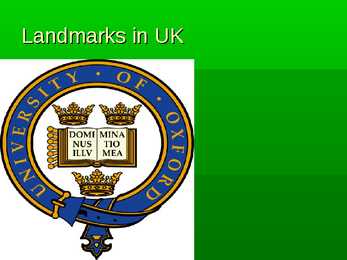
Landmarks in UK Annette Kirotar 8.c Gustav Adolf Grammar School 2008/2009 University of Oxford University of Oxford is located in the city of Oxford, Oxfordshire, England. Oxford is the oldest university in the English-speaking world. It is also one of the world's leading academic institutions. Oxford has 38 independent colleges. History The university was built in the end of 12th century, although the exact date remains unclear. After a dispute between students and townsfolk broke out in 1209, some of the academics at Oxford fled north-east to the town of Cambridge, where the University of Cambridge was founded. The two universities have since had a long history of competition with each other. Interesting to know Oxford is consistently ranked in the world's top 10 universities. Oxford's motto is Dominus Illuminatio Mea (Latin). Motto in English: "The L...
"YESTERDAY" Adrian Badjonkin About this song "Yesterday" is a song by English rock band the Beatles written by Paul McCartney on the album Help! in the United Kingdom in August 1965. Sir James Paul McCartney Sir James Paul McCartney, (was born 18 June 1942) is an English singer- songwriter and composer. James Paul McCartney was born on 18 June 1942 in Walton Hospital, Liverpool, England. With John Lennon he gained worldwide fame as the bassist of the rock band the Beatles, one of the most popular groups in the history of music. After the band's break-up, he pursued a solo career and formed Wings with his first wife, Linda. McCartney has been recognised as one of the most successful composers and performers of all time. More than 2,200 artists have covered his Beatles song "Yesterday", more than any other song in history. Song ,,Yesterday" Yesterday" is a melancholy ballad a...
Malaysia Ülle-Mai Kesamaa 10th form Content Location/Geography Geography British related history People Location/Geography ★ Continent - Asia ★ Region - Southeast Asia. ★ Located on the Sunda shelf ★ 2 distinct parts to this country: Peninsular Malaysia and East Malaysia ★ Total land area is about 329 847 km2 , ranked 67th ★ Capital is Kuala Lumpur Geography ★ Tropical climate, hot and humid throughout the year ★ Highest mountain range is the Crocker Range. ★ Tallest mountain is Mount Kinabalu, Kinabalu National Park, UNESCO British related history ★ English traders in Malay waters since 17th century ★ European power dominant with the arrival of the british ★ The britains interests in Malaysia were predominantly economic, not because of the territorial control. Just another base of trade People ★ Population 28 million people ★ 41st most populated country in the world ★ Malays - the largest community in Malaysia. The...
Revision questions for the test on Old English and Medieval Literature. 1.) How is literature analysed and studied? What is the difference between the diachronic and synchronic view? Literature is studied and analysed by reading the piece of work profoundly and work on all the aspects of the piece. Diachronic is development in history Synchronic is particular state at any given moment 2.) Give a general overview of Celtic Britain, Roman invasion in 55-54 BC, Anglo-Saxon invasion and the second Roman "invasion" of Great Britain, who were the leaders, what influence did they leave on the culture of Great Britain? Celtic Britain was during the Bronze Age, there were many small tribal kingdoms fighting one another. Many megalithic monuments were built around that time, e.g. Stonehenge, the Avebury ring. The Roman Invasion 55-54 BC, Julius Caesar ruled Rome, Rome built the Hadrian's wall (73 miles long, built in 121 127 AD) agains...
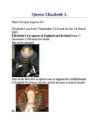
Queen Elizabeth I (1533-1603) Janeli Õim 11A Brief biography Elizabeth Tudor Click to edit Master text styles 7 September 1533 Second level 24 March 1603 Third level Fourth level Queen of England Fifth level Queen of Ireland - 17 November 1558 until her death (aged 69) Protestant Never married Janeli Õim 11A Family Click King Henry VIII (1491 - to edit Master text styles 1547) Second level Anne Boleyn (Executed 19 Third level Fourth level May 1536) Fif...
The Germanic Invasions Anglo-Saxon invasion During the 5th c. a number of Germanic tribes invaded The Angles, the Saxons, the Jutes Different peoples, but common language and customs Advance halted by King Arthur Distortions of popular history In folklore, myth (and films) a great English hero, an example of medieval nobility and chivalry In fact a Romanized Celt, lived before medieval times, fought the Anglo-Saxons (people who became "the English") Predominated by the end of the 6th c. Kingdoms established: Wessex, Essex, Sussex, Mercia, Northumbria, East Anglia etc. Kingdoms constantly at war with each other Celtic culture and language survived in Scotland, Wales and Cornwall Anglo-Saxon lifestyle A great impact on the countryside Introduced new farming methods Established numerous villa...
Australia and New Zealand Triin Tens Tartu Veeriku School 2016 General facts about Australia · Commonwealth of Australia · Capital: Canberra · Population: 21 507 717 (2011) · Area: 7 692 024 km² · Anthem: Advance Australia Fair · Currency: Australian dollar · Language: English Location · Bigger cities: Sydney, Melbourne, Brisbane · Regions · Geography History of Australia · Aborigines: 50 000 years ago · Dutch explorers: 1600s · Captain James Cook: 1770 · The British settlers: 1788 · 26 January Australia day · Free settles from Europe (19 th century) Gold Rush · Edward Hammond Hargraves · 1851 · Blue Mountains, New South Wales · Rushing to Australia · Population growth · The end of the prison Natural sites in Australia · Kangaroo Island Third-largest island Many animals · Bungle Bungles Purnululu National Park Last unexplored lands · Simpson Desert Red sand Largest sand dune desert C...
ENGLISH IN MY LIFE The British, defeated Bonaparte at the battle of Waterloo and peace settled across Europe after many years of war, the defeat of France saw the rise of Britain upon the world stage and the beginnings of the wholesale export of the English language across the globe, in the last century Britain an America again defeated tyranny in Europe the English language has evolved through popular culture , movies, music , sport , business and especially with the shrinking of the world through use of the internet to become what it is now a truly international language. Here in Estonia with our history of domination by foreign powers the last being the former soviet union an having our own language suppressed an languages imposed on us , it is a relief to see the importance of the English language an people have embraced it as a second language of Estonian people, it is the language that ev...
HISTORY TEST 5 invasions to Britain until 1066 1) The Celts o Gaels in 600BC; Cymry(Britons) in 300BC o From present-day Austria, Switzerland o The Celtic language survives in the names of many places in England- Dover, Kent, Thames o The Celts are best known for their art- many bronze objects with elaborate designs; brooches; pins; mirrors; Celtic stone crosses o The Celts had 3 social orders: warriors, druids(priests) ordinary people 2) The Romans o (55 BC-Caesar) 43 AD- 410 AD- Claudius o From present-day Italy o Southern Britain became Britannia and was ruled by a roman governor o The Romans built over 20 towns: Colchester, Londinium, Winchester etc. They were good engineers and built roads and villas that had central heating, glass windows and mosaic floors ...
William Shakespeare (1564-1616) playwright, actor, poet 37 plays, over 400 screen adaptions Lord Chamberlain's Men, King's Men, The Globe Early life: John Shakespeare, Mary Arden, 2 sis', 3 bros; married Anne Hathaway 3 children Life in London: 1599 built Globe, 1623 first compilation Forms: classical & history plays, comedies+tragedies, poetry Style: metaphors, rhetorical phrases, free flow of words, unrhymed iambic pentameter; deviations Renaissance (end of 14th century) Italy, reaches rest of Europe Elizabethan era (16th II h - 17th I h) Theatre: combined medieval theatre, morality plays & Roman drama to create Elizabethan tragedy Poetry: Italian influences, sonnet (English: cddc ee) Rulers of England: Henry VII (brings prosperity, repairs economic situation; made alliances); Henry VIII (beginning of English reformation; killed "traitors"; 6 marriages); Mary I (Catholic); Elizabeth I (The Virgin Queen restores order; Religiou...
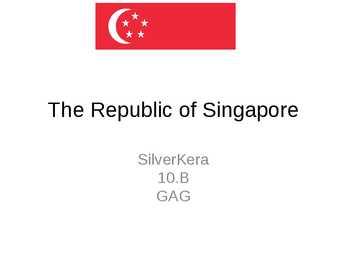
The Republic of Singapore SilverKera 10.B GAG Some statistics · An island country · Southern tip of the Malay peninsula · Total area of 710 km2and a population of 5 312 400 · Population density 7 315/ km2 · Left-handtraffic A brief history of Singapore · Comes from the Malay wordSingapura · British colony in 1819 · Occupied by Japan in 1942-1945 · 1959 self-governing state · 1963 joined Malaysia · 1965 complete independence Legal system · Legal system based on English common law · Trial by jury removed in 1970 · Caning · Mandatory death penalty · "Possibly the highest execution rate in the world relative to its population" Economy · Location made it an important trading post · In 2011 ranked 2ndfreest economy · Singaporean dollar · Port of Singapore · Worlds highest % of millionaires (1 out of 6) · No minimum wage and high income ineq...
The University of Oxford The University of Oxford, located in Oxford, England, is the second oldest and still remaining university in the world. The first one is the University of Bologna in Italy. But as for English speaking countries Oxford is a firm leader. There are evidence of teaching going far back to the 11th century, but a clear date is not known. In 1167, Henry II banned English students from studying in France which made Oxford's popularity grow rapidly. From then on, Oxford was named a real university and got it's first chancellor in 1201. For years, Oxford only accepted male students until four womens' colleges were opened thanks to the Association for Promoting the Higher Education of Women. First of them was Lady Margaret Hall, which was opened in 1878. Women have been able to be full members of the university and to take degrees since 7 October 1920, almost 900 years after the Univ...
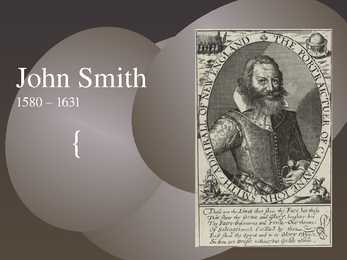
John Smith 1580 1631 { John Smith An outstanding explorer and leader, who played an important role in the history of America Responsible for the settlement and survival of first English colony in the New World English soldier, explorer, colonizer, publicist and an author Led the group of colonists of the first British colony at Jamestown from 16081609 His writings about Virginia and New England have considerable historical and literary merit He never married nor had any children Early Career Born to a freeman farmer family in England After his father's death, only 16, he quit school and started his life as a traveler and adventurer He first served as a trainee to a local merchant In 1597 he joined the army and went to wae Captured and kept as a slave for two years Managed to escape and return to England Virginia Colony Became with the Virginia Company to colonize North America for profit On May 13, 1607, 144 c...
English a global language Aleksander 10B This essay explores British and English history and its influence to the world. English is spoken all around the world. We can even say that it is a international language. It begun when Great Britain started founding colonies. Empire growed from the 17'th century up to 1920's. It was said that the sun never sets on British empire. It had expanded all over the world. In the colonies, English started to change, it had spread all around the world, just like the empire. It was leading country in the world for a very long time. It had strong economy and the strongest navy that any one had ever seen, so it was till the world wars. The British Isles, because of their good geographical position have been conqured only twice. And both occasions had a great influence...
ENGLAND General overview England is part of the United Kingdom Land borders with Scotland to the north and Wales on to the west The English Channel on south separates it form continental Europe The country includes over 100 smaller islands Capital and largest city is London Its has consitutional monarchy Monarch is Elizabeth II Total area is 130,395 km2 Population is 51,446,000 million, around 84% of the population of the UK Currency is Pound stearling(GBP) Has left-hand traffic Patron saint is ST. George Geography England comprises the central and southern two-thirds of the island of Great Britain, in addition to a number of small islands of which the largest is the Isle of Wight Much of England consists of rolling hills, but it is generally more mountainous in the north with a chain of mountains, the Pennines, dividing east and west Other hilly areas in the north and Midlands are the La...
01.12.14 The Priorities of Estonian Historical Research As a result of multiple nations having ruled over Estonian lands, Estonian history has been written from multiple perspectives. Often, religion, politics, and personal motives have fashioned history into what its authors wanted it to be. People have written from a multiplicity of perspectives. It should be one Estonian historical research's greatest priorities to distance itself from this, to seek after holistic, balanced accounts of the past. Early chronicles of Estonian history illustrate this diversity of perspective. Johann Renner, a Baltic German, held his own people in high esteem, deeming them the people of God. He implied this when he wrote that God would save His people from the hand of Gog. He seems to indicate that Gog was the Muscovite people. Perhaps the ...
Westminster Abbey Facts The Collegiate Church of St Peter at Westminster Owned directly by the royal family Dedicated to St Peter Located next to the Houses of Parliament UNESCO World Heritage Site History 616, a shrine was founded 10451050, Edward the Confessor Consecrated on December 28, 1065 Romaneque style, to house Benetictine munks Rebuilt 12451517 in Gothic style by Henry III History 2 Henry VII Lady Chapel in 1503 Dissolution of the Monasteries in 1534 Attacked by Puritans in 1640s Oliver Cromwell's funeral in 1658 Western towers were built between 1722 and 1745 Coronations The coronations of King Harold and William the Conqueror in 1066 All English and British monarchs have been crowned there Except Edward V, Edward VIII and Lady Jane Gray King Edward's Chair since 1308 More about Abbey Poets' Corner Tomb of The Unknown Warrior Statue of Martin Luther King Chapter Hou...
Queen Elizabeth 1. Nimi: Kristjan Jegorov 8.b Elizabeth I was born 7 September 1533 and she die 24 March 1603. Elizabeth I was queen of England and Ireland from 17 November 1558 until her death. She never married One of his first acts as queen was to support the establishment of English Protestant church, and he became a church should be. she looked like a witch. Governance, Elizabeth was more moderate than her father and siblings. Though Elizabeth was cautious in foreign policy and supported the halfway line but ineffective, poorly equipped launched military campaigns against the Netherlands, France and Ireland, online Spanish Invincible Armada breaking 1588th his name forever in the victory, which is often considered one of the greatest in the history of England. Government praises him for 20 years as the golden era of the ruler, and this notion still persists among the English. El...
Anton Teljutsenko AAp-11 What is it? Ruby is a dynamic, reflective, general-purpose object- oriented programming language that combines syntax inspired by Perl with Smalltalk-like features It was also influenced by Eiffel and Lisp Ruby has "Ruby License" and "BSD License" Ruby was first designed and developed in the mid-1990s by Yukihiro "Matz" Matsumoto in Japan Ruby is cross-platform programming language History Ruby was conceived on February 24, 1993 by Yukihiro Matsumoto who wished to create a new language that balanced functional programming with imperative programming Ruby was disignet to be more powerful than Perl and more object-oriented than Python The name "Ruby" was decided on during an online chat session between Matsumoto and Keiju Ishitsuka on February 24, 1993, before any code had been written for the language. History Initially two names were proposed: "Coral" and "Ruby", with the latter being chosen by M...
Museums and art galleries of London London is very rich in museums and art galleries. If you are fond of painting you'll go to the Tate Gallery. A rich sugar manufacturer Henry Tate founded it in 1897. There are about 300 oils and 19000 watercolours and drawings. There are many works by the English painter William Turner there. Most of his paintings are connected with the sea theme. There are a lot of paintings by the 16-th century English artists and paintings by foreign artists of the 19-20- th centuries. There are some paintings by impressionists there. You can see works by modern painters: Pablo Picasso among them. There are many interesting sculptures there. Henry Moor's can be seen there. He was a famous British sculptor. The National Gallery is one of the most important picture galleries in the world. The Tate Gallery is the most necessary compliment to the National Gallery as it contains contemporary works particularly by Engl...
The Middle Ages The Middle Ages are one of the most turbulent periods in English history. The Middle Ages are so called as the middle period between the decline of the Roman Empire and the Renaissance. The Middle Ages started in 1066. with the Battle of Hastings and the Norman Conquest. William the Conqueror took all the lands from the Saxon English and gave these to French nobles. Normans were known as great builders. This is assured by the fact that many great castles and other buildings, including the Tower of London, were built during the Norman Conquest. In 1086. Domesday Book was compiled. It is a detailed survey of England ordered by William the Conqueror. The reign of King William Rufus who was the son of William started in 1087 and lasted until 1100. Next king was Henry I who was the brother of William Rufus. His reign was from 1100-1135. In 1135 Henry I nephew Stephen got to the throne of Engla...
Queens Slideshow Alar Nort, Kevin Uueni, Mihkel Vaarmaa Nissi Põhikool 2015 History • Queens was settled in 1635 by dutch and english settlers. • Queens played a minor role in the American Revolution, as compared to Brooklyn, where the Battle of Long Island was largely fought. • It is believed that the county was named after Catherine of Braganza • From 1683 until 1784, Queens County consisted of five towns: Flushing, Hempstead, Jamaica, Newtown, and Oyster Bay. • The New York City Borough of Queens was authorized on May 4, 1897. Geography • Queens is located on the far western portion of Long Island and includes a few smaller islands. • Queens County has a total area of 460 km2, of which 280 km2 is land and 180 km2 is water. • Brooklyn, the only other New York City borough on Long Island, li...
Country Studies The United Kingdom Test revision questions Form 11 1. What are the capitals of the 4 constituent countries? England London; Wales Cardiff; N-Ireland Belfast; Scotland - Edinburgh 2. Order the invaders in correct chronological order: Anglo-Saxons, Normans, Romans, Celts, Vikings. Celts > Romans > Anglo-Saxons > Vikings > Normans 3. How did the Celts influence Britain? The Celts were in Britain long before the English language existed. Celtic influence on English is minimal. There are more Amerindian words in English than Celtic ones. 4. How many people approximately speak English? 300million as mother tongue, 470million as 2nd language. 5. Who (which tribes) gave the base of the English language? Anglo-Saxons 6. Describe Wales. Part of the United Kingdom and the island of Great Britain, population: 3,064,000, Wales has a distinctive culture including its...
English speaking countries- UK The United Kingdom of Great Britain and Northern Ireland is a sovereing state off the north-western coast of continental Europe. It consist of Great Britain, the north- eastern part of the island of Ireland and many smaller islands. The capital of United Kingdom is London.The flag of the United Kingdom is the Union Flag The United Kingdom is a unitary state governed under a constitutional monarchy and a parliamentary system, with its seat of government in the capital city of London. It is a country in its own right and consists of four countries:: England, Northern Ireland, Scotland and Wales . The United Kingdom is a unitary state under a constitutional monarchy. Queen Elizabeth II is the head of state of the UK as well as of fifteen other independent Commonwealth countries. The English channel is an arm of the Atlantic Ocean that separates Greate Britain from northern France...
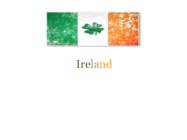
Ireland Ireland Ireland is a country which covers about 5/6 of Ireland island. Remaining 1/6 of this island is Northern Ireland. Republic of Ireland is located to west from Great Britain. Official language in Ireland is English and Irish. There's 26 countys WebRep Üldine reiting Dublin is the capital and most populous city of Ireland The population of Ireland is approximately 6.4 million. Just under 4.6 million live in the Republic of Ireland and just under 1.8 million live in Northern Ireland Ireland history The first known settlement in Ireland began around 8000 BC, when hunter-gathers arrived from continental Europe, probably via a land bridge. Few archaeological traces remain of this group, but their descendants and later Neolitchi arrivals, particularly from the Iberian Peninsula , were responsible for major Neolithic sites such as Newgr...
THE PHILIPPINES Officially known as the Republic of the Philippines Geographic information The Philippines are located in Southeast Asia in the western Pacific Ocean The Philippines consist of 7107 islands The total area of the Philippines is 300 000 sq/km2 The population of the Philippines is over 92 million people Most of the country is mountainous Country and it's symbols The capital city is Manila Official languages are Filipino and English Coat of arms Flag State system and currency The Philippines is a constitutional republic with a presidential system The president functions as both head of state and head of government and is the commander-chief of the armed forces The currency of the Philippines is peso (PHP) History The history of the Philippines is believed to have ...
History exam *Stonehenge - is a monument located in England. It is one of the most famous prehistoric sites in the world and is composed of earthworks surrounding a circular setting of large standing stones. The surrounding circular, earth bank and ditch, have been dated to about 3100 BC. Stonehenge was produced by a culture with no written language. Many aspects of Stonehenge remain subject to debate. There is little or no direct evidence for the construction techniques used by the Stonehenge builders. *The Celts in Britain and their legacy The Cets lived in Britain in The Iron Age. They were warring tribes who were battleful amongst themselves as well as inter-tribal war. They were not centrally governed. The Celts brought iron working, iron ploughs and metal swords, horses, wheels and chariots - all these things gave them an instant superiority over the native tribes. The Celts built a number ...
London is the capital of both England and the United Kingdom, and the largest metropolitan area in the European Union. An important settlement for two millennia, London's history goes back to its founding by the Romans. Since its foundation, London has been part of many movements and phenomena throughout history, including the English Renaissance, the Industrial Revolution, and the Gothic Revival.The city's core, the ancient City of London, still retains its limited medieval boundaries; but since at least the 19th century, the name "London" has also referred to the whole metropolis that has developed around it. Today the bulk of this conurbation forms the London region of England and the Greater London administrative area, with its own elected mayor and assembly. London is one of the world's most important business, financial and cultural centres and its influence in politics, education, entertainment, media, fashion and the arts contri...
TRANSGEENSETE ORGANISMIDE HEAD JA HALVAD OMADUSED Referaat SISUKORD SISUKORD.................................................................................................................................2 SISSEJUHATUS........................................................................................................................3 1.HÜPOTEES.............................................................................................................................4 2.HÜPOTEESI TÕESTUS.........................................................................................................4 2.1.Väiteid GMOde poolt........................................................................................................4 2.2.Väiteid GMOde vastu.......................................................................................................4 3.ANALÜÜS.......................................................
THE HISTORY OF JOURNALISM REPORT SUBMITTED TO: JELENA SCHMIDT SUBJECT: ENGLISH BY NIKITA GUSTSHIN TMHG 19.04.2012 "The History of Journalism" What is "Journalism"? Journalism is the investigation and reporting of events, issues and trends to a broad audience. Though there are many variations of journalism, the ideal is to inform the intended audience. Along with covering organizations and institutions such as government and business, journalism also covers cultural aspects of society such as arts and entertainment. The field includes editing, photojournalism, and documentary. His...
Jamaica report FORM: 10A 2009 Contents 1.Introduction........................................................ ....3 2.History................................................................ .....4 3.Geography......................................................... ......6 4.Economy............................................................ .....7 5.Crime................................................................. ......8 6.Sport.................................................................. ......9 7.Language........................................................... ....10 8.Conclusion......................................................... ....11 9.New words............................................................12 10.References...................................................... .....13 Introduction Jamaica is an island nation of the Great...
 annaabi.ee