 50 punkti
Autor soovib selle materjali allalaadimise eest saada 50 punkti.
50 punkti
Autor soovib selle materjali allalaadimise eest saada 50 punkti.
 ~ 3 lehte
Lehekülgede arv dokumendis
~ 3 lehte
Lehekülgede arv dokumendis
 2013-12-11
Kuupäev, millal dokument üles laeti
2013-12-11
Kuupäev, millal dokument üles laeti
 2 laadimist
Kokku alla laetud
2 laadimist
Kokku alla laetud
 0 arvamust
Teiste kasutajate poolt lisatud kommentaarid
0 arvamust
Teiste kasutajate poolt lisatud kommentaarid
 Aleks Jegorov
Õppematerjali autor
Aleks Jegorov
Õppematerjali autor
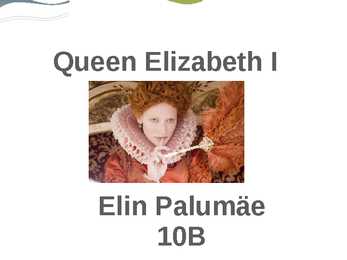
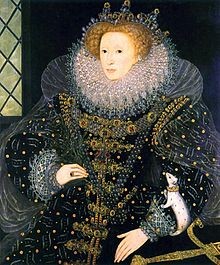
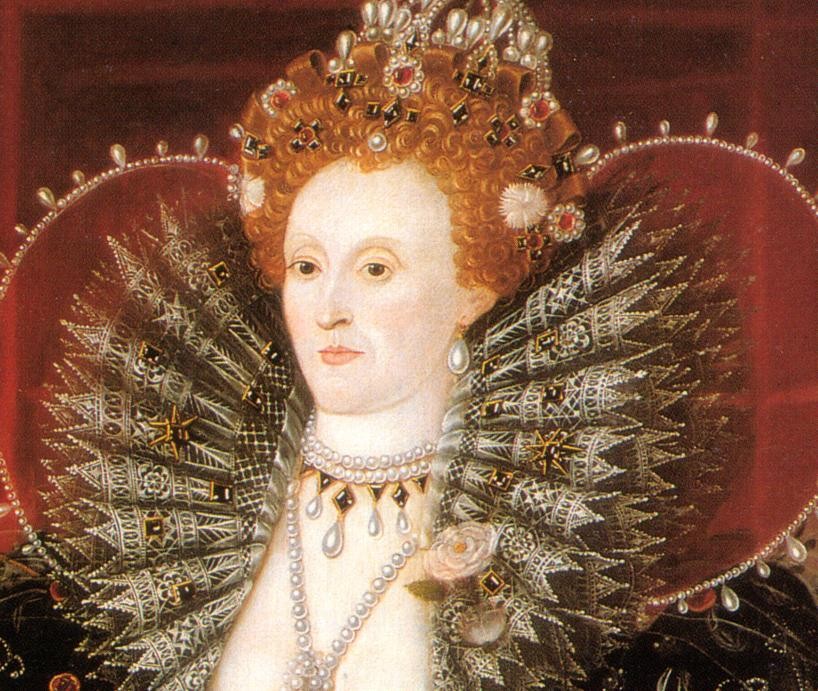
Queen Elizabeth I Elin Palumäe 10B Elizabeth I Reign - 17 Nov. 1558 24 March 1603 (44 years) Coronation - 15 January 1559(25 years) Predecessor - Mary I Successor - James I House - House of Tudor Father - Henry VIII Mother - Anne Boleyn Born - 7 September 1533 Greenwich, England Died - 24 March 1603 (aged 69) Burial - Westminster Abbey Anne Boleyn Queen consort of England Mother of Elizabeth I Tenure - 28 May 1533 17 May 1536 Coronation 1 June 1533 Anne Boleyn was Queen of England from 1533 to 1536 as the second wife of Henry VIII of England and the 1st Marquess of Pembroke in her own right for herself and her descendants. House - House of Tudor Father - Thomas Boleyn, 1st Earl of Wiltshire Mother - Lady Elizabeth Howard Born c.1501/1507 Blickling Hall/ Hever Castle, England Died 19 May 1536 (aged 29-35)Tower of London Religion - Anglican, formerly Roman Catholic King of England Henry VIII Reign - 21 April 1509 28 January House - House of Tudor
Legacy- new types of animals, plants; miles, feet, inches-roman measurements;christianity; Roman basilica in curches; reading, writing; buildings, roads Christianity in Roman Britain Until 4th C christians were persecuted 313 AD Emperor Constantine legalised christianity 380 AD Emperor Theodosius I made it the official religion of the empire Paganism had been eclipsed but continued to pose a political, religious challenge Boudicca Queen of Iceni people of Eastern England, led an uprising against Roman forces Prasutagus(ruler) was first allowed to rule when romans conquered England, after his death, romans decided to rule Iceni and flogged Boudicca and raped her daughters 60-62 AD Iceni rebelled, Boudicca´s warriors defeated Roman Ninth Legion, destroied capital-Colchester Finally Boudicca was defetated, she poisoned herself to avoid capture Hadrian´s wall
D. As the century progressed Christianity spread very quickly. Despite official recognition there was no mass conversion to Christianity; worship of the pagan gods and goddesses was not even formally banned until late in the fourth century. *Boadicea/Boudica At his death bed, Boudica's husband left half his possession to the emperor, expecting that this would protect his family. However, his property was confiscated. When Boudica, the queen of the Celts, protested, she was flogged and her daughters were raped. She swept trough Southern Britain with her tribe and tortured every Roman she met. A women having power seemed unnatural to the Romans. She fought back for 2 years, but finally took poison and died. *Hadrian's Wall It was built by the emperor Hadrian and it marked the Northen border of the Roman empire. Hadrian's Wall was built, beginning in 122, to keep Roman Britain safe from hostile attacks from the Picts
King Henry VIII (1491 - to edit Master text styles 1547) Second level Anne Boleyn (Executed 19 Third level Fourth level May 1536) Fifth level Mary I (1516-1558) - Half-sister Edward VI (1537-1553) - Half-brother Janeli Õim 11A From childhood to becoming Queen Anne Boleyn was beheaded on the Tower Green 1536. Elizabeth, who was two years and eight months old at the time, was declared illegitimate and deprived of the title of princess like her half-sister Mary. Elizabeth was sent away from court , as she was a reminder to Henry of Anne. Her last stepmother Katherine Parr, brought both Elizabeth and her half-sister Mary back to court. In eight short years she had lost her mother and had had three stepmothers, two of whom were now dead.
Mary I Mary I, called Mary Tudor (1516-1558), Queen of England (1553-1558). Mary was born in London on February 18, 1516, the daughter of Henry VIII by his first wife, Catherine of Aragón. Because Henry divorced Catherine, Mary was declared illegitimate. Nonetheless, Henry included her in his will, and on the death of her half-brother, Edward VI, on
The Wars of The Roses - a series of dynastic civil wars for the throne of England, fought between supporters of two rival branches of the Royal House of Plantagenet: the houses of Lancaster and York (the "red" and the "white" rose, respectively). They were fought in several spasmodic episodes between 1455 and 1485, although there was related fighting both before and after this period. The final victory went to a relatively remote Lancastrian claimant, Henry Tudor, Earl of Richmond, who married Elizabeth of York, the daughter of the late Yorkist king Edward IV, to reconcile the two factions and founded the House of Tudor, which subsequently ruled England and Wales for 117 years, until the succession of the Scottish House of Stuart. 17. Tudor Absolutism The Tudor dynasty or House of Tudor was a prominent European royal house of Welsh origin that ruled the Kingdom of England and its realms, including the Lordship and Kingdom of Ireland, from 1485 until 1603
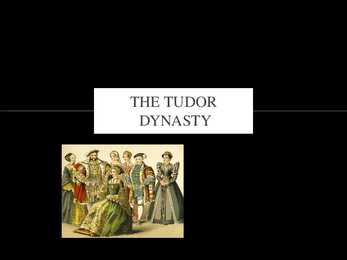
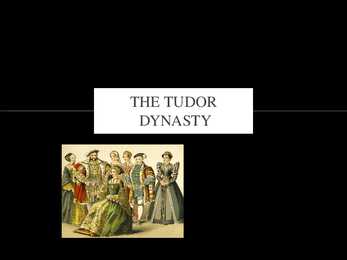
to the Kingdom of France, but none of them tried to make substance of it, though Henry VIII fought wars with France to try to reclaim that title. After him, his daughter Mary I lost the claim on France forever with the Fall of Calais. THE TUDOR DYNASTY Henry VII Henry VIII Edward VI There were six rulers of Tudors Dynasty. Jane Grey Mary I Elizabeth I THE TUDOR DYNASTY The most powerful and wellknown rulers of Tudors are Henry VIII and Elizabeth I. THE TUDOR DYNASTY Henry VIII Henry VIII was King of England from 21 April 1509 until his death. Henry VIII is known for his role in the separation of the Church of England from the Roman Catholic Church. Besides ruling with absolute power, he also engaged himself as an author
to the Kingdom of France, but none of them tried to make substance of it, though Henry VIII fought wars with France to try to reclaim that title. After him, his daughter Mary I lost the claim on France forever with the Fall of Calais. THE TUDOR DYNASTY Henry VII Henry VIII Edward VI There were six rulers of Tudors Dynasty. Jane Grey Mary I Elizabeth I THE TUDOR DYNASTY The most powerful and wellknown rulers of Tudors are Henry VIII and Elizabeth I. THE TUDOR DYNASTY Henry VIII Henry VIII was King of England from 21 April 1509 until his death. Henry VIII is known for his role in the separation of the Church of England from the Roman Catholic Church. Besides ruling with absolute power, he also engaged himself as an author
 annaabi.ee








Kõik kommentaarid