Leidsid 33 sarnast õppematerjali, mis on seotud failiga "Westminster Abbey". Need materjalid aitavad sul teemat sügavamalt mõista.
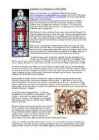
church, west, westminster, coronation, abbey, location, palace, tenth, century, since, present, traditional, burial, henry, mary, confessor, famous, isaac, newton, dickens, darwin, rudyardThe new king married Emma of Normandy and the couple had a son, Hardicanute. Edward lived in exile until 1041. At the death of Canute in 1035, Edward led an abortive attempt to capture the crown for himself. He was recalled, for some reason, to the court of Hardicanute. Edward was crowned at the cathedral of Winchester, the royal seat of the West Saxons on 3 April 1043. According to those who compiled the Anglo- Saxon Chronicle, the first thing Edward did, despite his religious views, was to deprive his mother of all of her estates and reduce her to relative poverty. It is said that Edward blamed her for his miserable and lonely childhood. For the first eleven years of Edward's reign the real ruler of England was
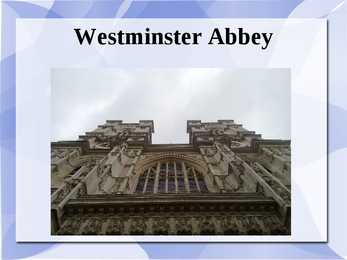
Westminster Abbey Westminster Abbey is a large, mainly Gothic church, in Westminster, London, England (UK). It's located just to the west of the Palace of Westminster. Westminster Abbey was built by Edward the Confessor and opened in 1065. It is one of the most important Gothic buildings in the country and in the world. In 1066, it saw its first coronation, that of William the Conqueror. Since then, nearly every king and queen has been coronated there. On 17 September 2010, Pope Benedict XVI became the first pope to set foot in Westminster Abbey. The Abbey has also been the church since 1066. Many of England's most illustrious statesmen, generals, politicians and artists have been buried there. It is also the final resting place of seventeen monarchs. Westminster School and Westminster Abbey Choir School are also in the precincts of the Abbey
London important sights guide Roman period 20th century · Big Ben is the nickname for the great bell of the clock at the north end of the Palace of Westminster in London and is often extended to refer to the clock or the clock tower as well. It is the largest four-faced chiming clock and the third-tallest free-standing clock tower in the world. The clock first ticked on 31 May 1859. The pendulum is installed within an enclosed windproof box sunk beneath the clockroom. It is 3.9m long, weighs 300 kg and beats every 2 seconds
March 28th Parliament of the United Kingdom The Parliament of the United Kingdom, commonly known as the UK Parliament or British Parliament, is the supreme legislative body in the United Kingdom, British Crown dependencies and British overseas territories. It alone possesses legislative supremacy and thereby ultimate power over all other political bodies in the UK and its territories. Its head is the Sovereign of the United Kingdom (currently Queen Elizabeth II) and its seat is the Palace of Westminster in the City of Westminster, one of the Boroughs of the British capital - London. Tower of London The Tower of London, officially Her Majesty's Royal Palace and Fortress of the Tower of London, is a historic castle located on the north bank of the River Thames in central London. It lies within the London Borough of Tower Hamlets, separated from the eastern edge of the square mile of the City of London by the open space known as Tower Hill.
By AD 100 it had also become the capital of the Roman province. A massive wall was built to protect the city from further attacks. The Roman Empire came under increasing attack across Europe and in AD 410 they retreated. The Romans gave us a language based on Latin, the calendar, law and legal system, the census and also straight roads, central heating and concrete. Anglo- Saxons around AD 400 Anglo- Saxons were warrior farmers from Germany, Denmark and the Netherlands. Later in the 5th century, Anglo-Saxons settled just west of Londinium, around the Strand, and formed the town of Lundenwic. The area of the old Roman city became a landing-place for ships and a centre for trade.The first English King to convert to Christianity, King Ethelbert, founded St Paul's Cathedral in 604. The Vikings 8th and 9th century By the 9th century, London was a very prosperous trading centre, and its wealth attracted the attention of Danish Vikings
LANDMARCS HYDE PARK: Hyde Park is one of the largest parks in central London, England and one of the Royal Parks of London, famous for its Speakers' Corner. The park is divided in two by the Serpentine. The park is contiguous with Kensington Gardens; although often still assumed to be part of Hyde Park, Kensington Gardens has been technically separate since 1728, when Queen Caroline made a division between the two. THE TOWER OF LONDON: Her Majesty's Royal Palace and Fortress, more commonly known as the Tower of London (and historically as The Tower), is a historic fortress and scheduled monument in central London, England, on the north bank of the River Thames. It is located within the London Borough of Tower Hamlets and is separated from the eastern edge of the City of London by the open space known as Tower Hill. It is the oldest building used by the British government. [1]
Westminster Today For centuries, Westminster was the political and religious center, but today Westminster is the center of government. Westminster Hall was built in 1099 by the son of William the Conqueror and is one of the largest medieval halls. It was part of the Westminster Palace, which was destroyed by a fire in 1834. The Houses of Parliament that we see today were rebuilt in the 19th century after the fire. The Big Ben clock tower is the largest four-sided ringing clock in the world and it is also one of the London's most famous symbols. Some think that Big Ben is the name of the clock on the tower, but actually it is the name of the big 13-ton bell that rings every fifteen minutes. The most historic religious building in Britain is Westminster Abbey, a beautiful church across the street from the Houses of Parliament. It was begun between
Westminster Abbey Facts The Collegiate Church of St Peter at Westminster Owned directly by the royal family Dedicated to St Peter Located next to the Houses of Parliament UNESCO World Heritage Site History 616, a shrine was founded 10451050, Edward the Confessor Consecrated on December 28, 1065 Romaneque style, to house Benetictine munks Rebuilt 12451517 in Gothic style by Henry III History 2 Henry VII Lady Chapel in 1503 Dissolution of the Monasteries in 1534 Attacked by Puritans in 1640s Oliver Cromwell's funeral in 1658
century) King Albert the Great London is the capital Edward the Confessor London began to develope Westminster Abbey and royal palace. 2 parts: Westminster and the City.. The Normans (1066 the 14th William the Conqueror century) the White Tower. Charter. Courts.
Subway is commonly used to move around in London. Climate London has a temperate marine climate. It has daily high temperatures during summer. The warmest month is July. The coolest month is January. Winders are seldom below freezing. Rainfall is regular, but most often in the form of drizzle occurring throughout the year. Snow occurs sometimes in winter but rarely settles more than a few millimetres deep. History The origin of London may be dated around the beginning of the 1st century AD, when a Celtic tribe settled near a fordable point of the Thames. L achieved real importance following the Roman conquest under Claudius (43AD). The Romans build a bridge, somewhat east of the present city. This bridge soon was part of a trade road and attracted more and more traders. Soon the flourishing city Londinium came into existence. The Romans rebuilt the town into a centre of great importance. After the Romans withdrew from Britain in the Picts, Scots, Jutes, Angles and Saxons
· Sacred Scottish Stone of Destiny was taken from Scone · In 1314 Robert the Bruce defeated the English at Bannockburn · In 1503 James IV of Scotland hoped to gain independence for Scotland but wasn't successful · Mary Queen of Scots claimed the English throne of Elizabeth I · She wanted to see the end of Protestantism but lost her Scottish throne · She was executed for treason in 1587 · In the 16th c. many Scots joined the Presbyterian church · James VI was the King of both countries, the crowns were united · In 1745, Bonnie Prince Charlie tried to seize the throne · The end of dreams of freedom for Scots · Major changes in the late 18th and 19th c. · Highland Clearances farmers were deprived of their land, filled with sheep instead · Fast development of coal mining, steel production and shipbuilding · Bridges, railways, canals
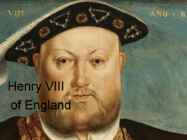
Charles Dickens, Rudyard Kipling, Dame Agatha Christie Philosophers &Economists: Francis Bacon, John Locke Inventors & Scientists: Isaac Newton, Charles Darwin Actors,Actresses & Filmmakers: Sir Charlie Chaplin, Dame Elizabethe Taylor, AlfredHitchock, Hugh Grant, Orlando Bloom, KeiraKnightley, Daniel Radcliffe Musicians & Singers: Sir Elton John,Phil Collins,George Michael,Robbie Williams King Henry VIII Born: June 28, 1491 at Greenwich Palace Parents: Henry VII and Elizabeth of Y ork House of Tudor Ascended to the throne: April 21, 1509 aged 17 years Crowned: June 24, 1509 at Westminster Abbey Married: (1) Catherine of Aragon 1509-1533 Divorced (2) Anne Boleyn 1533-1536 Beheaded (3) Jane Seymour 1536-1537 Died (4) Anne of Cleves 1540 Divorced (5) Catherine Howard 1540-1542 Beheaded (6) Catherine Parr 1543-1547 Survived Children: Three legitimate who survived infancy; Mary, Elizabeth and Edward
5. The Angles, Saxons and Jutes. The Angles were one of the main groups that settled in Britain in the post-Roman period, founding several of the kingdoms of Anglo-Saxon England, and their name is the root of the name "England". The Saxons were a confederation of Old Germanic tribes. Their modern-day descendants are generally considered ethnic Germans, Dutch or English.. Saxons participated in the Germanic settlement of Britain during and after the 5th century The Jutes were a Germanic people who were one of the three most powerful Germanic peoples of their time. They are believed to have originated from Jutland in modern Denmark. Were associated with the Saxons. The Jutes, along with some Angles, Saxons and Frisians, sailed across the North Sea to raid and eventually invade Great Britain from the late 4th century onwards, either displacing, absorbing, or destroying the native Celtic peoples there. 6. The Anglo-Saxon invasion
The Roman rule was more of a colonial control rather than a large-scale settlement. They left very little behind. 9. The Anglo-Saxon Invasion. The Angles, Saxons and Jutes came from present-day Northern-Germany and Denmark in 449. A number of tribes from the European mainland invaded and settled in large numbers; however, they were not always victorious. These Anglo- Saxons soon had the south-east of the country in their control. In the west, their advance was temporarily halted by an army of (Celtic) Britons under the command of the legendary King Arthur. By the 7th century the Anglo-Saxons were ruling most of Britain. 10. Scandinavian raids. In 789 three Viking ships landed on the coast of the kingdom of West Saxon. They were traders and raiders. In the 9th century they conquered and settled the islands around Scotland and some coastal regions of Ireland. Their conquest of England
A weekend in London Made by .... 6.d klass We will stay at the fabulous 5 Star Athenaeum Hotel in Mayfair which is close to Green Park and Buckingham Palace. It's creative and friendly. There are the colossal Living Wall and the beautifully refurbished spa and gym downstairs. There are also floor to ceiling windows, flat screen TV and complimentary mini bar soft drinks and snacks. Saturday At first we will go visit Buckingham Palace which is the official London residence and principal workplace of the British monarch. We would also like to see the nearby park where are a lot of birds and squirrels. Then we would like to see the river Thames and the Big Ben. Just a short walk from the Thames is situated Westminster Abbey which is a significant building in British history. This beautiful gothic church is a UNESCO World Heritage. Kings, Queens, statesmen,
Cultural life London is the worldclass centre. It has more than40 theatres, where audiences enjoy everything from musicals to William Shakespeare's plays. The city also contain many cinemas, concert halls, museums and art galleries. Royal residence English (later British) kings and queens have lived in London for almost 1,000 years. There are several royal palaces in the capital. St James's Palace was built by King Henry VIII in the 16th century. Since 1837 the monarch has lived in Buckingham Palace LONDON'S EARLY HISTORY The Romans invaded England in 43 AD. They landed in Kent, made their way to the River Thames and sailed up it. Then they settled in a place on the north bank, where the river was not to wide. This settlement was called Londinium. A bridge was later built across the Thames. Roman London Tribes in England fought the Romans
London was rapidly rebuilt, becoming the capital of the province Britannia. AD 122 Roman walls were built around it as a Around AD 400 the Anglo-Saxons invaded Britain. They destroyed the roman towns and formed many kingdoms that were hostile to one another. London fell into ruins. King Egbert united all the small kingdoms and formed one kingdom named Englad. Later king Alfred the Great chose London to be the capital of the country. During the reign of Edward the Confessor Westminster Abbey and the royal palace were built. In 1066 The Normans invaded an William the Conqueror took the British throne as William I. He built a mighty fortess, now known as the white tower. The 14th century was a messy period. In 1337 the Hundred years war against France began. The black death in 1348 took many many lives. Almost half of the city's population. In 1381 the grievances [griivensis] of the lower class exploded into the ,,Peasant's [pesents] revolt".
Westminster School The Royal College of St. Peter in Westminster, almost always known as Westminster School, is one of Britain's leading independent schools,with the highest Oxbridge acceptance rate of any secondary school or college. Located in the precincts of Westminster Abbey in central London, and with a history stretching back beyond the 12th century, the school's notable alumni include Ben Jonson, Robert Hooke, Christopher Wren, John Locke, Jeremy Bentham, and A. A. Milne. The school traditionally encourages independent and individual thinking. Boys are admitted to the Under School at age seven, and to the main school at age thirteen; girls are admitted only at sixteen. The school has around 750 pupils; around a third are boarders, of whom most go home for the weekends, after Saturday morning school
wanted to defeat it. He could clearly see that Britain was a threat to his latest and greatest conquest - France. He invaded Britain twice, in 55 and 54 BC. The first invasion was unsuccessful - it gained a beachhead on the coast of Kent but achieved little else. The second was more successful, the Celts asked for truce. However it wasn't a victory he had imagined and Julius Caesar never returned to Britain after that. The island was left undisturbed for nearly a century. *The Roman occupation of Britain 43-410 and its legacy Britain was conquered by Emperor Claudius, the Roman rule in England lasted up to 410. The Romans left behind a huge legacy: many types of animals and plants were brought to Britain in Roman times. Roman introduced theire measurements, Christianity, reading and writing. Also, many words in English and Welsh have been borrowed from the Latin language. An important legacy of the Romans was its roads, agriculture and cities
THE HOUSES OF PARLIAMENT a.k.a thePalace of Westminster IN GENERAL... The last monarch to live there, Henry VIII, moved out in 1512 Parliament has met in the Palace of Westminster since around 1550 there has been a royal palace on this site for nearly 1,000 years in the 19th Century a fire destroyed most of the earlier medieval buildings HISTORY Was originally laid out for Edward the Confessor more than 1,000 years ago in 1066, became the home of William the Conqueror in 1834, everything except Westminster Hall was burnt in the great fire the present building was designed specifically to house parliament and was laid out in Gothic style by Sir Charles Barry, completed in the 1840's THE BUILDING Nearly 1,200 rooms 100 staircases
Margaret, spent the war years in Windsor Castle away from harm. King Henry VI King Henry VI still holds the record for being the youngest king of England, it is unlikely that the record will be broken any time soon. He came to the thrown at just 9 months old. For the first 20 years of his life England and France were ruled by his uncles and advisors. King Stephen King Stephen was king of England (and not Normandy), although he was born in France. He was crowned at Westminster Abbey, like his father before him.Stephen was nephew of Henry I and grandson of William I, and was elected to be king in 1135 - although he presumed Henry I daughter Matilda would take the thrown. This decision was made by a council that threw the country into civil war. King Richard I the Lionheart Richard I was known as Richard the Lionheart. He was given this name as he was known for being a brave warrior king. Richard I (The Lionheart) was the oldest surviving son of Henry II
grown up around it. London has been an important settlement for over two millenniums. It is also one of the world's leading business, financial and cultural centres and its influence in politics, education, entertainment and even fashion contribute to its status as a major global city. London is a major tourist attraction with four world heritage sites, several royal parks and numerous iconic landmarks such as the Houses of Parliament, Towe Bridge, the Tower of London, Westminster Abbey and the London Eye. 2. History Although there is some evidence of a permanent settlement before the Romans came in 43 A.D., it is more accepted by historians that the Romans were the first. The settlement was called Londinium. The first London lasted for just seventeen years, for around AD 61, a tribe of Celts led by Queen Boudica stormed London, burning it to the ground. The next heavily-planned London
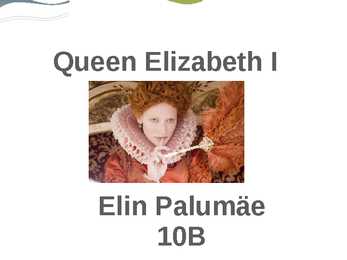
Queen Elizabeth I Elin Palumäe 10B Elizabeth I Reign - 17 Nov. 1558 24 March 1603 (44 years) Coronation - 15 January 1559(25 years) Predecessor - Mary I Successor - James I House - House of Tudor Father - Henry VIII Mother - Anne Boleyn Born - 7 September 1533 Greenwich, England Died - 24 March 1603 (aged 69) Burial - Westminster Abbey Anne Boleyn Queen consort of England Mother of Elizabeth I Tenure - 28 May 1533 17 May 1536 Coronation 1 June 1533 Anne Boleyn was Queen of England from 1533 to 1536 as the second wife of Henry VIII of England and the 1st Marquess of Pembroke in her own right for herself and her descendants. House - House of Tudor Father - Thomas Boleyn, 1st Earl of Wiltshire Mother - Lady Elizabeth Howard Born c.1501/1507 Blickling Hall/ Hever Castle, England Died 19 May 1536 (aged 29-35)Tower of London Religion - Anglican, formerly Roman Catholic King of England Henry VIII
Westminster Abbey Relle Undrus Form 8 Westminster Abbey The Collegiate Church of St Peter at Westminster popularly know as Westminster Abbey. Style Westminster Abbey is a large, mainly Gothic church. History That church is more than 900 years old. Since 11th century the kings and queens of Britain have been crowned and buried in there. Royal Weddings Since 1100, there have been at least 16 royal weddings at Westminster Abbey. 11. November 1100: King Henry I of England was married to Matilda of Scotland 29. April 2011: Prince William, grandson of Elizabeth II, was married to Miss Catherine Middleton Royal Weddings Royal Weddings Thanks for listening!
success than before. He died of perforated duodenal ulcer on 18 January 1936, two days before George V, at the age of 70. His death had in fact previously been incorrectly announced in a magazine, to which he wrote, "I've just read that I am dead. Don't forget to delete me from your list of subscribers." Rudyard Kipling was cremated at Golders Green Crematorium and his ashes were buried in Poets' Corner, part of the South Transept of Westminster Abbey, where many distinguished literary people are buried or commemorated. Despite changes in racial attitudes and literary standards for poetry, Kipling's poetry continues to be popular with those who see it as "vigorous and adept" rather than "jingling". In modern-day India, whence he drew much of his material, his reputation remains controversial, especially amongst modern Hindu nationalists and some post-colonial critics. In November 2007, it was
Prehistory (55BC) no written records 6th 3rd c. BC the Celts came to British isles hill figures, hill forts, stone circles ( Stonehenge ) RomanBritain (55BC 400AD) Julius Caesar, named the country Albion Hadrian's Wall, villas, roads, the town of Bath The AngloSaxon, Danish and Norman invasions Germanic tribes settled and stayed Anglia Christianity was brought, religion became important, churches were built 8th century = raids by the Vikings and the Danes 1016 1042 : Under Danish rule ( York was the capital ) 1042 : local AngloSaxons regain their rule 1066 : Normans arrive ( the Norman conquest ) Medieval Britain (106615th c.) the Battle of Hastings William the Conqueror a new AngloNorman state the feudal system introduced the rule of the king and church strengthened centralised country, military rule Scotland, Wales and Ireland conquered Norman castles built spoke Norman French
had a white rose as their symbol. The war was about who should be on the throne, the red rose won and thereafter the red rose has been the symbol of England. 7. How was Protestantism established in England? When and by who? It was established by Henry VIII because he wanted to divorce his first wife. Up until then England was Catholic and divorcing was not allowed for him. He really wanted a new wife, so he declared that England was no longer a part of the Catholic Church and made himself as the head of the new church. It happened in 15 8. What good did the invasion of Romans bring to England? It brought roads and order. They also built the first version of London. 9. What do you know about the Tower of London? It was at first a castle for the king of England, but Henry VIII turned it into a prison. There are Beefeaters, who are the tour guides now but used to be the guards. They keep the royal jewels there
Medieval literature Religious literature- mostly written in church languages(Latin, Greek, Old Slavic) Secular literature- written in vernacular languages as well 6th -15th century Anonymity Religious writing Liturgical writing-hymns, psalms Theological writing-aquinas, abelard etc Religious poetry Mystery plays-reenactment of bible stories Secular writing Troubadour writing:"courtly love", romance Epic poem(song of roland) Travel writing History writing-chronicles Allegory The use of symbols and analogy to convey a certain meaning /message Literary output of medieval English Anglo-saxon or Old English literature(7th century-1066)
o 5th century- 1066 o From Southern Denmark(angles); Germany(saxons); Jutland(jutes) o By the 7th c kingdoms had emerged and later KING ALFRED united the kingdoms o They were pagans and very rural people, built in wood rather than stone o It was the saxon farmstead that laid the foundations of the English village II. The Vikings o 8th century- 11th century o From Denmark, Norway o They were ship builders and sailors o In 886 the Danelaw peace treaty was made 4) The Normans/ the final conquest o 1066-1154 o From present-day France o In the battle of Hastings on 14.10.1066 the normans defeated the English and their leader, Duke William of Normandy, was crowned the king onf England(william the conqueror)
Henry VIII of England Henry VII Born on 21 June 1491. Died in January 28 1547. Is the 2nd son of King Henry VII and Elizabeth of York. Was crowned King at Westminster Abbey, London, on the 23 June 1509 at the age of 17. Elizabeth of York | King Henry VII Henry VIII is known for... Establishing the Church of England. Having six wives. Beind a big, fierce-looking man. Early life Not much is known about his early life, because he was not expected to become king. Around the age of ten his brother Arthur died, thus leaving the crown to him. He also married his brother`s widow, Catherine of Aragon. Little Henry VIII Young King Henry He was a great king and he loved all his subjects. And England loved him as a king.
people called the Iberians. These Stone Age people lived in limestone caves, they used stone axes and fashioned antlers and bones into leather-working tools. Later groups of people from what are now Germany, the Netherlands and Brittany also settled in Briton. During the Bronze Age, they mined tin, gold and copper and made bronze tools. They also probably built the spectacular prehistoric megaliths, such as Stonehenge on Salisbury Plain. The Celts invaded the British Isles in the 5th century BC in two waves. The Britons grew wheat and corn, caught fish, and tamed and bred animals. They made coarse cloth for their clothes, learned the art of pottery, made things of wool, metal and copper, and were good warriors. They traded with the Gauls and built many temples and altars. The Celts brought with them a knowledge of smelting iron, which produced stronger weapons than the bronze ones. They had a strange and cruel religion, sometimes human beings were sacrificed.
A Christmas Carol in Prose, Being a Ghost Story of Christmas (commonly known as A Christmas Carol) is a novella by Charles Dickens first published on December 19, 1843 with illustrations by John Leech. The story was an instant success, selling over six thousand copies in one week, and the tale has become one of the most popular and enduring Christmas stories of all time. William Makepeace Thackeray William Makepeace Thackeray was an English novelist of the 19th century. He was famous for his satirical works, particularly Vanity Fair, a panoramic portrait of English society. Thackeray, an only child, was born in Calcutta, India, where his father, Richmond Thackeray (1 September 1781 13 September 1815), held the high rank of secretary to the board of revenue in the British East India Company. William had been sent to England earlier, at the age of five, with a short stopover at St. Helena where the imprisoned Napoleon was pointed out to him
THE CITY OF LONDON History The City of London occupies one square mile in the middle of the capital. It once made up entire town of London, surrounded by the wall first built by Romans. The Romans also built a bridge over the Thames and there has been one in the same area ever since. The Roman Londinium grew up on the northern side of the bridge. In AD 61 the native Celtic tribe, led by Queen Boudicca, rose up against the Romans. They burnt down Londinium to the ground and killed most of its inhabitants. Roman armies eventually defeated Boudicca and Londinium was rebuilt. At the end of the fourth century AD the Roman Empire began to crumble and the Roman armies were recalled from Britain to defend Rome itself. Once they had left, tribes such as Angles,
 annaabi.ee