Leidsid 33 sarnast õppematerjali, mis on seotud failiga "Sun Bear". Need materjalid aitavad sul teemat sügavamalt mõista.
bearars, year, round, bears, males, weigh, between, inches, black, shape, species, years, female, making, member, tend, than, former, latter, shoulder, height, claws, relatively, light, weight, naked, soles, assist, climbing, turned, feet, walk, toed, stout, tail, size, tongue, length, honey, other, sleek, adaptation, lowland, dark, brown, covers, bodyWhen it looks like there is nothing to eat on the winter tundra, reindeer will scrape the snow away with their wide feet or antlers and eat lichens, dried sedges and small shrubs. In the summer they the will eat leaves of willows, sedges, flowering plants, mushrooms. Reindeer are social animals and live in huge herds, which will often have several thousand animals in it. Males are often loners, until its time to mate. They will migrate more than 650-800 kilometres to reach winter or summer feeding grounds, and can travel up to 80 kilometres a day. Their leg tendons make crackling sounds while walking, which would make a migrating herd a noisy bunch indeed. Females will give birth to a single calf. Most females don't breed until they are 28 months old, and will give birth every year.
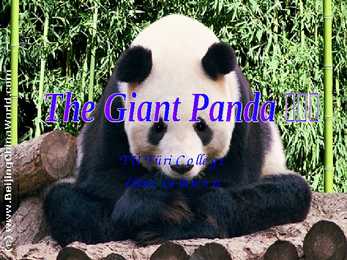
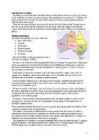
T Ü T üri C o lle g e Liina Le inm e ts Introduction · Panda (Ailuropoda melanoleuca) is a mammal classified in the bear family, native to centralwestern and southwestern China. It is easily recognized by its large, distinctive black patches around the eyes, over the ears, and across its round body. · The Giant Panda lives in a few mountain ranges in central China. · It once lived in lowland areas, but farming, forest clearing, and other development now restrict the Giant Panda to the mountains. In the wild · The Giant Panda is a · Pandas communicate terrestrial animal and through vocalization primarily spends its life and scent marking such roaming and feeding in as clawing trees or the bamboo forests
There are two different types of grasslands; tall-grass, which are humid and very wet, and short-grass, which are dry, with hotter summers and colder winters than the tall-grass prairie. In the winter, grassland temperatures can be as low as -40° F, and in the summer it can be as high 70° F. There are two real seasons: a growing season and a dormant season. Deciduos forest The average annual temperature in a deciduous forest is 50° F. The average rainfall is 30 to 60 inches a year. In deciduous forests there are five different zones. The deciduous forest has four distinct seasons, spring, summer, autumn, and winter. In the autumn the leaves change color. During the winter months the trees lose their leaves. The animals adapt to the climate by hibernating in the winter and living off the land in the other three seasons. DesertDeserts cover about one fifth of the Earth's land surface. Deserts temperature ranges from 20 to 25° C. The extreme maximum temperature
Tundra Tundra is the world's youngest biome. It was formed 10 000 years ago. Located at latitudes 55° to 70° North. Almost all tundras are located in the Northern Hemisphere, encircling arctic desert and extending south to the coniferous forests of the taiga. The ecotone (ecological boundary region) between the tundra and the forest is known as the tree line or timberline. Tundra comes from the Finnish word tunturi, meaning treeless plain. It is noted for its frost-moulded landscapes, extremely low temperatures, little precipitation, poor nutrients, and short growing seasons. Dead organic material functions as a nutrient pool. The two major nutrients are nitrogen and phosphorus. Nitrogen is created by biological fixation, and phosphorus is created by precipitation.
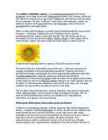
Sunflowers are native(pärit) to the Americas. The earliest known examples of a fully domesticated sunflower were found at the Olmec site of San Andrés dating some time before 2500 B.C.[1] The Incas used the sunflower as an image of their sun god. Gold images of the flower, as well as seeds, were taken back to Europe early in the 16th century. The Giant sunflower (Hlianthus giganteus) is native to Connecticut. They can grow to be between 3 and 12 feet tall. Their flower heads can be between 2 to 3 inches wide. They are most commonly found in valleys with wet meadows or swamps. The Giant sunflower grows between July and October. To grow well, sunflowers need full sun. They grow best in fertile, moist, well-drained soil with a lot of mulch. In commercial planting, seeds are planted 45 cm (1.5') apart and 2.5 cm (1") deep. Sunflower "whole seed" (fruit) is sold as snacks and can be processed into a peanut butter
Was it a spontaneous mutation? Crossing of those cats with known chocolate and cinnamon colour cats of other breeds ruled out chocolate/lilac and cinnamon/fawn genes. These cats were a totally new colour, peculiar to the Norwegian Forest Cat gene pool and dubbed the "X Colours". They are now called Amber and Light Amber. The Amber effect is due to the extension gene (also called red factor) which controls the production of red and black pigment. The dominant version of the gene produces normal black pigment in the coat while the recessive version produces red pigment. The name comes from the effect of black or brown pigment not being extended throughout the whole coat, but being restricted to the skin of the extremities and to the eyes (for example in bay horses). This Norwegian Forest Cat was bred by Yve Hamilton Bruce from a silver mackerel tabby female (imported from Denmark) and a classic red tabby and white male. The result was 1 silver tabbies and 2 silver tabbies with white
Introduction... I read a book abput the Galapagos islands writen by Paul D. Steward. I have devided my presentation in 3 paragraphs: Firstly i will tal about the origins of the islands and the history, secondly about life on the land and in the sea, finaly about conserving the Galapagos. The Galapagos Islands are situated on junctions between several shifting tectonic plates on the equator and about 1000 km off the Pacific coast of Ecuador. They are the product of one of the most volcanically active regions on our planet, a hot spot is situated directly beneath the islands and also It is the point where major ocean currents meet. These circumstances combine to make an area that truly is like no other place on earth. Galapagos is comprised of 13 major islands, more than 120 smaller islets and rocks, and the surrounding ocean
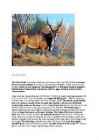
The Giant Eland The Giant Eland (Taurotragus derbianus also known as the Lord Derby Eland) is an open forest savannah antelope. It is found in Central African Republic, Sudan, Cameroon and Senegal. There are two subspecies: the endangered T. d. derbianus, found in Senegal's Niokolo-Koba National Park, and the low risk T. d. gigas, found in Central Africa. Characteristics Giant Eland are typically between 220-290 cm (7.3-9.6 ft) in length, stand approximately 150 to 175 cm (4.9 to 5.7 ft) at the shoulder, and weigh 440-900 kg (968- 1,980 lb). Despite its common name, it is of very similar size to the Common Eland. The smooth coat is reddish- brown to chestnut, usually darker in males than females, with several well-defined vertical white stripes on the torso. A crest of short black hair extends down the neck to the middle of the back, and is especially prominent on the shoulders
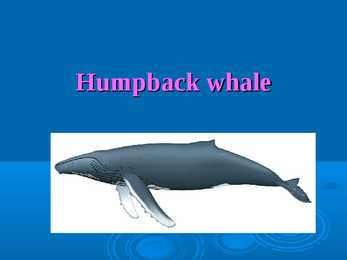
Humpback whale Humpback whale Megaptera novaeangliae CLASS: Mammalia ORDER: Cetacea SUBORDER: Mysticeti FAMILY: Balaenopteridae GENUS: Megaptera SPECIES: Novaeangliae Physical Description The head is broad and rounded when viewed from above, but slim in profile. The body is quite round, narrowing to a slender peduncle. The top of the head and lower jaw have rounded, bump-like knobs, each containing at least one stiff hair. The body is black on the dorsal side, and mottled black and white on the ventral side. About 2/3 of the way back on the body is an irregularly shaped dorsal fin. Its flippers are very long, between 1/4 and 1/3 the length of its body, and have large knobs on the leading edge. The flukes, which can be 5.5 m wide, is serrated and pointed at the tips. Adult males measure 12.2-14.6 m, adult females measure 13.7-15.2 m. They weigh 25 to 40 tons. Feeding
(where people are called the Yupik people). In some areas, Inuit people are called "Eskimos" however many Inuit find this term offensive. The word "Inuit" means "the people" in the Inuktitut language. Inuit Homes In the tundra, where Inuit communities are found, there are not many building materials. No trees grow in the tundra so houses can not be made from wood unless it is transported from elsewhere. However, during a large part of the year, the cold part, there is a lot of snow in the tundra. And it turns out that snow can be a very good construction material. In the winter, Inuit lived in round houses made from blocks of snow called "igloos". In the summer, when the snow melted, Inuit lived in tent-like huts made of animal skins stretched over a frame. Although most Inuit people today live in the same community year-round, and live in homes built of other construction
tablelands: the volcanic Columbia Plateau, the Great Basin, the Colorado Plateau. Further west is a narrow belt of the Cascade Mountains, and the Sierra Nevada Range Still further west lies an area of valleys. The forests cover 30% of the US. In the southern part of Alaska grow coniferous trees, notably spruces and firs. Around the Great Lakes and New England are mixed forests of pines, maples, elms, birches, oaks and beeches. Along the Gulf of Mexico grow magnolia, red and black gum, cypress and mangrove. Geographical Regions The territory of the United can be divided into eight regions: 1) New England; 2) the Mid-Atlantic region; 3) the South; 4) the Midwest; 5) the Southwest; 6) the Rocky Mountain region; 7) the Pacific Northwest and Alaska; 8) California and Hawaii. New England is highly industrial, but it also has many fields, woods and small towns. New England is the part of the United States that is most like "old" England. It includes
Territory). The Australian people are culturally the same as the Anglo Americans. There also live aborigines. Aborigines are the ancestors of the people. Like the US and Canada, Australia was an English speaking colony of Great Britain. Today Australia is a modern developed country with a diversified economy. Australia is an island continent of 7.7 million square kilometres, which makes it a little smaller than the USA. Located in south of Asia, between The Pacific and Indian Oceans, Australia is the World's driest continent. Although large areas of the centre are desert, Australia has a wide range of climate from tropical in the north to temperate in the south east, where it frequently snows in winter. Geographical position The coasts of Australia are surrounded by the Pacific Ocean, the Indian Ocean and the Southern Ocean. Four seas are surrounding Australia, which are the Timor Sea and Arafura Sea in the north of
Most of Canada's human population lives along its southern border. Geographical facts. Canada's geography is very diverse. It has huge lakes, evergreen forests, prairies, meadows and beautiful mountains. There are thousands of miles of coastline with beaches, fjords and wild rivers flowing to the oceans. Canada is a country of wide open spaces and beautiful landscape where traveling visitors can unexpectedly bump into wild animals like bears or be struck by unusual sight like the scarecrows on the Cabot Trail. Canada is rich in natural wonders, one of them, the Niagara Falls between lakes Erie and Ontario, which is the second biggest waterfall in the world is one of the greatest attractions in the world. About twelve million tourists come to see the beauty of the falling waters on the border between the United States of America and Canada.
wallabies, bandicoots, spiny anteaters and, in the coastal waters, the dugong. There are between 170 and 200 species of frog and 450 species of butterfly. /3/ 4 The forests of New Guinea Richer and more diverse in species than their montane counterparts, the lowland forests of southern New Guinea are the home of more than 1,200 species of trees. Lowland rainforests are demanding ecosystems. They need at least 2,500 mm of rainfall per year, and they only show the greatest species diversity on well-drained sites. /2/ Soil When seeing the rich canopy and massive trees of the lowland canopy, one is tempted to believe that the soils are very rich. In fact, the soil layer is thin and is easily leached of its nutrients compared to the highlands. /2/ Lowland forest Beyond 1,000 m, the lowland forest gives way to montane forests. Here, the canopy is lower than the lowland forests and fewer trees rely on buttresses
Australia's capital is Canberra, the only city with its own territory. It was built in the early 1900s just to be the capital. The official language is English and the official name of Australia is the Commonwealth of Australia. Australia is located on the Southern Hemisphere (because of that Australia is also called "A land down under"). 2 . Geographical position Australia is an island continent and it is located between the Indian and South Pacific oceans south east of Asia. From the north it is bordered by the Timor Sea and the Torres Strait. From the east by the Coral Sea and the Tasman Sea. Australia's coastline is about 37,000 km long. The Great Australian Bight washes the southern coast. The Gulf of Carpenteria and the Cape York Peninsula surround it in the south. 3. Relief Australia is the smallest continent in the world It is often called the island continent because is too big for
first. The Australian flag symbolises Australia's historical links with Britain, because it has British flag on it, and Australia's location in the southern hemisphere, because it has stars of the Southern Cross on it. The large seven-pointed star represents the six original states and the territories of Commonwealth. There is also the Indigenous Australian flag, which represents the Aboriginal Australians. The flag with its colours of red (representing the land), black (representing the people) and the yellow in the middle (representing the sun) is a source of pride for Indigenous Australians. The present coat of arms was granted by King George V in 1912. It consists of a shield containing the badges of six Australian states, enclosed by an ermine border. The shield is a symbol for the federation of the states, which took place in 1901. The crest, which is above the shield, is a seven-pointed gold star on a blue and gold wreath. The seven points of
Climate in Great Britain The British Isles which are surrounded by the ocean have an insular climate. There are 3 things that chiefly determine the climate of the United Kingdom: the position of the islands in the temperate belt; the fact that the prevailing winds blow from the west and south-west and the warm current -- the Gulf Stream that flows from the Gulf of Mexico along the western shores of England. All these features make the climate more moderate, without striking difference between seasons. It is not very cold in winter and never very hot in summer. So, the British ports are ice-free and its rivers are not frozen throughout the year. The weather on the British Isles has a bad reputation. It is very changeable and fickle. The British say that there is a climate in other countries, but we have just weather. If you don't like the weather in England, just wait a few minutes. It rains very often in all seasons in Great Britain. Autumn and winter are the wettest.
4Use a capital letter for the first letter in a sentence: The dog is barking. Come here! 4Always use a capital letter for the word I : I am eight years old. Tom and I are good friends. 4Use a capital letter for the names of people: Alice, Tom, James, Kim, Snow White 4Use a capital letter for the names of places: National Museum, Bronx Zoo, London, Sacramento 4Use a capital letter for festivals, holidays, days of the week, months of the year: New Year's Day, Christmas, Labor Day, Mother's Day, Sunday, Monday, Friday, January, May, July, October Exercise 1 Circle the letters that should be CAPITALS. Then write the correct letter in the space above them. 1 peter and i are good friends. we are going to chicago during our summer 2 vacation. 3 there is an interesting football game on sunday. 4 jason lives on thomson avenue.
oasis, Necker Island, murmured in the background. Twenty people sat around him at rapt attention, wondering what a billionaire's answer would be to one of the big questions--perhaps the biggest question--of business. The group had been assembled by marketing impresario Joe Polish to brainstorm growth options for Richard's philanthropic Virgin Unite. It was one of his many new ambitious projects. Virgin Group already had more than 300 companies, more than 50,000 employees, and $25 billion per year in revenue. In other words, Branson had personally built an empire larger than the GDP of some developing countries. Then he broke the silence: "Work out." He was serious and elaborated: working out gave him at least four additional hours of productive time every day. The cool breeze punctuated his answer like an exclamation point. 4HB is intended to be much more than a book. I view 4HB as a manifesto, a call to arms for a new mental model of living: the experimental lifestyle
The only big city in the Rockies is Denver. Lakes The Great Lakes are a group of five large lakes in North America. They are the largest group of fresh water lakes on Earth. They are sometimes called the inland seas. There are: 1. Lake Superior (the largest and deepest) 2. Lake Michigan (the only one entirely in USA) 3. Lake Huron 4. Lake Erie (smallest and most shallow) 5. Lake Ontario (much lower elevation than the rest). The Great Lakes between the USA and Canada are joined together by rivers and canals. The lakes are connected to the Atlantic Ocean by the St. Lawrence River and to the Hudson River by a canal. Between Lake Ontario and Lake Erie is Niagara Falls (51 m). Another large lake in the USA is Great Salt Lake. It is saltier than the sea. Rivers The Mississippi river is the major river of North America and the United States. It flows from north-western Minnesota south to the Gulf of Mexico
It is 7.6 million square kilometres big. It is often called the island continent because it is rather small for a continent and very big for an island. There are only five countries bigger than Australia in the World. There are five states in the mainland. Tasmania is also considered as a state so there are six states. The Northern Territory and Canberra are also independent but they are not states. Canberra is the capital of Australia and it is situated between Sydney and Melbourne because both of these cities wanted to be the capital. The population is about 19 million people and growing. New South Wales is the most populated state and Victoria is the most densely populated state. The national language is English. It is English because British settlers came to live in Australia in the past and they brought convicts with them who were also British. Symbols. The Australian Flag came into being after the federation of the
Parliament is consists of The House Of Representatives and The Senat. The House of Representatives consists of 150 members. The party with the majority provides the Prime Minister, who also forms the Government. Today the power is divided by three parties: The Australian Labour Party, the Liberal Party and National Party. The Senat's membership is wider, it comprises 12 senators from each state and 2 from each territory. Senators are elected for six year terms. The Executive power in Australia is in the hands of the Commonwealth Government lead by the Prime Minister. Today the Prime Minister is John Howard, the leader of the Liberal Party. History Australia was once a part of the giant continent Gondwana. It included Africa, South America and Antarctica. First Australia and Antarctica split from Gondwana, then Australia broke away from Antarctica and began to move north. Aborigines arrived there about 50 000 years ago
Light bulbs are measured in watts. Air conditioners and hot water heaters are measured in BTUs, while energy used by cars is measured in gallons of fuel. They used a spreadsheet to figure out how much energy they consumed for each of their activities. Each of the lights, car miles, games, and other appliances was converted to a common unit of power consumption called kilowatt-hours. The spreadsheet was used to determine how many kilowatt-hours were used during each day, each week, and each year for each energy consumption activity. The spreadsheet converted their energy consumption to show them the amount of money it costs for each energy consumption activity. In the end, they were shocked to see how much money Jules' energy using habits cost compared to Les' habits. USES OF ENERGY The United States is a highly developed and industrialized society. We use a lot of energy - in our homes, in businesses, inindustry, and for traveling between all these different places.
population of 1.5 million people. Tasmania is the second most densely populated state. Its capital is Hobart, which is a fine Georgian city. Tasmania became the most popular settling region for Europeans due to favorable climate to them. There is also the Northern Territory, but it has a special status being under the authority of the central government of the Commonwealth. The capital is not Sydney or Melbourne like many people think, but Canberra, which is situated just between those two. Canberra was chosen as the capital of Australia because Australians could not decide which to choose as the capital, either Melbourne or Sydney. So, Canberra was chosen instead as a fair end to a long fight. The population in Australia is very high compared with Estonia as there are about 21 million people living there. The most populous city is Sydney with 4.2 million people. Only about 320000 people live in Canberra, but it is still said to be a tourist must.
My carry-on item was a parka. In the Olympic Peninsula of northwest Washington State, a small town named Forks exists under a near-constant cover of clouds. It rains on this inconsequential town more than any other place in the United States of America. It was from this town and its gloomy, omnipresent shade that my mother escaped with me when I was only a few months old. It was in this town that I'd been compelled to spend a month every summer until I was fourteen. That was the year I finally put my foot down; these past three summers, my dad, Charlie, vacationed with me in California for two weeks instead. It was to Forks that I now exiled myself-- an action that I took with great horror. I detested Forks. I loved Phoenix. I loved the sun and the blistering heat. I loved the vigorous, sprawling city. "Bella," my mom said to me -- the last of a thousand times -- before I got on the plane. "You don't have to do this."
any fought believed 11 between 1 I take after my mum 2 1 disorientated 5 withdrawn 7 granted 12 Although 2 the spitting image 2 distraught 6 preoccupied 3 a strong family resemblance 4 1 F 2 T 3 F 4 F 5 T 3 bewildered 7 circumspect
Their national holiday is on the 26th of January. In 1788 on the 26th of January the first fleet arrived at Botany Bay and established a penal colony near modern-day Sydney. Geographical Position Australia is located in the Southern Hemisphere. It’s the only continent except for Antarctica that is all south of equator. Sometimes Australia is called the island continent. There is a great reason why. It really is an island. It is 2880 km from the mainland of Asia and is almost half way round the world from Europe. More than 9 600 km separates it from America. Australia lies between the Pacific and Indian oceans. The Timor Sea and the Arafura Sea separate Australia from Indonesia. In the north the coast is washed by Great Australian Bight and the Indian Ocean. In the northeast the Coral Sea washes the coasts and in the southeast there is the Tasman Sea which also separates Australia from New Zealand. The biggest island is Tasmania which is located to the south of the country.
He is often called England's national poet and the "Bard of Avon" (or simply "The Bard"). His surviv- ing works consist of 38 plays, 154 sonnets, two long narrative poems, and several other poems. His plays have been trans- lated into every major living language, and are performed more often than those of any other playwright. Shakespeare was born and raised in Stratford-upon-Avon. At the age of 18 he married Anne Hathaway, who bore him three children: Susanna, and twins Hamnet and Judith. Between 1585 and 1592 he began a successful career in London as an actor, writer, and part owner of the playing company the Lord Chamberlain's Men, later known as the King's Men. He ap- pears to have retired to Stratford around 1613, where he died three years later. Few records of Shakespeare's private life survive, and there has been considerable speculation about such matters as his sexuality, religious beliefs, and whether the works attributed to him were written by others. Shakespeare
It seems that the Celts, who had been arriving from Europe from the 8th cent BC onward, intermingled with the peoples who were already there. The Celts were extremely talented people, creative and artistic. More than 1 Celtic tribe invaded Br. The descendants of ancient Celts live in Wales, Scotland, Cornwall and Ireland. They lived in primitive society. Druids priests, more powerful than chiefs. Acted like prophets. 2. Stonehenge From prehistoric period. Was built on Salisbury plain between 2500 and 1500 bc. One of the most famous and mysterious archaeological sites in the world. One of the mysteries is how it was built at all with the technology of the time. Another is its purpose. It appears to function as a kind on astronomical clock and we know it was used by the Druids for ceremonies marking the passing of the seasons. It appears in number of novels. These days it is not only the interest of tourists but is also a gathering point of certain minority groups
This is a bad argument, because the conclusion does not follow from the premises. Logic is the science of correct reasoning. Logic helps us in constructing and evaluating arguments. How to recognize an argument? Generally a passage contains an argument if it attemps to prove something. It requires evidence presented (premise(s)) and a claim that is said to follow from the alleged evidence (conclusion). This inferential relationship might be explicit or implicit. The relationship between the premises and the conclusion might be explicitly expressed thanks to words that serve as indicators to distinguish the premises from the conclusion. Conclusion indicators Swans are birds and birds have wings. Therefore, swans must have wings. The word “Therefore” indicates the conclusion which are claimed to follow from the premises. Other conclusion indicators include: - consequently - thus - so - hence - it follows that - it implies that
Into his household; heaven sent him here, In your great need, to make you all repent; For your salvation, you must hearken to him; He censures nothing but deserves his censure. These visits, these assemblies, and these balls, Are all inventions of the evil spirit. You never hear a word of godliness At them--but idle cackle, nonsense, flimflam. Our neighbour often comes in for a share, The talk flies fast, and scandal fills the air; It makes a sober person's head go round, At these assemblies, just to hear the sound Of so much gab, with not a word to say; And as a learned man remarked one day Most aptly, 'tis the Tower of Babylon, Where all, beyond all limit, babble on. And just to tell you how this point came in . . . (To Cleante) So! Now the gentlemen must snicker, must he? Go find fools like yourself to make you laugh And don't . . . (To Elmire) Daughter, good-bye; not one word more. As for this house, I leave the half unsaid;
By then, Ghana the former Gold Coast had been independent for three years under the great Osagyefo Kwame Nkumah. It was a time for celebrating Africa’s coming of age, as more and more African countries received their independence either from Britain or France. It was especially a poignant time for Africa, as then British Prime Minister Harold McMillan articulated his now famous “winds of change” sweeping Africa. We had high hopes for Africa, for the Black race, that the insidious imposition of foreign rule on us, the looting of Africa’s natural resources by our colonial masters accorded us would be things of history. That is more than forty years ago. Unfortunately, the promise of independence has not been fulfilled. Today, Africa has become more desolate; there is more starvation, diseases and non-provision of essential services than when we got our independence. There are all kinds of wars in Africa than the rest of world put together.
I was not merely across the country from my former home in San Diego, but seemingly worlds away. Two major metropolises-one endlessly temperate and sensually lazy, the other teeming with life and frenetic energy. In my dreams, I'd imagining living in a walkup in Brooklyn, but being a dutiful daughter, I found myself on the Upper West Side instead. If not for Cary living with me, I would've been miserably lonely in the sprawling apartment that cost more per month than most people made in a year. The doorman tipped his hat to me. "Good evening, Miss Tramell. Will you need a cab this evening?" "No thanks, Paul." I rocked onto the rounded heels of my fitness shoes. "I'll be walking." He smiled. "It's cooled down from this afternoon. Should be nice." "I've been told I should enjoy the June weather before it gets wicked hot." "Very good advice, Miss Tramell." Stepping out from under the modern glass entrance overhang that somehow meshed with the
 annaabi.ee