 50 punkti
Autor soovib selle materjali allalaadimise eest saada 50 punkti.
50 punkti
Autor soovib selle materjali allalaadimise eest saada 50 punkti.
 ~ 2 lehte
Lehekülgede arv dokumendis
~ 2 lehte
Lehekülgede arv dokumendis
 2015-12-14
Kuupäev, millal dokument üles laeti
2015-12-14
Kuupäev, millal dokument üles laeti
 1 laadimist
Kokku alla laetud
1 laadimist
Kokku alla laetud
 0 arvamust
Teiste kasutajate poolt lisatud kommentaarid
0 arvamust
Teiste kasutajate poolt lisatud kommentaarid
 marianne.kymnik
Õppematerjali autor
marianne.kymnik
Õppematerjali autor
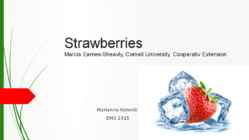
Strawberries Marcia Eames-Sheavly, Cornell University. Cooperativ Extension Marianne Kümnik EMÜ 2015 2 Choosing Cultivars[1] Some cultivars perform better than others. Best way to decide. Planting strawberries in a large area Some cultivars that perform well: Earliglow Northeaster Sable Allstar Honeoye Jewel Lateglow Marianne Kümnik 3 Site Selection[1] A pH of approximately 6.2 The strawberries do not tolerate extremes in pH. It's not good to plant strawberries in an area: where they were recently grown. where crops in the tomato family have been grown. Marianne Kümnik
The sunflower (Helianthus annuus) is an annual(iga aastane) plant in the family Asteraceae, with a large flower head (inflorescence(õiekobar, õisik, õitseaeg, õidumine)). The stem(tüvi) of the flower can grow up to 3 metres tall, with the flower head reaching 30 cm in diameter. The term "sunflower" is also used to refer(nimetama, viitama, üle andma) to all plants of the genus(perekond, sugu) Helianthus, many of which are perennial(alaline, aastaringne) plants. What is usually called the flower is actually a head (formally(ametlikult) composite(liit-, komposiit- ; korvõieline, komposiit) flower) of numerous flowers (florets) crowded(täistuubitud, tunglev, rahvarohke) together. The outer flowers are the ray florets(pähik (õisiku osa) and can be yellow, maroon, orange, or other colors, and are sterile(steriilne, viljatu). The florets inside the circular head are called disc florets. Sunflower head displaying florets in spirals of 34 and 55 around the outside The florets wi
BASIL Sandra Pähklepa Horticulture 1. course Introduction • I have grown basil • Member of mint family • Belongs to the genus ocimum • The genus includes over sixty species of annuals Chemistry • Essential oils in the plant • Most basils contain methyl chavicol, eugenol and linalool • Methyl chavicol provides a sweet flavor Nutrition • Low in calories • No fat • Source of vitamin A • Also contains Calcium and smaller amounts of other vitamins Cultivation indoors • Growing indoors is challenging • Basil needs alot of water • As a tropical plant, basil requires plenty of heat and light • Good soil is sphagnum, perlite and wood chip mix • Cool white or warm white fluorescent tubes on a timer work best from light • Whatever type of container you choose, be sure it has plenty of drainage holes. Cultivation outdoors • Sowing seeds “close toge
P arrived people CHEROKEE. Southeast U.S- their heartland, not on the ocean. Lanuage + customs + weapons-> related to IROQUIS family of nations (Iroquis lived around Great Lakes) 1300 A.D. established in South East U.S Classical Cherokee Civilization 16th-19th centuries MATERINEAL-(,,mother line") women controlled home, family, children, inheritana, clan membership. Men hunted and made babies. Cherokee Wedding Ceremony- ¤groom brings meat(,,hunter") ¤ bride brings other food (grains, berries etc.) -> prooves that she's ,,homemaker" They step on the Ceremonial Blanket-> family. A girl got her name from older females. Boys were given a soft, sweet nickname. Boys got a new name, when they got older. Boy-> ,,Vision guest"-passage to adulthood. Ceremony->spirtual discovery. Holding man/medicine man/ shamom gives permanent name . ¤ The husband moves into the wifes village, allows to live there. Wifes were free to devorce. WEAPONS. Short spear (1 m) made from river reed (bamboo)
of goods less difficult than in other nations. The south-eastern part of England is the most densely populated region. It is the main centre of printing, clothes and food industry. In that region lie the two biggest airports - Heathrow and Gatwick. The largest town is London, which is an important financial and cultural centre. East Anglia is extremely flat and is dominated by agriculture. They grow mainly fruit, vegetables and soft berries. East Anglia is famous for its large wheat fields. They grow wheat, potatoes and other sorts of vegetables there. There is not very much heavy industry in that region. The main branches of industry are connected with agriculture food industry. Agricultural machinery is produced there. 8 Population and Ethnicity
HOMES Almost 63% of British people own their own homes. There are about 25 million homes in the UK, of which seven out of 10 are owner-occupied. Most live in terraced houses and tower blocks located mainly in town centres, semidetached houses in districts nearer to town centres, or detached houses which usually lie in expensive suburbs, closer to the countryside than the centre. Many people live in rented accommodation, including council flats and houses built and owned by the local government. Modern council housing estates may be a mixture of different buildings, providing a variety of facilities for their inhabitants, such as play areas for children, a community centre, etc. Since the 1980s, council tenants have been allowed to buy their own homes very cheap if they have lived in them for more than two years. Since the early 1990s, building new houses and flats has been very slow. But today the number of new homes b
Chelsea Flower Show Referent 2 Tartu 2006 3 Contents Contents..........................................................................................................................3 Foreword........................................................................................................................4 Chelsea through the years, from beginnings to nowadays.............................................6 Changes........................................................................................................................14 The Role of the Royals.................................................................................................16 In Chelsea Flower Show have everyday different........................................................18 The Ch
There are often some evergreens, such as hemlock, spruce, and fir growing amongst them. Decidous forests have usually 3-5 layers of plants; Top layer, or canopy: tall deciduous trees. Although the canopy is quite thick, it does allow sunlight to reach the forest floor, which encourages the other layers to grow. The 2nd layer: saplings and shorter kinds of trees The 3rd layer, or understorey: shrubs. The 4th layer: forest herbs, such as wildflowers and berries. In spring, before the leaves develop on the deciduous trees, these herbs bloom and grow quickly while they are getting a lot of sunlight. The 5th layer: mosses and lichens that grow on tree trunks. Lianas such as wild grape, poison ivy, and Virginia creeper climb the trees to flower and fruit high in the forest canopy. Plant adaptations: The plants have adapted so that they can survive in this biome. The leaves of deciduous trees are broad and quite light
 annaabi.ee








Kõik kommentaarid