Leidsid 33 sarnast õppematerjali, mis on seotud failiga "Stonehenge - lühikokkuvõte inglise keeles". Need materjalid aitavad sul teemat sügavamalt mõista.
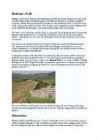
stone, henge, stonehenge, stones, round, heritage, monument, other, place, english, roadurial, sites, surrounding, around, however, visitor, original, centre, suggested, land, close, year, mystery, purpose, ancient, observatory, miles, setting, recent, first, evidence, years, there, professor, near, ritual, function, schemeuild, create, even, accessStonehenge Stonehenge is a prehistoric monument located in the English county of Wiltshire, about 3.2 kilometres (2.0 mi) west of Amesbury and 13 kilometres (8.1 mi) north of Salisbury. One of the most famous prehistoric sites in the world, Stonehenge is composed of earthworks surrounding a circular setting of large standing stones. Archaeologists had believed that the iconic stone monument was erected around 2500 BC, as described in the chronology below. However one recent theory has suggested that the first stones were not erected until 2400-2200 BC,[1] whilst another suggests that bluestones may have been erected at the site as early as 3000 BC (see phase 1 below). The surrounding circular earth bank and ditch, which constitute the earliest phase of the monument, have been dated to about 3100 BC. The site and its surroundings were added to the UNESCO's
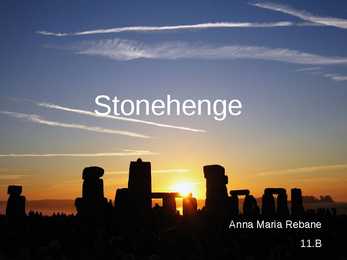
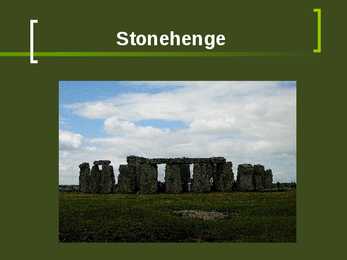
Stonehenge Anna Maria Rebane 11.B Facts about Stonehenge · 5000 year old prehistoric ritual monument · the most famous prehistoric monument in Europe · one of the most ancient and mysterious structures in the world · 3.2 kilometers west of Amesbury and 13 kilometers north of Salisbury · south-western England; in the English county of Wiltshire · built in the late Stone Age (Neolithic) and the Bronze Age The History of Stonehenge · "The Mystery of Stonehenge" · the building began in 3000 BC by semi-nomadic peoples · The first stone to be placed - Heel Stone. · some stones weigh about 45 tons each and are 7m high · the largest stone weights as much as 50 tons · no wheels and no metals · their tools - stones, bones and wood · built in several stages
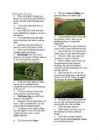
Stonehenge Hort 4000 Mary Laine What is Stonehenge? Derived from words that mean hanging stones, circle of stones, or stone hinges 162 stones originally and about half remain today Southern England, eight miles north of Salisbury and 30 miles north of the English Channel Nearby hillsides are covered with hundreds of burial pits known as barrows 80% of the barrows face east towards where the sun rises on the horizon There are at least 900 circles in Wales, Scotland, England, and Ireland. Most are made of stone, but wood was also used. Soil was also piled up to create banks, ditches, and circles. Many of these structures are of archaeological interest and are found throughout the countries. The builders
1) INDIAN ROCK ART: A NATIONAL TREASURE IN DANGER Unrecognized, unprotected, this priceless legacy of primitive art has endured the ravages of nature only to fall victim to wanton destruction by ,,civilized" man. Like the huge stone statues of Easter Island and prehistoric cave paintings of Altamira and Lascaux, North American Indian rock art is surrounded by an atmosphere of mystery. Although examples of rock art exist at some 15000 sites in canyons, deserts, caves and river gorges. Nowadays, however, primitive rock art in the United States has become a new field of scientific study. Klaus F Wellmann wrote two books about rock art. He is a professor of medicine. Rock art represents the history of aboriginal Americans
England Sightseeings Stonehenge Is a prehistoric monument located in the English county of Wiltshire, about 3.2 kilometres (2.0 mi) west of Amesbury and 13 kilometres (8.1 mi) north of Salisbury. The dating of cremated remains found that burials took place as early as 3000 B.C, when the first ditches were being built around the monument. One of the most famous prehistoric sites in the world. The site and its surroundings were added to the UNESCO's list of World Heritage Sites in 1986 in a co-listing with Avebury henge monument, and it is also a legally protected Scheduled Ancient Monument. Biggest stone is press 26 ton. Cambridge'is College was founded in the 13.century. this is world oldest ang the best collage. Oxford college Is founded in 1379. The College's motto, created by William of Wykeham, is "Manners Makyth Man"
1. The Queen’s official title. Elizabeth the Second, by the Grace of God, of the United Kingdom of Great Britain and Northern Ireland and of Her other Realms and Territories Queen, Head of the Commonwealth, Defender of the Faith. 2. The Queen’s working day. Starts after breakfast. Reads the newspapers which are prepared by the Press Secretary, and a report on the previous day’s proceedings in the Parliament and the letters she receives. Also phone calls. Once a month she attends the Privy Council in order to give Royal Assent to various items of government legislation.
Study questions on chapter 1 Stonehenge - is pre-historical moument located in the English county of Wiltshire. 2400 BC 22 000 BC. It is composed of a circular setting of large standing stones. The site and its surroundings were added to the UNESCO's list of World Heritage Sites in 1986 Celtic Invasion It begun about 500 years BC. Celts brought iron with them to Britain (and pagan traditions). But it is belived that there was never an organized Celtic invasion.(Celts were too fragmented to make it happen) Iron Celts brought iron with them into Great Britain which made some big changes. Iron is stronger then bronze and iron ore is more common(it made tools and weapons better). One of the interesting
Stonehenge About Stonehenge History "Mystery of Stonehenge" Construction Location Stonehenge Tour Location South-England 90 miles west of London 3.2 kilometres west of Amesbury, 13 kilometers north of Salisbury. History Evolved between 3,050BC and 1,600BC Constructed in three main phases: 3050BC, circular ditch and bank 2600BC, wooden structure constructed at centre 2500-1500BC, monument constructed, arranged and re- arranged "Mystery of Stonehenge" Multiplicity of theories: Stonehenge was domain of the dead, Woodhenge was land of the living. Place of healing. Observatory, temple Used for astronomical views. Construction Three periods: Period I (c. 2950-2900 BC) - circular enclosure (56 Aubrey holes and 4 Station Stones inside it), outlined by two banks, ditch with an entrance to the northeast, heel stone,
Main Sights England is known for its many world-famous sightseeings and people all around the world come to see them. Some of them are even like symbols of England. The most famous ones are: Stonehenge is one of the greatest national icons of Britain. That prehistoric monument is located in the plain of Salisbury, in the county of Wiltshire in the south-west of England. It is built of 150 enormous stones which are set in a purposive circular pattern. Stonehenge was probably built to mark the longest and shortest day of the year because it lies on the line of the midsummer sunrise and the midsummer sunset. That would have enabled people to keep a record of changing of seasons. Although it is still unclear who built it. Hadrian’s Wall is an ancient wall which was built in 2nd century by Hadrian, the emperor of Rome from AD 117 to 138, and it marked the northern border of the Roman Empire in Britain
Great Pyramid of Giza The Great Pyramid of Giza (also called the Pyramid of Khufu and the Pyramid of Cheops) is the oldest and largest of the three pyramids in the Giza Necropolis and is the only one of the Seven Wonders of the Ancient World that survives mostly intact. Originally the Great Pyramid was covered by casing stones that formed a smooth outer surface, and what is seen today is the underlying core structure. Some of the casing stones that once covered the structure can still be seen around the base. There have been different scientific and alternative theories regarding the Great Pyramid's construction techniques. Most accepted construction theories are based on the idea that it was built by moving huge stones from a quarry and dragging and lifting them into place. There are three known chambers inside the Great Pyramid. The lowest chamber is cut into the bedrock upon which the pyramid was built and was unfinished
suspension, or moveable); length (usually expressed in terms of clear or overall span); and materials (stone, wood, cast and wrought iron, and what we use today - concrete and steel). The purpose of this contextual essay is to provide parameters of value and significance so that we can focus our attention on those bridges - globally - that best illustrate the history of bridge building, and to encourage their preservation. What is a World Heritage bridge? The World Heritage Committee states that to be of World Heritage status a monument or site must be of outstanding universal value. It must illustrate or interpret the heritage of the world in terms of engineering, technology, transportation, communication, industry, history, or culture. World Heritage industrial sites and monuments must meet one or more of the following criteria and pass the test of authenticity: Represent a masterpiece of human creative genius;
The United Kingdom The United Kingdom consists of England, Scotland, Wales and North Ireland and it is situated in the Atlantic Ocean near the mainland of Europe. The population of the UK is 58.6 million and area is 244,110 sq km. Britain has a temperate humid climate. Its characteristic features are mild winters, warm summer, no temperature extremes, abundant rain all year round and frequent changes of weather. The mild climate is partly due to the warm Gulf Stream and partly to the south westerly winds. Occasional winds from the east in winter may bring cold and dry weather. The distribution of rainfall is influenced by the Atlantic Stream. The mountainous areas of the north and west have more rain than the lowlands of the south and east. Wales is located on a peninsula in central-west Britain. The entire area of Wales is about 20,779 km²
It seems that the Celts, who had been arriving from Europe from the 8th cent BC onward, intermingled with the peoples who were already there. The Celts were extremely talented people, creative and artistic. More than 1 Celtic tribe invaded Br. The descendants of ancient Celts live in Wales, Scotland, Cornwall and Ireland. They lived in primitive society. Druids priests, more powerful than chiefs. Acted like prophets. 2. Stonehenge From prehistoric period. Was built on Salisbury plain between 2500 and 1500 bc. One of the most famous and mysterious archaeological sites in the world. One of the mysteries is how it was built at all with the technology of the time. Another is its purpose. It appears to function as a kind on astronomical clock and we know it was used by the Druids for ceremonies marking the passing of the seasons. It appears in number of novels. These days it is not only the interest of tourists but is also a
In the 13th-century Chronicle of Henricus de Lettis the town was called Lyndanise. Later came Reval (presumably after the old county of Rävala), the name used by the Germans who ruled the country for seven centuries. Russians then modified Reval to Revel. For Estonians, the town came to be called Tallinn from Taanilinn (Danish town) after Danish conquest in the 13th century. Over the course of time, Taanilinn was shortened to Tallinn The place is believed to have been settled by Finno-Ugric peoples about 2500 BC. The Danes, led by King Valdemar II, conquered northern Estonia in 1219. Legend has it that one day, when the Danes were about to lose a bloody battle, the sky suddenly opened and a red flag with a white cross on it dropped down upon them from the heavens. This is allegedly how the Danes obtained their national flag, the Dannebrog in a battle against the Estonians.
Romans. The Roman Londinium grew up on the northern side of the "London Bridge" in the past. Products such as olive oil, wines and fruit were brought by ships from different parts of the Roman Empire and unloaded onto wooden quays along the river. In AD 61 the native Celtic Iceni tribe, led by Queen Boudicca, rose up against The Romans. They burnt Londinium to the ground but Roman armies eventually defeated Boudicca. The city was rebuilt and was gradually surrounded with a wall of stone and brick which lasted for many centuries. During the archeological excavations in 1954 the Roman Temple of Mithras was revealed. It was a pagan temple dedicated to the Persian Sun-god. The Temple was later reconstructed only a short way from its original site and the relics are displayed in the Museum of London in the Barbican. At the end of the fourth century AD the Roman Empire began to crumble and the Roman armies were recalled from Britain to defend Rome itself. Once they had
The present architecture of the square is due to Sir Charles Barry and was completed in 1845. Trafalgar Square is owned by the Queen in Right of the Crown, and managed by the Greater London Authority.[1] Trafalgar Square ranks as the fourth most popular tourist attraction on Earth with more than 15 million visitors a year. Overview The square consists of a large central area surrounded by roadways on three sides, and stairs leading to the National Gallery on the other. The roads which cross the square form part of the A4 road, and prior to 2003, the square was surrounded by a one-way traffic system. Underpasses attached to Charing Cross tube station allow pedestrians to avoid traffic. Recent works have reduced the width of the roads and closed the northern side of the square to traffic. Nelson's Column is in the centre of the square,surrounded by fountains designed by Sir Edwin
Sights in the UK Hardi anton Big Ben Location: London, Palace of Westminster. The tower was finished in 1858. Largest fourfaced chiming clock and the third highest clock tower in the world. Big Ben is a nickname, the clock towers official name is Elizabeth tower. The clock chimes every 15 minutes and can be heard for a radius up to 5 miles. Stonehenge Location: southern England. Built 2000BC to 3000BC. Archaeologists think it was an ancient place of burial. Stonehenge had about 1 million visitors in 2012. It was added to the UNESCO's list of world heritage in 1986. Giant's Causeway Location: Northern Ireland. It developed 50 to 60 million years ago due to intense volcanic activity. It's the fourth greatest natural wonder in the UK. Most of the rocks are hexagonal, but some have four, five, seven or eight corners. The tallest are 12 metres tall. Snowdonia national park Location: north Wales. The highest mountain is Snowdon which is 1085 metres tall.
50 000 BC in a milder Ice Age period Britain became habitable again. People from that time were the ancestors of the modern British. 10 000 BC ige age ended and Britain became inhabited by small groups of hunters who probably followed herds of deer. 5000BC Britain became an island and deer died out. 3000BC the Neolithic people came (probably from Spanish peninsula or even North African coast). They may be the forefathers of the people from Cornwall and Wales. The building of Stonehenge started around that time. 2400BC the 'Beaker' people arrived in Britain. They had better metal working skills and they soon became the leaders of the British society. They started building individual graves. 1300BC the farming society became more important than the henge society. 55BC the Romans arrived. The Celts The Celts arrived from central Europe or further east around 700BC. They were tall and had fair or red hair and blue eyes. They knew how to work with iron
deeper ocean waters, as well as the excellent land conditions available for bridge building. The home of the London Bridge as it appeared in Roman times was in virtually the same spot as the home of the London Bridge today, suspended over the Thames River. The Romans were not the only people in London Bridge history to construct a wooden bridge. After the fall of the Roman Empire, the Saxons were known to have built at least one, if not many (due to destruction by fire and other calamities) timber bridges. The first stone structure in London Bridge history was built in the 12th century and took 33 years to complete. King John was in power when the bridge was finally completed, and it was King John who had the idea to build houses on the bridge itself. The history of the London Bridge goes on to reflect that scores of houses and shops quickly built up on the bridge. The number of people residing on the bridge
in Iberian Peninsula Spain. It is the third largest of the Balearic Islands, an autonomous community of Spain. With Formentera, it is one of the two Pine Islands or Pityuses. Its largest cities are Ibiza Town (Catalan:Vila d'Eivissa or simply Vila), Santa Eulària des Riu and Sant Antoni de Portmany. Eivissa is the official Catalan name (Catalan pronunciation:, locally. The name in Spanish is Ibiza . In British English, the name is usually pronounced in an approximation of the Spanish while in American English the pronunciation is more anglicized The island is well-known for its summer club parties which attract large numbers of tourists, but the island and the Spanish Tourist Office have been working to shed the prevailing "sex-and-alcohol" image in order to promote more family- oriented tourism. Noted clubs include Space, Pacha, Privilege (ex Ku), Amnesia,
White Cart Water.Crookston is surrounded by a defensive ring-ditch that dates back to the 12th century when Sir Robert de Croc, built a timber and earth castle. Remains of a chapel founded by de Croc in 1180 have been uncovered. Evidence of an even earlier fortification on the same site has also been found. The lands of Crookston were bought by Sir Alan Stewart in 1330, and passed to Sir John Stewart, 1st Lord Darnley, in 1361. The Darnley Stewarts replaced the early castle with the present stone structure around 1400.In 1489 the Stewart Earl of Lennox rebelled against James IV. James responded by bringing the cannon Mons Meg from Edinburgh, and bombarding the castle, virtually destroying its western end, and ensuring a quick surrender. In 1544 the castle was besieged and taken by the Earl of Arran and Cardinal Beaton, while the then Earl of Lennox was defending Glasgow Castle.Charles, the Earl of Lennox.The castle passed through several owners, until in 1757 it
than an actual decision maker these days. 5. What is the British Parliament made up of? What are their roles? It's made of 3 parts: the monarch, the House of Commons and the House of Lords. The House of Lords can ask the House of Commons to rewrite parts of the bill. The bill needs the Queen's signature to pass. The House of Commons writes the bills. 6. What do you know about the Wars of the Roses? It was a war between two families, one had a red rose as their symbol and the other had a white rose as their symbol. The war was about who should be on the throne, the red rose won and thereafter the red rose has been the symbol of England. 7. How was Protestantism established in England? When and by who? It was established by Henry VIII because he wanted to divorce his first wife. Up until then England was Catholic and divorcing was not allowed for him. He really wanted a new wife, so he declared that England was no longer a part of the Catholic Church
Prehistoric Britain · They built forts on hilltops and · When the English Channel was pro-tected them with ditches and formed by meltic ice(around 6000 BC), ramparts. Britain was part of the European land mass. · The earliest inhabitants lived in limestone caves. · About 3000 BC the British Isles were inhabited by a people as known as the Iberians. · Celts and Iberians both lived under · They used stone axes and made
boundaries, but the name "London" has long applied more to the whole metropolis that has grown up around it. London has been an important settlement for over two millenniums. It is also one of the world's leading business, financial and cultural centres and its influence in politics, education, entertainment and even fashion contribute to its status as a major global city. London is a major tourist attraction with four world heritage sites, several royal parks and numerous iconic landmarks such as the Houses of Parliament, Towe Bridge, the Tower of London, Westminster Abbey and the London Eye. 2. History Although there is some evidence of a permanent settlement before the Romans came in 43 A.D., it is more accepted by historians that the Romans were the first. The settlement was called Londinium. The first London lasted for just seventeen years, for around AD 61, a tribe of Celts led by
These seaplane hangars are unique shell concrete structures, which demonstrate engineering 20 years ahead of its time. The Post-War Years On January 24th, 1945, the secret decision No 010 of the ESSR National Economy Council granted the military a 14.2 ha premises in the area located on Küti and Noole streets. From then on until the end of the 1980s, the whole territory was under the control of the Baltic Shipping Administration and other Soviet military contingents. In addition, the roadstead fleet was based at the harbour. For decades the area remained closed off for regular citizens. In 1951 a new pier No 36A was constructed on the former piers No 36 and 37 which were built during the time of hangar construction for the purpose of shielding the water area from north winds. In 1962, Professor Heinrich Laul of the Tallinn Polytechnic Institute published,
History exam *Stonehenge - is a monument located in England. It is one of the most famous prehistoric sites in the world and is composed of earthworks surrounding a circular setting of large standing stones. The surrounding circular, earth bank and ditch, have been dated to about 3100 BC. Stonehenge was produced by a culture with no written language. Many aspects of Stonehenge remain subject to debate. There is little or no direct evidence for the construction techniques used by the Stonehenge builders. *The Celts in Britain and their legacy The Cets lived in Britain in The Iron Age. They were warring tribes who were battleful amongst themselves as well as inter-tribal war. They were not centrally governed. The Celts brought iron working, iron ploughs and metal swords,
* everybody from the UK is called British * the capital city is London * is made up of four constituent countries: England, Scotland, Wales and Northern Ireland which in turn are divided into counties * the flag is called the Union Jack which is a combination of the flags of England, Scotland and Northern Ireland * the population is about 60,000,000 people, the population density is 242 people/sq km * its coasts are washed by the Atlantic Ocean, the North Sea, the English Channel, the Celtic Sea, Saint George's Channel, and the Irish Sea. It is linked to France by the Channel Tunnel * the United Kingdom is a constitutional monarchy. The current monarch is Queen Elizabeth II, who is also the Queen and Head of State of fifteen other Commonwealth Realms, such as Canada, Australia, New Zealand and Jamaica. England: * it has 50 cities, the capital city is London
It’s the official name of the country. Australia is the smallest continent, but one of the largest countries on Earth. It’s 6th largest country. Its area is about 7.6 million sq km. One third of it is occupied by deserts. It’s both the flattest and, except for Antarctica the driest. Neighbouring countries include Indonesia, East Timor and Papua New Guinea in the north, the Solomon Islands, Vanuatu in the northeast, and New Zealand in the southeast. Its capital is Canberra. Other big cities are Melbourne, Sydney, and Brisbane. National language in Australia is English. Monetary unit is Australian dollar. Their national holiday is on the 26th of January. In 1788 on the 26th of January the first fleet arrived at Botany Bay and established a penal colony near modern-day Sydney. Geographical Position Australia is located in the Southern Hemisphere. It’s the only continent except for Antarctica that is all south of equator
Tallinn English College Topic The United States of America Tallinn 2007 1. Introduction The United States of America's territory is over 3.7 million square miles (over 9.6 million km²) and population more than 300 million people. The capital city is Washington D.C. Although the United States has no official language at the federal level, English is the de facto national language. English is the most common language for daily interaction among both native and non-native speakers. Spanish is the second language. The largest city is the New York City. The Government is Federal constitutional republic and the president is George W. Bush. 2. Geographical position The United States of America is located on the continent of North America. It has borders with two countries Mexico and Canada. There are also the Atlantic Ocean, the Pacific Ocean and
economic stability and provide peaceful conditions in the Roman province of Britannia to the south, to physically mark the frontier of the Empire, and to separate the unruly Selgovae tribe in the north from the Brigantes in the south and discourage them from uniting. The name is also sometimes used jocularly as a synonym for the border between Scotland and England, although for most of its length the wall follows a line well south of the modern border -- and neither the Scoti tribe nor the English lived in Britain at the time of the wall's construction. The wall was the northern border of the Empire in Britain for much of the Roman Empire's rule, and also the most heavily fortified border in the Empire. In addition to its use as a military fortification, it is thought that the gates through the wall would also have served as customs posts to allow trade taxation. A significant portion of the wall still exists, particularly the mid-section, and for much of its
and covers an area of almost 160 sqkm. It is also an important economic and cultural centre and one of the main ports in the Baltic States. Tallinn is one of the oldest cities on the Baltic Sea. It is unique for its well-preserved architecture from the 13-15 centuries. In contrast to the ancient town-walls and towers, Tallinn of today offers modern hotels, restaurants, sport and cultural centres. Every five years national song and folk dance festivals take place in Tallinn. The yachting regatta of the 1980 Moscow Olympic Games was held at Pirita. History Tallinn means in English "Danish town". The place is believed to have been settled by Finno-Ugric people about 2500 BC. It was first marked on a map of the world by the Arab geographer al-Idrisi in 1154. The Estonians were the first to build a stronghold on the spot of the Toompea Hill, but the real Tallinn was built by the Danes who conquered the north of Estonia in 1219
Royal International Horticultural Exhibition held at the Royal Hospital in 1912. This one off event was backed but not run by the RHS, which cancelled its own Great Spring Show for that year. The RHS Great Spring Flower Show had normally been based at the Inner Temple in the hart of London, but in 1913 RHS had idea of moving the Show to Holland Park. They thought that the Show was becoming too big for the Inner Temple site. Anyway it stayed in first place. July 1912 the RHS President Sir Trevor Lawrence had met Major General Crutchley Of the Royal Hospital at Chelsea, and the two began to talk about a 14-day reservation of the gardens and a 14-year agreement. At the RHS Council meeting the following month, 13 August 1912, all had been decided. The show would move to Chelsea for 1913.The Council then turned to more pressing matters: primulas and experiments in electrical cultivation, for which the RHS would be "put to no expense whatsoever".
There is evidence suggesting Aborigines in northern Australia maintained trade with some of the Indonesian islands closest to the coast. Chinese and Arab's may have had contact with the Aborigines in the 15th century. When British people came to live in Australia, they decided that the land was empty, that there were no people living there. This was called "Terra nullius", Latin words for "empty land".Under British law, all land belongs to the king,who is then able to sell it to other people. The sacred sites and other land which had belonged to aboriginal people for thousands of years were simply taken from them. If they did not leave peacefully then the new settlers used force to get them to leave. Many aboriginal people were killed during the settlement of Australia. The aborigines that were left were made to live on in special areas, reservations, that the government set aside for them. One of these was at Lake Tyers, Victoria
 annaabi.ee