Leidsid 33 sarnast õppematerjali, mis on seotud failiga "Report ". Need materjalid aitavad sul teemat sügavamalt mõista.
british, students, children, uniform, report, prepare, them, different, purpose, everyday, result, surprised, kids, schools, shows, britain, compare, opinions, based, career, showed, expected, uniforms, wide, spread, than, issue, results, another, clearly, conclusion, really, prefer, reasonReport The aim of this report is to compare Estonian and British students opinion on educational system. We wrote down our opinion on the 6th of september 2012 in our english class. We had 12 students who gave an opinion about the Estonian educational system. Corporal punishment is illegal in British and Estonian schools. 62% of British childrens think that it would be needful but only 31% Estonian childrens have the same opinion. Actually it could be not banned, because if they used controlled corporal punishment it is not likely to be harmful. I would argue that there were actually fewer discipline problems back in the old days when corporal punishment was more common. Most school in England require children to wear school uniform. Estonian children no longer wear uniforms but few decades ago they wore uniforms
fellow students’ awareness of the latest linguistinc tendences in order to develop their understanding of the importance of learning languages, English in particular. 3 The theoretical part of the study relies upon the works of such scholars as David Cristal, Luke Mastin, David Graddol, etc. For the practical part, a survey has been conducted among the students of the 10th, 11th, 12th forms of Tallinn Mustamäe Gymnasium of the Humanities and other schools . The answers of 105 students to 23 questions of the survey have been analyzed, Analytical, statistical and descriptive methods of the study have been used. The paper is divided into an introduction, two chapters, followed by a conclusion, which summarizes the most important findings and observations that have been brought out during the analysis.
Active Citizenship in Cadle Primary School: A Case Study 20 Conclusion 29 Bibliography 32 Appendices Appendix 1: The United Convention of the Rights of the Child Appendix 2: Interview with Jamie Richards, the Head Teacher of Cadle Primary School 2 Abstract: Children inherently have had a rather tenuous relationship with citizenship. Similarly to how women were once viewed, children have not been considered as subjects of rights due to their perceived incompetence and irrationality. Currently, children are not considered as being rational and capable of exercising responsibility until the age of majority, the age of 18. However, the adoption of the U.N Convention of the Rights of the Child (UNCRC) in 1989 granted for the first time the recognition for children as worthy individuals with rights of their own
Report A report is based on facts/data etc. The writer knows more than the reader. The reader needs the information. A report should be clear and easy to follow. The person who reads it should find the information quickly. THINK: why you are writing the report, why the reader needs your report and what she might be interested in. Think about the best way to present the facts. If it’s a report of events (e.g. a traffic accident), describe them in chronological order. It should NOT be written like a letter! NO salutation/sign-off. Impersonal style (PASSIVE!), unless you make suggestions or give personal opinion – then you can use “I”. Formal language –no contractions, slang, etc. You can use the following format at the beginning of the report: To: From: (DO NOT write your own name. A member of the student committee etc. is fine) Subject: Basic structure 200 (+/- 10%) Introduction: Aim of the report
Comparison of Education in Britain and Estonia When looking into the educational systems of Britain and Estonia, several differences appear. In this essay I am going to point out some of the most distinguish features in the education of both countries. Firstly, there are dissimilarities in the age at which children go to school. In Estonia the age is 7 whereas in Britain children start their educational journey already as young as 5 years old. Primary school lasts 6 years just like in Estonia but the pupils in Britain are 2 years younger when they finish primary school than the pupils in Estonia. However, students in Britain and Estonia finish secondary school at the same age because secondary school lasts 5 years in Britain instead of 3 like it is in Estonia. Altogether, compulsory school in Britain lasts 11 years which is 2 years more than in Estonia.
BRITISH NATIONAL SYMBOLS Research work CONTENTS CONTENTS.....................................................................................................................................2 INTRODUCTION............................................................................................................................3 1. BRITISH NATIONAL SYMBOLS..............................................................................................5 1.1 Great Britain and British story................................................................................................5 1.2 National Symbols and Nation Building..................................................................................5 1.3 The Use of Flags throughout History.....................................................................................6 1.4 The Early Modern Flags. United Kindom: Union Jack..........................................................8 1
An Essay There are many different education systems in the world. Basics are pretty much the same, but ofcourse depending of the culture, the differences and interests of educating people, are big. Children go to school at age five in Great Britain, which is too early in my opinion. Most children in Estonia start school at age seven, only some of them at age six. I think starting with school and competition, rivalry, witch always associates with schooling, too young, shortens the childhood and may affect negatively self-esteem, success and coping in the future. Children´s job is to play, it develops child the best, so I think anyone shouldn't forbit humans inherent needs. Children don´t have to become too fast to an adult. The high school in Great Britain starts at age eleven, but in Estonia at about age fifteen.
Great Britain Pärnu 2012 Contents Great Britain Great Britain or Britain is an island situated to the northwest of Continental Europe. It is the ninth largest island in the world, the largest European island, and the largest of the British Isles.
endorsements or funding to carry out its work. Maintained schools funded by the state. Schools maintained by the local education authority (LEA, or, in Northern Ireland, by Education Authority). Some of those schools are voluntary schools (also known as religious schools or faith schools) where the land and buildings are owned by a charity, often a religious organisation such as a church, but the school is at least partly funded by the local education authority. In all state schools, students must follow the National Curriculum. Independent schools independent fee-charging schools. Schools that are independent of local or central government control; private schools • financed by fees and endowments financially independent Public schools = now a somewhat archaic term for the oldest, most exclusive and expensive of the boys' independent secondary boarding schools (some are now at least partly co- educational).
Education Education is so multifaceted that it is difficult for me to know where to begin discussing it, or how to prioritize the many factors. Relaying my own experience is easy: I had a standard classroom approach, supplemented by inordinate reading. In only the briefest and least memorable instances did I receive any individual tutoring. Education is commonly thought of as the job of schools. Adults cry "educate our children!" Everyone has opinions about the best way to do the job. It is of urgent importance, and all the numerous factors are much studied, debated, and new (or old) ideas continually tested or retested. Some people say "it's as simple as . . . " and then name their pet peeve or passion. My view is not of an education specialist, but of one who loves sharing what I learn, and owes much to educators. Since I don't have an educational theory neatly worked-out, nor an outline
ages. People in all walks of life use libraries to get information for their work. Libraries also play an important role in preserving people's cultural heritage. For example, some libraries have rare books, authors' and composers' manuscripts or works by artists. Today's libraries differ very much from the ones from the past - not only in the contents and services, but also in physical layout and atmosphere. Library derives from the Latin word "liber" which means book. It shows that libraries were collections of books at first but now they have also a wide variety of other materials: magazines, newspapers, disc and cassette tape recordings, films and videos, computerized databases, maps etc. In addition to ordinary books libraries may have large-print books and Braille books for people with impaired vision. There are different kinds of libraries to meet the needs of people: university, research, school, medical, government libraries and other libraries
TALLINN COLLEGE OF ENGINEERING INGLISE KEEL Essee Differences between Estonian and USA school and education systems. Juhendaja: Koostanud: 2009 Differences between Estonian and USA school and education systems. Question is, how different are our own and this big country they call United States of America's education. Or maybe there is no difference at all, and our systems about school and education are more similar than they appear at first sight. After reading all the materials and all sorts of notes about USA's education systems and their school household. All at once I realized, that they are not so different at all. Like for example USA's kids have to go to school exactly the same amount of time as our Estonian children
Edulugude võistlus Success-story competition „Small Town Inhabitants – Educated or Uneducated People“ To begin with, my childhood was quite ordinary, I spent a lot of time in my country home, spending most of my time playing. I have been raised by my mother. As I grew older, I got more and more interested in different things. At one point it occured to me that when I want to be successful in some field, then I really have to educate myself in that filed.When my friends have characterised me then they have mainly mentioned that I am an active person, who has been successful in different fields. I still do not think I am succesful because it is a really complicated definition, but I know that I have succeeded in doing several things. For me the key is my so called success has been
include the battery, and the space in the box for the charger was empty. I am now in Wondercity, and I am not returning to Freetown, so I need to get the missing parts here. I would be grateful if you could arrange for the parts to be sent to me. I attach a copy of the receipt for your information. I look forward to hearing from you. Yours faithfully, Introduction This report looks at the dietary habits of twenty students in their final year at Freedonian Secondary School. The report is based on the students' responses to the questionnaire administered by the school's doctor. Meals The survey have revealed that the students do not have enough meals. Only eight of those questioned eat before school, and half of them have their midday meal at school. Worryingly, as few as four students have both breakfast and school lunch. Still more disturbing is the fact that an alarming proportion--approximately onethird--of the students have neither. Eating brown bread
ELT Methodology (FLGR.01.041) 27.12.2012 Home Assignments. I Youtube clips: · A vision of K-12 students I personally think that Estonian learners are also digital learners. They spend more time at the computers or laptops or iPads etc. than read books or move outside. And another thing is that teachers are less capable in using technological appliances. But the latter mentioned fact is an advantage for us teachers as well. It gives us an opportunity to provide our students to experience success. They can help and assist us if we need some technological help.
When I was just a little girl, my mother died and everything in my life changed. My father separated me from my sister and brother. I had to go to live in his family and accept with a stepmother and their kids. To me was verboten to say my opinion about something. I knew only that, everyday there was a paper on my desk and there were jobs, what I had to do along this day. Sometimes they were too hard to me and I had to study late at night. In my opinion every person should feel them well and free at home. But with me it did not happened. What I am trying to say with that long story is, that if there is a freedom of speech, it is still limited with laws or from other humans. Limited freedom is understandable in state bust at home it still should be aloud. Talkeing about the school. There has it's own determined rules, what students by all means have to detain. It is because of that: these rules are determined from school. In the old times I
British Cuisine Some people criticize English food. They say it's unimaginable, boring, tasteless, it's chips with everything and totally overcooked vegetables. The basic ingredients, when fresh, are so full of flavour that British haven't had to invent sauces to disguise their natural taste. What can compare with fresh pees or new potatoes just boiled and served with butter? Why drown spring lamb in wine or cream and spices, when with just one or two herbs it is absolutely delicious? If you ask foreigners to name some typically English dishes, they will probably say "Fish and chips" then stop. It is disappointing, but true that, there is no tradition in England
Throughout the period, Estonia was mainly an agrarian society. The townspeople formed a modest 5 per cent of the whole population. By 1782, their number had grown to 23 000. The biggest town was Tallinn with a population of 10 700; in Tartu the number was 3400. And there were some smaller towns like Rakvere and Paide, mercilessly plundered in the Northern War. Townspeople had to fight hard with the neighbouring landlords who considered them as. The population kept growing very slowly: in 1862 the number of townspeople was 64 000, which formed only 8.7 per cent of the population living on Estonian territory. The Estonian population in 1782 was divided according to social class as follows: nobility 0.6%; the clergy, townspeople, and other free people (excluding the Swedish "free peasants" of the coast and islands, resident since the 13th century); peasants, of who'm most were serfs.
light. Only the bedroom should be dark, because in dark is better sleep. 4. What makes a good home? I think that everybody's home is the best place in the world. You can always go there. It's good to go home when somebody is waiting you to come home. There shouldn't be noisy at home. Home makes a good home for each other's trust, helpfulness and good relations with other family members. I love my home. 5. How people make choices about where they live? Every person is different. Some people like sun and sea and that kind of person's usually go to live in tropical countries. People must choose the best climate for him. And the work shouldn't be far from home. But it's everybody's own decision what they like or not. ENGLISH SPEAKING COUNTRIES 1. What is your favourite food? I'm quite choosy human. I don't eat many things like mushrooms, carrots, eggs, fish etc. My favourite food is French fries with salad. In general, I like fast food. But fast food is not always
century festival in China and the Apollo 11 moon landing in 1969. However, there is a link and that is that they both relied on the use of rockets. The Chinese first developed rockets by filling bamboo tubes with an explosive made from saltpetre, charcoal, and sulphur. The sealed tubes would be thrown onto fires during celebrations because it was thought that the loud explosions would protect them. It was not long before the ancient Chinese realised the military potential of these devices and primitive rockets were used to repel a Mongol invasion in 1232 AD. Word of these new amazing weapons quickly spread around the world and soon rockets were being used in military operations in North Africa and Europe. During the 15 th and 16th centuries they were widely used in naval battles to set fire on enemy ships. Around this time they also started being used for more peaceful purposes again
reforming. Nowadays, the main focus seems to be on subjects like maths, physics, chemistry etc. because of current IT-era demands more knowledge in those regions than in humanities. I agree that Estonia's government's steps towards making maths and physics our school- system's top priority is quite right, but I think that there can be a lot more done to improve our educational structure. I find that Estonian schools should pay more attention to teaching our children current state in our political landscape. Kids, who go to school, are our future and soon-to-be full- right voters in national elections. They will become old and independent enough to be a part of deciding process over their country's future. So, it is very important that they would know which political party stands for what beliefs and who are the politicians in Estonia who are leading our country. Youth, especially youngsters aged 15-18 should know or find out what is
PHYSICAL EDUCATION Physical education has long been a staple in schools on a K-12 level and beyond, with all students required to participate in some form of physical education. Also referred to as "gym class" students participated in activities such as team sports, (volleyball, soccer, basketball, etc.) walking or running (running a mile was common), cardiovascular and strength training exercises (such as pull-ups and push-ups) and even swimming. Physical education provides children with an opportunity to exercise during the day. It gives children early exposure to team sports, and promotes good physical fitness. Children who participate in physical education get a workout, and they also learn the importance of exercise as a lifelong habit. Physical education is clearly an important course in schools, with many benefits for children. In addition to helping kids learn healthy habits and stay off drugs, physical education can also increase learning by getting the blood
34. Are sports days held at your school? 35. What sports events do you watch on TV? 36. Do you read the sports page in a paper? Do you watch/listen to sports news? Could you tell us the latest sports news? 37. Who is the best athlete in your class? 38. Who is your favourite athlete? What do you know about him? 39. What sports events are popular in Estonia? How many Estonian Olympic gold medalists can you name? 40. Do you think it is necessary for children to play sport? Why? 41. Do you know any Estonian people who are known to everyone and liked by all? Are they politicians, writers, scientists, musicians? 42. Can you name some Estonian writers who are famous for their humour? Which of their books have you read? 43. What kind of books do you like to read? 44. When did you last read a poem? 45. Do you enjoy reading poems? http://www.abiks.pri.ee 46
Kristiina Moosel N-14 Ken Robinson had a greate speech in TedX 2006. He was discussing about creativity and how we help ourselves and others to develope it. Mostly I agreed with him but still there were some points, where I could argue with him. Ken Robinson says noone knows how’ll the future be like. The future where our kid’s are going to have to live in. Still our education system wants us to prepare them for that. Prepare them for the mystery, for something we have no idea about how it’s going to be. If I had no younger relatives, I’d have to dissagree with him - I mean, when I was in secondary school I had to study mostly only those subjects I’d really need in the future. But I have some relatives younger than I am. The youngest is 9 right now. And when I look at what she must study, well, I studied it in 4th or 5th grade and I didn’t have to study that much with that heavy pressure.
ESSAY 2010 Stress in the Life of Young People Today Stress is a natural part of young people's lives. Negative stress can affect people's ability to be positive. I'd probably agree with the statement. To begin with, one of the main sources of stress for young people today can be relationships with parents. Everybody knows that fighting with parents can affect ours ability to be positive. Moreover, parents are the closest persons in our lives and fighting with them break us. For instance, I am always so depressed after arguing with my mother, I do not want to hurt her feelings. In my view, young people should avoid fighting with parents to cope with this source of stress. Secondly, school is another main source of stress and can affect people's ability to be positive. Nowadays young people have so much to study in school. They are always under the pressure, because tests are almost everyday and everybody wants to pass them. For example, I
Personal statement ,,Whatever course you decide upon, there is always someone to tell you that you are wrong. There are always difficulties arising which tempt you to believe that your critics are right. To map out a course of action and follow it to an end requires courage." - Ralph Waldo Emerson This quato, mentioned before, gives me confidence to do great things myself in life and pursue them into bigger ones one day ahead. In these moments i like to remember what Napoleon Hill once said: ,,If you can´t do great things, do small things in a great way." The things is, that everyone has to start somewhere, to find their own way in this life-that is the reason why i am writing this letter at this very moment, to let you know, that i am ready to make a change. To introduce myself, i would use one word-determined. I am 19 years old girl from Estonia
Main Sights England is known for its many world-famous sightseeings and people all around the world come to see them. Some of them are even like symbols of England. The most famous ones are: Stonehenge is one of the greatest national icons of Britain. That prehistoric monument is located in the plain of Salisbury, in the county of Wiltshire in the south-west of England. It is built of 150 enormous stones which are set in a purposive circular pattern. Stonehenge was probably built to mark the longest and shortest day of the year because it lies on the line of the midsummer sunrise and the midsummer sunset. That would have enabled people to keep a record of changing of seasons. Although it is still unclear who built it.
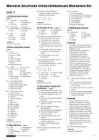
Students' own answers pointing to his sister's ice cream. 5 The thief grabbed my bag and ran The photos are connected with the 1B Past and perfect tenses off. topic of school. Both photos show page 4 6 He dropped a leaf into the water students in class. In the first photo I imagine that 1 1 ate and watched it drift under the they're about 13 years old. 2 have/'ve met bridge.
School uniforms Uniforms are in many schools nowadays and they are approved by many people. Also, there are people who do not like them. So, are the uniforms good for pupils or not? There are many good sides of wearing uniforms. First, everyone is equal. There would be no fights or teasing about people's clothes because everyone is wearing the same ones. Secondly, school uniforms help to create a strong sense of belonging somewhere. With different clothes no one would notice, that for instance you and your friend go the same school. It would be easier to recognize people with their uniforms. Uniforms also prepare you for your future life, when you often have to dress smart when you go to work. It is a lot easier to dress every morning because you do not have to choose between different sets of clothes. You will have only one to choose the uniform. However, I think, that students should not wear uniforms. Wearing uniforms will
Advantages and disadvantages of television Television is one of the greatest achievements of the 20-th century. It is the most popular part of mass media. Today every family has a TV-set. TV has changed much since the time of its invention and so has its role. There have been numerous debates concerning advantages and disadvantages of television. When TV first appeared its main purpose was to give official information to people. It was supported by the government. Now television plays a big role in every civilised society. Today television gives people a possibility to be well informed and enjoy "civilised pleasures." The programmes are various and people have a chance to select what they want to see. Television provides great opportunities for education. There are programmes devoted to specialised subjects. With the help of
My languages I love different languages. I mean, I really, really love different languages. I also believe and have been told that I pick them up rather easily. That might be true, although I did not pick any Greek up in Greece but that might have been because they spoke so damn fast that I could not tell if it was a word or an entire sentence. The first foreign language I learned was Russian. Considering I was ten when Estonia became a Republic, it makes sense. We began studying Russian in first grade, though it was simplified – "koška" instead of "kot", "medvešonok" instead of "medved", "saichik" etc. Did not make much
Introduction English is spoken on all five continents. With regard to the numbers of speakers it is only exceeded by Chinese and Spanish. But in terms of geographical spread it stands at the top of the league. The varieties of English in the modern world are divided into four geographical groups as follows. British Isles America United States (with African American England English) Wales Canada Ireland The Caribbean Africa Asia, Pacific West Africa South- and South-East Asia
ads and the subliminal presentation o Twice as many Reader's Reports- first-person accounts in which readers of odors. of previous editions describe how e Increased coverage of how compliance they've seen a principle work on principles work in other cultures. or for them. Reader's Reports have New insights are derived from the become the most popular feature of research findings, sayings, and customs the book. Boston. New York • San Francisco Mexico City • Montreal • Toronto • London • Madrid • Munich • Paris Hong Kong • Singapore • Tokyo • Cape Town • Sydney Acquisitions Editor: Michelle Limoges Editorial Assistant: Christina Manfroni Executive Marketing Manager: Wendy Gordon
 annaabi.ee