Leidsid 33 sarnast õppematerjali, mis on seotud failiga "Puritanism in John Winthrop "A model of Christian Charity"". Need materjalid aitavad sul teemat sügavamalt mõista.
other, puritan, christ, follow, christian, unity, them, poor, message, charity, spirit, bible, simple, body, cause, mean, rich, these, work, another, thing, nation, shall, plain, choose, meaning, success, puritanism, hill, colony, equality, rise, religious, through, again, among, christians, power, there, choice, might, live, idea, clear, serve, phraseThe making of a new nation. The Enlightenment in America. The emergence of the notion of the American Dream. The great Enlighteners: Crèvecoeur, Jefferson, Paine, Franklin. The American Enlightenment is the intellectual thriving period in the United States in the midtolate 18th century (17151789), especially as it relates to American Revolution on the one hand and the European Enlightenment on the other. Influenced by the scientific revolution of the 17th century and the humanist period during the Renaissance, the Enlightenment took scientific reasoning and applied it to human nature, society, and religion. American Enlightenment a gradual but powerful awakening that established the ideals of democracy, liberty, and religious tolerance in the people of America.
ISLAM Islam is a monotheistic and Abrahamic religion articulated by the Koran, a book considered by its adherents to be the verbatim word of God. By the teachings and normative example of Muhhamad, considered by them to be the last prophet of God. An adherent of Islam is called Muslim. Muslims believe that God is one and incomparable and the purpose of existence is to worship God. Muslims are beliving that Islam is the complete and universal version of a primordial faith that was revealed before many times throughout the world, including notably through Noah, Adam, Abraham, Jesus and Moses, whom they consider prophets. They belive that the
who submits (to God)". There are between 1.1 billion and 1.8 billion Muslims, making Islam the secondlargest religion in the world, after Christianity. Muslims believe that God revealed the Qur'an to Muhammad, God's final prophet, and regard the Qur'an and the Sunnah (words and deeds of Muhammad) as the fundamental sources of Islam.They do not regard Muhammad as the founder of a new religion, but as the restorer of the original monotheistic faith of Abraham, Moses, Jesus, and other prophets. Islamic tradition holds that Jews and Christians distorted the revelations God gave to these prophets by either altering the text, introducing a false interpretation, or both. Islam includes many religious practices. Adherents are generally required to observe the Five Pillars of Islam, which are five duties that unite Muslims into a community. In addition to the Five Pillars, Islamic law (sharia) has developed a tradition of rulings that touch on virtually
„unpotic” figures like compass or mosquito to reach surprise effects, paradox and oxymoron. About the profound areas of experience: love (romantic and sexual), man’s relationship with God. Brief but intense meditations, striking use of wit, irony and wordplay. John Donne: passionate feeling and logical argument are mixed, play of intellect, conceits (extended metaphors), wit, huge range of ideas with startling connections between them, analyses love with different moods (cynicism and profound dedication) The First Anniversary. An Anatomy of the World; The Flea; Love’s Alchemy; Elegy XIX To His Mistress Going To Bed; Holy Sonnets (9, X, XIV); Hymn To God My God, in My Sickness. Francis Quarles: emblem poems Canticle George Herbert: courtly urbanity of language, certain neatness and point, his wit „homely” (simple), sometimes queer, conceits in title. The Dawning; The Altar; The Collar; The Pilgrimage
Source: Feedbooks 1 About Shakespeare: William Shakespeare (baptised 26 April 1564 – died 23 April 1616) was an English poet and playwright, widely regarded as the greatest writer in the English language and the world's pre-eminent dramatist. He is often called England's national poet and the "Bard of Avon" (or simply "The Bard"). His surviv- ing works consist of 38 plays, 154 sonnets, two long narrative poems, and several other poems. His plays have been trans- lated into every major living language, and are performed more often than those of any other playwright. Shakespeare was born and raised in Stratford-upon-Avon. At the age of 18 he married Anne Hathaway, who bore him three children: Susanna, and twins Hamnet and Judith. Between 1585 and 1592 he began a successful career in London as an actor, writer, and part owner of the playing company the Lord Chamberlain's Men, later known as the King's Men. He ap-
blue sky shall be his fretted dome". Romantic poets often expand upon this idea of nature providing a tranquil environment by actually bringing it to life and making it into something capable of having plans, ideas and actions. Nature can therefore not only create the place, but also perform certain actions, like dancing, breathing, thinking, planning, all to help the person in search of himself feel more in touch with nature by giving them a sense of company, a feeling that they are not alone but with a friend. This kind of personification is used in Wordsworth's "Lines written in early spring": /.../ And 'tis my faith that every flower Enjoys the air it breathes. /.../ The budding twigs spread out their fan, To catch the breezy air; /.../ The author describes flowers breathing and plants reaching higher and higher to get more air and sunlight. In addition to this, Wordsworth's "Daffodils" shows how the jocund flowers are
Islam Assemblers: ********and ******* ************** 8a form 2011.a Table of contents · Introduction · Muhammad · Angels · Five Pillars · Golden Age · Prophets · Family Life · Modern times Intoduction For other meanings, including people named 'Islam', see Islam (disambiguation). Islam is the monotheistic religion articulated by the Qur'an, a text considered by its adherents to be the verbatim word of God (Allah), and the teachings and normative example of Muhammad, often considered by the adherents of Islam as the last Prophet of God. In addition to referring to the religion itself, the word Islam means 'submission to God, 'peace', and 'way to peace'. An adherent of Islam is called a Muslim.
Ameerika Kirjandus 30.01.13 Naturalism · France, Emile Zola · Put down his theory in 1879: Le Roman Experimental, attempt to explain the development of human society throuch biological laws · Outlook is deterministic, pessimistic, fatalistic (fate or biology) · Man as an animal-clever than other beasts, still explainable within the framework · Man is not a free agent, is govern by something · Unable to determine his own faith · Hereditary · Naturalists tried to apply in fiction the processes of natural sciences · Writers task is to record facts, systems of behaviour, living conditions, never revealing any natural unbiased (completely natural) · Point of view: amoral-outside the category of morality, neither good or bad
likely not yet favorable for a widespread flowering to occur. One day, however, a critical threshold was reached, and suddenly there would have been an explosion of color and scent all over the planet – if a perceiving consciousness had been there to witness it. Much later, those delicate and fragrant beings we call flowers would come to play an essential part in the evolution of consciousness of another species. Humans would increasingly be drawn to and fascinated by them. As the consciousness of human beings developed, flowers were most likely the first thing they came to value that had no utilitarian purpose for them, that is to say, was not linked in some way to survival. They provided inspiration to countless artists, poets, and mystics. Jesus tells us to contemplate the flowers and learn from then how to live. The Buddha is said to have given a “silent sermon” once during which he held up a flower and gazed at it. After a
1. Beowulf. The dating of Beowulf is still controversial. The poem is one of the earliest and greatest monuments of the Germanic literatures. The main stories of the poem (the fights of B.) are versions of common folk-tales, but the poet also introduces many incidental stories, some of which belong to the world of ancient Germanic legend. He writes his folk-tales and legends in a web of other events, mainly set in the Baltic Kingdoms. He shows a very rich and leisurely portrayal of this Baltic world, providing many customs like the close relationship between lord and man in the war-band and others. All this encouraged the supposition that the unknown author of the poem was himself a bard of the ancient type portrayed within the poem (a lord's scoop). However, many people propose that the author could be
There are all kinds of wars in Africa than the rest of world put together. The majority of so-called Africans leaders want to stay in power until the day their bodies are put in the grave. Through buffoonery, utter mismanagement and downright stealing of the wealth of the masses, these leaders have so impoverished Africa that we are now nothing but a beggar continent. We beg for everything; we are more dependent on our colonial masters than when we received our independence from them. Africa owes the West more money than we and our generations to come can pay. I arrived in America in December of 1967as an official of what we believed was going to be a dynamic African nation – the young Republic of Biafra. But Biafra was defeated and Nigeria remained one, as a giant of Africa. In the last 32 years, I have watched with horror and outright helplessness as the downward slide of the African race continues to escalate. But rather than address the problems, we
I leave your house, I tell you, quite disgusted; You do the opposite of my instructions; You've no respect for anything; each one Must have his say; it's perfect pandemonium. DORINE If . . . MADAME PERNELLE You're a servant wench, my girl, and much Too full of gab, and too impertinent And free with your advice on all occasions. DAMIS But . . . MADAME PERNELLE You're a fool, my boy--f, o, o, l Just spells your name. Let grandma tell you that I've said a hundred times to my poor son, Your father, that you'd never come to good Or give him anything but plague and torment. MARIANE I think . . . MADAME PERNELLE O dearie me, his little sister! You're all demureness, butter wouldn't melt In your mouth, one would think to look at you. Still waters, though, they say . . . you know the proverb; And I don't like your doings on the sly. ELMIRE But, mother . . . MADAME PERNELLE Daughter, by your leave, your conduct In everything is altogether wrong;
for an action that must be completed. For example, if i want to get a grade for this exam, it is imperative that i answer these questions. It is a certain action or inaction that must be theoretically completed in order to achieve what is necessary. The necessity for this moral law is quite simple: Immanuel Kant provided a sort of equation for the humanity, if we can name it that, that determines a reason for things we do or why we find certain things moral or immoral and why we want to follow certain things through, example given why we eat - so to not starve or why we follow the law - so to not go to jail. 4. What was civic democracy in Medieval society? Civic democracy was called feudalism. It comes from the Latin word feodum or feudum. It is a structure in society, which includes higher ups that had land or could afford protection for themselves and fo those, who could not afford it and people working for them in a way that benefits everyone in the society
literary quality (1650) and Edward Taylor, who was born in England but lived in Boston, wrote some poetry in the style of John Donne and the metaphysical poets. All 17 th cent Am writings were, both in content and form, similar to English lit of the same period. The great literary figures of the 18th cent were Benjamin Franklin (1706-1790), Thomas Paine (1737-1809) and Thomas Jefferson (1743-1826). The common sense and witty aphorisms of Franklin's popular Poor Richard's Almanac series appealed to colonial readers. Franklin also wrote effectively on the question of allegiance to the British crown but it was his protégé, Thomas Paine, who inspired colonists during the dark days of the Revolution with his stirring pamphlet Common Sense (1776), which sold over half a million copies, and American Crisis Papers (1776-1783). Thomas Jefferson was also an influential political writer. He made important
it, and criticising what he feels is falseness in others. He develops ideas relating to agriculture and the unique relationship between the agricultural labourer and his native land and culture. He believes that the agricultural reforms of Europe will not work in Russia because of the unique culture and personality of the Russian peasant. Stiva stays with Levin on his country estate when he makes a sale of a plot of land, to provide funds for his expensive city lifestyle. Levin is upset at the poor deal he makes with the buyer and his lack of understanding of the rural lifestyle. Levin pays Dolly a visit, and she attempts understand what happened between him and Kitty and to explain Kitty's behaviour to him. Levin is very agitated by Dolly's talk about Kitty, and he begins to feel distant from her as he perceives her behaviour towards her children as false. Levin resolves to forget Kitty and contemplates the possibility of marriage to a peasant woman
Part IV: Of the kingdom of darkness Churches are misinterpreting the bible to make profit of it. Church condemned Galileo for no good reason and is not a institution what helps to create an ideal society. Locke second treatise on government I Locke defines political power as the right to make laws for the protection and regulation of property. In his view, these laws only work because the people accept them and because they are for the public good. Monarchy is not derived from god or a direct decender of leaders described in the Old testament. Sovereign protects people and their property. Sovereginity not analouges to a father's relation to his children husband, wife etc II People have an obligation to punish those who go against God's will and attempt to harm another by compromising his life, liberty, or possessions. In the state of nature man is equal to his fellows
anger(tema viga), young, bad temper o Agamemnon- son of King Atreus - Olympics - Sculptures- more lifelike, human figures come out of the stone - Greek liked physical beauty - Development of medicine - Greeks are pirates, they steal- high technology - Bad tempered people Men's progress towards freedom. (Hegel) Persia is under emperor Xerxes- slaves, fighting for Xerxes and their country, but it does not mean anything to them Greece cities- Patriotism, they are fighting for their freedom and for their country, you can quit, because you volunteered, individuality. o Zeus (son of Chronos Time and Gaia Earth) · Moira- Fate, An underlying order which not even the Gods can alter · Transmigration of Souls- souls leave the bodies · Psyche- the mind · Morality and psychology might be important Miletus
vigorous [ jõuline ] debate over the natural world. Not so much man, but Nature. After all, the Renaissance had refined the dignity of man as perhaps distinct from the human depravity that the Church had preached. Nature the new focus was Nature. But why was this a subject for examination? Why had Nature become the new object of study? The reasons for this are complicated but for now I will suggest that answer lay with the Christian matrix. More specifically, the new focus on Nature was a direct result of the collapse of the Christian matrix [ raamistik ], and this was the result of a combination of forces which produced intellectual change. To be brief, these forces were the Renaissance, Reformation, the Age of Exploration and the spirit of capitalism. The major obstacle faced by the scientific revolutionaries was one of knowledge it was a specifically epistemological question
1 The Medium Is the Message In a culture like ours, long accustomed to splitting and dividing all things as a means of control, it is sometimes a bit of a shock to be reminded that, in operational and practical fact,, the medium is the message. This is merely to say that the personal and social consequences of any medium-that is, of any extension of ourselves-result from the new scale that is introduced into our affairs by each extension of ourselves, or by any new technology. Thus, with automation, for example, the new patterns of human association tend to eliminate jobs, it is true. That is the negative result. Positively, automation creates roles for people, which is to
It is likely some of those traits depend on genetic brain makeup. In any case, for purposes of an essay on education, I propose to say no more about common sense. Similarly, where do concentration, reflection, analysis and criticism enter? Are they best taught individually, or learned wholly as byproducts of studying mathematics, geography, history, etc? It is obvious that such skills are more valuable than any single subject which might be used as the vehicle to develop them. Inequality. Some students, subjected to identical classwork, learn rapidly and progress, while others fail. How can we predict success or failure, and compensate the at-risk children? Few practical options may be available to teachers. It is inevitable in universal public schooling that the extreme students, either dull or bright, will be hurt by our emphasis on the average. It is horrible to admit, but our society cannot assume that all members are capable of being well educated
We are secondary owners. We are tenants. Also in our body body can be take away at any moment. One may say, body comes from nature, but where nature comes from? What is it's source? Ultimately everything has to have source. Source is God. Atheists say that everything comes by chance. Things don't come by chance. This idea is based on misuse of the word "chance". Word "chance" is applicable when there is pattern of events which are likely and there is certain probability of each of them. When there is no pattern of possibilities given & there is not probability of each of those possibilities occuring, then to say "chance" is just to cover up the ignorance. To use word "chance in causal-principal is misleading. Fundamental question is: where things come? Everything has to come from something or everything has to come from nothing? We have no experience of everything coming from nothing. Logically everything comes from something
Sõprus 1. Aristoteles sõpruse olemusest ning tüüpidest Sõprus ja armastus pole selgelt eristatud philia. Sõprus iseloomustab vabal kiindumusel põhinevaid inimsuhteid perekondlikud, võimulolijate suhted kodanikesse, kodanike omavahelised suhted. Sõprus hoiab riike koos. Eeldab vastastikku heasoovlikkust ja ühistegevust. Sõprus jaguneb 2 viisil 3-ks: Vastavalt põhjusele, miks head soovitakse: Kasu äri Nauding sõbrad Täiuslik sõprus loomutäiuselt sarnaste inimeste vahel Vastavalt osapoolte seisundile: Ülimuslikkus vanemad laste suhtes Paremus mehed naiste suhtes Võrdsus vennad Täielikku sõprust naudivad üksikud, sest nad suudavad arendada omavahel loomutäiust täiuslikkuseni. Linnriik põhineb sõprusel, kiindumusel põhinevatel inimestevahelistel suhetel. Timokraatia (varanduslikel klassidel rajanev poliitiline süsteem) põhineb võrdsusel vennalikel suhetel. 2. Cicero isiklikust ja po
some of life's difficult questions. In 1968, Allen Tate, a conservative thinker and a convert to Catholicism, wrote "The Unilateral Imagination; or, I too Dislike it", in his Essays of Four Decades. This critique was established from a lecture given by Tate in 1955 based on his works. An example of Dante's ability to tell so much in one single word was expressed by Tate when he cited the word "ombre" which translates "shades," to remind us of the continuity of the Christian Hell and Virgil's pagan Hades. "Shades" are referred to as three-dimensional bodies, able to feel pain as if they were alive in solid ice and immobile, yet to have the intensity of fire. If Dante had tried to touch one of them, his hand would have met no physical resistance since the shades would melt into the air. Tate stands in awe of Dante's abilities to express such a large concept or picture in so few words. He says, "I believe we all wish we
When there's a problem I want a solution. Don't offer me any half measures. 31. Literal-mindedness is good. 32. One of the biggest energy-wasting manifestations is the compulsion to begrudge energy. 33. One need not have a better theory to object to a theory's defects. 34. One needs more energy, higher frequencies, more bandwidth, and less interference in order to sustain a finer quality of attention. 35. One who has authority over others is responsible for deterring them from behaving unustly toward one another and for effecting the redress of injustices when they occur. 36. One who is not still looking for answers is either a buddha or a damn fool. 37. People say that they want to be "loved for themselves" but I find that insulting. I want to do things that are worthwhile and be admired because my actions are admirable, not for foolish subjective reasons. 1 38
"This exceptional text fulfils two essential criteria of a good introduc- tory textbook in the philosophy of language: it covers a broad range of topics well, all of which are the basis of current active research, and does so in an accurate manner accessible to undergraduate students." Mike Harnish, University of Arizona ". . . an excellent textbook for teaching. The examples throughout are delightful and students will love them." Edwin Mares, Victoria University of Wellington William G. Lycan is William Rand Kenan Professor of Philosophy at the University of North Carolina. He is the author of over 150 articles as well as seven books. Routledge Contemporary Introductions to Philosophy Series Editor: Paul K. Moser Loyola University of Chicago This innovative, well-structured series is for students who have already done an introductory course in philosophy
Why do we need morality? As an English philosopher Thomas Hobbes (1588-1679) said, all humans are made equal in mental and physical abilities. This does not mean that all of us are equally strong, smart or beautiful, but that everyone has the ability to damage or kill the other. The main goals, we all want to achieve, are having a shelter, security, power, wealth and enough food. This means that people are constantly competing with each other and that makes all of us (who desire the same things) enemies. Hobbes names the insecurity and fear people feel towards each other a "state of nature". In this state there are no moral rules or enforced laws, also no justice or injustice. People, being violent and arbitrary, will only follow their own interest. So without laws and boundaries, people would be in constant war - every man for himself. In this kind of society there is no time for cultural or industrial development.
do it, enabled us to make significant changes. His work has enabled us to gain significant competitive differentiation and advantage" -LAURENCE HOF, Vice President, Relationship Consulting, Advanta Corporation "This will help executives make better decisions and use their influence wisely ... Robert Cialdini has had a greater impact on my thinking on this topic than any other scientist." -CHARLES T. MUNGER, Vice Chairman, Berkshire Hathaway, Inc. If you're wondering why of Latin America, the Far East, and Central Europe. you should buy this new edition of Influence: o More neuroscience evidence of how the influence process works is inte-
To her, the ideal marriage is based on rational love, mutual understanding and respect. The Bronte sisters, Ann, Emily and Charlotte, wrote a few decades later. Although often viewed collectively, their literary output differs greatly from each other. Wrote under male pen names – difficult to get published as a woman. At the time they wrote, their works were considered blasphemous (dealt with sexuality and death). Emily Bronte – Wuthering Heights, critics presumed was written by a woman. Not understood by her contemporaries
At first, each pilgrim was to tell two stories on the way to Canterbury and two on the way back; the innkeeper would give a good meal and a night at the inn to the best storyteller. Altogether 144 stories, GC only managed to write 24 before his death. It is studied as a faithful reflection of 14th century life in England. GC was amused by his own characters and rarely criticises them sharply; shows a very deep understanding of human motivation. His comments reveal his profound understanding of the social problem of his day. o The Prologue paints the setting of the story. Introduces each character (30). GC himself functions as the narrator. He tries to be objective and tries to keep a distance from the characters. The descriptions are very vivid and economic.
for a particular purpose. No warranty may be created or extended by sales representatives or written sales materials. The advice and strategies contained herein may not be suitable for your situation. The publisher is not engaged in rendering professional sevices, and you should consult with a professional where appropriate. Neither the publisher nor author shall be liable for any loss of profit or any other commercial damages, including but not limited to special, incidental, consequential, or other damages. For general information on our other products and services, please contact our Customer Care Department within the United States at (800) 762-2974, outside the United States at (317) 572-3993 or fax (317) 572-4002. Wiley also publishes its books in a variety of electronic formats. Some content that
we today call book printing. The first book was printed between 1444 and 1446, so these years can be considered as the beginning years of book printing. His most important preserved printings are the 40 copies of the Bible. By the end of the 15 th century there were about 1000 print-shops in Europe already. The oldest Estonian book dates back to 1535. Libraries form a vital part of education. They make available-through books, films, recordings and other media- knowledge that has been accumulated through the ages. People in all walks of life use libraries to get information for their work. Libraries also play an important role in preserving people's cultural heritage. For example, some libraries have rare books, authors' and composers' manuscripts or works by artists. Today's libraries differ very much from the ones from the past - not only in the contents and services, but also in physical layout and atmosphere. Library derives
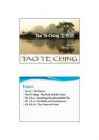
the essence of his wisdom as a guide for future generations y This became the book Tao Te Ching Tao Te Ching The Book y ~5000 characters divided amongst 81 chapters y Succinct to read in an afternoon, but profound to study for a lifetime y Can't go through every chapter and analyze every phrase, but will attempt to cover some of the key concepts mentioned in the book y Once we understand the essence, we can observe it in other scriptures, books, and in the world we live in y Book that teaches you how to fish instead of giving you a fish y Sharing of my personal and distilled interpretation of the many translations and explanations of the book y Doesn't mean one interpretation is better than yours or any others Tao Te Ching The Name y Tao =Way, Path, Truth; Te = Virtue; Ching = Scripture y In Math, Y = F(X), or equal to the function as applied to X
Why are they important? In a synthetic judgement, the predicate concept contains information not contained in the subject concept, and so is informative. 28. Why Kant believes that his philosophy is a Copernican Revolution? According to Kant the mind of man is not passive but an active organ which molds and coordinates sensations into ideas, an organ which transforms the chaotic multiplicity of experience reported. 29. What are the pure forms of perception? Which are them? From the external world we receive different stimuli. the sense of space, and the sense of time. 30. What are the pure forms of conception? In a second stage, the mind raises the perceptual knowledge of objects into the conceptual knowledge of relationships, sequences and laws. 31. What is the difference between noumena and phenomena? Noumena, which is the world of things-in-themselves. Phenomena are often, but not always, understood as 'appearances' or 'experiences'
 annaabi.ee